

How Olive Oil Trade Connected Civilizations
Olive oil did more than fill jars. It linked ports, markets, and daily life across the Mediterranean for thousands of years.
If you want the short answer, here it is: I’d say olive oil connected civilizations because it was used for food, lamps, skin care, medicine, ritual, and burial, so demand stayed high. That demand pushed trade from the southern Levant and Crete to Egypt, Greece, Phoenician ports, and Rome. Over time, ships, amphorae, storage systems, and port networks turned one farm product into a shared Mediterranean trade system.
Here’s the article in plain terms:
- I see the eastern Mediterranean as the starting point, with olive oil production going back about 7,600 to 7,000 years
- I’d point to Crete as one of the first big export centers
- I’d say sea trade mattered most because it moved oil farther and in larger loads than land routes
- I’d highlight the Minoans, Phoenicians, Greeks, Egyptians, and Romans as the main players
- I’d note that oil trade spread not just goods, but also food habits, rituals, container standards, and production methods
- I’d end with Rome, where Monte Testaccio shows the huge scale of imports, with fragments tied to billions of liters of oil
- I’d also note the long afterlife of this trade: modern buyers still care about origin, handling, and labels
The Olive Oil Odyssey: A Historical Exploration
sbb-itb-4066b8e
Quick comparison
| Group | Main role | Why it mattered |
|---|---|---|
| Minoans | Stored and shipped surplus oil | Helped turn production into export trade |
| Phoenicians | Linked ports across long sea routes | Extended trade west across the Mediterranean |
| Greeks | Expanded production and marked exports by origin | Helped buyers connect place with quality |
| Egyptians | Bought and used imported oil for daily and ritual needs | Kept demand steady for long-distance trade |
| Romans | Managed oil at imperial scale through ports, taxes, and redistribution | Made oil supply part of state systems |
The main point: olive oil trade helped tie separate societies together through exchange, routine demand, shipping systems, and shared habits.
Where the olive oil trade began and how it spread
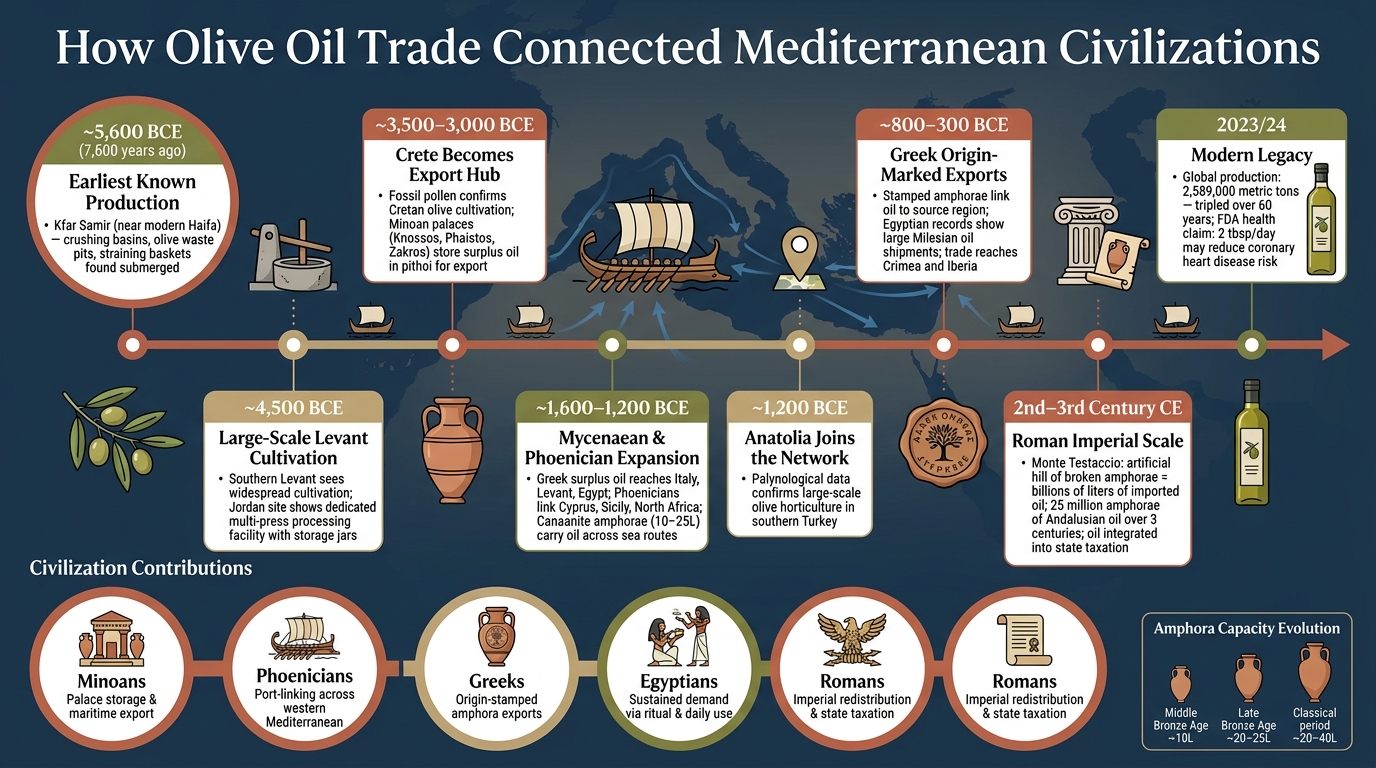
Olive Oil Trade: 7,600 Years of Mediterranean Civilization
Early production centers in the eastern Mediterranean
Olive oil production started early in the eastern Mediterranean and then spread outward across the region. At Kfar Samir, a submerged Neolithic site near modern Haifa, archaeologists found crushing basins, a pit packed with olive waste, and a straining basket. Together, those finds point to organized olive oil production dating to about 7,600–7,000 years ago. In plain terms, people were making olive oil far earlier than many once thought.
By about 4,500 BCE, large-scale cultivation was underway across the southern Levant. As towns and cities expanded, production grew past small village pressing. A 4,500-year-old site in Jordan included multiple olive presses, stone tools, and large storage jars set up as a dedicated processing facility. That setup looks less like household use and more like surplus production meant for exchange.
Crete then became an organized export center. Fossil pollen and plant remains show olive cultivation taking shape there during the early to mid-4th millennium BCE. By the Middle Minoan I A period, sites such as Chamalevri show systematically broken olive pits and pressing installations, which points to organized extraction, while Minoan palaces such as Knossos handled large-scale surplus storage. Trade links and sea routes helped drive that spread.
Anatolia came later. Palynological data places large-scale olive horticulture in southern Turkey at around 1,200 BCE.
Why seaborne trade accelerated growth
Once producers had surplus oil, ships changed the game. Olive oil could move farther, in larger amounts, and with less friction than overland routes usually allowed.
Transport amphorae made that possible. In the eastern Mediterranean, jars often identified as Canaanite amphorae carried oil from the Levant and northwest Syria/southeast Turkey to sites in Egypt, Cyprus, Turkey, and Crete. Chemical residue studies confirm what they held, and inscriptions on some fragments explicitly name "oil". Standard amphorae also helped merchants plan cargo and track shipments, with jars ranging from about 10 liters in the Middle Bronze Age to 20–25 liters in the Late Bronze Age.
Geography helped too. The Mediterranean had a dense web of ports and short sailing distances, which let ships move amphorae between Levantine, Aegean, Anatolian, and Egyptian coasts with relative ease. Inland farms could send surplus oil to depots, and from there it moved to distant markets. Over time, that shipping network turned olive oil into a shared Mediterranean commodity.
The civilizations that built the network
Once olive oil turned into a trade good, a few Mediterranean powers did more than sell it. They built the routes, storage systems, and market links that let it move farther and in larger volumes.
Minoans, Phoenicians, and Greeks
The Minoans of Crete were among the first to push olive oil beyond local use and into export. Palace complexes at Knossos, Phaistos, and Zakros stored surplus oil in pithoi before it was shipped abroad. Their ships were built to carry large oil cargoes across the Aegean, which helped make Crete an early export hub, not just a place of production.
The Phoenicians took that system and stretched it across more ports. They linked oil-producing regions with markets in Cyprus, Sicily, and North Africa. As they set up trading posts across the western Mediterranean, they also helped spread olive cultivation itself.
Greek producers then pushed the trade to a larger scale. By the Mycenaean period, roughly 1600–1200 BCE, Greek surplus oil was already reaching southern Italy, the Levant, and Egypt. Greek traders shipped oil in amphorae that were stamped or shaped to show where the contents came from. Egyptian records also point to large shipments of Milesian oil entering Egyptian markets.
Trade, of course, was not just about transport. It also relied on steady demand and, later, tighter state control.
Egyptians and Romans
Egypt helped keep long-distance routes active because demand stayed steady for centuries. Cretan and Greek olive oil shows up in tomb finds and inventory texts, where it appears in lighting, ritual anointing, and cooking. That steady use gave merchants a reason to keep the routes open.
Rome took a different path. It made olive oil part of state administration. Through roads, ports, taxes, and redistribution, Rome turned oil into a routine supply across the empire. The best-known proof is Monte Testaccio in Rome, an artificial hill made almost entirely of broken amphorae. It contains fragments tied to billions of liters of imported oil, mostly from Baetica and North Africa during the 2nd and 3rd centuries CE.
Their roles were different, but together they shaped the Mediterranean oil economy.
Comparison table: each civilization's role in olive oil trade
| Civilization | Main Contribution | Trade Reach | Key Influence |
|---|---|---|---|
| Minoans | Surplus production and maritime export | Aegean, Egypt, eastern Mediterranean | Pioneered palace storage systems (pithoi) and export coordination |
| Phoenicians | Port-linking and spread of cultivation | Levant, Cyprus, Sicily, North Africa | Connected distant regions and extended routes westward |
| Greeks | Organized surplus production and origin-marked export | Egypt, Levant, southern Italy, Crimea, Iberia | Refined amphora markings and built port infrastructure for export |
| Egyptians | Import demand driven by ritual and daily use | Imports from Crete and Greece | Sustained long-distance trade routes through consistent demand |
| Romans | Imperial-scale administration and redistribution | Entire Mediterranean basin | Formalized standard amphora types and integrated oil into state taxation |
How trade routes carried goods, ideas, and habits
Ports, ships, and amphorae across the Mediterranean
Mediterranean shipping made large-scale olive oil trade possible. And once olive oil started moving by sea, it carried more than cargo. It also moved customs, beliefs, and shared standards from one shore to another.
These routes connected Cyprus and the Levant with the Aegean, southern Asia Minor, Italy, North Africa, and Iberia. The scale becomes easier to picture when you look at the archaeology. Surveys near the Fournoi islands in the Aegean have documented at least 58 shipwrecks loaded with amphorae from places including Spain, Sicily, Cyprus, Egypt, the Middle East, and North Africa.
Amphorae made this bulk trade work. They usually held about 20 to 40 liters, and they were tough, stackable, and easy to seal. Some shapes even told buyers what was inside. Forms like Africana I and Tripolitanian I were tied to oil, with shape and clay type signaling both contents and place of origin. Stamps and inscriptions on amphorae worked a bit like early labels. They linked oil to its source region and hinted at quality before the jar was even opened.
Shared food customs, rituals, and technologies
Olive oil moved habits along with cargo. As it passed through ports, it carried food customs, rituals, and production methods across societies that were otherwise quite different.
Cooking practices spread as traders and merchants settled in port cities and shared what they knew with local communities. Bread dipped in oil, vegetables dressed with oil, and fish preserved in oil became common across many of these places. Over time, that helped shape a shared Mediterranean food culture.
Religious uses traveled just as far. Olive oil appeared in temple lamps, ritual anointings, and ceremonial offerings in Greek, Egyptian, and Roman settings. The olive branch also became a shared symbol of abundance and peace.
Trade carried know-how too. Pressing and storage methods spread west along with the oil itself. Amphora workshops in the Aegean and Asia Minor made containers tuned for sea transport, and producers in newly reached regions adopted or copied those designs so they could join larger trade networks. In plain terms, if you wanted in on maritime trade, you often had to package your oil in ways the market already understood.
Olive oil as a marker of status and exchange value
Access to olive oil - especially high-grade oil - could signal social rank. In Rome, elite households preferred fine oils for dining and personal care, while lower grades were used for lamps and mass-market food.
Stamped amphorae strengthened that system. When a container reached a Roman port with its region of origin marked on it, buyers could make a judgment about likely quality before tasting the oil. That mattered in a busy market.
Over three centuries, an estimated 25 million amphorae of Andalusian olive oil moved across the Mediterranean. That kind of volume points to steady demand for a product people trusted from a known source. The link between place and quality didn't disappear with antiquity. It still shapes how olive oil is labeled today.
Legacy: from ancient trade to modern appreciation
How ancient exchange shaped modern cooking
Ancient trade routes did more than move olive oil from one place to another. They changed the way people cooked, ate, and judged quality, and that pattern still shows up today.
Olive oil’s impact reached far beyond the ancient Mediterranean. In the U.S., it later became a health-food staple, pushed by Mediterranean diet messaging and stronger consumer demand. Clinical research links extra virgin olive oil in a Mediterranean diet with lower cardiovascular risk. The U.S. Food and Drug Administration also allows a qualified health claim saying that about 2 tablespoons (23 g) of olive oil each day may reduce coronary heart disease risk.
People still read olive oil much like ancient buyers did. They look at where it came from, how it was handled, and whether the seller seems trustworthy. In that sense, modern labels continue an old habit: name the source, then trust the oil.
Conclusion: the connections olive oil created between civilizations
That trade also left behind a lasting model for how people judge olive oil. Global olive oil production has tripled over the last 60 years, reaching about 2,589,000 metric tons in the 2023/24 crop year. What started as trade grew into a lasting standard for flavor, health, and quality.
FAQs
Why was olive oil so valuable in ancient trade?
Olive oil mattered because it did many jobs at once. People used it for cooking, lamp fuel, wound care, perfumes, and ointments. It also held strong religious and ceremonial value.
It was also a luxury good that could cost several times more than wine. That made it worth shipping over long distances in standardized amphorae through organized trade networks.
How did amphorae improve olive oil trade?
Amphorae made olive oil trade much easier by giving merchants a practical, durable container for moving a high-value liquid. These clay vessels helped shield olive oil during transport from heat, light, and constant jostling.
They also could be stamped or sealed with details about the producer, place of origin, or quality. That gave merchants an early way to signal quality and build a brand. As a result, trade by sea and over land became safer and more efficient.
How did olive oil trade spread culture?
Olive oil trade helped spread culture by linking far-off societies through sea routes that connected Greece, Rome, Egypt, and the Levant.
Phoenician and Greek merchants moved more than oil from port to port. They also passed along olive growing, irrigation methods, and social habits. As olive oil became part of religious rituals, athletic prizes, and daily cooking, it helped shape customs that different civilizations came to share.