

Olive Pomace Soil Amendment: Study Summary
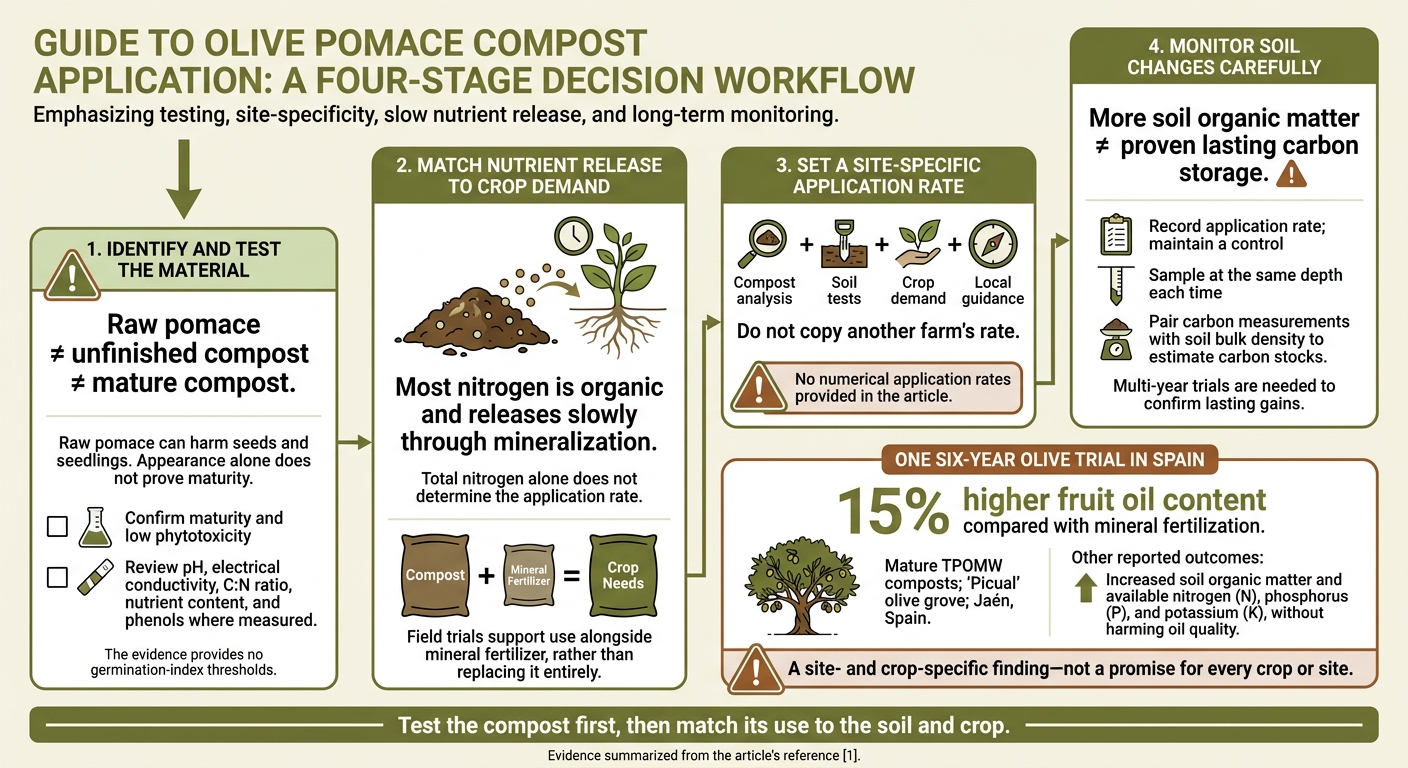
I’d check compost maturity and plant toxicity before using olive pomace in soil. Raw pomace can harm seeds and seedlings; properly composted material can supply nutrients and organic matter.
A six-year olive trial in Spain reported 15% higher fruit oil content with mature pomace compost than with mineral fertilizer, without reducing oil quality. But I wouldn’t treat that result as a promise for every crop or site.
Here’s what I’d check before application:
- Material and maturity: Raw pomace, unfinished compost, and mature compost are not substitutes for one another.
- Nutrient timing: Nitrogen releases slowly, so I’d plan around crop demand rather than total nitrogen alone.
- Application rate: I’d use compost analysis, soil tests, and local guidance - not another farm’s rate.
- Carbon claims: More soil organic matter does not prove lasting carbon storage. I’d look for repeated measurements at the same depth, including soil bulk density.
My starting rule: <u>test the compost first, then match its use to the soil and crop</u>.
Olive Pomace Compost: Test Before Soil Application
802 - Olive Pomace Valorization as a Soil Amendment
sbb-itb-4066b8e
Compost Maturity and Plant Toxicity
Composting TPOMW with olive prunings and manure is the main step in stabilizing it for soil use. Studies link poor germination to compounds that are toxic to plants, but they do not identify a single cause. Once toxicity drops, the next test is whether the compost improves plant growth and nutrient uptake.
Signs of Compost Stability
Mature compost supports plant nutrition without suppressing growth. Raw TPOMW is unstable and poses risks to plants. Mature compost, by contrast, is stabilized and supplies organic matter and available nitrogen (N), phosphorus (P), and potassium (K). This change sets the stage for the crop-response results that follow.
Germination-Index Tests and Limits
The evidence does not provide germination-index thresholds. It does, however, support lower plant toxicity after composting.
Plant Response and Nutrient Value
Nutrient Content and Nitrogen Release
Once compost passes maturity checks, studies assess whether it supplies nutrients and supports crop growth. Most nitrogen in TPOMW compost is organic, so it releases slowly through mineralization.
Crop Results and Risks
Field trials test whether these nutrients improve fruit and soil performance.
In a six-year ‘Picual’ olive grove trial in Jaén, Spain, mature TPOMW composts increased fruit oil content by 15% compared with mineral fertilization and raised soil organic matter and available N, P, and K without harming oil quality.
Timing is the main limitation: nitrogen becomes available as mineralization occurs. Field trials support using TPOMW compost alongside mineral fertilizer, rather than replacing it entirely.
Soil Organic Matter and Carbon
Studies look beyond crop response to test whether pomace compost builds soil organic matter and carbon.
Measured Changes in Soil Carbon and Fertility
Mature pomace compost adds organic matter to soil. In a six-year orchard trial, repeated applications increased soil organic matter and available nitrogen (N), phosphorus (P), and potassium (K).
Short-Term Results and Long-Term Carbon Storage
For carbon accounting, concentration alone doesn't tell the whole story. A higher carbon concentration does not prove lasting carbon storage. Short-term tests show immediate changes in nutrients and carbon. Multi-year trials are needed to confirm lasting gains in soil organic matter and actual carbon stocks.
To track these changes, record the application rate, maintain a control, and sample at the same depth each time. Pair carbon measurements with soil bulk density to estimate carbon stocks.
Conclusion: What the Studies Support
The studies show that properly stabilized olive pomace compost reduces phytotoxicity. But appearance alone doesn't prove maturity. Nutrient availability and plant response depend on the material, site, and crop conditions. Likewise, gains in soil carbon don't prove long-term carbon storage.
Study Evidence to Check Before Application
Before field use, check the material type and confirm maturity and low phytotoxicity. Review pH, electrical conductivity, C:N ratio, nutrient content, and phenols where measured.
Nitrogen is largely organic, so total nitrogen alone doesn't determine the application rate.
Base rates on compost analysis, soil tests, crop demand, and local guidance - not a rate copied from another site.
FAQs
Which tests confirm my pomace compost is safe?
Check whether your pomace compost is safe and mature with a Solvita test kit. It measures carbon dioxide and ammonia emissions; low levels indicate the compost is ready. Chemical tests should also check pH (5.5–8.0), the carbon-to-nitrogen ratio, and electrical conductivity.
To check for phytotoxicity - harmful effects on plants - plant seeds directly in a compost sample. Normal growth without stunting indicates no harmful effects on seedlings.
How do I account for slow nitrogen release?
Composted olive mill pomace releases nitrogen more slowly than synthetic fertilizers. Add nitrogen-rich materials to your soil during the first year to support plant development.
Research shows that nitrogen availability from this compost is about 15% in the first year and 8% in the second. This slow release helps reduce nitrogen loss and improves soil health over time, while the early supplements help plants grow.
How often should I measure soil carbon?
No specific testing schedule is required, but test soil carbon regularly when using olive waste compost to manage soil health. Check soil pH and salinity regularly, too. Olive waste contains mineral salts that can accumulate and affect your grove. These checks help you keep practices such as irrigation adjustments effective at supporting long-term soil fertility and carbon sequestration.