

Organic Certification Standards: Explained
Organic certification ensures that products meet strict rules for farming, processing, and labeling. It’s more than just a label - it guarantees that items like olive oil and balsamic vinegar are made without synthetic additives, GMOs, or harmful chemicals. This involves inspections, detailed documentation, and adherence to national and international standards.
Key Points:
- What It Covers: Organic farming methods, processing, and packaging rules.
- USDA Standards: Includes a 3-year transition for land, no synthetic pesticides, and strict ingredient labeling (e.g., "100% Organic" or "Organic").
- EU Rules: Focuses on quality and origin, especially for olive oil and balsamic vinegar, with specific acidity and peroxide limits for olive oil.
- Global Equivalency: Countries like the U.S., EU, Japan, and Australia recognize each other’s certifications, simplifying international trade.
- Certification Process: Involves a 36-month transition, submission of an Organic System Plan (OSP), inspections, and annual renewals.
Why It Matters:
Organic certification builds trust by verifying that products are grown and processed to high standards. For premium items like olive oil and balsamic vinegar, it confirms quality and traceability from farm to shelf.
USDA Organic Certification - How it Works
sbb-itb-4066b8e
Core Requirements of Organic Certification
Organic certification involves a detailed system of rules and standards that guide how products like olive oil and balsamic vinegar are produced. These standards exist at both national and international levels.
USDA Organic Standards
In the United States, the USDA's National Organic Program (NOP) establishes the foundational requirements for organic certification. Producers are required to maintain an Organic System Plan (OSP), which outlines their production methods, materials used, and monitoring practices. For products like olive oil and balsamic vinegar, this includes:
- A three-year transition period for land, during which no prohibited substances can be applied.
- Strict restrictions on synthetic fertilizers (permitted only if listed on the USDA's National List) and a complete ban on sewage sludge.
- Emphasis on biological and cultural pest management methods.
- Preventing any mixing of organic and non-organic products during processing.
The USDA also has three labeling tiers based on the percentage of organic ingredients:
| Label | Organic Content Required |
|---|---|
| 100% Organic | All ingredients must be certified organic. |
| Organic | At least 95% of ingredients must be organic. |
| Made with Organic | At least 70% of ingredients must be organic. |
Other regions around the world have similar, though not identical, standards.
EU Organic Regulation
The European Union enforces its own organic certification standards, particularly for products like Extra Virgin Olive Oil. To qualify as "extra virgin", the oil must meet two key quality measures:
- Free acidity must not exceed 0.80%.
- Peroxide value must be at or below 20.0 mEq O₂/kg.
For balsamic vinegar, especially those originating from Modena, Italy, the EU combines organic certification with Protected Geographical Indication (PGI) status. This means producers must comply with both the EU's organic production standards (EU Regulation 2018/848) and traditional methods specific to the Modena region. Imported products must meet these same equivalency standards. For example, Big Horn Olive Oil sources balsamic vinegar directly from Modena, ensuring both authenticity and adherence to these rigorous production rules.
Other Global Organic Standards
In addition to the U.S. and EU, countries like Japan and Australia have developed their own organic certification systems:
- Japan: The Japanese Agricultural Standard (JAS) requires certification by an approved organization, covering both domestic and imported products.
- Australia: Organic certification is managed by multiple accredited bodies operating under the National Standard for Organic and Bio-Dynamic Produce. This standard aligns closely with the international Codex Alimentarius guidelines.
These diverse certification systems highlight the importance of equivalency agreements. Such agreements allow certified organic products to be traded internationally without requiring duplicate certifications, simplifying the process for producers and maintaining consistent standards across borders.
The Organic Certification Process
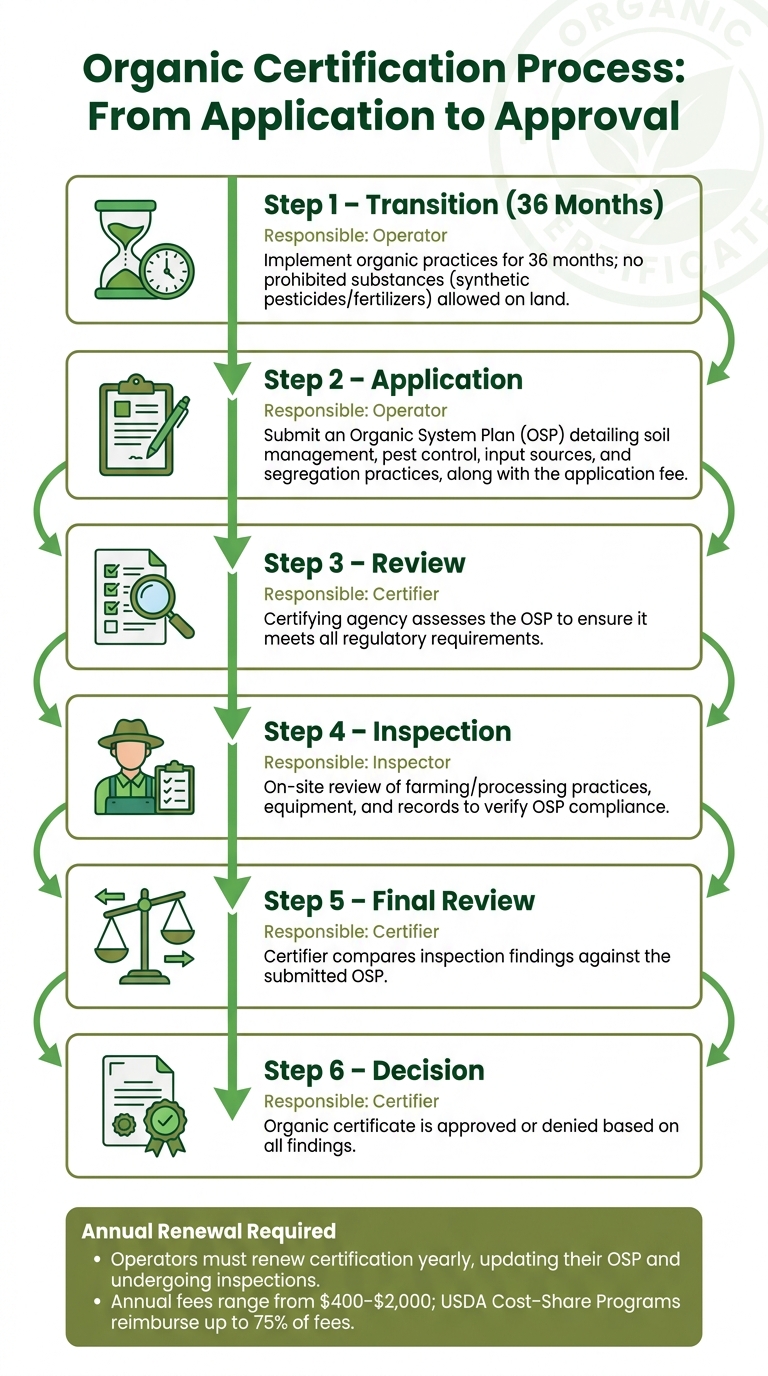
Organic Certification Process: From Application to Approval
Organic certification is a continuous commitment that follows a structured process, requiring regular verification to maintain compliance.
Steps from Application to Certification
Before becoming certified, producers must transition their land for 36 months, ensuring it remains free from prohibited substances like synthetic pesticides and fertilizers. Only after this period can their crops qualify for organic certification.
The certification process unfolds in these key steps:
| Step | Who's Responsible | What Happens |
|---|---|---|
| 1. Transition | Operator | Implement organic practices for 36 months |
| 2. Application | Operator | Submit an Organic System Plan (OSP) along with the application fee |
| 3. Review | Certifier | Assess the OSP to ensure it meets regulatory requirements |
| 4. Inspection | Inspector | Conduct an on-site review of practices, equipment, and records |
| 5. Final Review | Certifier | Compare the inspection findings with the OSP |
| 6. Decision | Certifier | Approve or deny the organic certificate |
A critical part of this process is the Organic System Plan (OSP), which serves as the foundation of the application. This document outlines every detail, including soil management practices, pest control methods, input sources, and how organic products are kept separate from non-organic ones. As CCOF explains:
"The purpose of the inspection is to verify that what is detailed in your OSP is happening in practice."
Certification isn’t a one-time event. Operators must renew annually, updating their OSPs and undergoing inspections. Annual fees range between $400 and $2,000, depending on the complexity of the operation. To help offset these costs, USDA Organic Certification Cost-Share Programs reimburse up to 75% of the fees.
Once certified, strict controls throughout the supply chain ensure the organic integrity of products is maintained.
Supply Chain Controls and Traceability
Certification doesn’t stop at the farm. Every step in the supply chain - from processors to handlers and importers - must uphold the organic status of the product from production to the final consumer.
Mass-balance audits play a key role in this process, ensuring that the volume of organic goods sold matches the quantity produced or purchased. This level of traceability aligns with international standards and reassures consumers. Processors must also document their cleaning and storage procedures to prevent cross-contamination.
For imported products, the USDA’s Strengthening Organic Enforcement (SOE) rule - fully implemented in March 2024 - requires certification for brokers, traders, and importers. This measure closes previous loopholes that allowed fraud to occur. Every organic product entering the U.S. now needs an electronic NOP Import Certificate in the Organic Integrity Database, creating what regulators describe as a "certification handshake" across borders. Similar to USDA and EU standards, this rule enhances traceability and builds consumer confidence.
"The amendments protect integrity in the organic supply chain and build consumer and industry trust in the USDA organic label by strengthening organic control systems, improving farm to market traceability, and providing robust enforcement." - Jennifer Tucker, Ph.D., Deputy Administrator, National Organic Program
For example, Big Horn Olive Oil's balsamic vinegars, sourced from Modena, Italy, benefit from the SOE framework. This ensures their organic status is verified before reaching U.S. shelves, providing consumers with a dependable chain of accountability from origin to product.
Global Recognition and Consumer Trust
Organic certification isn't confined by borders. Thanks to equivalence agreements, countries agree to acknowledge each other's organic standards as comparable. This means a product certified organic in one country can be sold as organic in another without needing additional certification. For example, by 2026, the EU will recognize 14 countries and regions, including the United States, Canada, Japan, Australia, and the United Kingdom, as having equivalent organic standards. This global recognition is reflected in the labels consumers see on products.
Recognized Organic Seals and Logos
Two key symbols stand out for organic products: the USDA Organic seal and the EU organic leaf logo. These are more than just logos - they represent rigorous organic standards. Thanks to the U.S.-EU equivalence agreement, products certified under either system can be labeled and sold as organic in both regions. So, when you pick up a bottle of Italian olive oil or balsamic vinegar that displays both logos, it’s a sign that the product has passed two of the world's strictest organic certification processes.
In the EU, the organic leaf logo is required on all pre-packaged organic food, while in the U.S., the USDA Organic seal is optional for certified operations. Both logos, however, signify that the product contains at least 95% organic ingredients. For U.S. consumers, seeing both logos on a product provides extra reassurance that it meets high organic standards.
How Consumers Can Verify Organic Certifications
While recognized seals are a strong indicator of authenticity, consumers can take additional steps to confirm a product's organic certification. Labels must include the statement "Certified Organic by [Certifier Name]", which identifies the third-party agency responsible for verification. For EU-certified products, a certifier code - like "IT-BIO-XXX" for an Italian certifier - must also appear near the organic logo.
Beyond the label, tools like the USDA Organic Integrity Database allow consumers to verify certifications. This online resource lets users search by business name, location, or product to check if an operation is certified and in good standing. Similarly, the EU offers verification platforms like the Organic Farming Information System (OFIS) and the TRACES electronic certification system for imported products.
"Third-party certification in the organic industry provides independent verification to consumers that farmers are using organic methods."
- Cassandra Brown, Program Manager at The Ohio State University
For imported products, such as olive oil or vinegar, it's also worth checking the "place of farming" statement on the label. This EU-mandated detail specifies where the raw ingredients (like olives or grapes) were grown - for example, "EU Agriculture". This extra layer of transparency helps consumers make informed choices.
Conclusion: Why Organic Certification Matters
Organic certification goes beyond being just a label - it represents a commitment to product quality, consumer trust, and responsible environmental practices. Achieving this certification isn’t a quick process. It involves a three-year transition period, strict fraud prevention protocols, and the use of electronic NOP Import Certificates to ensure authenticity. Starting March 19, 2024, the USDA's Strengthening Organic Enforcement (SOE) rule closes gaps in the supply chain by requiring certifications for previously exempt importers and brokers.
For premium products like extra virgin olive oil and balsamic vinegar, certification guarantees they’re made without synthetic pesticides, GMOs, or banned substances. It also ensures a fully traceable journey from production to sale. At Big Horn Olive Oil, sourcing Ultra Premium Extra Virgin Olive Oils and Balsamic Vinegars from Modena, Italy involves adhering to these rigorous international standards, ensuring all products meet organic certification before arriving on U.S. shelves.
Key Takeaways
These measures are designed to strengthen consumer trust and uphold product quality:
- USDA Organic Seal: Indicates that a product is made with at least 95% organic ingredients and meets federal production and handling standards.
- Fraud Prevention: Certified businesses must maintain detailed plans to verify their suppliers' organic status, reducing the risk of fraud.
- Traceability and Verification: Certified operations keep comprehensive records of sourcing, ownership transfers, and transportation. Consumers can also verify certification status in real time through the USDA Organic Integrity Database.
When you see an organic label, you can trust that it stands for quality and authenticity.
FAQs
What’s the real difference between “Organic” and “100% Organic” on a label?
The key difference lies in the percentage of organic ingredients. Products labeled 100% Organic must be made entirely of organically produced ingredients (excluding water and salt). On the other hand, Organic products must consist of at least 95% organic ingredients. The remaining 5% can include either organic ingredients (if available) or approved nonorganic substances. Both categories are subject to strict certification standards and must avoid prohibited practices, such as the use of synthetic fertilizers or genetic engineering.
How can I verify an imported product is truly organic in the U.S.?
To verify that an imported product is organic in the U.S., make sure each shipment includes a valid electronic NOP Import Certificate from the USDA’s Organic Integrity Database. This certificate is mandatory for all certified organic imports. Along with that, check supporting documents such as commercial invoices and bills of lading, which should clearly label the product as organic. Big Horn Olive Oil exemplifies global standards, delivering premium oils and vinegars known for their exceptional quality.
Does 'organic' mean extra virgin olive oil meets quality tests like acidity limits?
Organic certification and extra virgin grading are two entirely different things. Organic certification is all about how the olives are grown - specifically, avoiding synthetic pesticides and following certain farming practices. On the other hand, extra virgin status is determined through chemical and sensory evaluations. For example, in the U.S., extra virgin olive oil must meet strict criteria, including having no more than 0.8 grams of free fatty acids per 100 grams.
It’s worth noting that an olive oil can be organic without being extra virgin, and the reverse is also true - an oil might qualify as extra virgin but not be organic. These labels serve separate purposes and don’t automatically overlap.