

Soil Erosion in Olive Farms: Causes and Solutions
Soil erosion is a major challenge for olive farms, especially in regions with heavy rainfall and sloped terrain. It strips away the nutrient-rich topsoil that olive trees need to thrive, reducing productivity and threatening long-term viability. Key causes include water runoff, bare soil, intensive tillage, and natural landscape factors like steep slopes and intense rainfall.
Key Insights:
- Erosion Rates: Rainfed olive orchards in southern Spain lose 13-21 short tons of soil per acre annually, far exceeding sustainable levels.
- Impact: Loss of nutrients like nitrogen and phosphorus harms soil fertility, while shallow soils (under 8 inches) make farming unprofitable.
-
Solutions:
- Cover crops reduce erosion by up to 80%.
- No-till farming paired with cover crops preserves soil structure.
- Terracing is effective for steep slopes, reducing runoff and soil loss.
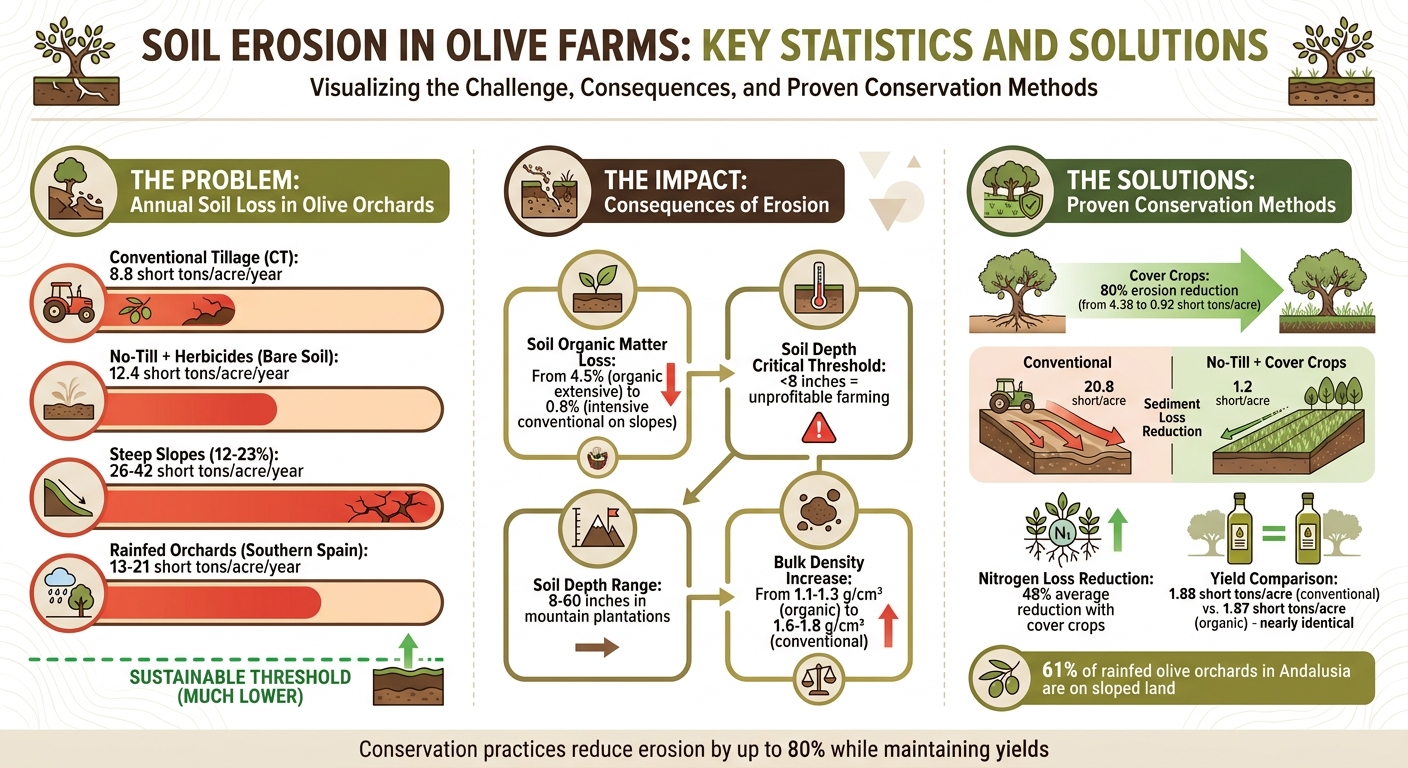
Soil Erosion Rates and Solutions for Olive Farms
The impact of olive cultivation on soil erosion in the Mediterranean (Spain)
sbb-itb-4066b8e
Main Causes of Soil Erosion in Olive Farms
Protecting your olive orchard starts with understanding what drives soil erosion. Many of the issues stem from farming decisions combined with natural factors like weather and terrain. Together, these elements can create the perfect conditions for topsoil loss. Let’s break down the key contributors to this problem.
Water Runoff and Lack of Ground Cover
Exposed soil is one of the biggest culprits behind erosion in olive orchards. When the ground between trees is left bare - often due to herbicide use or frequent clearing - raindrops hit the soil directly. This dislodges soil particles, reduces water absorption, and increases runoff.
Research highlights just how damaging this can be. Long-term studies found that no-tillage systems using herbicides to keep the soil bare (NT+H) resulted in erosion rates of about 12.4 short tons per acre annually. This is significantly higher than the 8.8 short tons per acre associated with conventional plowing. Bare soil also seals quickly, further reducing water infiltration and washing away fertilizers that would otherwise benefit the trees and ensure a high-quality extra virgin olive oil harvest.
"The implementation of NT-CC [no tillage with cover crops] not only reduced erosion rates but also caused a change in the trend of soil productivity loss observed under CT [conventional tillage] and NT + H [no tillage with bare soil]." - Manuel González-Rosado et al.
Beyond leaving soil exposed, tillage practices amplify erosion risks, especially on sloped lands.
Tillage Methods and Sloped Land
Conventional plowing disrupts the soil’s structure, creating a surface that may seem porous at first but quickly seals after rainfall. This leads to increased runoff during subsequent storms. The problem becomes even worse on sloped terrain, where water naturally moves faster downhill. In Andalusia, for example, 61% of rainfed olive orchards are located on sloped land, making them especially vulnerable.
Agricultural intensification has added to this issue. Planting up to 800 trees per acre often means removing all ground vegetation to minimize competition for water. While this may boost short-term yields, it leaves the soil completely unprotected. On slopes ranging from 12% to 23%, research from Alentejo, Portugal, found erosion rates as high as 26 to 42 short tons per acre annually in southern Spain.
Natural Landscape Factors
Beyond farming practices, the natural landscape plays a major role in soil erosion. The Mediterranean climate, with its dry summers and heavy autumn rainstorms, is particularly challenging. For instance, a single storm in September 2015 dropped 3.6 inches of rain at a rate of 4.2 inches per hour, producing an erosivity index 42 times higher than the annual average.
Other natural factors, like thin soils and steep slopes, make the problem worse. Many mountain olive plantations have soil depths of just 8 to 60 inches. Combined with steep terrain and intense rainfall, these conditions create what researchers refer to as the "R-factor" (rainfall erosivity) and "LS-factor" (slope length and steepness), both critical in predicting soil loss. While farmers can’t control the weather or reshape the land, understanding these vulnerabilities is key to developing effective soil conservation strategies.
Solutions to Reduce Soil Erosion
Erosion can significantly harm soil health, especially in olive orchards. However, a range of strategies can help protect the soil, manage water flow, and preserve its structure - even in areas with difficult terrain.
Using Cover Crops
Planting cover crops between olive trees is a highly effective way to combat soil erosion. These crops, often cereals or legumes, form a protective layer over the soil, shielding it from the impacts of wind and rain. Research from the University of Córdoba highlights the benefits of this approach: combining cover crops with no-tillage practices reduced erosion by about 80%, from 4.38 short tons per acre to just 0.92 short tons per acre.
The advantages of cover crops go beyond erosion control. They also cut nitrogen losses by an average of 48%, helping retain critical nutrients that might otherwise wash away. Additionally, sediment losses in no-till systems with cover crops average just 1.2 short tons per acre, compared to a staggering 20.8 short tons per acre in conventional-till systems. To maximize these benefits, pair cover crops with reduced- or no-tillage methods. However, it’s essential to avoid bare soil under no-till conditions, as it can increase erosion risks.
Better Tillage Methods
Adopting improved tillage techniques can significantly reduce soil erosion. Reduced-tillage and no-tillage methods disturb the soil less, preserving its structure and stability, especially on sloped land. A 15-year study published in April 2021 by researchers Manuel González-Rosado and Luis Parras-Alcántara demonstrated that combining no-tillage with cover crops not only reduced erosion but also reversed soil productivity declines often seen with conventional farming.
"The implementation of NT-CC [no tillage with cover crops] not only reduced erosion rates but also caused a change in the trend of soil productivity loss observed under CT [conventional tillage] and NT + H [no tillage with bare soil]." - Manuel González-Rosado et al.
This combination of techniques is a powerful tool for maintaining soil health and nutrient levels over time.
Terracing and Soil Retention Structures
For olive orchards on steep slopes, structural solutions like terracing provide a reliable way to combat erosion. Terraces create flat platforms on hillsides, forming a staircase-like layout that reduces runoff and soil loss. This traditional method has been used for centuries in the Mediterranean Basin, with examples in the Levant dating back to the fourth millennium BCE.
Modern terracing often incorporates stone walls, known as cadenas in the Canary Islands, to support each level. These terraces also feature integrated water channels and outlets to manage runoff effectively. In the Jerusalem Mountains, ancient agricultural terraces still cover around 56% of the open land, showcasing their durability. For farmers working on narrow or steep terraces, small two-wheel tractors (4–9 hp) are particularly useful for navigating slopes steeper than 20%. Proper drainage systems are crucial when designing terraces to prevent water pooling and maintain the stone structures’ stability over time.
Terracing not only offers immediate erosion control but also contributes to long-term soil conservation, ensuring the land remains productive for olive cultivation.
Long-Term Benefits of Soil Conservation
Better Soil Fertility and Water Absorption
Healthy soil is the backbone of olive tree growth, supporting their development over decades. By using herbaceous cover and conservation methods, farmers can significantly boost soil organic matter. For instance, organic extensive groves can achieve organic matter levels as high as 4.5%, while intensive conventional groves on steep slopes may drop as low as 0.8%. This increase in organic matter enhances nutrient availability and improves the soil's ability to absorb and retain water.
Conservation efforts also play a big role in reducing soil compaction. Organic and extensive management systems generally show dry bulk densities between 1.1 and 1.3 g/cm³, compared to the denser 1.6 to 1.8 g/cm³ found in conventional systems. Looser, less compacted soil allows roots to grow deeper and water to seep in more effectively - an essential advantage in the dry periods typical of Mediterranean climates.
Soil depth is another key factor for long-term productivity. Olive groves need a minimum soil depth of 20 cm (about 8 inches) to remain productive. Organic extensive groves, however, can sustain depths up to 154.1 cm (roughly 60.7 inches). When soil becomes shallower than 20 cm, farming becomes unsustainable, often leading to land abandonment. These improvements in soil quality not only support tree health but also contribute to producing better-quality olives.
Higher Quality Olive Oil
The link between soil health and the quality of olive oil is stronger than many might think. Improved soil conditions, achieved through conservation practices, are the foundation for consistently high-quality olive production. Farms following sustainable practices can maintain yields nearly identical to those of conventional systems - research shows average yields of about 1.88 short tons per acre in conventional systems versus 1.87 short tons per acre in organic systems. For producers aiming to craft ultra-premium olive oil, long-term soil fertility is vital. It results in olives with the nutrient profiles and flavors that define exceptional extra virgin olive oil.
At Big Horn Olive Oil, these conservation practices are at the heart of their approach, ensuring the production of ultra-premium extra virgin olive oil that embodies both outstanding quality and a commitment to environmental responsibility.
Conclusion: Steps Toward Better Soil Management
As outlined earlier, issues like unmanaged water runoff, excessive tillage, and steep slopes significantly contribute to soil erosion. Tackling these challenges requires practical strategies. Techniques such as maintaining ground cover, adopting no-till farming, and building terraces can cut erosion by up to 80%, helping to preserve soil fertility. These methods not only protect the land but also ensure the long-term productivity of orchards.
"Soil management seems to be a key determinant of farm sustainability."
- Springer Nature, Landscape Ecology
Springer Nature highlights how conservation practices safeguard farmland, promoting sustained productivity and quality. By keeping herbaceous cover intact and minimizing tillage, farmers can maintain high levels of soil organic matter, improve water retention, and stabilize nutrient levels. These efforts are essential for producing olives with the distinct flavors and nutritional qualities that define ultra-premium extra virgin olive oil.
At Big Horn Olive Oil, this dedication to soil conservation is at the heart of their mission. Sustainable soil management is key to delivering the quality and freshness their customers rely on. By prioritizing soil health, olive producers can continue crafting oils that meet the highest global standards.
FAQs
How can I tell if my olive grove is losing topsoil?
You can spot signs of topsoil loss in your olive grove by observing a few key indicators. Look for reduced soil depth, noticeable erosion features like rills or gullies, or an increase in water runoff during rainfall. To confirm erosion, you can use tools that measure soil loss rates by comparing current soil levels to historical data.
Which cover crops work best between olive trees?
Spontaneous vegetation (SVE) and legumes such as Vicia ervilia (BIT) serve as effective cover crops in olive groves. SVE is popular because it grows naturally, requiring minimal intervention, while Vicia ervilia contributes to better soil health. Both options play a role in reducing soil erosion and supporting more sustainable farming practices.
When is terracing worth the cost on a sloped orchard?
Terracing can be a game-changer for sloped orchards. By cutting down on surface water runoff and controlling soil erosion, it helps protect the land. It also improves water retention, which is key for better productivity. This approach is particularly useful on steep slopes, where the risk of erosion is much higher. Overall, terracing offers a practical way to keep sloped olive farms productive and healthy over time.