

Steps in Making Balsamic Vinegar of Modena
Balsamic Vinegar of Modena is crafted in Italy's Modena and Reggio Emilia provinces using grape must and specific aging techniques. There are two types: PGI (aged at least 60 days, includes wine vinegar and additives) and PDO (aged 12+ years, 100% cooked grape must, no additives). The vinegar production process involves:
- Grape Selection: Varieties like Trebbiano and Lambrusco are harvested at peak ripeness.
- Cooking the Must: Grape juice is simmered to concentrate sugars and flavors.
- Fermentation and Acetification: Yeasts convert sugars to alcohol, then bacteria transform alcohol into acetic acid.
- Aging: Vinegar matures in wooden barrels for years, developing complex flavors.
PDO vinegar undergoes strict quality checks and is bottled in distinctive 100ml bottles. Use PGI for cooking and PDO as a finishing touch for dishes like cheese or desserts.
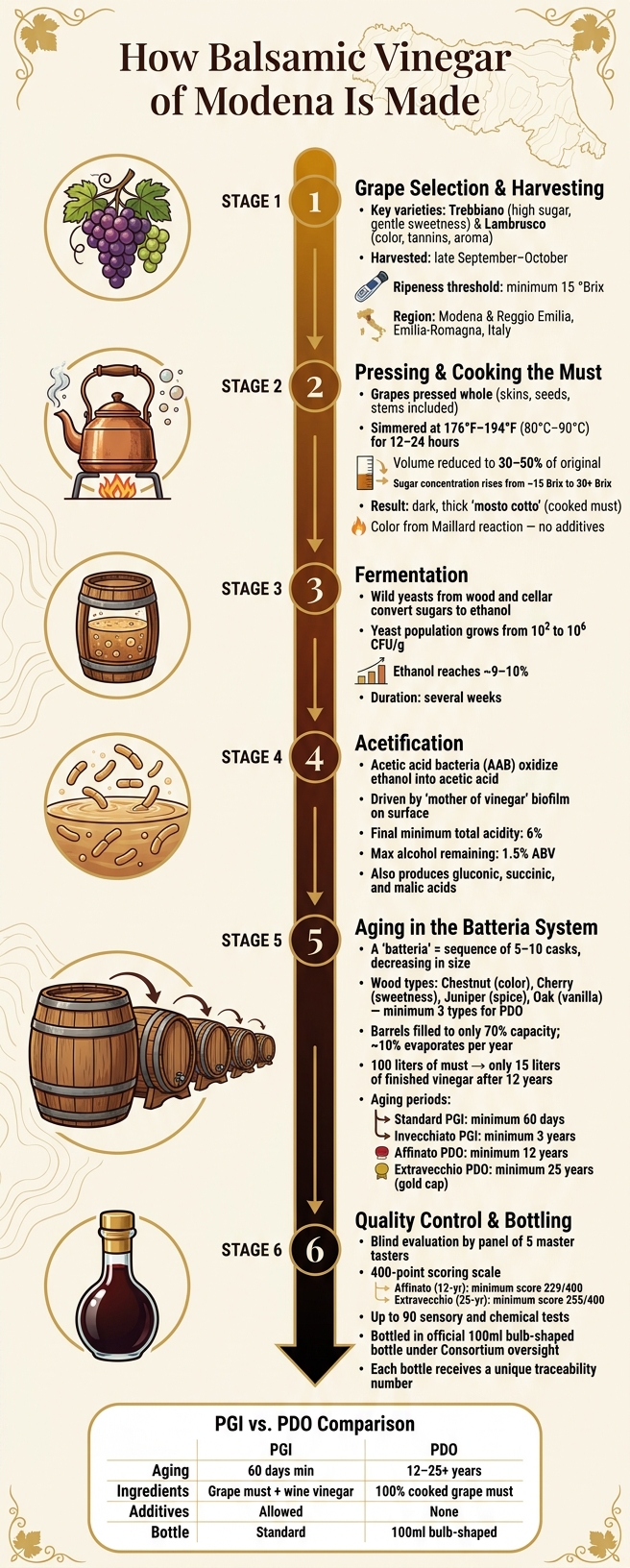
How Balsamic Vinegar of Modena Is Made: Step-by-Step Process
Creating Italian food’s “black gold”: how Traditional Balsamic Vinegar of Modena is made
sbb-itb-4066b8e
Grape Selection and Harvesting
The quality of balsamic vinegar starts with the grapes. Producers carefully choose grape varieties and decide on the perfect time to harvest before any barrels are filled.
Approved Grape Varieties
The types of grapes allowed depend on the vinegar's classification. For Traditional Balsamic Vinegar (PDO), the primary grapes are Trebbiano di Castelvetro and Lambrusco, with smaller contributions from Spergola. Meanwhile, Balsamic Vinegar of Modena (PGI) can include Lambrusco, Sangiovese, Trebbiano, Albana, Ancellotta, Fortana, and Montuni. Each grape variety adds something distinct: Trebbiano stands out for its high sugar levels and gentle sweetness, while Lambrusco offers a deeper color, tannins, and aromatic layers. Ancellotta is sometimes included for its rich pigmentation. Importantly, all grapes must come from Emilia-Romagna, specifically the provinces of Modena and Reggio Emilia.
"In this area there is an abundance of grapes with just the right concentration of sugars and acidity." - Compagnia Del Montale
Harvesting Practices
Once the grape varieties are selected, timing becomes crucial. harvesting typically happens in late September or October, similar to the fresh harvest cycles of premium oils, when the grapes reach their peak sugar levels. Producers use degrees Brix (°Bx) to measure ripeness, ensuring the fresh grape must achieves at least 15 °Bx before further processing. Grapes are harvested by hand and pressed whole to preserve the must's full character. To maintain quality, the must is immediately transferred to cooking kettles, preventing premature fermentation and starting the traditional production process.
Pressing and Cooking the Grape Must
Pressing the Grapes
When the freshly harvested grapes arrive at the production facility, they’re pressed in their entirety - skins, seeds, stems, and all. This method extracts a liquid that’s far richer and more layered than simply squeezing the fruit. As Understanding Italy explains:
"Balsamic vinegar is made from grape 'must' which is the freshly pressed juice of complete bunches of grapes, including the skins, pips and stems."
The resulting juice, known as mosto (or must), is then filtered to remove larger solids. Once filtered, it’s quickly moved to the cooking vessel to begin developing the flavors that define traditional balsamic vinegar.
Cooking the Must
The filtered must is poured into large, open kettles made of copper or stainless steel and gently simmered over direct heat. Temperatures are carefully maintained between 176°F and 194°F (80°C–90°C) to protect the delicate flavor compounds from being destroyed by excessive heat. Unlike a full boil, this controlled simmering is key to preserving the essence of the must.
Over the course of 12–24 hours, the must reduces in volume, intensifying its sugars and complexity. Longer cooking times result in a thicker, richer texture. By the end of the process, the liquid is reduced to about 30–50% of its original volume, and the sugar concentration increases significantly, rising from approximately 15 Brix to over 30 Brix.
The iconic deep brown color of the must isn’t from any additives - it’s a natural result of the Maillard reaction. This chemical process, caused by prolonged heating, occurs when sugars interact with amino acids, creating both the rich caramel color and the signature aroma that sets balsamic vinegar apart. Giusti 1605, one of Modena’s oldest balsamic producers, describes the transformation like this:
"It is obtained by cooking in open air must of local grapes for many hours, reduced down to a sweet and dense liquid."
The end product, known as mosto cotto or cooked must, is thick, dark, and intensely sweet. This concentrated base not only serves as the foundation for aging but is sometimes sold on its own as Saba. It’s this dense, flavorful liquid that sets the stage for the meticulous aging process that follows.
Fermentation and Acetification
After cooling, mosto cotto undergoes two key microbial processes: alcoholic fermentation and acetification. These steps are crucial for transforming the concentrated must into a well-rounded vinegar.
Alcoholic Fermentation
The concentrated must, now measuring around 35–60° Brix, is placed into open wooden vessels where wild yeasts naturally kickstart fermentation. These yeasts, originating from the wood and the surrounding acetaia (vinegar cellar), play an essential role in the process. As researcher Alice Vilela explains:
"The cooked and sterile must is transferred into open wooden vessels already contaminated by yeast. Over a few weeks, alcoholic fermentation occurs due to the rapid increase in yeast population."
During this phase, the yeasts convert glucose and fructose into ethanol and carbon dioxide. Yeast populations surge from 10² to 10⁶ CFU/g within weeks. The fermentation continues until the ethanol concentration reaches approximately 9–10%.
Acetification Process
Once the alcohol level hits 9–10%, acetic acid bacteria (AAB) begin oxidizing the ethanol into acetic acid, giving vinegar its characteristic tang. This process is driven by a thin biofilm on the liquid's surface, commonly called the "mother of vinegar."
For Balsamic Vinegar of Modena (PGI), acetification must follow one of three approved methods: using selected bacterial colonies, lenta in superficie (a slow surface process), or lenta a truciolo (a slow method utilizing wood shavings). Regulations also require a combination of grape must and wine vinegar, with at least 10% wine vinegar included to aid acetification. The final vinegar must achieve a minimum total acidity of 6% and contain no more than 1.5% alcohol by volume.
Beyond acidity, acetification also produces organic acids like gluconic, succinic, and malic acids, along with volatile esters and aldehydes that add complexity to the vinegar's aroma and flavor, similar to the depth found in specialty flavors. Experienced acetaios (vinegar makers) don't just rely on measurements; they also use their senses, such as detecting subtle shifts in aroma, to track the transition from fermentation to acetification.
Aging in Wooden Barrels
Once fermentation and acetification are complete, the vinegar moves into the aging stage, where its depth and character truly take shape. This process can vary widely in duration, from a minimum of 60 days for some PGI styles to several decades for the more traditional PDO varieties.
The Batteria System
At the core of balsamic vinegar aging lies the batteria - a sequence of five to ten wooden casks that gradually decrease in size. Giusti 1605, one of Modena's historic producers, provides insight into this method:
"The ageing of a Traditional Balsamic Vinegar of Modena PDO takes place in a series of five or seven small casks of different woods, arranged in increasing order of capacity and, importantly, left open. This set of barrels is called a 'battery' and forms a complete ageing cycle."
The process is meticulous. Each year, a small amount of vinegar is drawn from the smallest cask for bottling. That cask is then refilled from the next larger one in the sequence, and the largest barrel is topped off with fresh cooked grape must that has been fermenting for about two years in a separate vessel called a badessa. This careful transfer, done using a long glass pipette known as a "thief", typically takes place in January and February.
The barrels themselves are made from various types of wood - chestnut, cherry, juniper, mulberry, and oak - each adding a unique layer of flavor. Chestnut enhances color, cherry adds sweetness, juniper lends spice, and oak contributes vanilla notes. For PDO varieties, at least three different wood types are required during aging .
Interestingly, the barrels are only filled to about 70% of their capacity. This allows for evaporation, which occurs at a rate of roughly 10% per year. Over a 12-year period, 100 liters (around 26.4 gallons) of grape must will yield just 15 liters (approximately 4 gallons) of finished vinegar.
Aging Periods and Classifications
The aging process takes place in the acetaia, traditionally located in an attic. This space leverages Modena's seasonal temperature extremes - hot summers encourage fermentation and acetification, while cold winters allow the vinegar to rest and its flavors to mature .
The batteria system not only refines the vinegar's flavor but also determines its classification based on how long it has aged:
| Classification | Minimum Aging | Cap Color | Minimum Quality Score |
|---|---|---|---|
| Affinato (PDO) | 12 years | Ivory or Red | 229 / 400 |
| Extravecchio (PDO) | 25 years | Gold | 255 / 400 |
| Invecchiato (PGI) | 3 years | - | - |
| Standard PGI | 60 days | - | - |
For Balsamic Vinegar of Modena PGI, the minimum aging period is just 60 days in wooden barrels, but it takes at least three years to earn the invecchiato designation. Traditional PDO balsamic vinegar, however, requires a minimum of 12 years of aging. Additionally, PDO varieties must pass rigorous evaluations by a panel of five experts who conduct up to 90 sensory and chemical tests before the vinegar can be certified.
Quality Control and Bottling
Before any bottle of Traditional Balsamic Vinegar of Modena (PDO) makes its way to store shelves, it must pass through a series of stringent quality checks. Even after aging for years - or sometimes decades - every batch has to meet strict standards before earning its label.
Sensory and Chemical Testing
Each batch is submitted to the Consorzio for a blind evaluation by a panel of five master tasters. At specialized tasting stations, equipped with a candle for visual inspection and a ceramic spoon for sampling, tasters carefully assess each sample. Bread and water are used to cleanse the palate between tests. The evaluation focuses on three key aspects: visual appearance, aroma, and flavor. Scores are compiled on a 400-point scale, and the thresholds are high: a minimum score of 229 is required for a 12-year-old Affinato, while a 25-year-old Extravecchio must score at least 255. If a batch falls short, it’s returned to the producer for additional aging or adjustments, ensuring only top-quality vinegar reaches consumers.
Bottling and Labeling
Once a batch passes inspection, the bottling process is conducted under the direct oversight of the Consortium to guarantee authenticity. PDO balsamic vinegar is packaged in a distinctive 3.4-ounce (100 ml) bulb-shaped bottle, a design that’s instantly recognizable. The cap color indicates the vinegar’s classification: ivory or red for 12-year-old Affinato and gold for 25-year-old Extravecchio. Each bottle is also assigned a unique traceability number, linking it directly to its production batch and the registered barrel it came from. This number serves as a final mark of authenticity, capping off a process that may have started over 25 years ago.
How to Use Balsamic Vinegar of Modena
Knowing how balsamic vinegar is traditionally made can help you use it more effectively in your kitchen. Here's the key: the older the vinegar, the less you should cook it. This simple guideline can help you decide how to pair and use it in your recipes.
Tasting and Pairing
Because of its long aging process, Tradizionale DOP balsamic vinegar shines when used as a finishing touch. A few drops can elevate dishes like Parmigiano-Reggiano, fresh strawberries, gelato, or panna cotta. Always use it unheated to preserve its complex flavors.
For everyday cooking, a high-quality IGP-grade balsamic vinegar is your best bet. It holds up to moderate heat, making it perfect for vinaigrettes, marinades, and glazes. For a simple salad dressing, combine 1 part balsamic vinegar with 3 parts extra virgin olive oil, a bit of Dijon mustard, salt, and pepper. When making a glaze, reduce IGP balsamic over low heat until it thickens (about half the original volume). Brush it onto meat during the last 2–3 minutes of cooking to avoid burning.
"The right balsamic for the job depends on the dish. A general rule: the more expensive the vinegar, the less you should cook it." - vomFASS USA
Choosing the Right Balsamic for the Job
Here’s a quick guide to help you pick the right type of balsamic for different uses:
| Use | Best Type | Notes |
|---|---|---|
| Finishing cheese or fruit | Tradizionale DOP (12–25+ years) | Use sparingly; never heat |
| Salad dressings | Quality IGP | Mix with olive oil in a 1:3 ratio |
| Glazes and reductions | IGP | Reduce by half; add at the end of cooking |
| Marinades | Younger, more acidic IGP | Marinate meat for 2–4 hours |
| Desserts (gelato, strawberries) | Aged IGP or Tradizionale DOP | Drizzle and let rest for 10–15 minutes |
When shopping for balsamic vinegar, check the label carefully. Look for "grape must" (mosto d'uva) as the first ingredient. Steer clear of bottles that include caramel color, cornstarch, or added sugars - these indicate lower-quality products. For example, Big Horn Olive Oil offers Traditional 18-Year Aged Dark Balsamic Vinegar and Molto Denissimo 25-Year Aged Dark Balsamic Vinegar, both sourced from Modena, Italy. They’re excellent options with clean ingredient lists and affordable prices ($8.99 and $12.99, respectively).
Store your balsamic vinegar in a cool, dark spot. If you notice cloudy sediment, don’t worry - it’s the harmless "mother of vinegar", a natural byproduct of fermentation. Thanks to its acidity, balsamic vinegar has an impressive shelf life.
Conclusion
Creating Authentic Balsamic Vinegar of Modena is a slow, intricate process. It starts with carefully chosen Trebbiano and Lambrusco grapes and ends after 25 years of aging in wooden barrels. Each step - cooking the grape must, transferring it through a series of wooden casks (batteria), and allowing time to work its magic - adds layers of complexity to the final product.
This attention to detail ensures every bottle meets the highest standards. The PDO and PGI designations are more than just labels; they are a promise of authenticity. Each bottle undergoes rigorous testing, including blind evaluations, to guarantee its quality.
"The ABTM is a one-of-a-kind product of highest quality and closely tied to its region of production." - AED Associazione esperti degustatori
If you want to enjoy this exceptional quality at home, consider trying authentic balsamic vinegar from Big Horn Olive Oil. They offer options like the 18-Year Aged Dark Balsamic Vinegar ($8.99) and the Molto Denissimo 25-Year Aged Dark Balsamic Vinegar ($12.99), both made with pure, clean ingredients.
FAQs
How can I tell if a bottle is real PGI or PDO Balsamic Vinegar of Modena?
To ensure a bottle is genuine PGI or PDO Balsamic Vinegar of Modena, check the packaging for official certification labels. Look for symbols indicating PGI (Protected Geographical Indication) or PDO (Protected Designation of Origin). These certifications are verified by authorities and typically feature easily identifiable logos.
What do the barrel woods (oak, cherry, juniper, etc.) change in the flavor?
Barrel woods such as oak, cherry, and chestnut play a key role in shaping the flavor of balsamic vinegar. Oak introduces hints of vanilla and spice, while cherry lends a fruity sweetness. Chestnut, on the other hand, deepens the color and adds tannins. Together, these woods create the intricate flavor profile that develops during the vinegar's aging process.
Why does traditional balsamic get so thick without any thickeners?
Traditional balsamic vinegar gets its thick, syrupy texture through a natural process. It's crafted by reducing grape must and aging it for years in wooden barrels. During this time, water slowly evaporates, allowing the sugars and flavors to concentrate. This rich consistency develops entirely on its own, without the use of added thickeners.