

Symbolism of Olive Oil in Mediterranean Rituals
Olive oil is far more than a cooking ingredient - it’s a symbol of life, healing, and spirituality across Mediterranean cultures. For thousands of years, it has played a central role in religious ceremonies, medicinal practices, and cultural traditions. From Ancient Greece to modern Christian, Jewish, and Islamic rituals, olive oil represents purity, divine connection, and protection.
Key takeaways:
- In Ancient Greece, olive oil symbolized peace, endurance, and divine favor, used in offerings, athletic rituals, and funerals.
- In Jewish traditions, it sanctified kings, priests, and temple objects, symbolizing authority and abundance.
- In Christianity, it represents the Holy Spirit and salvation, used in sacraments like Baptism and Anointing of the Sick.
- In Islam, it is tied to divine blessings and guidance, celebrated as a "blessed tree" in the Quran and used in healing practices.
Despite variations, all traditions highlight olive oil’s role in purification, sanctification, and spiritual light. Even today, its use in ceremonies like King Charles III’s 2023 coronation reflects its enduring importance.
This article explores how olive oil connects ancient customs to modern practices, blending the sacred and the practical.
1. Ancient Greek Rituals
Historical Context
The story of olive cultivation in the Mediterranean stretches back around 6,000 years, with early production hubs flourishing in places like Minoan Crete and Mycenaean Greece. Archaeological finds reveal that the oldest surviving olive oil amphorae date to around 3500 BC, during the Early Minoan period. By the mid-2nd millennium BCE, Mycenaean tablets from the palace of Pylos documented the production of perfumed oils specifically crafted for divine offerings. Over centuries, olive oil evolved from a practical commodity into a cornerstone of religious, medicinal, and civic life, symbolizing much more than its functional uses.
Symbolic Meanings
In Ancient Greece, the olive tree and its oil carried deep symbolic weight, representing peace, endurance, vitality, and purity. A famous myth highlights this: when Athena and Poseidon vied for the patronage of Athens, Athena's gift of the olive tree was deemed more valuable than Poseidon's salt spring. Olive oil also became a symbol of divine favor and eternal glory, particularly in the Olympic Games. In Minoan society, it signified wealth and economic power, further underscoring its cultural and practical importance.
Ritual Practices
Olive oil was woven into nearly every facet of Ancient Greek religious and civic life. Priests used perfumed olive oil to anoint statues of gods during sacred ceremonies, consecrating them for worship. It was also burned in temples as part of rituals and offered to the gods in sacrifices. Athletes applied oil to their bodies before competitions, both to enhance performance and protect their skin, later scraping it off with a strigil. Victors in the Olympic Games were crowned with olive wreaths and awarded oil from sacred trees, a dual symbol of divine favor and earthly honor. Olive oil's presence extended to personal milestones too - newborns were anointed for protection, and the deceased were sometimes buried with oil or oil-filled amphorae as part of their funerary rites.
Contemporary Relevance
The ancient Greeks' use of olive oil for medicinal purposes, as recorded by Hippocrates - who described over 60 therapeutic applications - still resonates today. Modern practices like using olive oil for skincare, massage, and wound care reflect a renewed appreciation for these age-old traditions, showing how Ancient Greek wisdom continues to influence contemporary wellness.
2. Jewish Blessing Ceremonies
Historical Context
Olive oil has played a profound role in Jewish ceremonies, carrying a legacy that stretches back thousands of years. In ancient rituals, olive oil was used to sanctify (qdš) individuals and objects for divine service, emphasizing its sacred significance. Dating back to the second millennium BCE, the process of ritual anointing followed a detailed sequence: removing non-sacred items, performing ritual washing, donning sacred garments, and finally, applying the oil. This practice was central to consecrating three key groups - priests, kings, and occasionally prophets. The 12-day dedication of the Tabernacle altar, where each of Israel's twelve tribes presented offerings, further highlighted the vital role of olive oil in sacred traditions. These rituals bridged the spiritual and the everyday, embedding the sacredness of olive oil into Jewish life.
Symbolic Meanings
The symbolism of olive oil in Jewish tradition is deeply rooted in its historical use. The Hebrew word yād (hand) is associated with power, and anointing with oil symbolized the transmission of divine authority. This connection is so significant that the word "Messiah" (Moshiach) translates to "one anointed with sacred oil". Jewish sages also drew a powerful analogy between olive oil and the Jewish people. Just as oil does not mix with other liquids and naturally rises to the surface, this comparison reflected a commitment to spiritual values and resistance to cultural assimilation. The prophet Jeremiah reinforced this imagery by likening the Jewish nation to an evergreen olive tree, a symbol of enduring light and vitality.
Ritual Practices
Ritual anointing was a meticulous process, as seen in the consecration of Aaron. Moses performed four key acts: ritual washing, dressing Aaron in eight sacred garments, anointing him with oil, and sprinkling a mixture of oil and blood on his vestments. Similarly, King Solomon's anointing was marked by Zadok using oil from the Tabernacle at the Gihon Spring, accompanied by trumpet blasts and the proclamation, "God save King Solomon". The anointing oil was so revered that replicating its specific formula for personal use was strictly forbidden, with violators facing expulsion from the community. Beyond anointing, olive oil played a daily role in fueling the Temple Menorah, and during Chanukah, it became central to the celebration of the miracle where a single day's supply of pure oil burned for eight days.
Contemporary Relevance
The sacred legacy of olive oil continues in modern practices. For example, during King Charles III's coronation in May 2023, oil pressed from olives harvested on Jerusalem's Mount of Olives was used. This oil, prepared at revered monasteries and blessed by both the Anglican Archbishop and the Orthodox Patriarch in Jerusalem, echoed the ancient tradition of anointing kings. Today, olives maintain their special status in Jewish blessings, with a specific prayer recited after consuming them. This honors their inclusion among the Torah's seven species that celebrate the bounty of the Land of Israel.
3. Christian Blessing Practices
Historical Context
The use of olive oil in Christian rituals has deep historical roots, tracing back to Jewish traditions where it was used to anoint leaders and believers. The very word "Christian" comes from the Greek Christos, meaning "anointed one", which connects to the Hebrew title Messiah. By 381 CE, church councils had formalized the use of holy chrism - olive oil mixed with balsam - for baptisms and confirmations. Evidence of this practice can even be found in 4th-century shipwrecks marked with Christian symbols. By the 6th century, monastic estates were managing large olive groves and producing olive oil on a significant scale, positioning the Church as a major player in the olive oil trade.
Symbolic Meanings
In Christian tradition, olive oil holds deep spiritual meaning. It represents the Holy Spirit, divine favor, purity, healing, joy, and spiritual strength. Pope Benedict XVI highlighted its rich symbolism during his April 1, 2010 homily at Saint Peter's Basilica:
"Olive oil has a wide range of meaning. It is nourishment, it is medicine, it gives beauty, it prepares us for battle and it gives strength... It means belonging to him whom God himself anointed – not with material oil, but with the One whom the oil represents: with his Holy Spirit."
The Church uses three specific types of olive-based oils for sacraments. Sacred Chrism, a blend of olive oil and balsam, is used in Baptism, Confirmation, and Holy Orders. The Oil of Catechumens is applied during Baptism to strengthen individuals against evil, while the Oil of the Sick is used to bring comfort and healing. Beyond personal anointing, blessed oils are also used to consecrate altars, chalices, and church buildings.
Ritual Practices
The consecration of holy oils is a significant event in Catholic and Orthodox traditions. During the Chrism Mass on Holy Thursday, bishops bless the oils that will be used throughout the year. While Catholic, Anglican, and Orthodox churches all incorporate olive oil into their sacraments, their approaches differ. For instance, in the Orthodox Church, Chrismation occurs immediately after Baptism, whereas in Catholic practice, Baptism and Confirmation are often separate ceremonies.
Historically, olive oil served both spiritual and practical purposes. Churches used scented olive oil in lamps to symbolize God's light and fill worship spaces with a "heavenly fragrance." Pilgrims visiting martyrs' shrines would collect oil from these lamps, believing it had healing powers. A 9th-century account describes the tomb of Saint Menas in Egypt, where a lamp burned continuously, and its fragrant oil was thought to have miraculous healing effects when applied to the sick. These ancient practices continue to shape Christian sacraments today, connecting past traditions to present faith.
Contemporary Relevance
The tradition of anointing with olive oil remains alive in modern Christian practices across denominations. The Sacrament of the Anointing of the Sick reflects the age-old association of olive oil with healing, while baptismal anointing extends blessings once reserved for kings, priests, and prophets to all believers. This enduring ritual, rooted in history and adapted for today, provides a bridge to understanding similar practices in Islamic traditions.
4. Islamic Blessing Traditions
Historical Context
Islamic traditions, much like those across the Mediterranean, hold olive oil in high regard, attributing to it deep spiritual significance. Olive cultivation in the Mediterranean dates back over 6,000 years, making it a cornerstone of both cultural and religious heritage. In Islamic tradition, the olive tree is revered not only for its longevity and vitality but also for its sacred status, as emphasized in the Quran and the teachings of Prophet Muhammad.
Symbolic Meanings
In Islamic thought, the olive tree is celebrated as a "blessed tree" (shajaratin mubarakatin), a description found in the Quran (Surah An-Nur 24:35). The famous "Verse of Light" uses olive oil as a metaphor for divine purity and guidance, linking it to spiritual enlightenment. This connection elevates olive oil from a simple product to a symbol of Barakah - divine blessings and spiritual power - representing both physical sustenance and spiritual clarity.
Ritual Practices
Olive oil plays a significant role in Prophetic Medicine (Tibb-an-Nabawi), with Prophet Muhammad encouraging its use for both consumption and external application. It is often used in ruqyah, a practice where Quranic verses are recited over the oil before it is applied. This echoes ancient customs in the Eastern Mediterranean, where oil from sacred shrine lamps was used to anoint those seeking healing. Such practices highlight the enduring role of olive oil as a medium for divine blessings across different traditions.
Contemporary Relevance
Today, olive oil remains cherished within Muslim communities for its spiritual and medicinal properties. Families often keep olive oil that has been blessed through Quranic recitation for special occasions or times of need. The anointing of newborns with olive oil continues to be a meaningful tradition, invoking protection and blessings for the child.
sbb-itb-4066b8e
The Oil of Anointing: The Bible's Sacred Secret | Cooking with Kimberly
Comparison of Traditions
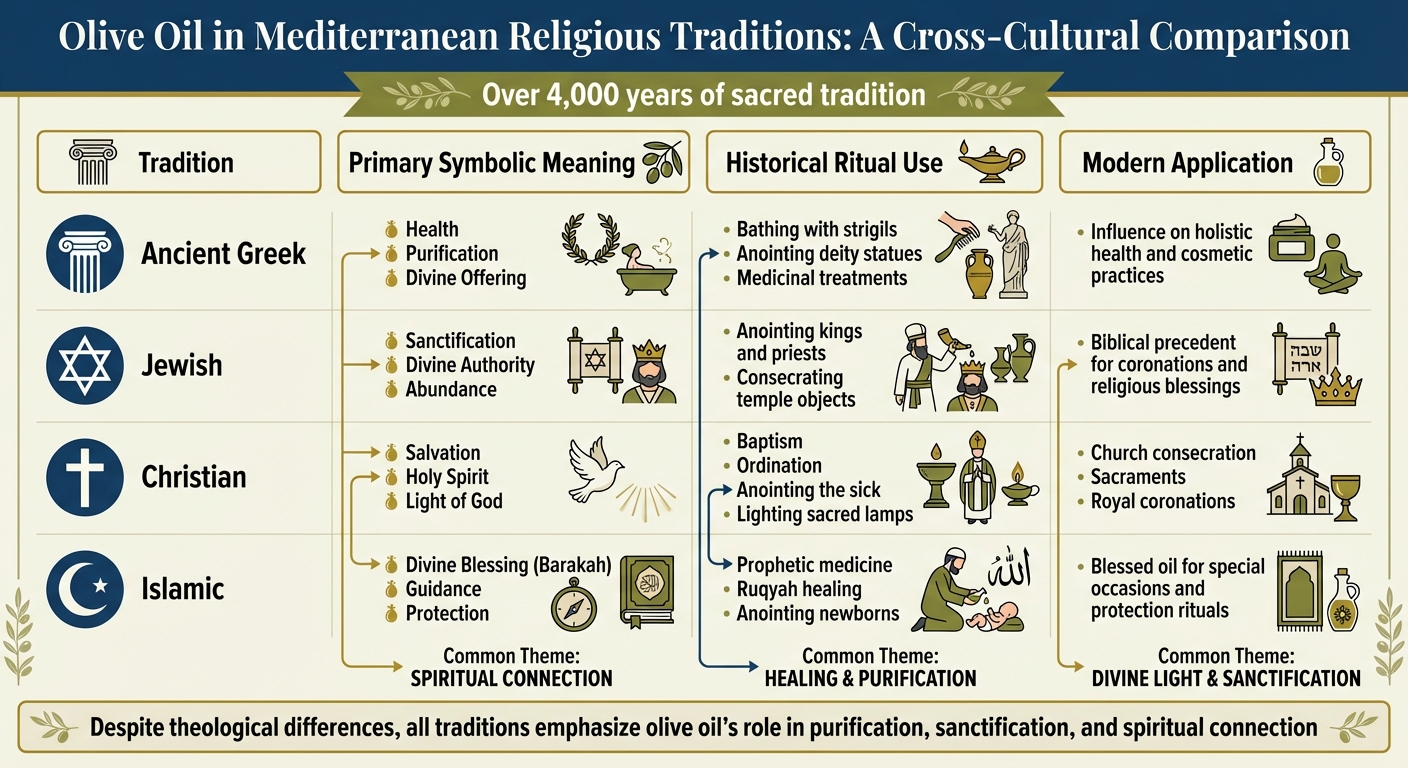
Symbolism and Uses of Olive Oil Across Mediterranean Religious Traditions
Mediterranean blessing traditions, despite their unique theological underpinnings, reveal striking similarities in their use of olive oil. Across these traditions, olive oil has been a symbol of healing and purification. Whether it’s Greek athletes, Jewish priests, Christian baptisms, or Islamic ruqyah, olive oil plays a dual role as both a physical and spiritual cleanser.
Another shared concept is sanctification - the act of designating people or objects as holy. In Jewish, Christian, and Islamic practices, anointing with oil has long represented the transfer of divine authority. From ancient Hebrew kings to modern coronation ceremonies, olive oil has carried this symbolic weight. Similarly, Islamic rituals incorporate olive oil for its protective and healing properties, further emphasizing its spiritual significance.
The motif of divine light also connects these traditions. In Christian rituals, olive oil fuels polycandelon lamps, symbolizing God's presence. Ancient Greeks, too, used scented olive oil offerings as a way to commune with their gods. While the symbolism of olive oil ties these practices together, each tradition interprets it in its own way.
The differences, however, reflect the distinct priorities of these cultures. Greek and Roman traditions placed a strong emphasis on physical well-being - Pliny the Elder even described olive oil as "an absolute necessity" for the body. Jewish practices prioritized divine authority, using oil to anoint kings and priests. In Christianity, the focus shifts to spiritual grace and salvation, evident in sacraments like baptism and anointing the sick. Meanwhile, Islamic rituals highlight protection and blessings, or Barakah, often tied to olive oil's use in prophetic medicine and other healing practices.
Here’s a quick look at how these shared themes and unique priorities compare across traditions:
| Tradition | Primary Symbolic Meaning | Historical Ritual Use | Modern Application |
|---|---|---|---|
| Ancient Greek | Health, Purification, Divine Offering | Bathing with strigils, anointing deity statues, medicinal treatments | Influence on holistic health and cosmetic practices |
| Jewish | Sanctification, Divine Authority, Abundance | Anointing kings and priests, consecrating temple objects | Biblical precedent for coronations and religious blessings |
| Christian | Salvation, Holy Spirit, Light of God | Baptism, ordination, anointing the sick, lighting sacred lamps | Church consecration, sacraments, royal coronations |
| Islamic | Divine Blessing (Barakah), Guidance, Protection | Prophetic medicine, ruqyah healing, anointing newborns | Blessed oil for special occasions and protection rituals |
This table highlights both the shared themes and the unique ways each tradition has embraced olive oil in their rituals and beliefs.
Conclusion
For over 4,000 years, olive oil has served as a bridge between ancient rituals and modern practices, symbolizing purification, divine connection, and healing.
Even today, ceremonies like King Charles III's 2023 coronation continue the tradition of anointing, tying contemporary rites to biblical sanctification. This timeless tradition is reinforced not only through ceremonial use but also by modern scientific findings.
The "fine oil" once reserved for temples and royal rituals now parallels the demand for ultra-premium extra virgin olive oils. Ancient knowledge about olive oil’s health properties aligns with today’s discoveries. High-quality EVOO boasts over 20 types of polyphenols that help protect cells from oxidative damage and is associated with a 19% reduced risk of cardiovascular death. As registered dietitian Julia Zumpano emphasizes:
No other oils can provide as many benefits as extra virgin olive oil can. It's the far superior oil.
From lighting sacred lamps to enhancing modern kitchens, olive oil remains a testament to both spiritual significance and health benefits. At Big Horn Olive Oil, every bottle of our Ultra Premium EVOO reflects this rich heritage and its scientifically-backed advantages.
FAQs
What is the symbolic significance of olive oil in Mediterranean religious rituals?
Olive oil has been cherished for centuries as a symbol of purity, healing, and divine favor, particularly in Mediterranean religious rituals. Its significance runs deep in both cultural and spiritual traditions, often serving as a bridge between humanity and the divine.
In ancient Greek and Roman practices, olive oil played a key role in anointing and purification rituals, symbolizing protection and vitality. Early Christian ceremonies embraced olive oil as well, using it in sacraments to represent the Holy Spirit and spiritual renewal. Even today, throughout the Mediterranean, olive oil remains a powerful emblem in ceremonies, signifying life, grace, and spiritual connection.
What does olive oil symbolize in Jewish and Christian rituals?
In both Jewish and Christian rituals, olive oil carries deep meaning, symbolizing purity, sanctity, and a connection to the divine.
In Jewish traditions, pure olive oil holds a central place in religious practices. It is essential for lighting the menorah, a symbol of spiritual light and divine presence. Additionally, olive oil was used in the Bible for sacred purposes such as anointing kings, priests, and temple offerings, underscoring its spiritual significance.
In Christianity, olive oil represents healing, purification, and holiness. For centuries, it has been a key element in anointing ceremonies like baptisms and confirmations, symbolizing spiritual cleansing and blessings. In both faiths, olive oil serves as a profound symbol, linking the physical world with the sacred.
What is the significance of olive oil in Islamic traditions and Prophetic Medicine?
Olive oil carries profound spiritual and symbolic meaning in Islamic traditions. The Qur’an describes the olive tree as a blessed tree, with its oil representing divine light and guidance. In Surah An-Nur (24:35), olive oil serves as a metaphor for spiritual clarity and enlightenment. Similarly, Surah At-Tin emphasizes its connection to purity and divine blessings.
In Prophetic Medicine, olive oil is also celebrated for its practical uses. Prophet Muhammad (peace be upon him) encouraged its use for health and healing, a perspective that aligns with today’s understanding of olive oil as a nutrient-dense, antioxidant-rich food. Whether as a symbol of divine wisdom or a source of physical wellness, olive oil holds a special place in Islamic teachings, bridging the sacred and the practical.