

Third-Party Audits: Key Benefits for Consumers
If you buy extra virgin olive oil, third-party audits can lower your risk of paying for the wrong product. Shelf tests have found high failure rates in some oils labeled “extra virgin,” while audit programs that use lab tests, taste panels, plant checks, and off-the-shelf sampling give shoppers a better way to judge what they’re buying.
Here’s the short version:
- Mislabeling has been found in retail testing. UC Davis studies reported that 69% of imported oils labeled “extra virgin” failed sensory standards, and one follow-up found a 73% failure rate among top-selling imported brands.
- Self-claims are weaker than outside checks. A producer can say its oil meets the grade, but an outside group can test that claim against set rules.
- Not all seals mean the same thing. Some programs test producer-submitted samples. Others buy bottles from store shelves. Some also inspect plants and records.
- Trust affects buying. One survey found 85% of consumers trust independent certification bodies to verify product claims.
- Certification can affect price. Studies cited in the article found shoppers paid about €2.16 more per liter for EU-certified organic EVOO and about €1.79 to €2.13 more per liter for PDO-certified EVOO.
- Good audit programs check more than one thing. They may use chemistry tests, trained sensory panels, random shelf sampling, and plant visits.
- Repeat checks matter. They can catch problems that show up after first approval, such as storage issues, blending changes, or relabeling.
Olive Oil Scandal Exposed 13 Popular Brands Tested in 2025–2026
sbb-itb-4066b8e
Quick Comparison
| Check type | Who does it | What it tells you | Limits |
|---|---|---|---|
| Self-claim | Producer | The brand says the oil meets the grade | Conflict of interest |
| Buyer check | Retailer or buyer | The product meets that buyer’s specs | Not fully independent |
| Third-party audit | Outside certifier or lab | The oil is checked against set standards | Quality depends on the program design |
I’d sum it up this way: third-party audits do not make every bottle perfect, but they give you a clearer signal than the label alone. That matters in a market where grade, storage, and shelf age can all affect what ends up in your kitchen.
What Third-Party Audits and Certification Mean
A third-party audit in olive oil is an independent review done by someone outside both the producer and the retailer. That outside group checks the product, production records, and lab results against published quality and safety standards. Because the auditor isn't the one making or selling the oil, there’s less conflict of interest. For shoppers, that matters. The kind of verification behind a bottle can shape how much trust they put in it.
Certification is the written attestation that comes after an audit and shows the product or system met the program's requirements.
How Third-Party Audits Differ From Self-Claims
There are three main ways verification can happen, but only one is fully independent.
- First-party verification means the producer tests its own oil and says it is extra virgin.
- Second-party verification means a buyer, such as a grocery chain, tests a supplier's oil against its own specs.
- Third-party verification means an outside body tests against published standards.
First-party and second-party checks can still involve real lab work. But neither one is fully independent. Third-party verification adds outside oversight instead of relying only on the producer's claim.
Olive Oil Quality Programs Consumers May Encounter
Shoppers may run into a few different verification programs, and each one uses a different testing model. One of the biggest differences is simple: does the program test only a sample sent in by the producer, or does it pull bottles from the market?
| Program | Who Tests | What They Test | How Often |
|---|---|---|---|
| USDA Quality Monitoring Program (QMP) | USDA Agricultural Marketing Service | Chemistry, sensory evaluation, production records, facility practices | Ongoing; includes random, unannounced plant visits |
| NAOOA Certified Seal | Independent labs using bottles pulled from retail shelves | IOC physico-chemical purity and quality standards | At least twice per year, off the shelf |
| COOC Certified Extra Virgin | COOC-approved labs and sensory panels | Free acidity ≤ 0.5%, peroxide value ≤ 15 meq O₂/kg, UV absorbance, defect-free sensory evaluation | Per submission; lab and panel both required |
The USDA QMP, added for olive oil in 2012, goes past lab testing alone. Auditors make random, unannounced plant visits to review production processes, quality assurance records, and standard operating procedures. That’s a big deal. An unannounced visit can show what day-to-day practice looks like, not just what appears in a single sample.
NAOOA tests bottles bought off retail shelves in independent labs. COOC requires both chemical limits and blind sensory approval, including positive fruitiness, and a failed product triggers a recall of licensed products across North America.
Those details change how much weight a shopper should give a seal. A seal tied to outside testing and audit checks means a lot more than a label that rests on a company’s own word.
How Audits Benefit Consumers: Trust, Safety, and Better Buying Decisions
Third-Party Olive Oil Audits vs. Self-Claims: What Consumers Need to Know
Now that the audit types are clear, the next question is what they change for shoppers. Third-party audits turn label claims into verified claims, which cuts uncertainty at the shelf.
Why Certification Seals Build Consumer Trust
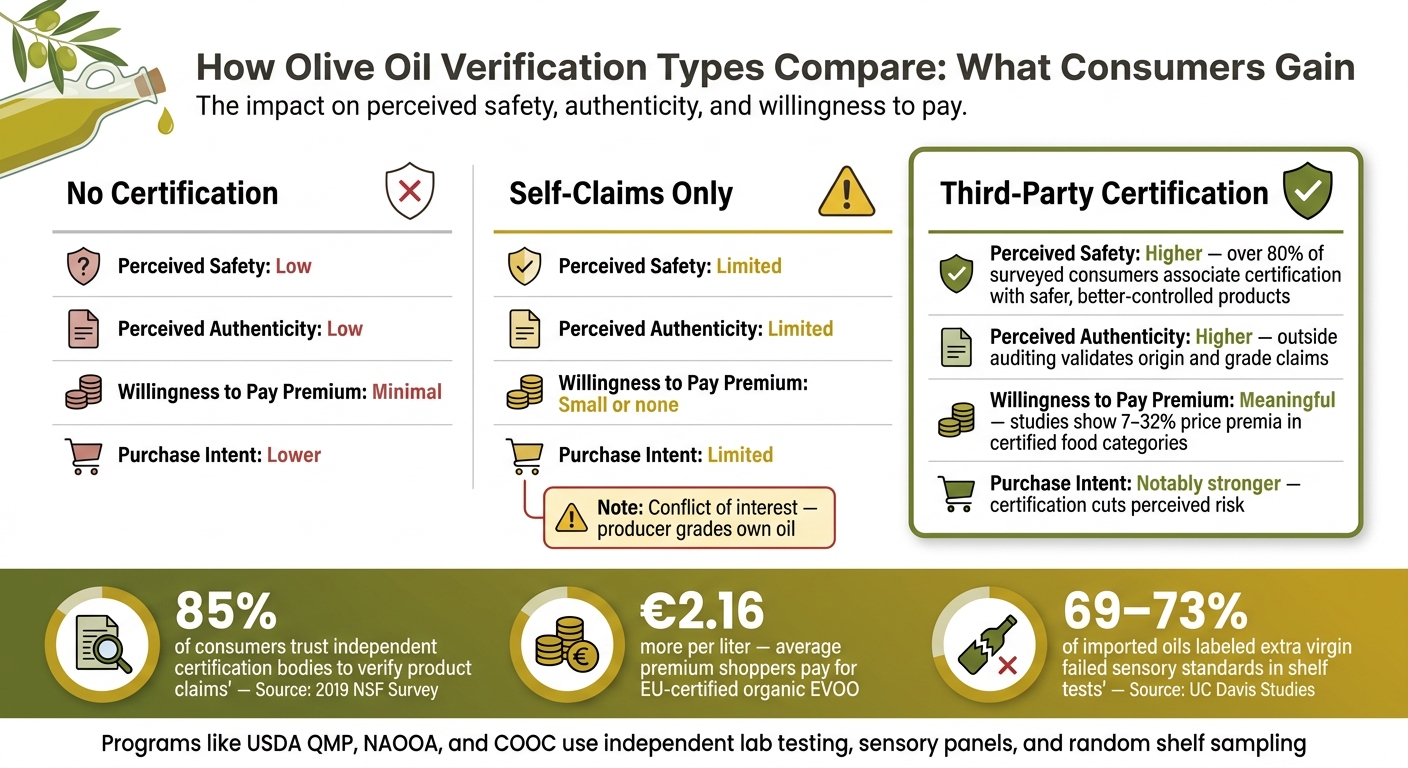
Research keeps pointing to the same thing: shoppers put more trust in independent certification bodies than in a producer’s own word. A 2019 NSF survey found that 85% of consumers trust independent certification bodies to verify product claims.
A seal backed by outside lab testing and repeat monitoring tells shoppers that someone with no financial stake in the sale has already checked the product. Studies on certified foods show that independently certified labels are among the most trusted signals consumers see at the point of purchase. When people know a certification involves documented standards, independent testing, and repeat monitoring, they’re more likely to view it as accountability, not just a one-time stamp. That’s what turns certification into a buying signal.
In olive oil, outside verification also cuts shelf-level uncertainty.
What Research Shows About Purchase Intent and Willingness to Pay
Trust doesn’t just shape perception. It also affects purchase intent and willingness to pay. Across multiple studies, consumers are more willing to buy and spend more on certified products than on identical products that rely only on self-claims.
In olive oil studies, consumers were willing to pay about €2.16 more per liter for EU-certified organic extra virgin olive oil and about €1.79 more per liter for PDO-certified EVOO compared with non-certified options. Another study estimated an added PDO premium of roughly €2.13 per liter. In plain terms, certification changes both confidence and checkout behavior.
The table below shows how consumer responses shift based on the kind of verification behind a product:
| Verification Type | Perceived Safety | Perceived Authenticity | Willingness to Pay | Purchase Intent |
|---|---|---|---|---|
| No certification | Low | Low | Minimal | Lower |
| Self-claims only | Limited | Limited | Small or none | Limited |
| Recognized third-party certification seal | Higher; over 80% of surveyed consumers associate certification with safer, better-controlled products | Higher; outside auditing validates origin and grade claims | Meaningful premium - studies show 7–32% price premia in certified food categories | Notably stronger; certification cuts perceived risk |
When certified products enter the market, bids for uncertified products fall while certified bids hold steady, which widens the price gap. For a shopper standing in front of a higher-priced bottle, a recognized certification seal is one of the clearest signs that paying more may be worth it.
How Audits Improve Olive Oil Quality and Authenticity
Those trust signals matter for another reason: audits can improve the oil itself, not just the label on the bottle.
Testing Standards That Support Better, More Accurate Oil
These tests help protect shoppers from stale, flawed, or misgraded oil. Free acidity (FFA) points to poor fruit quality or delays in processing. Peroxide value (PV) tracks early-stage oxidation. UV values (K232, K270, ΔK) can show oxidation or refining.
Chemistry tests tell part of the story, but not the whole thing. That’s why leading standards - including IOC, USDA, and Ultra Premium programs - also require sensory evaluation by trained tasting panels. Panels can spot rancidity, fusty notes, and vinegary off-flavors that lab tests may miss. For an oil to qualify as extra virgin, it must have no defects and clear fruitiness.
One clean test result, though, doesn’t settle everything.
Why Repeat Monitoring Helps Cut Fraud Risk
Random, ongoing off-the-shelf sampling helps catch issues that show up after certification - during blending, storage, relabeling, or bottling. That matters because shelf quality is where the shopper meets the product.
NAOOA's 2024–2026 shelf studies found no adulteration in the top 15 brands and 37 private labels. Only 2 of 216 samples failed purity standards, which put overall adulteration below 1%. That’s the value of repeat monitoring: it checks what’s actually being sold, not just what passed once on paper.
The table below shows how major olive oil quality programs handle testing:
| Program | Testing focus | What it adds for consumers |
|---|---|---|
| IOC Trade Standard | FFA, PV, UV, trained panel review | Lab and sensory baseline combined |
| USDA Olive Oil Standard | FFA, PV, UV, ΔK, trained panel review | Classification checks for extra virgin quality |
| OOCC Standard | FFA, PV, UV, plus freshness markers such as PPP and DAGs | Tighter freshness-focused controls tied to production |
| Ultra Premium (UP) Standard | Stricter FFA, PV, and UV limits, sensory review, process documentation | Targets freshness and filters out borderline oils |
Programs like OOCC and Ultra Premium set tighter chemical limits than the IOC baseline. They push FFA well below the legal 0.8% ceiling and PV well below 20 meq/kg, with a clear focus on freshness. And that’s not a small detail. A 2015 NAOOA study showed why: 67% of 18 California EVOO samples bought at random in stores failed at least one OOCC chemical measure, while 28% failed one or more IOC quality measures.
That kind of pressure changes behavior. Producers have to guard freshness from harvest all the way to bottling.
How Premium Standards Connect to Freshness-Focused Brands
To stay certified, producers need to harvest at peak ripeness, mill fast, store oil away from heat and light, and keep traceable lot records.
Big Horn Olive Oil's emphasis on Ultra Premium Extra Virgin Olive Oils reflects that link in a direct way: independent verification turns freshness claims into measurable claims.
Conclusion: What Consumers Gain From Third-Party Audits
Put all of this together, and one thing becomes clear: audits can improve consumer trust and the quality of the oil that ends up on store shelves.
Key Takeaways for Shoppers
Independent oversight tends to be more dependable than self-claims. A 2015 National Consumers League study found that 6 of 11 bottles of extra virgin olive oil from major U.S. retailers failed to meet extra virgin requirements. That’s a big gap. Third-party programs help narrow it.
Certification seals cut down on guesswork at the shelf. A recognized seal gives shoppers a fast signal that the oil met set standards. Research also shows that certification can increase willingness to pay. That added trust matters, especially since quality can still decline after certification.
Regular testing helps keep quality steady over time. Ongoing checks can catch problems that show up after the first round of certification.
Choosing audited oils supports better production standards. When shoppers keep choosing certified products, producers have more reason to invest in better harvesting, storage, blending, and traceable records. In plain terms, audited standards help turn freshness and grade claims into checked quality signals instead of just marketing copy.
FAQs
How can I tell if a seal is truly independent?
Look for verification from an outside organization that has no financial stake in the producer’s success. An independent seal points to objective testing by accredited labs and certified sensory panels, all using strict, standardized rules.
That’s a big difference from self-certification. Independent seals show the product went through unbiased chemical and sensory review to confirm purity, quality grade, and origin.
Do third-party audits guarantee an olive oil is fresh?
Not on their own. Third-party audits and certifications can help confirm quality, but they don't guarantee freshness.
What they do offer is objective, science-based proof from the time of testing. That can include acidity, peroxide values, and markers such as 1,2-Diacylglycerols (DAGs).
If you want the clearest sign of freshness, look for independent verification plus a clear harvest date. Ideally, that harvest date should be within the last 12 to 18 months.
What tests matter most for extra virgin olive oil?
The most important tests combine chemical analysis with sensory evaluation.
Chemical tests check purity and freshness by looking at free fatty acids, peroxide values, UV absorbency, PPP, and DAGs. Then blind tastings by trained panels help confirm the oil has no defects, such as rancidity, and that it shows the fruity traits required for the grade.