

Third-Party Testing vs. Self-Certification
When choosing olive oil, the difference between third-party testing and self-certification can determine the quality of what ends up on your table. Here's the key takeaway: third-party testing ensures unbiased, independent checks for quality and authenticity, while self-certification relies on producers' internal standards, often leading to inconsistent or misleading claims.
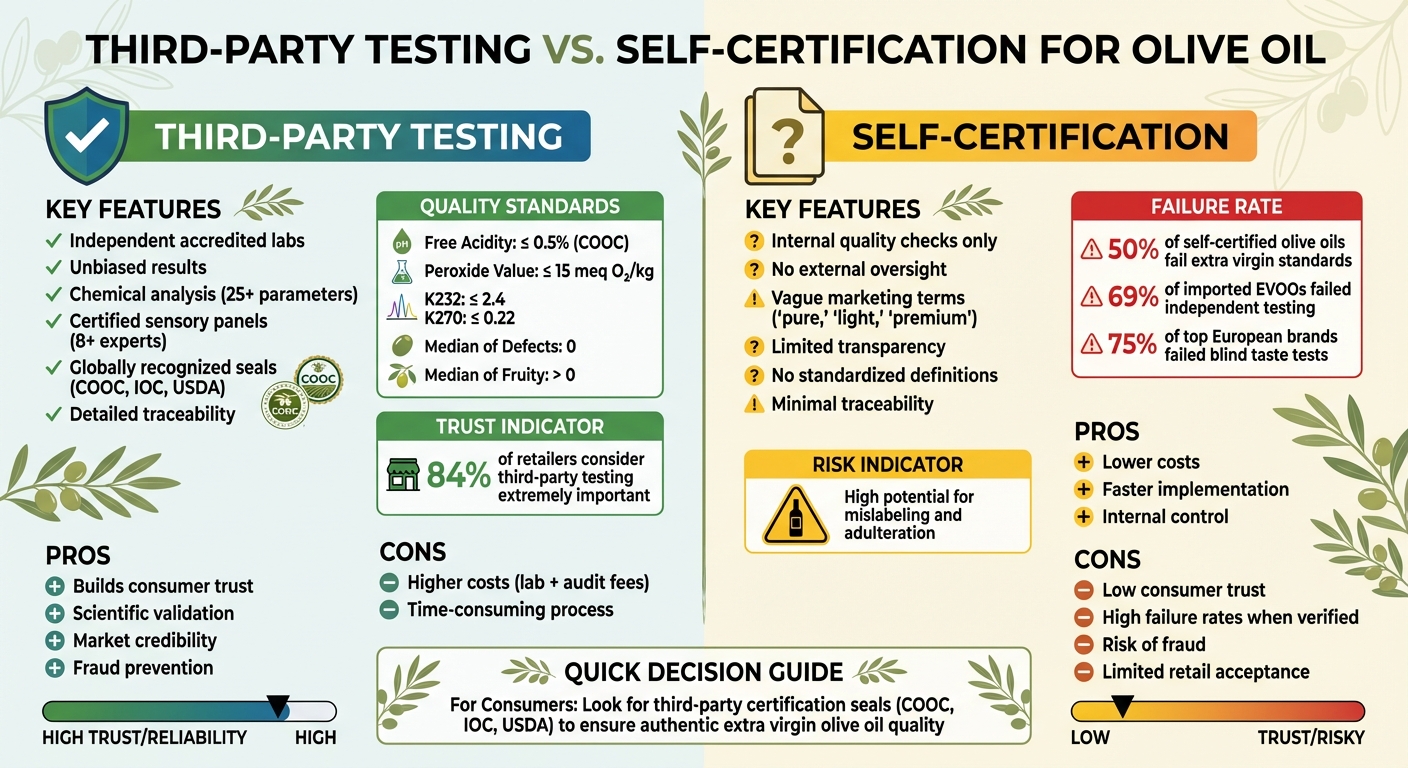
- Third-Party Testing: Conducted by independent labs using strict standards (e.g., IOC, COOC). Tests include chemical analysis (e.g., free fatty acid levels) and sensory evaluations for flavor and defects. This process builds trust and ensures oils meet high-quality benchmarks.
- Self-Certification: Relies on producers' internal checks. Lacks transparency, making it harder to verify quality. Studies show nearly 50% of self-certified olive oils fail to meet extra virgin standards.
Quick Overview:
- Third-Party Testing: Higher cost, unbiased results, globally recognized seals (like COOC), and detailed traceability.
- Self-Certification: Lower cost, potential conflicts of interest, and limited consumer trust.
If you're looking for olive oil that delivers on its label claims, third-party testing is the more reliable option.
Third-Party Testing vs Self-Certification for Olive Oil Quality
Interpreting Olive Oil Test Results
What Is Third-Party Testing?
Third-party testing involves using independent, accredited laboratories and certified tasting panels to verify the quality of olive oil. By relying on external experts, this process eliminates conflicts of interest and ensures that quality claims are based on objective, unbiased analysis. Instead of a company grading its own product, professionals use scientific methods to confirm whether an oil meets "extra virgin" standards.
Chemical tests assess factors like acidity, oxidation levels, and purity, while certified tasting panels evaluate aroma and flavor to ensure the oil complies with extra virgin criteria. Both evaluations must meet the required standards for certification.
"To gain COOC certification, an oil must comply with requirements for both a chemical analysis and a sensory evaluation."
– California Olive Oil Council
Organizations like the International Olive Council (IOC), the United States Department of Agriculture (USDA), and the California Olive Oil Council (COOC) set the benchmarks for these tests. These standards outline acceptable ranges for key parameters, such as free fatty acids, peroxide values, and UV absorbency. For instance, the COOC caps free acidity at 0.5%, while the IOC allows up to 0.8%.
Third-party testing also verifies authenticity and traceability. Laboratories confirm the oil’s origin - such as 100% California olives - and ensure it comes from the most recent harvest. This process helps prevent fraud and guarantees that consumers get exactly what the label promises.
Next, let’s break down the steps behind this rigorous testing process.
The Third-Party Testing Process
The process starts when producers send samples to an accredited laboratory. These labs meet strict certification requirements, ensuring their results are recognized by both legal and industry standards.
Chemical testing focuses on multiple quality indicators. For example, the Free Fatty Acid (FFA) content reflects the quality of the olives during harvest, with lower percentages indicating better quality. The Peroxide Value (PV) measures oxidation levels, which can signal rancidity. UV tests (K232 and K270) detect oxidized compounds, revealing if the oil has been heated or refined. Producers with larger outputs - over 5,000 gallons - must also undergo additional tests, such as those for DAGs and PPP, which help determine the oil’s age.
The COOC sets specific thresholds, such as K232 levels at or below 2.4 and K270 at or below 0.22. For extra virgin certification, DAGs must be at least 35%, while PPP levels cannot exceed 17%.
Simultaneously, sensory evaluations are conducted by certified tasting panels. These blind tastings involve at least eight experts to ensure impartial results.
"The sensory based flavor and aroma qualities, also known as organoleptic qualities are determined by an independent group of certified tasters."
– The Olive Tap
Panelists assess whether the oil has a median fruitiness score greater than zero and is free of sensory defects. Any defect - like a hint of rancidity or mustiness - disqualifies the oil from being labeled as extra virgin.
| Quality Parameter | COOC Requirement | IOC Requirement |
|---|---|---|
| Maximum Free Acidity (FFA) | ≤ 0.5% | ≤ 0.8% |
| Peroxide Value (PV) | ≤ 15 meq O₂/kg | ≤ 20 meq O₂/kg |
| K232 (UV Absorbency) | ≤ 2.4 | ≤ 2.50 |
| K270 (UV Absorbency) | ≤ 0.22 | Not specified |
| Median of Defects | 0 | 0 |
| Median of Fruity | > 0 | > 0 |
With the process explained, let’s explore the benefits of such thorough testing.
Benefits of Third-Party Testing
The most important advantage of third-party testing is the trust it builds with consumers. When an independent organization verifies the quality of an olive oil, buyers can be confident they’re getting authentic extra virgin olive oil, not a mislabeled or substandard product.
This rigorous process catches issues that internal quality checks might miss. Chemical testing provides precise data on freshness and purity, while sensory panels detect subtle flavor flaws that could indicate issues like poor storage or handling. Together, these methods ensure comprehensive quality assurance.
Meeting international standards also enhances the credibility of certified oils in global markets. Products that pass benchmarks set by the IOC, USDA, or COOC gain worldwide recognition, with the COOC standard being one of the strictest in the industry.
Third-party certification doesn’t just guarantee quality - it also ensures traceability and freshness. Programs like the COOC Seal Certification confirm that the oil comes from the most recent harvest and a specific region, giving consumers confidence they’re purchasing a fresh, premium product.
For producers, certification serves as a valuable marketing tool. Displaying recognized quality seals helps premium olive oils stand out on the shelf and supports higher price points, as more consumers actively seek out verified products.
These rigorous measures reinforce the high standards associated with extra virgin olive oil and ensure consumer confidence in the product’s quality.
What Is Self-Certification?
Self-certification is a process where producers independently claim the quality of their products without involving an accredited certifying body. Unlike third-party testing that relies on external labs and sensory panels, self-certification allows companies to grade their products based on their internal standards alone.
In the olive oil industry, this practice often leads to unregulated marketing terms. Words like "pure", "light", "authentic", "gourmet", or "premium" are commonly used, but they lack standardized definitions or legal backing.
"Other words like 'pure', 'light', 'authentic', or even 'cold-pressed' are meaningless and have no official industry definition."
– Brightland
Self-certified products rarely provide key quality indicators. Instead of offering details like harvest dates or chemical profiles (e.g., free fatty acid levels or peroxide values), these products typically display vague information such as "Best By" or "Bottled On" dates. Unfortunately, these labels don’t give an accurate picture of the oil's freshness or chemical quality.
This lack of external oversight poses significant risks. A study by the National Consumer League found that nearly 50% of olive oil bottles tested from major retailers failed to meet the standards for the "extra virgin" label, even though they were marketed as such. This sets the stage for understanding the internal workings of self-certification.
The Self-Certification Process
The self-certification process involves internal testing and labeling practices that don’t align with the rigorous standards set by organizations like the California Olive Oil Council (COOC) or the International Olive Oil Council (IOC). Unlike third-party testing, which uses objective benchmarks, self-certification relies on the producer’s own criteria. This means a product can be labeled "Extra Virgin" without meeting independently verified standards.
For example, the IOC allows a free fatty acid level of up to 0.8% for extra virgin olive oil, but top-quality oils typically measure around 0.3% or lower. Self-certified oils, however, can vary significantly - sometimes even exceeding these limits - without disclosing this information.
Some producers turn to self-certification as a way to cut costs, often at the expense of quality. Common practices include certifying a small batch of oil, then blending it with lower-quality oils before distribution. Another tactic involves labeling oil as "Made in Italy" when, in reality, the olives were grown elsewhere and only bottled in Italy.
"These fakes get through by getting a batch of oil certified, then mixing it with lower quality oils after certification."
– Martina Crocker, Cooking Instructor and Personal Chef
Such internal practices come with considerable risks.
Drawbacks of Self-Certification
The biggest issue with self-certification is that it opens the door to misleading claims, which can erode consumer trust. When producers rely solely on their own assessments, there’s a clear conflict of interest. This creates a financial incentive to label lower-quality oils as "Extra Virgin" to charge premium prices.
"While extra virgin olive oil is objectively superior, lower quality oil is much easier and cheaper to grow and harvest, incentivizing producers... to mislabel and mislead."
– Brightland
Self-certified oils are also more likely to suffer from quality issues that go unnoticed. Without mandatory sensory panels, defects like rancid, fusty, or musty flavors may develop, disqualifying the oil from being truly "extra virgin." Chemical tests alone often fail to catch these sensory flaws.
Additionally, the lack of transparency - such as withholding harvest dates, polyphenol counts, or detailed chemical profiles - makes it difficult for consumers to evaluate the oil’s freshness and quality. Without a recognized certification seal from reputable organizations like the COOC or NAOOA, consumer confidence takes a hit.
Third-Party Testing vs. Self-Certification: Key Differences
When it comes to evaluating products, third-party testing and self-certification take very different approaches, especially in terms of independence, thoroughness, and accountability. Third-party testing involves an unbiased organization with no financial ties to the product's success, while self-certification leaves the responsibility of evaluation entirely in the hands of the manufacturer. These distinctions are crucial when comparing the two methods.
Third-party testing programs often include unannounced facility audits and regular compliance checks, ensuring that products consistently meet standards beyond their initial launch. This is particularly important in industries like olive oil production. A study by the UC Davis Olive Center revealed that 69% of imported extra virgin olive oils failed to meet internationally accepted standards, emphasizing the risks of relying on self-reported claims.
"Third-party certification means that an independent organization has reviewed the manufacturing process of a product and has independently determined that the final product complies with specific standards for safety, quality or performance."
– NSF
These differences have a direct impact on the reliability of the certification process and the trust consumers place in it. While third-party testing comes with higher costs due to lab fees and audits, it offers greater credibility. In fact, 84% of retailers consider third-party testing extremely important for inventory decisions, making it a key factor in market acceptance. Self-certified products, while less expensive, may struggle to gain the same level of trust and access.
Consumers tend to favor third-party verification, as recognizable seals like the COOC mark provide clear evidence that a product has been independently vetted. On the other hand, self-certified products rely solely on the manufacturer's claims, which can leave buyers skeptical.
Comparison Table
Here's a side-by-side look at the key differences:
| Aspect | Third-Party Testing | Self-Certification |
|---|---|---|
| Independence | High; conducted by an external organization | Low; handled internally by the manufacturer |
| Process | Involves audits, lab testing, and sensory reviews | Relies on internal quality control |
| Reliability | High; backed by strict standards | Lower; risks of error or adulteration |
| Consumer Trust | High; seals like COOC boost confidence | Variable; skepticism around unverified claims |
| Cost | Higher; includes lab and audit fees | Lower; uses internal resources |
| Conflict of Interest | Safeguards prevent bias | Greater risk of bias |
| Traceability | Tracks harvest dates and origins | Often lacks detailed traceability |
sbb-itb-4066b8e
Pros and Cons of Each Method
Choosing between third-party testing and self-certification often boils down to balancing cost savings with scientific credibility, consumer trust, and market access. Third-party testing involves expenses like lab fees, auditor charges, and FDA fees. On the other hand, self-certification eliminates external costs by relying on in-house quality checks. However, research shows that over 69% of olive oils labeled as "extra virgin" through self-certification fail to meet independent standards.
Recognized certifications, such as the COOC seal, build consumer confidence by validating quality through independent testing. As EVOO Marketplace explains:
"Lab testing levels the playing field, enabling consumers to compare EVOOs based on science rather than marketing claims"
Third-party certification also opens doors to programs like the FDA's VQIP, setting products apart in competitive markets. In contrast, self-certification may work for low-risk products but often leads to issues like fraud, mislabeling, and limited acceptance by retailers. The table below highlights the key advantages and disadvantages of each approach.
Pros and Cons Table
| Method | Advantages | Disadvantages |
|---|---|---|
| Third-Party Testing | Builds trust with independent validation Boosts consumer confidence through recognized seals Relies on scientific standards via accredited labs Qualifies for programs like VQIP Helps products stand out in competitive markets |
Higher costs, including lab and audit fees Requires working with external certification bodies Time-consuming due to rigorous testing protocols |
| Self-Certification | Cost-effective by using internal resources Quicker implementation without external coordination Allows more control over testing schedules and processes |
Lower consumer trust due to potential bias High failure rates when independently verified (69% for olive oil) Increased risk of fraud and mislabeling Limited acceptance in retail and restricted market access Lacks scientific backing for quality claims |
This comparison highlights why companies like Big Horn Olive Oil invest in third-party testing to ensure their products meet rigorous quality and authenticity standards.
How Big Horn Olive Oil Uses Third-Party Testing
Big Horn Olive Oil takes quality control seriously, relying on independent third-party testing to ensure every bottle of their Ultra Premium Extra Virgin Olive Oil (EVOO) meets strict standards for purity, freshness, and health benefits. Unlike self-certified products, their oils undergo detailed chemical and sensory evaluations to confirm they are 100% olive-derived, free from any adulteration with cheaper oils like canola or soybean. This rigorous process helps maintain a consistent, scientifically validated quality that sets their products apart.
The testing process involves analyzing over 25 parameters in accredited labs. Key markers include Free Fatty Acids (FFA) at levels of ≤0.5% (well below the standard 0.8%) and Peroxide Values capped at ≤15 meq O₂/kg, ensuring minimal oxidation. Freshness is further confirmed by checking 1,2-Diacylglycerols (DAGs), which must meet or exceed 35%.
In addition to lab tests, third-party sensory panels conduct blind tastings to detect any defects and evaluate the fruity characteristics expected of premium EVOO. This dual method ensures the oils not only taste authentic but also deliver significant health benefits, thanks to their high polyphenol content (200+ ppm), which supports antioxidant and heart health.
Big Horn Olive Oil works with independent certification organizations that uphold some of the toughest standards worldwide, comparable to those of the California Olive Oil Council (COOC). These standards require that their oils are cold-pressed within two hours of harvest and delivered fresh within three months. Furthermore, their oils meet FDA heart health claims by containing at least 70% oleic acid.
This meticulous process guarantees transparency and traceability for every bottle, including single-source varieties like Picual and Coratina. Big Horn's commitment to third-party testing ensures their Estate Reserve EVOO consistently delivers exceptional quality and authenticity.
Conclusion
When it comes to ensuring quality, third-party testing remains the benchmark for premium products like Ultra Premium Extra Virgin Olive Oils. Accredited labs bring an unbiased perspective through blind testing, where brand names and labels are concealed from sensory panels. This ensures evaluations are based solely on the product itself, free from any manufacturer influence.
Such rigorous standards not only validate the testing process but also build trust among consumers. For example, in a study of 88 EVOO samples from the market, independent testing revealed adulteration in less than 5% of the products, exposing oils that failed purity standards despite their labeling. This kind of scrutiny is crucial, especially considering findings from 2011, where professional panels discovered that nearly 75% of top imported European olive oil brands failed blind taste tests - even though they were labeled as "extra virgin".
For shoppers, third-party certification offers real peace of mind, ensuring that the product inside the bottle lives up to the promises on the label. Dan Flynn, Executive Director of the UC Davis Olive Center, highlights the shortcomings of unreliable home testing methods, stating:
"The fridge test is unreliable in judging whether an olive oil is truly made from olives, nor does it provide information on the quality of the oil".
Independent testing eliminates such uncertainty.
This commitment to rigorous testing is at the heart of Big Horn Olive Oil’s promise to deliver authentic quality. By subjecting their products to thorough chemical analysis and sensory evaluations, they provide a level of transparency that self-certification simply cannot achieve. Every bottle is crafted to meet the highest standards of purity, freshness, and health benefits - ensuring consumers get exactly what they expect from Ultra Premium EVOO, supported by science rather than marketing hype.
FAQs
Why is third-party testing more trustworthy than self-certification for ensuring olive oil quality?
When it comes to ensuring quality, third-party testing stands out as a more reliable option. Independent, accredited laboratories conduct standardized chemical analyses and sensory evaluations, guaranteeing that the olive oil meets strict quality benchmarks, such as the standards required for extra virgin classification.
On the other hand, self-certification depends entirely on the producer's own assessments, which may not have the same level of impartiality or rigor. Opting for products tested by third-party experts - like the Ultra Premium Extra Virgin Olive Oils from Big Horn Olive Oil - means you can feel confident about their quality, freshness, and authenticity.
What tests are performed during third-party evaluations of olive oil?
Third-party testing of olive oil relies on a mix of chemical analysis and sensory evaluation to verify its quality and authenticity. On the chemical side, tests focus on critical factors like free acidity (which should be ≤ 0.8% oleic acid), peroxide value, and UV absorption levels (K232 and K270). These measurements help determine the oil's freshness and purity. Additionally, markers such as desmethylsterols and triterpene dialcohols are analyzed to confirm authenticity.
Beyond the lab, a trained sensory panel examines the oil for any off-notes, such as rancidity, or undesirable characteristics like fusty or musty aromas. They also assess positive traits, including fruitiness, bitterness, and pungency. This dual approach of precise chemical testing and expert sensory evaluation ensures the olive oil adheres to rigorous quality standards.
Why does third-party testing build consumer confidence in olive oil products?
Third-party testing plays a key role in boosting consumer trust by subjecting olive oil to impartial, independent evaluations. Certified labs carry out thorough chemical and sensory tests to confirm that the oil meets extra virgin standards and hasn’t been tampered with.
This rigorous process reassures buyers about the oil's authenticity, quality, and origin, giving them confidence that they’re purchasing a genuine product they can rely on.