

Transparency vs. Greenwashing in Olive Oil
When buying olive oil, labels like "eco-friendly" or "traditionally produced" can be confusing. Are they trustworthy or just marketing tricks? Here's the difference:
- Transparency: Provides clear details like harvest dates, farm names, batch codes, and certifications. Look for specifics like milling times, olive varietals, and lab-tested metrics (e.g., free fatty acidity below 0.8% or polyphenols above 250 mg/kg). QR codes linking to Certificates of Analysis (COA) are a bonus.
- Greenwashing: Relies on vague terms like "natural" or "clean" without proof. Common tactics include misleading labels (e.g., "Packed in Italy" for non-Italian oil), omission of harvest dates, and clear glass bottles that degrade quality.
To avoid being misled, read labels critically, verify certifications, and prioritize brands that share detailed sourcing and quality information. For example, some producers ensure cold-pressing within hours of harvest and transparent supply chains. Paying attention to these details helps you choose better oil for health and flavor.
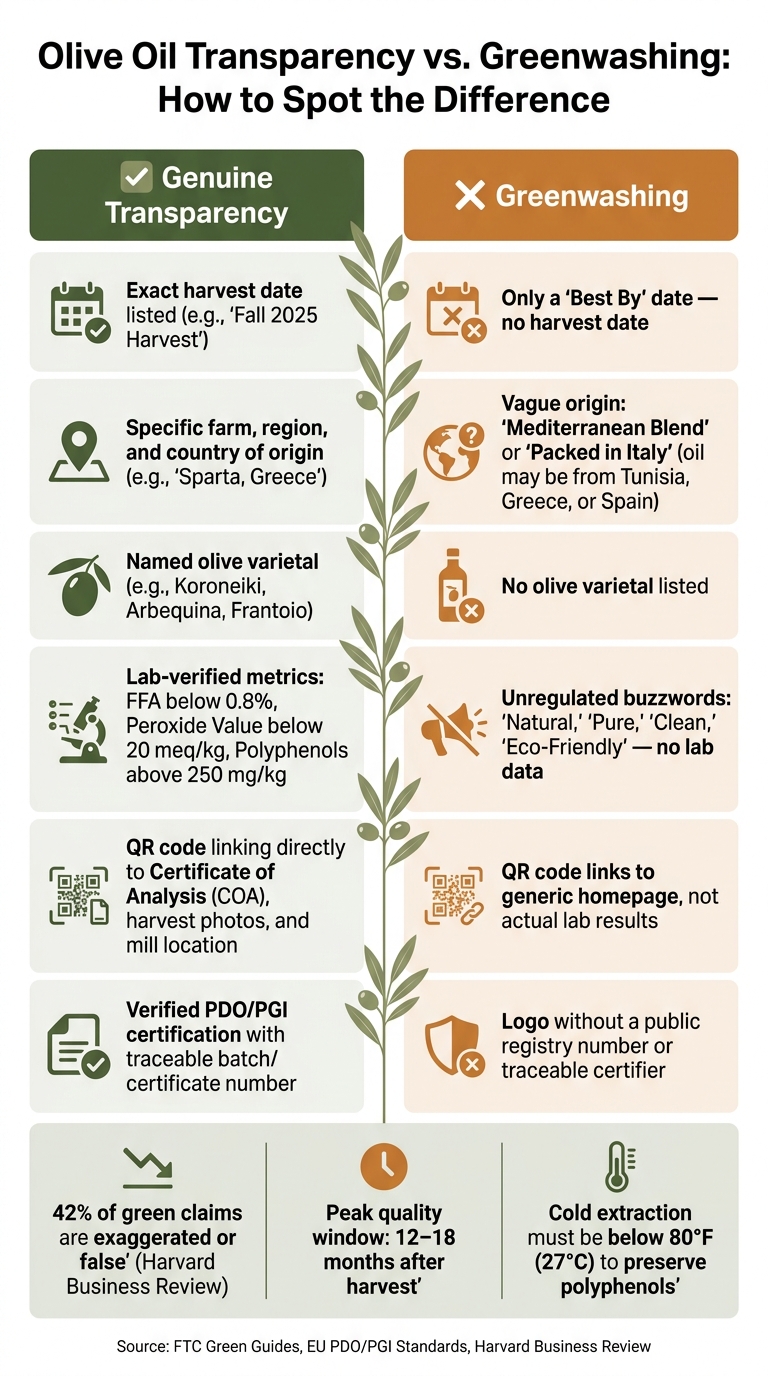
Olive Oil Transparency vs. Greenwashing: How to Spot the Difference
The Olive Oil SCAM: 5 Brands to Throw Away (And What to Buy)
sbb-itb-4066b8e
What Genuine Transparency Looks Like
Transparency isn’t just about using the right words or marketing buzz - it’s about offering clear, verifiable proof. Brands that truly embrace transparency provide detailed, checkable information at every step, from the olive grove to the bottle on your shelf.
Clear Sourcing and Harvest Information
Brands committed to transparency go beyond vague labels. They specify the country, region, farm or cooperative, and even the specific olive variety. Instead of relying on a generic "best by" date, they include an exact harvest date, which gives a much clearer picture of the oil's freshness. For example, a label stating "2025 Harvest" provides far more assurance than just an expiration date.
"Treat harvest date like a 'best before for flavour'. An oil bottled the same year has a greater chance of vibrant flavour." - Natural Olive
These brands also share details about milling time - ideally within 6–24 hours of harvest - and the temperature used during extraction. For extra virgin olive oil, cold extraction at temperatures below 80°F (27°C) is key to preserving both flavor and beneficial compounds. Packaging also matters; dark glass or tin containers are preferred to protect the oil from light and maintain its quality.
This level of transparency sets the stage for understanding and assessing the overall quality of the product.
Verifiable Quality and Certification
While terms like "Premium" or "100% Pure" might sound appealing, they don’t guarantee much. What really matters are the chemical metrics that can be verified through lab testing. Here are some critical standards for extra virgin olive oil:
| Metric | Standard EVOO Threshold | Higher Standard |
|---|---|---|
| Free Fatty Acidity (FFA) | Below 0.8% | Below 0.5% or 0.3% |
| Peroxide Value (PV) | Below 20 meq/kg | Below 10 meq/kg |
| Total Polyphenols | No minimum required | Above 250 mg/kg; high-phenolic above 500 mg/kg |
Reputable producers often provide a Certificate of Analysis (COA) for each batch. This certificate should be easily accessible, often via a QR code on the packaging. But be cautious - a QR code that leads to a generic homepage isn’t enough. It should link directly to harvest photos, mill locations, and lab results.
"A logo without a published standard or registry is weak evidence." - Natural Olive
Geographic certifications, like the EU’s PDO (Protected Designation of Origin) or PGI (Protected Geographical Indication), add another layer of accountability. However, even these certifications should be verified by checking the certifier’s public registry using the batch number on the bottle.
By focusing on measurable quality and transparent certifications, brands can build trust that extends to their sustainability claims.
Honest Sustainability and Ethical Sourcing Claims
In the same way that sourcing and certifications require concrete details, sustainability and ethical sourcing claims must also be backed by evidence. Phrases like "sustainably grown" or "eco-friendly" are often overused and vague. Transparent brands, on the other hand, provide specifics - like their use of cover crops, managed deficit irrigation, and low-energy milling with water recycling.
Ethical sourcing follows the same principle. Instead of broad statements, credible brands share measurable details about labor standards, wage transparency, or third-party audits of working conditions. These specifics give consumers confidence that the claims aren’t just empty promises.
"Sustainability is not one claim. It is a stack of evidence. The strongest producers usually show consistency across certifications, farming methods, traceability, packaging, and third-party verification." - naturalolive.co.uk
How Greenwashing Appears in Olive Oil
Greenwashing in the olive oil industry often flies under the radar. It uses clever language, imagery, and selective information to create a perception of quality that doesn’t always hold up under scrutiny. Let’s break down how these tactics work.
Vague Sustainability Language
One of the most common tricks is relying on feel-good buzzwords that lack substance. Phrases like "natural", "eco-friendly", "clean," or "ethically produced" often appear on labels without any concrete evidence or third-party verification to back them up. These terms are completely unregulated, meaning any brand can use them freely.
In fact, a Harvard Business Review study revealed that 42% of "green" claims made by brands were either exaggerated or outright false. In olive oil specifically, you might see labels boasting "sustainably grown", but there’s no mention of critical factors like water usage in drought-prone areas, soil management practices, or independent audits to verify these claims.
"Broad, unqualified claims like 'green' or 'eco-friendly' are difficult to substantiate and likely deceptive." - U.S. Federal Trade Commission (FTC)
Misleading Labels and Imagery
Visual design plays a huge role in greenwashing. Picture rustic stone mills, lush Tuscan hills, or an Italian flag on the label. These elements suggest artisanal quality, but they’re just marketing tools with no regulatory oversight.
Consider the "Packed in Italy" label. It’s a common tactic where oil sourced from countries like Tunisia, Greece, or Spain is shipped in bulk to Italy, bottled there, and then marketed as Italian. This exploits Italy’s reputation for high-quality olive oil, even though the product itself has little connection to the country.
Another example is the use of clear glass bottles. While these bottles show off the oil’s color, they also expose it to light, which causes oxidation. This degrades the polyphenols - the compounds that make extra virgin olive oil so beneficial.
"Clear bottles are a sign that the producer prioritizes marketing (showing off the color) over quality." - O-Liv Research Team
Beyond misleading visuals, brands often leave out key details to further mislead consumers.
Selective Disclosure and Omission
The most subtle form of greenwashing involves what brands choose not to say. For example, a producer might highlight an organic certification but avoid mentioning water use in drought-stricken areas, labor conditions, or the fact that the oil is a blend from multiple unnamed countries. This selective storytelling creates a false sense of transparency.
Another common omission is the harvest date. Olive oil maintains peak quality for only 12–18 months after harvest, yet many labels skip the harvest date entirely. Instead, they rely on a "Best By" date, often set two years after bottling, which hides how long the oil has been sitting in storage. Without a harvest year, there’s no way for consumers to judge freshness, no matter how premium the packaging looks. Choosing a fresh harvest extra virgin olive oil ensures you receive the full health benefits and flavor profile.
| Red Flag | What It Hides |
|---|---|
| "Packed in Italy" | Olives sourced from cheaper-origin countries |
| No harvest date listed | Oil may be 1–2+ years old before reaching shelves |
| Clear glass bottle | Light exposure degrading polyphenols |
| "100% Pure" or "Natural" | Unregulated terms with no quality guarantee |
| Single "sustainable" line | Other production may follow conventional practices |
How Consumers Can Tell Transparency from Greenwashing
Understanding the tactics used in misleading claims can help you make informed choices. By focusing on detailed sourcing and verifiable quality, you can separate genuine transparency from greenwashing.
Reading Labels Critically
Labels are your first clue. Start by checking for a harvest date - not just a "Best By" date. A harvest date reveals when the olives were picked and pressed, which is key to confirming freshness. Look for something like "Fall 2025" instead of vague or missing information.
Next, pay attention to the origin. Labels listing specific locations such as "Sparta, Greece" or "Napa Valley, California" are far more reliable than generic terms like "Mediterranean Blend." Specific origins are harder to fabricate. Additionally, check for the olive varietal - names like Koroneiki, Arbequina, or Frantoio indicate that the producer knows and values what’s in the bottle.
For further assurance, look for QR codes linking to Certificates of Analysis (COA). These provide instant access to verified quality metrics.
"Learning to decipher the information on the label is the most powerful skill you can develop as a consumer." - O-Liv
Checking Claims with Independent Sources
Labels are just the starting point. For certification logos, check for a certificate number and verify it through the certifier’s public registry. A logo without a traceable number is often just decorative.
You can also dig deeper by searching for the producer’s name along with terms like "technical spec sheet" or "lot code." These documents often provide more detail than what’s printed on the label. Megan Harlow, Senior SEO Editor & Food Research Strategist, advises:
"If an olive oil brand makes a strong origin claim, search for three things: the producer name, the bottler name, and the harvest or lot code. Those three identifiers often unlock more of the supply chain than the marketing page ever will."
For sustainability claims, look for concrete details. Genuine producers share specifics about practices like soil management, water use, or composting. Vague statements with no operational details are red flags.
Beyond documentation, consider the brand’s actions over time.
Watching Brand Behavior Over Time
Truly transparent brands show their commitment consistently. They provide regular updates on harvest dates, batch data, and other key information. This consistency builds trust.
On the flip side, silence can be revealing. If a brand claims sustainability but avoids discussing critical topics like water use in drought-prone areas, labor conditions, or packaging materials, it may be practicing selective disclosure. As James Holloway, Senior SEO Content Strategist, explains:
"Sustainability is not one claim. It is a stack of evidence. The strongest producers usually show consistency across certifications, farming methods, traceability, packaging, and third-party verification."
Take Big Horn Olive Oil (bhooc.com) as an example. They emphasize freshness and quality by sourcing Ultra Premium EVOO and providing clear product information, empowering consumers to make informed decisions.
Lastly, consider price as a practical indicator. High-quality EVOO is costly to produce due to careful harvesting, rapid milling, and proper storage. A surprisingly low price could signal shortcuts in the supply chain.
Conclusion: Supporting Transparency in Olive Oil
The difference between genuine transparency and greenwashing lies in the details. True transparency provides specifics like harvest dates, exact origins, batch codes, and third-party certifications backed by traceable data. On the other hand, greenwashing thrives on vague promises, flashy logos, and missing information.
"If sustainability is not documented, tagged, and cross-checked, treat it as a claim - not a fact." - James Holloway, Senior SEO Content Strategist
Recognizing these distinctions highlights why transparent practices matter. Authentic extra virgin olive oil (EVOO) offers better antioxidants and flavor compared to mislabeled alternatives. When you're paying a premium, you should know exactly what's in the bottle and where it came from.
Brands like Big Horn Olive Oil (bhooc.com) set a strong example of responsible sourcing. Their Ultra Premium EVOO is cold-pressed within 2 hours of harvest and reaches consumers within 3 months, showcasing a clear commitment to transparency.
FAQs
What should a real COA QR code show?
A genuine COA QR code offers extensive traceability details. It should include information like the origin of the olives, the harvest date, specifics about the processing methods, and confirmation of authenticity backed by third-party certifications or standards. This level of transparency is key to verifying the quality and authenticity of the olive oil.
How can I verify an olive oil certification fast?
To verify the quality and authenticity of olive oil, start by checking for third-party lab reports and seals like PDO (Protected Designation of Origin) or COOC (California Olive Oil Council). These certifications ensure the oil meets strict standards. Pay attention to the harvest date - oil produced within the last 18–24 months is generally fresher.
You can also look for digital tools like QR codes or RFID tags, which can confirm the oil's origin and quality. These features offer an extra layer of independent verification, giving you confidence in your purchase.
Is a clear glass bottle always a red flag?
Clear glass bottles can showcase the quality and freshness of olive oil, but they also expose it to light, which can impact its quality over time. For better preservation, look for green or opaque bottles, as they shield the oil from light and help maintain its freshness. To feel confident in your choice, consider brands that are open about their sourcing and storage practices. Transparency in these areas often reflects a commitment to quality.