

How Treated Wastewater Impacts Olive Oil Quality
Yes - olive growers can use treated wastewater without hurting extra virgin olive oil quality, but only if the water is treated to a high level and salts stay under control.
If I had to boil the whole article down, it would be this:
- Tertiary or advanced treated water usually keeps oil quality on track
- Salty reclaimed water is where more problems show up
- The main risk is salt buildup in soil and trees
- The main oil checks are FFA, peroxide value, phenolics, and sensory defects
- Drip irrigation, water testing, soil checks, and fast milling make a big difference
Premium extra virgin olive oil is not judged by one thing. I have to look at the full picture:
- FFA: legal limit ≤0.8%, with many premium oils closer to 0.25%–0.4%
- Peroxide value: legal limit ≤20 meq O₂/kg, with premium oils often around 8–12 meq O₂/kg
- Phenolics: often 250–350 mg/kg or more
- Sensory quality: no defects like musty, rancid, or winey notes
Here’s the short answer on what the research shows:
| Water type | What usually happens to oil quality | Main risk |
|---|---|---|
| Tertiary treated wastewater | Often stays close to freshwater results | Poor monitoring or poor delivery |
| Advanced treated wastewater | Can support stable quality when salts are low | Cost and testing needs |
| Saline reclaimed water | Can shift fatty acids, push oxidation, and cut stability | EC, sodium, chloride, soil salt buildup |
| Lower-treatment wastewater | More safety and soil concerns | Pathogens, metals, poor soil structure |
What would I watch first if I were growing olives with reclaimed water?
- EC and SAR
- Chloride and sodium
- Pathogen levels
- Nutrient load from the water
- Time from harvest to milling: under 24 hours
The bottom line is simple: treated wastewater itself is not the main problem. Poor treatment, high salinity, and weak orchard management are. Once that is clear, the rest of the article is about how growers keep oil quality, shelf life, and flavor from slipping.
The Core Problem: How Treated Wastewater Can Affect Olive Oil Quality
Reclaimed water doesn't automatically hurt olive oil quality. The trouble starts when water treatment is poor or orchard management slips. Then salinity, soil damage, and contamination pressure can build slowly in the tree, the soil, and the oil itself. Over time, those changes can pull the oil away from the quality targets described above.
How Reclaimed Water Can Alter Oil Chemistry
When reclaimed water is too saline or not managed well, the oil's chemistry can shift in the wrong direction. Studies link it to lower oleic acid, higher linoleic acid, and a higher peroxide value, which can shorten shelf life and make the oil less stable.
One long-term study found that free acidity still stayed within the legal limit after ten years of irrigation with treated municipal wastewater. But phenols, δ-tocopherol, and oxidative stability fell. Put simply, the oil still passed the basic rulebook, but it didn't hold up as well over time.
Soil and Safety Risks in the Orchard
These chemistry changes often begin in the soil. If sodium is high compared with calcium and magnesium, sodicity can develop. That can break down soil structure and reduce infiltration. In one long-term reclaimed water study, the exchangeable sodium percentage reached about 14%, almost twice the level in the freshwater treatment.
That kind of soil damage can create a chain reaction:
- shallower rooting
- poorer aeration
- patchy tree stress across the orchard
- lower fruit quality before harvest
Salinity buildup is a linked risk, especially in places with high evapotranspiration, where salts collect in the root zone if leaching isn't enough. Safety risks also go up when irrigation water touches the fruit directly. On top of soil structure issues, growers also need to watch for pathogens, heavy metals, and organic contaminants.
WHO and FAO advise stopping fruit-tree irrigation at least two weeks before harvest and avoiding overhead irrigation that wets fruit. Heavy metals and persistent contaminants tend to build slowly, which is why routine monitoring matters so much.
sbb-itb-4066b8e
What Research Shows: When Oil Quality Holds and When It Drops
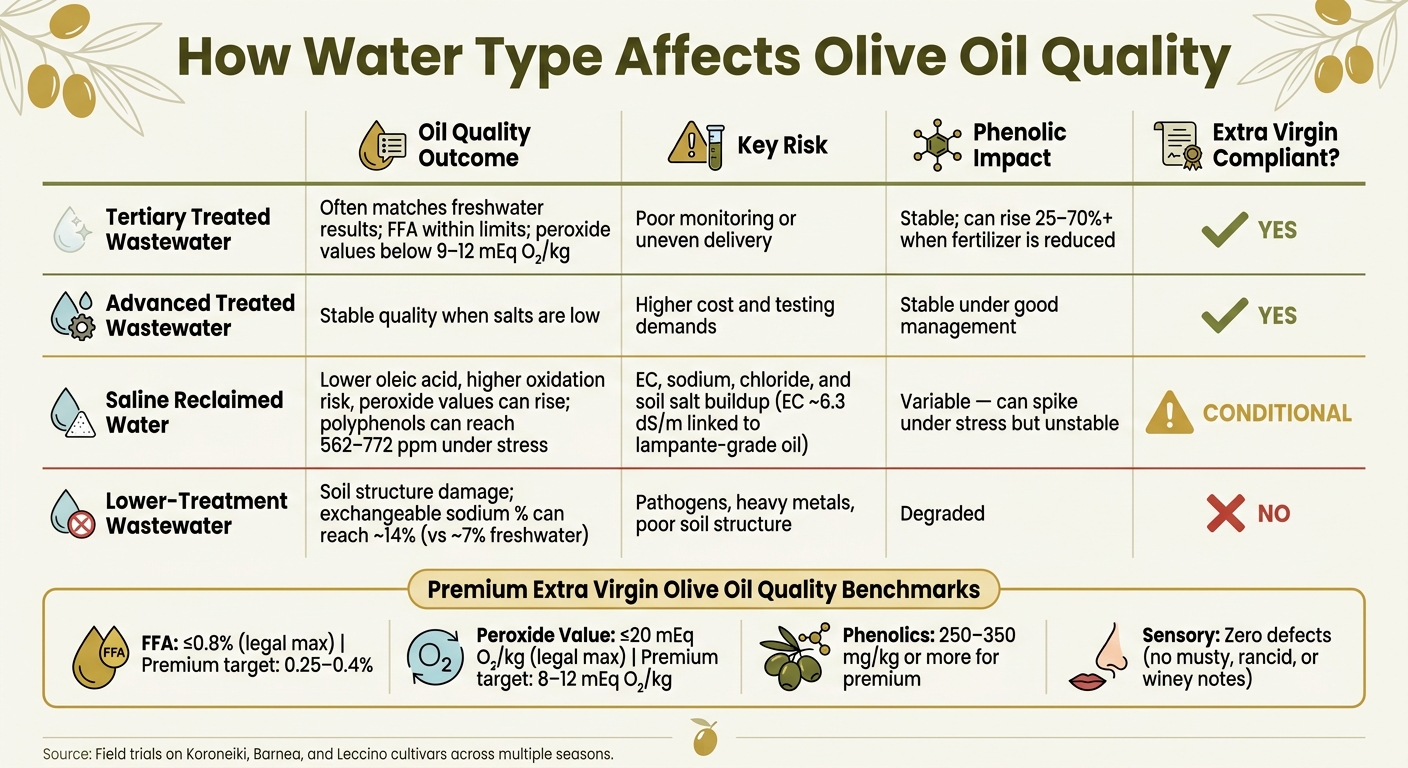
Treated Wastewater & Olive Oil Quality: What the Research Shows
Field trials now give a clearer picture of what happens to olive oil chemistry under different irrigation setups. And the pattern is pretty clear: tertiary treated wastewater usually keeps oil quality steady, while saline reclaimed water is harder to control. The main checks here are the same ones used to judge premium olive oil - acidity, peroxide value, and phenolic content.
Results from Well-Managed Tertiary Treated Wastewater
Across several long-term trials, tertiary treated municipal wastewater performed much like freshwater. Studies on the Koroneiki cultivar found no significant impact on free acidity, peroxide value, or UV absorption indices (K232, K270) when trees were irrigated with tertiary treated wastewater. Oils stayed within extra virgin limits over multiple seasons.
Work on Barnea and Leccino cultivars irrigated with reclaimed wastewater over multiple seasons found peroxide values below 9 mEq O₂/kg for Barnea and below 5 mEq O₂/kg for Leccino - both well under the 20 mEq O₂/kg extra virgin ceiling.
There was another interesting result. When growers cut fertilizer inputs while using reclaimed water, total phenolic content rose by more than 70% in Barnea and about 25% in Leccino compared with standard fertilization. So in some trials, reclaimed water paired with lower fertilizer use led to higher phenolics.
Results from Saline Reclaimed Water and Deficit Irrigation
Saline reclaimed water paints a different picture. Study after study shows it can lower oleic acid, increase the ratio of fatty acids tied to faster oxidation (C18:2/C18:3), and drive peroxide values upward - signals of an oil that may oxidize sooner.
At the same time, salt stress can push the tree into defense mode, which can increase phenolic production. In one field study using saline reclaimed water with regulated deficit irrigation, total polyphenols climbed to roughly 562–772 ppm. Even so, all samples still met extra virgin limits for acidity and peroxide value.
Put simply, tertiary treated wastewater is the more predictable option for growers aiming for steady extra virgin quality. Saline reclaimed water can still produce oils with strong antioxidant traits, but the margin for error is smaller. It needs tighter control - the right cultivar, a salinity cap, and well-timed deficit irrigation - to avoid moving key quality markers in the wrong direction. That pattern helps show which management choices keep oil quality on track.
Solutions: How Growers Protect Oil Quality When Using Treated Wastewater
Treated wastewater can help preserve oil quality, but it takes tight control from the water source all the way to storage. The big idea is simple: when growers use well-managed tertiary water, oil quality can hold up well. When salinity stress creeps in, quality can slip. So the main pressure points are water treatment, salinity control, and careful harvest handling.
Choosing the Right Treatment Level, Testing, and Irrigation Method
The minimum bar should be tertiary treatment with disinfection. In plain terms, that means filtration plus disinfection to bring pathogen levels down to safe reuse levels before the water enters the orchard.
For routine checks, test irrigation water at least once per season. If the source changes or conditions shift, test more often. Focus on:
- coliforms
- E. coli
- EC
- SAR
- chloride
- trace metals
- nutrients
Keep those results in farm logs so trends don’t slip by unnoticed.
On the irrigation side, drip irrigation makes the most sense for premium blocks. Drip lines placed under the canopy keep water in the root zone instead of on the fruit surface, which cuts pathogen contact. It also helps to install sand and screen filters before the emitters. Without them, biofilm can build up, water spread can turn uneven, and some spots in the orchard can end up with worse salt and nutrient issues than others.
Managing Salinity, Nutrients, and Soil Health Over Time
Once treatment and delivery are in place, salinity becomes the main long-term risk. Some treated-wastewater studies found that EC values around 6.3 dS/m were tied to poorer oil quality and lampante-grade oil, along with high free acidity and very low polyphenols.
That’s why growers need to track EC, SAR, chloride, and sodium in both water and soil. Soil testing every two to three years helps show whether salts are building up over time. If numbers start pushing toward crop tolerance limits, leaching irrigations with lower-salinity water can move those salts below the root zone.
Reclaimed municipal wastewater can also bring in meaningful amounts of nitrogen, potassium, and micronutrients. That sounds helpful, and it can be, but only if the fertilizer plan accounts for it. If not, over-fertilization becomes a real problem. Too much added nutrition can push excess vegetative growth, slow ripening, and shift phenolic content.
A better approach is to run a full nutrient analysis of the irrigation water, estimate the nutrient load per acre from seasonal water volumes, and then cut synthetic fertilizer inputs to match. Leaf tissue tests can help fine-tune those adjustments during the season.
Protecting Flavor and Freshness After Harvest
Good orchard management gets fruit to the mill in better shape, but post-harvest handling still has a huge effect on what ends up in the bottle. Fruit under saline or oxidative stress can show higher hydroperoxide levels and shifted fatty acid ratios, so milling discipline matters even more in these cases.
Processing fruit within 24 hours of harvest helps limit the enzymatic activity that pushes free acidity and peroxide value higher. That short window can make a big difference.
Inside the mill, keep malaxation at or below 82°F (28°C) and limit oxygen exposure as much as possible. Closed mixers and inert gas blanketing, when available, help protect phenolics and keep the oil tasting fresh. After extraction, store the oil in stainless steel tanks under nitrogen at 57–64°F (14–18°C) through bottling to slow oxidation.
Conclusion: Using Treated Wastewater Without Lowering Oil Quality
Treated wastewater isn't the issue. Poor management is.
When the water is treated well, and salinity and orchard practices stay in check, producers can still maintain extra virgin quality. In plain terms, the outcome depends less on the water source itself and more on the treatment level, salt control, and how the fruit is handled at harvest.
The main risk is salt buildup. That can reduce oil stability and drag quality down. At the same time, some trials found an upside under careful fertigation: total phenolic content rose by more than 70% in Barnea olives irrigated with reclaimed water and lower fertilizer inputs.
The season-long test is straightforward:
- Keep water quality within target limits
- Keep soil salinity stable
- Protect fruit quality from the orchard to the mill
Treatment quality, salinity control, irrigation method, and post-harvest speed all shape the result. Get those right, and treated wastewater can support olive oil quality instead of weakening it.
FAQs
Can treated wastewater still produce extra virgin olive oil?
Yes. With close oversight and proper treatment, treated wastewater can be used to produce high-quality extra virgin olive oil.
Research suggests that oils from groves irrigated with properly treated wastewater may show better quality markers, including lower acidity, lower peroxide levels, higher oxidative stability, and higher fat content.
What water quality tests matter most for olive growers?
Olive growers using treated wastewater need to keep a close eye on water quality. That’s how you protect both tree health and oil quality over time.
The main tests to track are pH, COD, BOD₅, conductivity, phosphate, ammonium, nitrite, and heavy metals.
Microbiological safety matters too, especially Salmonella and E. coli. On top of that, regular soil testing helps growers watch for salinity, sodicity, nutrient levels, heavy metals, and possible microbial contamination.
That kind of routine checking supports the long-term health of the grove.
How does salt in reclaimed water affect oil flavor and shelf life?
Salt in reclaimed water needs close management to protect olive oil quality. If growers don’t keep an eye on it, salt can build up in the soil and interfere with healthy tree growth.
To lower that risk, producers often blend treated wastewater with surface water or fresh water. They may also apply extra irrigation to push salts below the root zone.
When salinity is kept under control, olive trees can still produce high-quality oil. In some cases, that oil shows improved acidity, higher polyphenols, and better oxidative stability, which helps support flavor and shelf life.