

European Union Standards for TSG Certification
TSG is about method, not place. If you want the short answer: under EU law, a product can get TSG status only if it has a set character, follows a set recipe or production method, and shows at least 30 years of use on the market.
Here’s what I’d keep in mind right away:
- TSG does not require a geographic link
- PDO and PGI do
- A TSG file must include a product specification
- That specification must be clear enough for inspection and enforcement
- EU review can take up to 12 months at the Commission stage
- Registered names are now handled through eAmbrosia
- Since January 1, 2025, EU rules under Regulation (EU) 2024/1143 also cover some website and domain-name misuse
If I were checking a TSG claim for olive oil or aged balsamic vinegar, I’d focus on three things: the registered name, the exact production rules, and whether the seller’s label and web copy match the official record. That matters because TSG protects a long-used product method, while olive oil and balsamic products often rely more on PDO or PGI when place is the main selling point.
| Scheme | What it protects | Geographic link | Main proof |
|---|---|---|---|
| PDO | Product tied to a named area | Yes, strong | All production stages linked to that area |
| PGI | Product tied in part to a named area | Yes, partial | At least one stage linked to that area |
| TSG | Product name tied to a long-used method or recipe | No | Specific character + 30 years of market use |
So in plain English: if a food name is protected as TSG, I’d read it as a claim about how the product is made, not where it comes from.
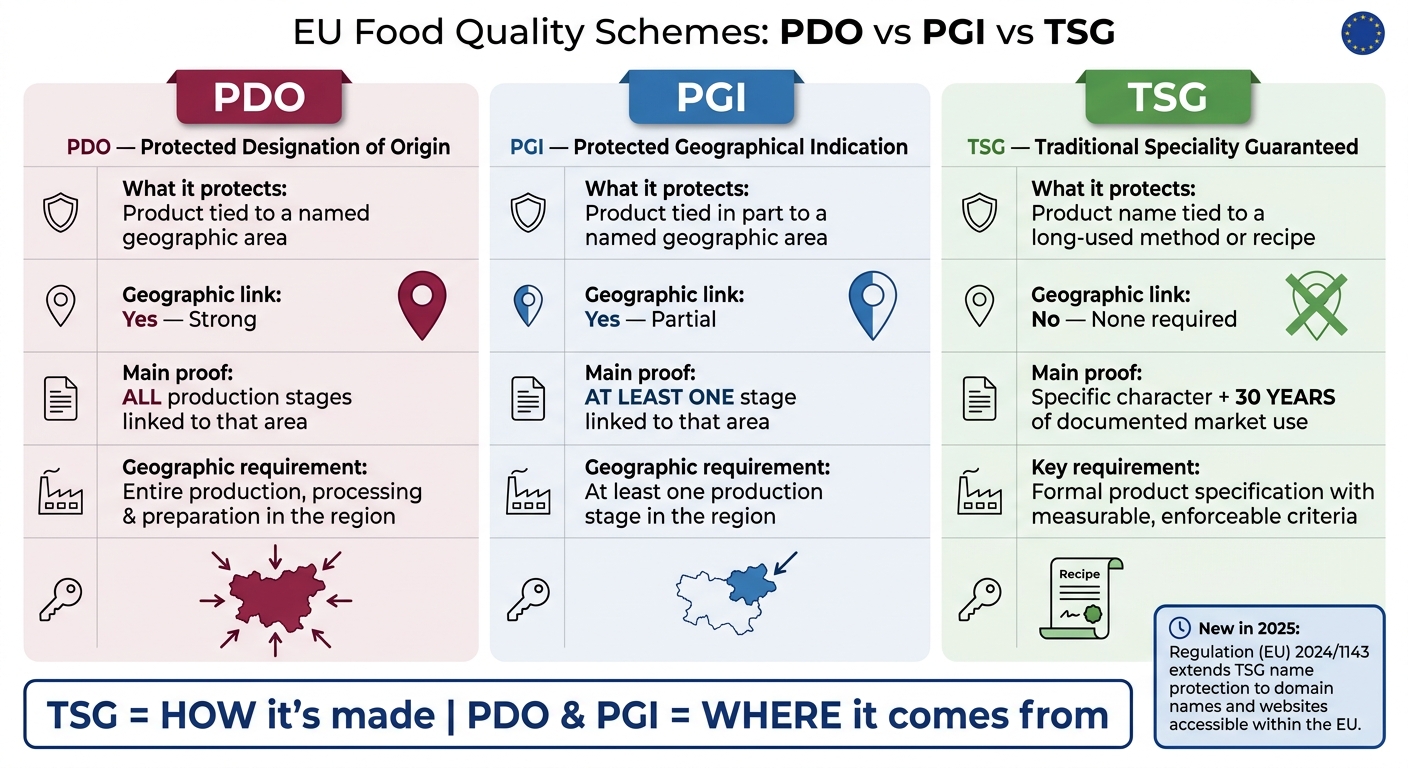
EU Food Quality Schemes: PDO vs PGI vs TSG Explained
Core Standards for TSG Certification
Specific Character and the 30-Year Tradition Rule
TSG registration rests on two main proofs: specific character and at least 30 years of documented market use.
Specific character means the traits that set a product apart from other products in the same category. In plain English, the product needs something that makes it stand out. That may include physical, chemical, microbiological, or organoleptic traits.
The tradition rule matters just as much. Under Regulation (EU) 2024/1143, a product must show a documented history of at least 30 years of market use, backed by historical records. So this isn't just a story producers tell. They need evidence, such as old documents, recipes, or sales records, to back it up.
Required Elements of a TSG Product Specification
Every TSG application must include a formal product specification. This document is the legal backbone of the certification. It spells out what the product is, how it's made, and how compliance is checked. If the specification is vague, inspection becomes guesswork.
| Required Element | What It Must Cover |
|---|---|
| Registered name | The exact name to be protected |
| Product Description | Physical, chemical, microbiological, and organoleptic properties |
| Production Method | Raw materials, ingredients, and specific manufacturing steps |
| Specific Character | The defining traits that distinguish the product from similar items |
| Proof of traditional character | Evidence supporting the 30-year history of use |
| Control procedures | How compliance is checked |
Specifications must be measurable and enforceable.
Legal Protection a Registered TSG Name Provides
A registered TSG name comes with legal protection. If the name is reserved, only products that meet the specification may use it. If the name is not reserved, others may still use the name, but only compliant products may display the TSG term, abbreviation, and EU symbol.
Either way, Member States must protect registered names against misuse, imitation, and misleading practices.
These standards feed straight into the EU application, review, and control process.
sbb-itb-4066b8e
How the EU Certification and Control Process Works
Application, Review, and Opposition Stages
Once the specification is set, the EU review and control process starts. Registering a TSG takes several steps and moves from the producer group to the European Commission.
The process begins with a producer group submitting a full application that includes the product specification. In rare cases, a sole producer can apply too.
For groups in the EU, the application goes first to the relevant national authority. That authority reviews the file and opens a national objection window of at least one month. This gives local parties time to flag concerns before the application moves on.
After that, the Commission has up to 12 months to check whether the application meets the rules. If it clears that review, the specification is published in the Official Journal. That opens an EU opposition period. If any valid objections are settled, the Commission adopts an implementing regulation and adds the name to the eAmbrosia register.
Control Bodies, Audits, and Specification Amendments
After registration, the focus shifts from approval to day-to-day compliance. Producers must work with designated control bodies to verify that they still meet the specification, and the operators cover those costs.
Member States also carry out official controls. For olive oil, these checks are risk-based and include at least one annual conformity check for every 1,000 tonnes marketed. Mills and bottlers must also keep entry and withdrawal logs for each product category.
If a producer does not meet the rules, they cannot use the TSG name, abbreviation, or symbol. And if the specification can no longer be met in practice, the Commission can start a formal cancellation procedure.
Changes to the specification follow two tracks. Major amendments go through the full process again, while minor amendments use a simpler Commission procedure.
What TSG Standards Mean for Olive Oil and Vinegar
Production Features That Matter in a TSG Specification
Once a TSG name gets approved, the specification becomes the product’s rulebook. It sets the standard for both product details and labeling. For olive oil or vinegar, that specification must spell out the recipe, raw materials, and measurable quality traits.
For olive oil, that means clear chemical and sensory limits that inspectors can check. Those measurable limits are a big part of why the label carries weight.
For vinegar, the specification must define the method, raw materials, and sensory profile. That’s where TSG makes sense for products whose identity comes from how they’re made, not where they come from.
Labeling and Consumer Trust in Premium Categories
EU certification standards do more than regulate production. They also shape what shoppers can trust when they read a label. For U.S. buyers shopping online for premium olive oil or balsamic vinegar, the label is often the only direct clue about how the product was made.
EU olive oil rules are meant to prevent misdescription and adulteration. Under those rules, extra virgin olive oil labels must include the legal name and category description. They also need storage instructions stating that the oil must be kept away from light and heat.
TSG adds another layer: name protection. If a name is registered with reservation, only producers that follow the full specification can use it. So a TSG label points to a verified production process, not just marketing copy.
How Big Horn Olive Oil Fits This Regulatory Conversation
These rules are easier to explain when a brand already speaks plainly about production. Big Horn Olive Oil is a good example. Its EVOOs note quick pressing after harvest, and its balsamic vinegars state aging periods.
Recent Updates and Key Takeaways
What Regulation (EU) 2024/1143 Changes
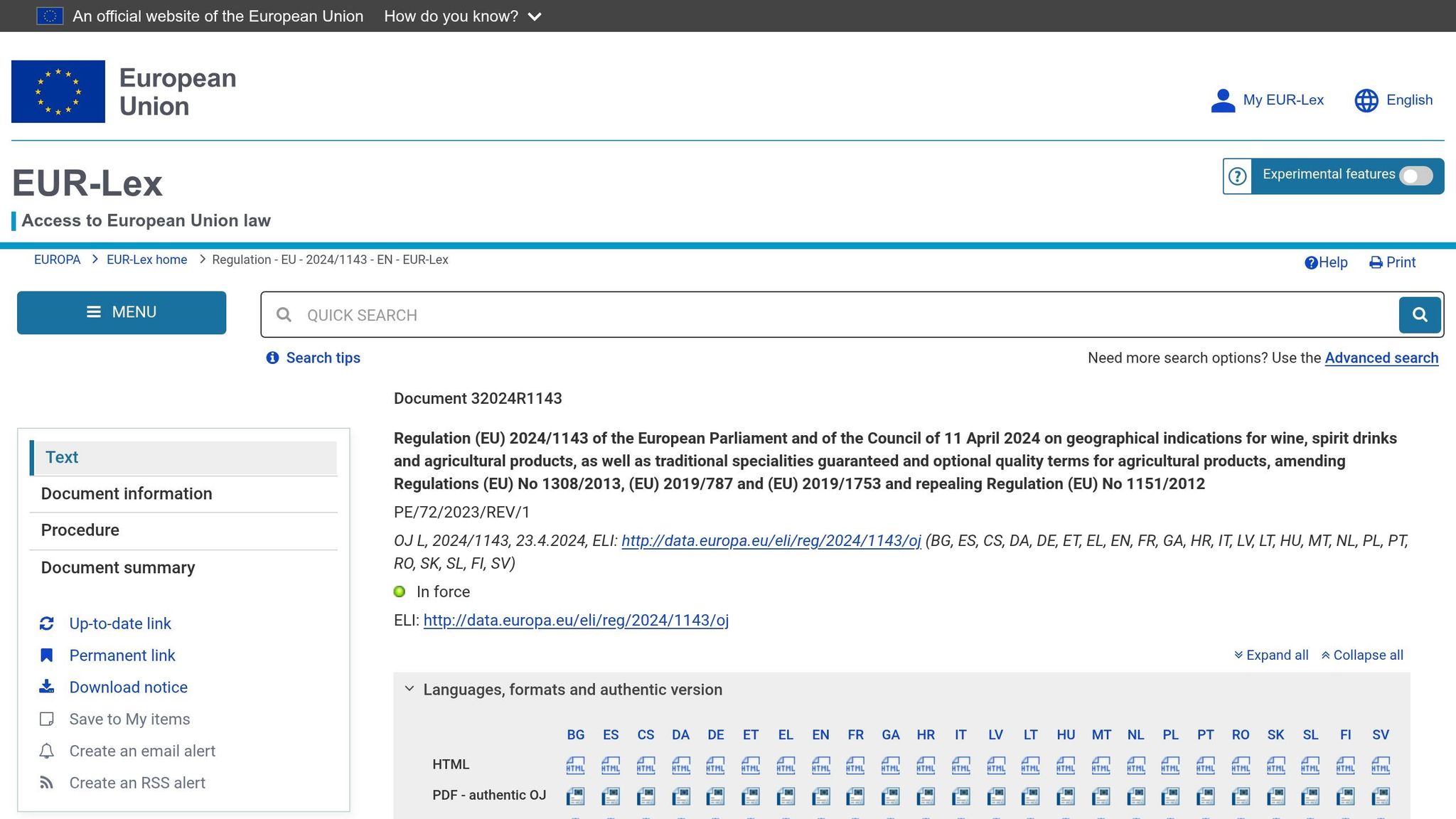
As of January 1, 2025, Regulation (EU) 2024/1143 governs TSG applications, amendments, and cancellations through eAmbrosia. In plain English, the big shift after registration is mostly administrative: filings, updates, and protection-related steps now run through eAmbrosia, and applications must be submitted there electronically.
The regulation also extends protection for registered names to domain names and to information published on websites that can be accessed within the EU. That matters because protection no longer stops at packaging or printed marketing. It also reaches digital use.
There’s also a clearer split for amendments. Non-essential changes can now go through a standard amendment path, with approval handled by Member States. Union amendments, by contrast, still stay under Commission review.
Main Points for Readers and Specialty Food Businesses
TSG protects how a product is made, not the place it comes from. That distinction matters a lot. A name under TSG is about method, recipe, or production rules, not geographic origin.
For U.S. shoppers and specialty food brands, eAmbrosia is the place to verify whether a name is registered and to check the current product specification. If you want the official file, that’s where you look.
For premium olive oil and vinegar sellers, the practical issue is simple: public claims need to line up with the registered record. For Big Horn Olive Oil, that means labels, product pages, and marketing claims should match the registered specification exactly.
Food Quality Checks : DOC, DOCG, DOP, IGP, IGT, STG, TSG, PAT, BIO | 2K video | Ciao Sara
FAQs
How is TSG different from PDO and PGI?
TSG is different from PDO and PGI because it isn't linked to one specific place. With PDO and PGI, a product has to come from a defined geographic area.
TSG focuses on old recipe standards or time-tested production methods instead. So a TSG-certified product can be made anywhere, as long as it follows the required traditional criteria.
What proof is needed for TSG certification?
To obtain TSG certification, a group of producers or processors needs to file a formal application. That application must include a detailed product specification, along with documents that show the product’s specific nature and its traditional character.
In plain terms, the file needs to cover the product from every angle: its physical, chemical, microbiological, and organoleptic properties, plus its production methods, ingredients, and proof that it has been used in the domestic market for at least 30 years.
How can I verify a registered TSG name?
You can verify a registered Traditional Specialty Guaranteed (TSG) name in eAmbrosia, the European Commission’s official database for names that have been applied for or are protected.
It shows whether a name is registered and what stage it’s in. But if you want the full product specifications, you won’t find them in the database itself. Those are published by the relevant Member States.