

Vinegar in Ancient Diplomatic Gifts
The short answer: ancient records do not show vinegar as a common formal diplomatic gift. What they do show is something narrower: vinegar moved through state supply systems, labor payments, and daily food use.
If you want the main point fast, here it is:
- At Arad, around 600 BCE, vinegar appears in a military supply order
- The line “if there is white balsamic vinegar, give it to them” links vinegar to official distribution
- That is not the same as a royal gift list
- Biblical and Egyptian sources show vinegar in daily use and payment, not high-status exchange
- So the best-supported claim is simple: vinegar was a tracked, useful good, mostly tied to rations and control
In other words: vinegar mattered because authorities could hand it out, not because it was a luxury item. That difference is the whole story.
A few facts stand out right away:
- The Arad ostraca include more than 100 inscribed pottery sherds
- They date to about 600 BCE
- One study says soured wine at Arad may have been given to mercenaries as a kind of gift within a ration system
- Egyptian evidence goes back to about 3000 BCE
- Ruth 2:14 shows vinegar served with bread to field workers
Quick comparison
| Source | What it shows | What it does not prove |
|---|---|---|
| Arad ostraca | Official supply of vinegar to mercenaries | A formal diplomatic gift between states |
| Egyptian evidence | Vinegar known, used, and paid out in measured amounts | A common elite exchange item |
| Biblical evidence | Vinegar used in everyday meals | Court diplomacy or prestige gifting |
My takeaway: the evidence supports a small, careful claim. Vinegar was part of ancient systems of payment and provisioning. It may sometimes have worked like a favor inside those systems. But the article does not support saying vinegar was a standard diplomatic gift across the ancient world.
That’s the lens I’d use for the rest of the piece: less ceremony, more supply control.
sbb-itb-4066b8e
Documented evidence: where vinegar appears in ancient records
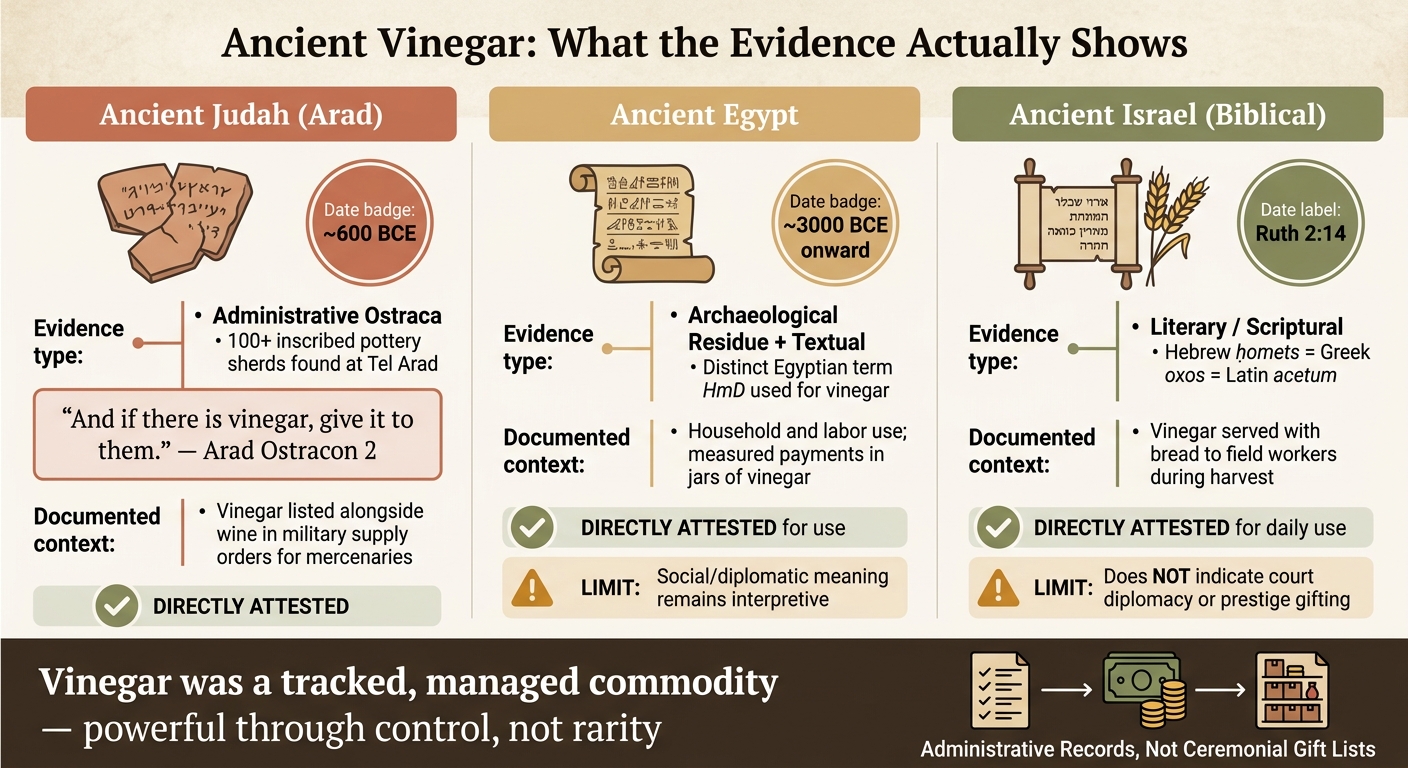
Ancient Vinegar in History: Supply System vs. Diplomatic Gift
The Arad ostraca and official distribution of vinegar
The surviving records don’t show ceremonial gift lists. But they do show vinegar moving through official supply channels. At Tel Arad, one ostracon places vinegar inside a state supply order for mercenaries.
The text first orders that "a full homer of wine" be delivered, then adds:
"And if there is vinegar, give it to them."
That short line matters. It puts vinegar directly inside state provisioning. One study reads Arad Ostracon 2 as evidence that soured wine was intentionally given to mercenaries as a gift within the ration system. That is the strongest scholarly case for treating the entry as more than plain rationing. In that reading, it reflects a structured, status-linked act of giving inside a military chain of command.
Arad gives us the clearest administrative example. The rest of the evidence is less direct, but it still shows that vinegar had recognized use and worth.
Egyptian and biblical references to vinegar in rations and daily use
Egyptian residues from around 3000 BCE, along with the term HmD, show that vinegar was known as its own substance, not merely spoiled wine.
In Ruth 2:14, Boaz offers Ruth bread dipped in vinegar, which shows vinegar as a familiar food for field workers. The Hebrew word is ḥomets, matched by the Greek oxos and the Latin acetum. In plain terms, these were everyday items, not luxury products. That’s exactly why their appearance in managed supply systems stands out.
Comparison table of ancient vinegar evidence
| Civilization | Documented Context | Type of Evidence | Historical Significance |
|---|---|---|---|
| Ancient Judah (Arad) | Military provisioning; vinegar listed alongside wine in supply orders for mercenaries | Administrative ostraca (early 6th century BCE) | Directly attested; a scholarly study interprets the vinegar as a gift within the ration system. |
| Ancient Egypt | Household and labor use; vinegar residues and a distinct term for vinegar in texts | Archaeological residue + textual evidence (around 3000 BCE onward) | Directly attested for use; social meaning remains interpretive. |
| Ancient Israel (Biblical) | Harvest rations; vinegar served to field workers as food accompaniment | Literary/scriptural evidence (Ruth 2:14) | Directly attested for daily use; social meaning remains interpretive. |
Taken together, these sources show vinegar moving through systems of supply before it took on broader symbolic meaning.
Why vinegar was worth exchanging in the ancient world
Preservation, portability, and daily usefulness
Vinegar had value because it was dependable, not glamorous. Soured wine kept well in ceramic vessels or skin containers during long trips across the Near East and Mediterranean. That made it a practical item to move through official exchange networks.
When mixed with water, vinegar became a safer drink for soldiers on campaign. The Roman version, posca, was standard military fare. Its acidity also helped preserve food during storage and transport. For frontier officials, vinegar was a useful ration rather than a leftover or spoiled product.
How practical value became symbolic value
That everyday usefulness also gave vinegar a second kind of value. In a military ration system, handing out vinegar showed that authority could supply even modest goods. The point was not luxury. The point was controlled distribution.
And because vinegar was so ordinary, elite use of it could send a message. It could suggest restraint, solidarity, or a willingness to share hardship with others. That blend of utility and status made vinegar fit naturally into gift, tribute, and ration systems alike.
What vinegar reveals about diplomacy, hierarchy, and exchange systems
Gift, tribute, and ration: three different categories
Vinegar was common. It was useful. And that’s exactly why its distribution mattered.
Its political meaning did not come from luxury. It came from control. The same product could mean very different things depending on three basic facts: who gave it, who got it, and what the transfer was for. That distinction becomes especially important when the same goods move through military and state systems.
At Fort Arad, vinegar was issued in standardized units to named recipients, which points to administrative control, not ceremonial exchange. There may still have been room inside that system for discretionary distribution to mercenaries. But those are not the same thing. If we blur that line, it becomes too easy to turn a ration system into a story about ancient generosity, when the record fits bureaucratic control much better.
How everyday goods carried political meaning
The same basic pattern shows up in other records, even if the proof for formal exchange is less direct.
When a commander decided who received extra vinegar, better wine, or a higher-grade ration, that choice could shape loyalty among soldiers and foreign mercenaries. It was political leverage on a small scale. Not grand ceremony, not royal theater - just repeated acts of controlled distribution that kept people cooperative and, in many cases, dependent.
Egyptian records also show vinegar used in measured labor payments. That matters because these were not isolated gestures. They were repeated flows of practical goods that linked households, workers, and officials over time.
So the main point is simple: vinegar was not powerful because it was rare. It was powerful because ordinary goods in the right hands could carry authority. That helps explain why many ancient relationships ran not only through formal exchanges between kings, but also through steady, practical movement of goods like vinegar, oil, and grain. Their meaning came from control and dependence, not rarity.
Research limits and conclusion: what the evidence actually supports
Limits of the surviving evidence
Taken together, the evidence supports a narrow claim. The record is fragmentary and uneven. Vinegar shows up mostly in administrative material - ration lists, payment records, and provisioning logs - not in ceremonial gift accounts.
The Arad ostraca show vinegar being distributed inside a tightly managed military supply system around 600 BCE. An Egyptian text records payment in jars of vinegar. Those are documented cases. But they are still isolated examples, not proof of a universal pattern across ancient civilizations.
When we look at prestige diplomatic gifts, the picture is different. Those gifts were more often oils, textiles, spices, or metals. Basic vinegar does not show up in that category in any strong cross-regional way. So saying vinegar was a common diplomatic gift across the ancient world goes beyond what the record can support.
What the evidence does support is more limited, but still useful. Vinegar was a recognized and managed commodity. It moved through official systems, could serve as payment, and in some settings worked as a quasi-gift. That distinction matters.
Key takeaways
The historical pattern is pretty clear: vinegar was practical, tracked in official exchange, and usually tied to provisioning rather than formal diplomacy.
That functional value has not disappeared. Today, Traditional Balsamic Vinegar of Modena received PDO status on April 17, 2000, and Balsamic Vinegar of Modena received PGI status in 2009.
FAQs
Was vinegar ever a diplomatic gift?
Yes. Vinegar - especially aged balsamic vinegar - was once treated as a high-status diplomatic gift in European courts.
A clear example comes from 1792, when Duke Ercole III of Este presented a bottle of aged balsamic vinegar to Francis I of Austria during his coronation.
Why did ancient states track vinegar?
Ancient states kept close tabs on vinegar because people relied on it for both health and everyday use. Greek and Roman records show that it was used as a remedy for wounds and respiratory issues, and also as a disinfecting and sanitizing agent.
That made vinegar more than a pantry item. It had a direct link to health, hygiene, and survival, so leaders treated it as a strategic resource worth monitoring and managing.
How is a ration different from a gift?
In ancient societies, a ration was about plain day-to-day need. Roman soldiers, for example, were given vinegar-based posca to stay hydrated, curb hunger, and make drinking water safer while on duty.
A gift meant something different. It showed status, loyalty, or diplomacy. Items like aged balsamic vinegar for nobility or olive oil for deities and winning athletes signaled honor, polish, and favor.