

5 Seasonal Factors Influencing Vinegar Fermentation
Seasons change vinegar fermentation more than most people think. If I had to sum it up in one line, I’d say this: harvest ripeness, temperature, humidity, local climate, and microbial activity decide how fast vinegar forms, how much liquid evaporates, and how the final taste develops.
Here’s the short version:
- Harvest timing sets the starting sugar and acid balance.
- Temperature speeds up or slows down acetic acid bacteria.
- Humidity affects evaporation and concentration.
- Regional climate shapes how strong those seasonal swings are.
- Spring and fall often support the steadiest microbial work.
A few numbers stand out:
- Acetic oxidation in balsamic-style production can take about 1 year.
- Producers may withdraw only 25% to 30% from the smallest barrel at one time.
- A steady aging temperature near 55°F (13°C) can help slow excess acid buildup.
If you want the plain answer: summer tends to concentrate vinegar, winter helps it settle, and the milder parts of the year keep fermentation moving. That cycle is a big part of why barrel-aged balsamic-style vinegar gains depth over time.
Quick Comparison
| Factor | What changes with the season | Main effect on vinegar |
|---|---|---|
| Harvest ripeness | Sugar and acid at picking | Sets the starting point for fermentation |
| Temperature | Warm vs. cold periods | Changes fermentation pace |
| Humidity | Dry air vs. damp air | Changes evaporation and concentration |
| Local climate | Strong or mild seasonal shifts | Affects consistency and barrel behavior |
| Microbial activity | More active in mild weather | Shapes acid development and aroma |
So when I look at vinegar fermentation, I don’t see one single process. I see a year-long cycle where each season pushes the liquid in a different direction.
Making Apple Cider Vinegar: The Fermentation Process Explained
sbb-itb-4066b8e
Why Seasons Matter in Vinegar Making
How the 4 Seasons Shape Vinegar Fermentation
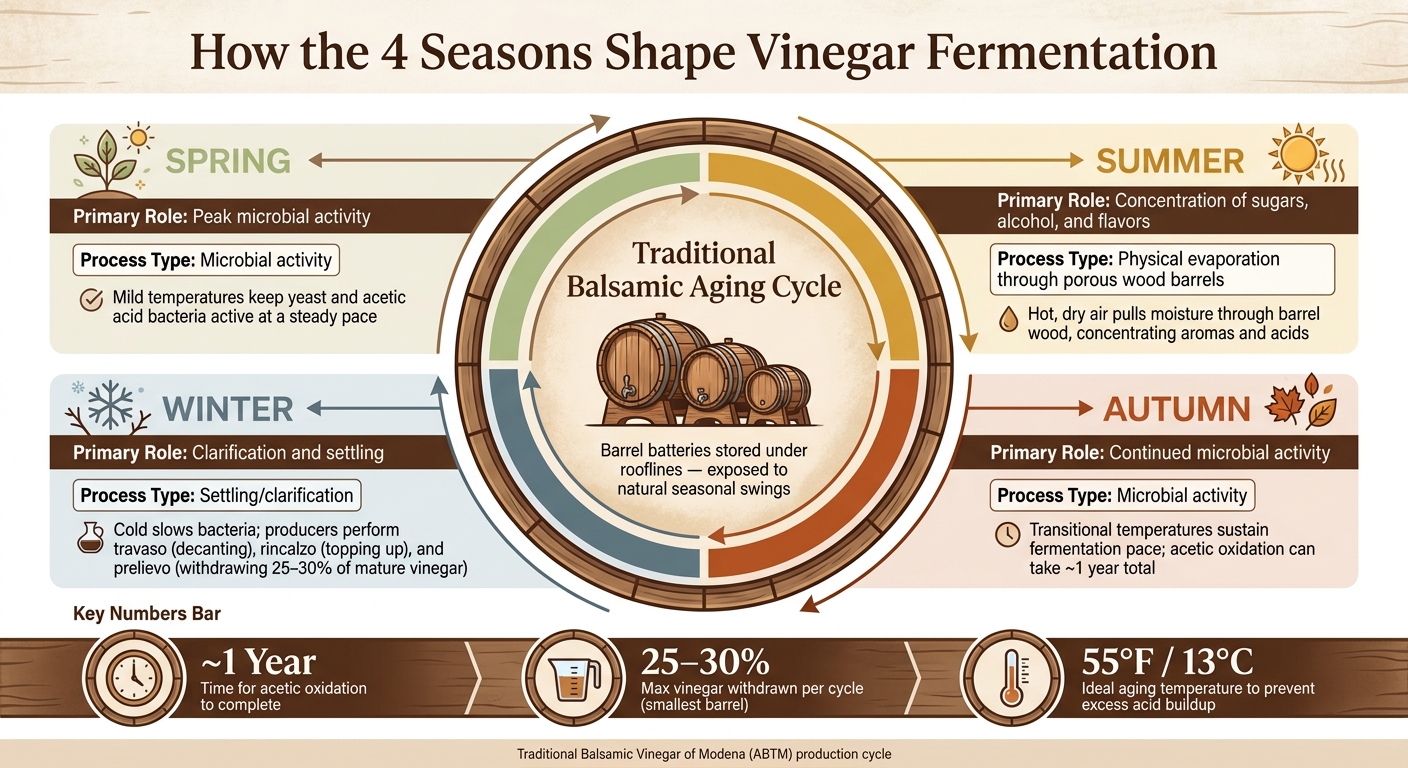
In traditional production, especially Traditional Balsamic Vinegar of Modena (ABTM), barrel sets sit under rooflines and follow natural temperature swings instead of controlled conditions. In this setup, those shifts in heat and cold aren't something producers try to smooth out. They're part of the job.
Each season helps move the vinegar through a different stage. Summer heat pushes evaporation through porous wood, which concentrates sugars, alcohol, and aromas. This concentration is essential for creating a premium white balsamic with balanced acidity. Winter cold gives the liquid time to settle and clear. Spring and autumn, with their milder temperatures, help yeast and acetic acid bacteria stay active. One phase leads into the next, shaping fermentation speed, texture, and flavor.
| Season | Primary Role | Type of Process |
|---|---|---|
| Spring | Peak microbial activity | Microbial activity |
| Summer | Concentration of sugars, alcohol, and flavors | Physical (Evaporation) |
| Autumn | Continued microbial activity | Microbial activity |
| Winter | Clarification and settling | Settling/clarification |
The result is a repeating cycle of activity, evaporation, and settling that adds more depth over time. The next section breaks that cycle into five specific factors.
1. Harvest Timing and Raw Material Ripeness
Fermentation starts at harvest. The moment fruit is picked sets the sugar-to-acid balance that shapes everything that happens next. Pick too early, and the fruit is higher in acid and lower in fermentable sugars. Pick too late, and overripe fruit can make fermentation harder to control. That first balance sets the rhythm for the whole process.
In traditional balsamic production, producers often choose grapes such as Trebbiano and Lambrusco because they produce a high-sugar must. That must is then cooked down to concentrate it even more, leaving a golden-brown base with a sweet, sugar-rich must. In plain terms, that gives fermentation a steadier place to begin.
The ripeness of the fruit also shows up in flavor. Peak-ripe fruit tends to bring fruitier, floral notes. Underripe material comes across greener and sharper. And if the material is too concentrated, it can turn harsh when fermentation isn’t managed well.
To keep things in check, producers monitor sugar levels during harvest and again during cooking so the must stays in the right range before fermentation begins. Once harvest sets that baseline, temperature takes over as the main factor that controls speed.
2. Seasonal Temperature Swings
Temperature is one of the main levers that controls how fast vinegar fermentation moves. The work is done by acetic acid bacteria (AAB), which convert alcohol into acetic acid.
Put simply, temperature sets the pace. Warmer conditions speed fermentation up, while cooler seasons slow it down and can stretch the process to months or even years.
Too much heat is a problem. It can harm or kill AAB, which stops acid production. If you're trying to support long-term aging or avoid too much acidity, keep the temperature steady at 55°F (13°C).
Temperature also affects flavor. Faster fermentation often leads to a sharper taste sooner.
| Temperature Condition | Effect on AAB | Fermentation Speed |
|---|---|---|
| Warm | Increased activity | Faster; can finish in a few weeks |
| Cool | Reduced activity | Slower; can take months or years |
| Excessively hot | Bacteria may be harmed or killed | Stalled or stopped |
Even when temperature is dialed in, shifts in humidity can still change how fermentation unfolds.
3. Humidity and Evaporation Levels
Temperature sets the pace. Humidity sets the concentration.
During warmer months, lower humidity and summer heat push more water out of the liquid through the wood. The result is a more concentrated vinegar, with higher levels of sugars, acids, and aromas. That shift matters even more during seasonal barrel aging.
With open-air barrel aging, vinegar sits right in the path of seasonal heat and dry air. That means evaporation increases as the weather turns hotter and less humid.
The type of wood also shapes how fast that happens:
- Chestnut is more porous, so it speeds up evaporation in the early stage.
- Oak and mulberry are denser, so they slow moisture loss in later barrels.
- In winter, when volume drops, producers top up each barrel with vinegar from the next larger one.
| Barrel Stage | Wood Type | Primary Role |
|---|---|---|
| Early stage | Chestnut (Porous) | Speed evaporation and fermentation |
| Middle stage | Cherry, Juniper | Develop aromas and flavors |
| Late stage | Oak, Mulberry (Dense) | Conserve mature product and limit moisture loss |
That pattern can change from one place to another. Regional weather, and even small local climate shifts, affect how much liquid evaporates and how the vinegar develops over time.
4. Regional Climate and Microclimate Conditions
Place shapes fermentation as much as process.
Temperature and humidity matter, but regional climate can push seasonal change harder or keep it gentler. That shift changes both the pace of fermentation and how concentrated things become. In inland areas like Modena, Italy, the seasons tend to hit with more force. Summer heat, mild spring and fall weather, and winter cold each drive fermentation through a more defined phase than you’d usually get in coastal or more temperate places.
Then there’s the smaller, more local layer: microclimate. This is where details like airflow and heat exposure start to matter. Acetic acid bacteria need oxygen, so spaces with good ventilation can move acetification along faster. On the flip side, trapped heat can slow the process or put stress on the culture. In plain terms, the room itself can nudge the microbial stage forward or hold it back.
That’s why producers using traditional methods often keep barrel batteries under rooflines, where they stay exposed to those seasonal swings. For Traditional Balsamic Vinegar of Modena, place doesn’t just sit in the background. It directly shapes how fermentation behaves.
These local differences affect how fermentation shifts from one season to the next.
5. Seasonal Microbial Activity and Fermentation Pace
Seasonal shifts also shape microbial activity, and that sets the pace of fermentation and the final flavor. Once harvest timing, temperature, humidity, and place have done their part, microbial activity becomes the last seasonal control point.
Spring and fall tend to be the busiest periods. Mild temperatures help yeasts and acetic acid bacteria keep working at a steady clip, turning sugars into alcohol and then alcohol into acetic acid. But that rhythm changes over the course of the year.
The pace can swing a lot from season to season. Warm conditions speed up acetification, while cooler weather can slow it down sharply. For Traditional Balsamic Vinegar of Modena, acetic oxidation usually takes about a year to finish.
That slow shift from one season to the next helps build the aldehydes, acids, and esters that give aged balsamic its bouquet. Producers keep an eye on titratable acidity, density, and °Bx as the liquid becomes more concentrated. If concentration gets too high, the vinegar becomes thicker and moves more slowly. That’s why they schedule travaso and rincalzo in winter, when a 5- to 7-barrel aging set is dormant.
The table below shows how each seasonal factor affects fermentation speed, concentration, and flavor.
How Each Seasonal Factor Changes Fermentation: A Side-by-Side Look
Each of the five seasonal factors changes fermentation a little differently. The table below gives you a quick, side-by-side view of what’s happening and what producers usually do in response.
| Seasonal Factor | Seasonal Change | Effect on Fermentation Rate | Likely Flavor Impact | Practical Producer Response |
|---|---|---|---|---|
| Harvest Ripeness | Peak late-summer harvest with high sugar content | More sugar available for the first fermentation stage | Richer, more complex fruit notes in the finished vinegar | Monitor initial sugar levels closely and dilute if concentration runs too high |
| Temperature | Warm summer heat vs. winter cold | Faster acetification in summer; conversion slows sharply in winter as bacteria become sluggish or dormant | Brighter acidity in warmer months; more subdued profile in cooler months | Use cellar insulation or move vessels to warmer areas to keep fermentation stable across seasons |
| Humidity & Evaporation | Hot, dry summer conditions | Dry heat increases evaporation and concentration | More intense aroma and concentrated sourness | Use breathable covers to balance oxygen flow and evaporation |
| Regional Climate | More extreme inland climates, such as Modena | Sharper seasonal swings drive more defined fermentation phases | Sharper profile from more volatile compounds | Adjust production schedules to match local microclimate conditions; keep barrel rooms exposed to seasonal shifts |
| Microbial Activity | Transitional seasons - spring and fall | Steady activity in mild temperatures; fluctuates as seasons shift | Uneven acidity from day to day | Monitor acidity and airflow to keep bacteria active |
In plain terms, fermentation doesn’t move at the same pace all year. Sugar levels, heat, moisture in the air, local weather patterns, and bacterial behavior all push the process in different directions.
This matters most for balsamic and wine vinegars, where timing plays a big part in concentration and complexity.
What These Factors Mean for Balsamic and Specialty Vinegars
These seasonal shifts show up most clearly in Traditional Balsamic Vinegar of Modena, where aging depends on the weather just as much as fermentation does. Summer thickens the cooked must. Winter helps clarify it. Spring and fall keep fermentation moving along. The barrels are arranged in a series of decreasing sizes and stored under rooflines, so the vinegar stays exposed to natural swings in temperature across the seasons.
That same rhythm shapes when producers work with the barrels. Winter is the main season for maintenance. This is when producers carry out prelievo (withdrawing mature vinegar), travasi (decanting into smaller barrels), and rincalzo (topping up with fresh cooked must). Even then, they usually remove only 25% to 30% from the smallest barrel at one time to protect quality. Those winter steps help keep the aging process in balance as one season gives way to the next.
The end result is a vinegar with depth built by years of seasonal change. Not by shortcuts. Not by controlled indoor conditions. By time, patience, and the same cycle repeating year after year.
Conclusion
Put it all together, and the seasonal shifts in vinegar fermentation start to make sense. Harvest timing, temperature changes, humidity, regional climate, and microbial activity shape how fermentation moves through the year, and each factor affects the others.
During warm months, concentration tends to move faster. In colder months, microbial activity slows down. Then, in milder seasons, that pace picks up again.
In traditional balsamic, age labels point to years of slow concentration and repeated seasonal change - not just time spent sitting in storage.
Seasonal conditions control the rhythm. That slow, repeating cycle is what gives traditional vinegar its character.
FAQs
Why are spring and fall better for fermentation?
In balsamic vinegar production, spring and fall bring the kind of mild weather that supports key microbiological activity.
Summer heat speeds up evaporation and acetic fermentation. Winter cold gives the vinegar time to rest, clear, and age. Then spring and fall step in with a middle ground: not too hot, not too cold.
That steady, temperate rhythm helps native acetic bacteria do their work and plays a big part in the layered flavor profile of Big Horn Olive Oil’s balsamic vinegars.
How does barrel wood affect seasonal aging?
In the batteria system, barrel wood changes with the seasons and helps shape the vinegar’s character. Larger barrels, often made from porous woods like chestnut, support early evaporation and acetification.
As the vinegar moves into smaller barrels made from harder woods like oak or mulberry, the goal shifts. At that stage, the barrels help hold onto flavor while letting it deepen over time. Each wood leaves its own mark: oak can add vanilla notes, cherry can bring a fruity sweetness, and chestnut can contribute tannins.
Can home vinegar makers manage seasonal changes?
Yes. Home vinegar makers can work with the seasons instead of fighting them by using spaces with natural temperature shifts, like an attic.
Summer warmth speeds up fermentation, acetification, and evaporation. That can concentrate sugars and deepen flavor.
Winter brings cooler temperatures, which give the vinegar time to rest. During that slower period, sediment can settle, which helps with clarity and a smoother finish. It’s also a good window for routine upkeep, like topping up or moving vinegar from one barrel to another.