

Water Deficit Stress and Olive Oil Quality
Less water can make olive oil taste better - but only up to a point. I’d sum it up like this: moderate water stress often leads to more phenolics, stronger bitterness and pepperiness, and longer shelf life, while severe stress can cut yield hard, make milling tougher, and hurt balance.
Here’s the short version:
- Yield can drop fast in drought. Spain’s 2022/23 olive harvest fell about 50% after the 2021–2022 drought.
- Moderate stress can improve oil style. Oils often end up more bitter, more pungent, and more stable because phenolic levels go up.
- Severe stress can hurt both crop and oil. Fruit gets smaller and drier, oil per acre falls, and harsh flavors become more likely.
- Timing matters. Stress during flowering and early fruit set tends to do more damage than stress later in the season.
- Milling gets harder with dry fruit. Fruit moisture below about 50% can make paste too dry and cut oil recovery.
- Good orchard and mill decisions matter. Growers watch tree water status, harvest earlier in dry years, and process olives within 24 hours to protect oil grade.
If you want the plain answer: water deficit stress is not automatically bad for extra virgin olive oil. In many cases, a controlled water cut - often around 30% less than full irrigation - can keep oil within extra virgin standards and improve flavor intensity. But when stress gets too strong or lasts too long, the trade-off shifts and losses pile up.
| Water status | Main effect on yield | Main effect on flavor | Main effect at the mill |
|---|---|---|---|
| Well-watered | Higher crop volume | Milder oil | Easier extraction |
| Moderate stress | Lower yield | More green notes, bitterness, and pepper | Needs mill setting changes |
| Severe stress | Much lower yield | Very strong, sometimes harsh | Dry paste, lower recovery |
I’ll keep the rest simple: this article explains how water stress changes the tree, the fruit, the milling process, and the oil in the bottle - and why the amount and timing of stress make all the difference.
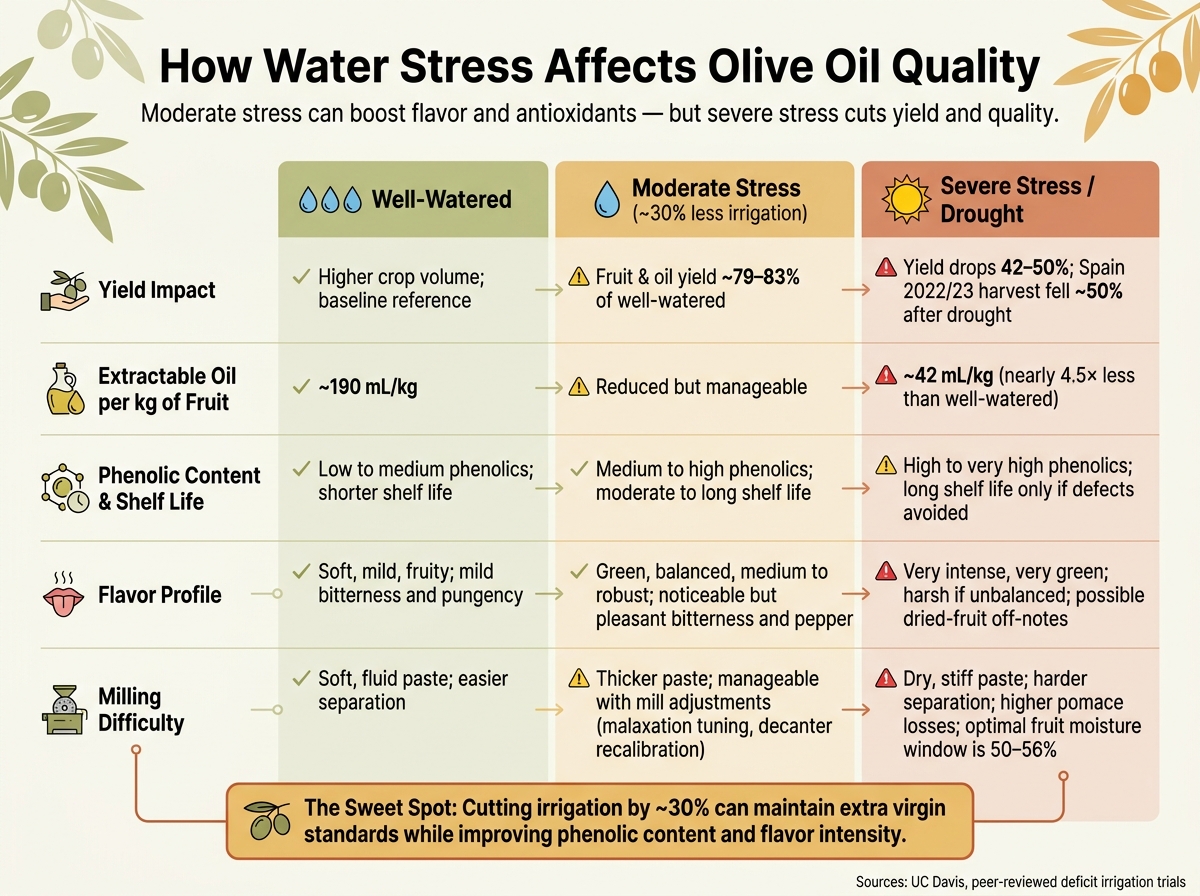
Water Stress & Olive Oil Quality: How Irrigation Levels Affect Yield, Flavor & Shelf Life
What Water Deficit Stress Means in Olive Orchards
Water deficit stress happens when the soil can't supply enough moisture to match what the tree needs. When that gap opens up, photosynthesis slows down and shoot growth loses pace. Drought is the weather pattern behind it: a long stretch of below-average rainfall paired with high evaporative demand that steadily pulls moisture out of the soil. Deficit irrigation is different. It's a planned orchard practice where growers apply less water than the tree would use at full demand, but do it at times meant to avoid the most sensitive growth stages. That gap in timing matters both in the orchard and later at the mill.
Olive trees handle dry conditions better than many fruit crops. Even so, moderate stress and severe stress do not lead to the same outcome. The level of stress can change both yield and oil quality.
How Climate and Timing Shape Stress in Olive Trees
Timing is especially important in hot, dry regions. In California and other similar U.S. olive-growing areas, long dry summers and low humidity can strip soil moisture fast, especially from flowering through fruit development. If stress hits early, fruit set and fruit size can both drop. If it shows up later, it usually reduces size more than fruit number and may increase phenolics. Over time, chronic drought slows canopy growth, reduces the number of flowering sites for the next season, and can lower total oil per acre by 20–50%.
What Happens Inside the Tree and Fruit Under Stress
When olive trees come under water stress, they close their stomata to hold onto water. That defense helps limit water loss, but it also reduces carbon dioxide intake. With less carbon dioxide available, photosynthesis drops, and the tree has fewer carbohydrates to put into fruit growth and oil formation. In one drought-stress experiment, severe water stress cut stomatal conductance by about 28% and reduced midday leaf water potential by roughly 42% compared with fully irrigated trees.
You can see the impact in the fruit itself. Stressed olives tend to be smaller and drier, and they often ripen unevenly across the canopy. Fruit exposed to more sun may ripen faster than fruit in shaded spots. As less water reaches the flesh, fruit moisture falls, and under severe stress, mild shriveling can start. Those shifts don't stop at harvest. They also affect milling performance and oil yield.
sbb-itb-4066b8e
How Water Deficit Affects Yield and Milling Performance
Water deficit cuts oil yield first, but it also changes how the fruit moves through the mill.
Why Less Water Often Means Less Oil Per Acre
When olive trees don't get enough water, production gets squeezed from both sides. Fruit gets smaller, and trees can drop fruit before harvest. That means less fruit reaches the mill and less extra virgin olive oil comes out the other end.
A three-year deficit-irrigation study found that fruit yield and oil yield from deficit-irrigated trees were 79% and 83% of well-irrigated trees, respectively. In a separate drought trial on young olive trees, olive fruit and pit weight fell by nearly 50% at harvest. Under severe drought, severely stressed trees produced only 42 ± 32 mL of oil per kg of fruit, compared with 190 ± 13 mL/kg in well-watered trees. That's close to a 4.5-fold difference in extractable oil. For growers, that kind of drop can hit revenue hard.
How Low-Moisture Olives Behave During Extraction
Lower fruit moisture changes the way olive paste acts in the mill. Smaller, drier fruit tends to make a thicker, stiffer paste during crushing and malaxation. And that matters. A dense paste is harder to separate cleanly, so extraction efficiency can fall if the mill runs the same settings it would use for fruit with more moisture.
UC Davis guidance for California mills points to fruit moisture in the 50% to 56% range as the best window for processing. Below 50%, the paste gets too dry for clean separation. Above 56%, emulsions form more easily and oil separation gets tougher.
For 'Arbequina', the picture gets even more specific. An industrial study covering 897 samples found that fruit moisture below 52% was tied to better oil recovery, while moisture above 54% lowered extraction efficiency and increased pomace oil losses.
So what happens when drought pushes moisture too low? Mills usually have to adjust the process on the fly, such as:
- changing crusher screen size or hammer speed
- tuning malaxation time
- recalibrating decanter settings
Those changes can help the line keep moving and cut oil losses.
That shift in moisture affects both oil recovery and the mill settings needed to get there.
Well-Watered vs. Moderately Stressed vs. Severely Stressed Fruit: A Comparison
The table below shows how orchard water status often carries straight through to milling.
| Condition | Paste Consistency | Extraction Ease | Expected Oil Yield |
|---|---|---|---|
| Well-watered | Soft, fluid | Easier separation | Higher volume per acre |
| Moderately stressed | Thicker, still workable; needs tuned malaxation and decanter settings | Manageable with adjustments | Lower than well-watered |
| Severely stressed | Dry, stiff; more variable maturity across the canopy | Harder separation; higher pomace losses | Significantly reduced |
Severely stressed fruit is the hardest to process. The paste is denser, maturity can vary more across the canopy, and oil recovery drops in a noticeable way. It helps to share crop size and fruit-moisture estimates with the mill before harvest so the team can prep for those conditions.
Yield loss is only part of the story; water stress also changes oil chemistry and flavor.
How Water Stress Changes Olive Oil Chemistry and Flavor
After yield and milling, the next step is the oil itself. Water stress doesn't just change how much oil you get. It also changes the chemistry of that oil, which then shapes flavor and how well it holds up over time.
Phenolics, Shelf Life, and Taste Intensity
When olive trees go through a moderate water deficit, they often build up more phenolic compounds in the fruit. These natural antioxidants are closely linked to the bitter, pungent, and astringent sensations in extra virgin olive oil. They also help the oil resist oxidation, which can support better day-to-day shelf life. Put simply, these chemical changes are what people taste as bitterness, pungency, and fruitiness.
TPC levels often track bitterness:
| TPC (mg/kg) | Perceived bitterness |
|---|---|
| Below 220 | Non-bitter or very mild |
| 220–340 | Lightly bitter |
| 340–410 | Bitter |
| Above 410 | Very bitter / robust |
Oleocanthal is one of the compounds behind that peppery throat hit many tasters look for in robust EVOOs. Moderate stress often keeps this in check. Severe stress can push bitterness and pungency too far and make them feel harsh.
Aroma, Fruitiness, and Shifts in Oil Composition
Water availability also affects aroma. The lipoxygenase pathway, which produces many of olive oil's green and fruity aromas, responds to water status. Moderate deficit irrigation often increases green volatiles such as hexanal, trans-2-hexenal, trans-2-hexen-1-ol, and 1-hexanol. In the bottle, those compounds can come across as grassy, green apple, and leafy notes.
That helps explain why, in sensory studies, oils from deficit-irrigated trees often score higher in overall preference. Those green aromas tend to work well with clear but balanced bitterness and pungency.
Water stress can also shift fatty acid composition, although the effect is usually small. Some studies show that heavier irrigation can slightly lower oleic acid, while deficit irrigation may preserve it or nudge it up a bit, depending on cultivar, climate, and timing. These changes rarely affect classification, but they can influence oxidative stability.
If the stress is too severe, or hits at the wrong time, the tradeoff gets less attractive. Fruitiness can drop, and the oil may turn overly bitter or pungent. In more extreme cases, dried-fruit notes can show up.
Oil Styles Under Different Irrigation Regimes: A Comparison
The same pattern appears when you compare orchard styles side by side.
| Orchard Regime | Phenolic Level | Expected Shelf Life | Bitterness | Pungency | Overall Tasting Profile |
|---|---|---|---|---|---|
| Fully irrigated | Low to medium | Shorter to moderate | Mild to light | Mild | Soft, mild, fruity |
| Regulated deficit irrigated | Medium to high | Moderate to long | Noticeable, balanced | Clear, pleasant | Green, balanced, medium to robust |
| Dry-farmed / severely stressed | High to very high | Long, if defects are avoided | Strong to very strong | Strong, can be aggressive | Very intense, very green; harsh if unbalanced |
Regulated deficit irrigation often hits the sweet spot. It puts enough stress on the tree to build phenolics and green aroma, but not so much that the oil loses balance. That is why producers often pair irrigation decisions with harvest timing to steer the final style of the oil.
How Producers Protect Extra Virgin Olive Oil Quality During Drought
Stress can help or hurt olive oil quality. It all comes down to when it happens and how intense it gets. That’s why producers watch water use, harvest timing, and milling so closely. The goal is simple: keep the fruit in that middle zone where stress helps oil quality instead of dragging it down.
Irrigation and Orchard Management Options
A lot of growers use regulated deficit irrigation, drip irrigation, and soil-moisture monitoring to keep stress at a moderate level. In Arbequina, controlled deficit irrigation works best after pit hardening and before oil accumulation. But severe stress during flowering and early fruit set can reduce fruit set and yield.
Midday stem water potential is one of the main ways growers track tree stress. Readings around −2 to −3 MPa point to moderate stress that can still line up with good oil quality. Readings near −4 MPa or lower are a warning sign. At that point, stress can start hurting fruit size and oil quality.
Growers also lean on a few orchard practices to help trees get through dry periods:
- Mulch and higher soil organic matter help buffer drought. Organic mulch cuts evaporation, moderates soil temperature, and improves infiltration.
- Pruning lowers canopy density, which can reduce water demand.
- Drought-tolerant cultivars like Koroneiki and Picual can show stronger phenolic potential under limited water.
Once stress is under control in the orchard, the next checkpoint is harvest and milling.
Harvest and Milling Adjustments for Stressed Fruit
When drought pushes fruit stress higher, harvest decisions matter just as much as irrigation decisions. In dry years, producers often harvest earlier. That helps limit shriveling, free fatty acids, and off-flavors while phenolics are still high. If ripening is uneven, lots can be separated by maturity so the oil doesn’t end up out of balance.
At the mill, speed matters. Drought-stressed olives should be processed fast because low pulp moisture changes how the paste behaves and how oil is extracted. Fruit should stay cool and out of direct sun during transport. Milling within 24 hours helps protect freshness and antioxidants. Malaxation is usually kept at 75–78°F (24–26°C) for 20–30 minutes to help protect aroma and polyphenols.
There’s also a small but important milling call here: if the fruit is dry enough, don’t add water. Water-soluble phenols can shift into the water phase and be lost.
These steps help producers keep drought stress from becoming a grading problem instead of a quality edge.
Conclusion: Balancing Drought Pressure and Olive Oil Quality
Water deficit stress is neither a defect nor an automatic plus. What matters most is how much stress the trees face and when it happens. You can see that pattern in the oil’s measured chemistry.
Trials point to the same outcome: cutting irrigation by about 30% compared with full irrigation can maintain or improve phenolic content while still keeping oils within extra virgin standards.
A clean, peppery EVOO with balanced bitterness often comes from controlled stress and careful production choices. By contrast, harsh bitterness, off-flavors, or oxidized notes usually point more to poorly managed drought or weak post-harvest handling than to the dry season itself. The practical lesson is pretty simple.
Key Points to Remember
The timing and severity of water stress shape yield, extraction behavior, flavor, and antioxidant levels. Moderate, managed stress can be a useful tool for producing high-phenolic, intensely flavored oils. Severe stress, especially during flowering and early fruit development, is where quality risk climbs fast.
Skilled orchard and milling decisions often make the difference between a tough drought year and a lost one. Producers who track tree water status, harvest at the right moment, and process fruit fast can still deliver premium-quality oil under climate pressure. When you evaluate EVOO, freshness, harvest date, and the producer’s approach to water management can tell you as much as the flavor in the glass.
FAQs
Can drought improve olive oil?
Yes, moderate drought stress can improve olive oil quality when it’s handled with care. But there’s a clear line: extreme drought usually cuts yields and hurts quality.
One common approach is Regulated Deficit Irrigation, which applies controlled stress during certain growth stages. A good example is pit hardening, usually from late July through late August. When growers time it well, this can improve flavor and increase polyphenol levels.
When is water stress most harmful?
Water stress hits olive trees hardest during critical growth stages, when they need a steady water supply to keep fruit and oil development on track.
The main risk windows are floral development in mid-April, early fruit development in June, and oil accumulation from late August to mid-September. If trees face stress during those periods, the result can be lower fruit set, smaller fruit, less oil, and poorer fruit quality.
How do mills handle dry olives?
At the mill, managing olive moisture is a big part of getting good oil extraction. The target is to keep moisture at the right level, ideally around 50 percent.
If olives hold too much water, they can get in the way during malaxing and water down the oil’s final flavor. That’s why producers often stop irrigation in the weeks before harvest.