

Why Modena Became the Home of Balsamic Vinegar
Modena's balsamic vinegar is a product of history, geography, and craftsmanship. This Italian city, located in the Emilia-Romagna region, has perfected the art of balsamic vinegar production over centuries. From its origins in ancient Rome to its recognition as a luxury item by European nobility, Modena's vinegar owes its success to:
- Unique climate: Cold winters and hot summers create ideal conditions for aging vinegar.
- Historic techniques: Methods refined by the Este family in the 16th century and formalized in the 19th century ensure consistent quality.
- Strict certifications: PDO and PGI labels protect quality and origin, with PDO requiring at least 12 years of aging.
Today, Modena balsamic vinegar is exported worldwide, with the U.S. as its largest market. Companies like Big Horn Olive Oil bring these rich flavors to American kitchens, offering products aged up to 25 years at accessible prices.
Whether used as a finishing touch or in everyday cooking, Modena's balsamic vinegar continues to honor its rich heritage while delighting modern palates.
Balsamic vinegar, the "black gold" of Modena, Italy
sbb-itb-4066b8e
Historical Development of Modena Balsamic Vinegar
Balsamic vinegar traces its origins back to ancient Rome, where the practice of defrutare - cooking grape must - was common. The Romans stored this concentrated must in special rooms called cella defrutaria and used it as a sweetener, known as saba, as well as a medicinal remedy. This early innovation laid the groundwork for its later reputation.
By the 11th century, vinegar from the Canossa region near Modena had already achieved widespread recognition. During the Middle Ages, it was valued more for its healing properties than as a culinary ingredient, marking its importance as a therapeutic substance.
The tradition took a significant step forward in 1598 when the Este family relocated their duchy to Modena. They established vinegar cellars in the attics of the Ducal Palace, where they refined production techniques for what became known as "Aceto del Duca." The natural temperature fluctuations in the attics allowed for slow fermentation and aging, which became key to the exceptional quality associated with Modena. The first recorded use of the term "balsamic vinegar" appeared in 1747 in the Este court's official documents, signifying its evolution into a luxury product.
In 1796, Napoleon's conquest of Modena led to the auctioning of the Ducal casks. Local noble families acquired these barrels, ensuring the preservation of traditional production methods by continuing the practice in private attics. Later, in 1862, Francesco Aggazzotti formalized these methods, providing detailed guidelines that would shape the quality standards we recognize today.
Carrying forward this rich history, Big Horn Olive Oil remains committed to these age-old traditions. Our Traditional 18-Year Aged Dark Balsamic Vinegar and Molto Denissimo 25-Year Aged Dark Balsamic Vinegar are crafted using carefully cooked grape must and aged naturally in wooden casks. These methods reflect the meticulous processes first established by the Este family and codified over 160 years ago, ensuring every bottle honors the legacy of Modena's balsamic vinegar.
Production Methods and Quality Standards
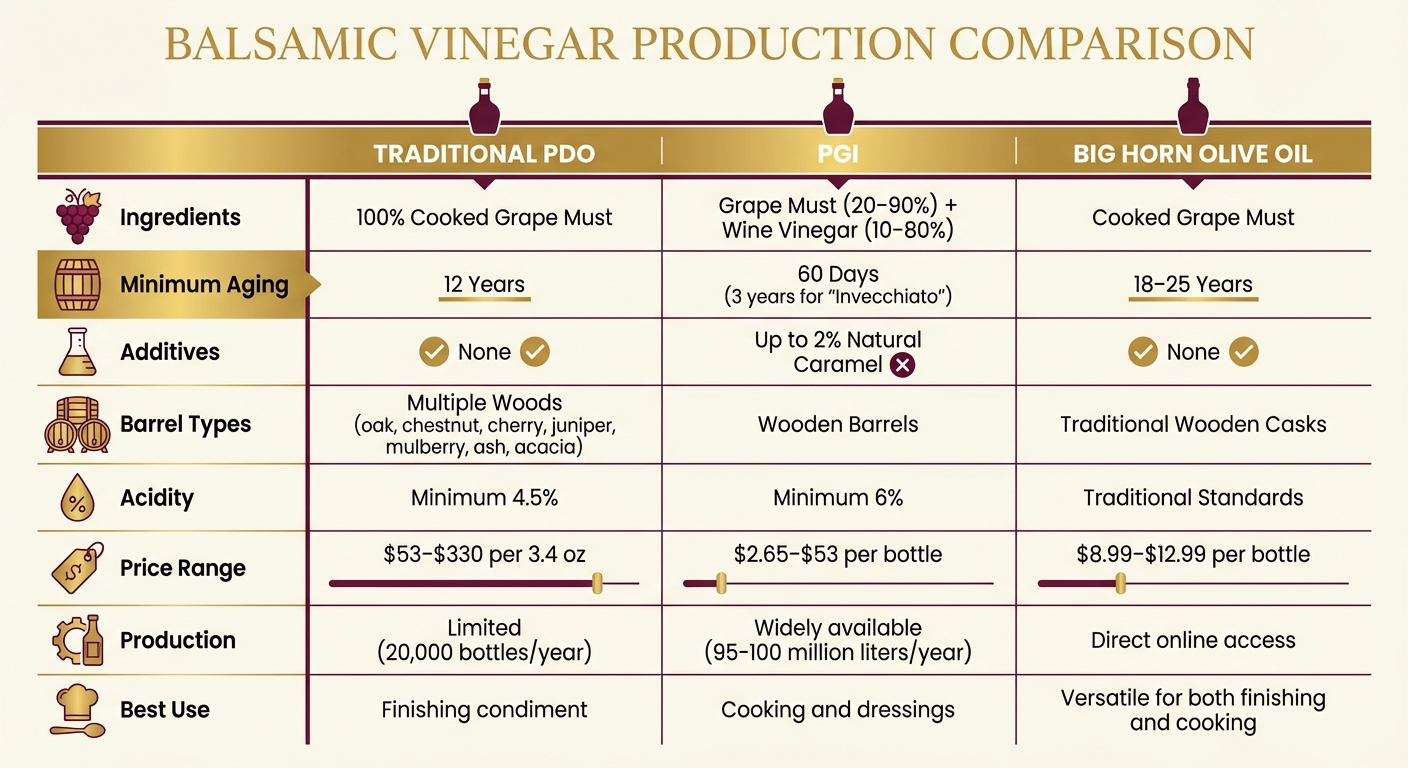
Traditional PDO vs PGI vs Big Horn Balsamic Vinegar Comparison
Rooted in centuries of tradition, modern balsamic vinegar production in Modena stays true to these established principles. Two key certifications define the quality of balsamic vinegar from this region. The Traditional Balsamic Vinegar of Modena PDO (Protected Designation of Origin) is crafted exclusively from 100% cooked grape must, using seven specific grape varieties native to the area: Lambrusco, Sangiovese, Trebbiano, Albana, Ancellotta, Fortana, and Montuni. Among these, Trebbiano and Lambrusco dominate. Grapes are harvested with a minimum sugar level of 15° Brix, and vineyard yields are limited to about 14,200 pounds per acre, ensuring rich, concentrated flavors.
PDO vinegar is reduced to 30% of its original volume and aged for at least 12 years in a batteria - a series of progressively smaller wooden barrels made from a mix of woods like oak, chestnut, cherry, juniper, mulberry, ash, and acacia. Before bottling, each batch undergoes blind tasting to evaluate its color, density, aroma, and flavor. The result? A product that encapsulates Modena's deep-rooted heritage in every drop.
On the other hand, the PGI certification offers a more adaptable approach while maintaining high-quality standards. Balsamic Vinegar of Modena PGI (Protected Geographical Indication) allows for a blend of grape must (20–90%) and wine vinegar (10–80%), with a minimum of 10% aged vinegar. The cooked must for PGI must reach a density of at least 1.240 at 68°F, and up to 2% natural caramel can be added for color adjustment. PGI vinegar is aged for a minimum of 60 days in wooden barrels, though those labeled "Invecchiato" must age for three years.
Reflecting these PDO traditions, Big Horn Olive Oil sources its balsamic vinegar directly from Modena. Their Traditional 18-Year Aged Dark Balsamic Vinegar ($8.99) and Molto Denissimo 25-Year Aged Dark Balsamic Vinegar ($12.99) are made from cooked grape must and aged in traditional wooden casks with no additives, resulting in a rich and layered flavor. As VinePair describes:
"Balsamico Tradizionale bears the luscious sweetness and piercing acidity of the world's finest dessert wines".
| Production Element | Traditional PDO | PGI | Big Horn Olive Oil |
|---|---|---|---|
| Ingredients | 100% Cooked Grape Must | Grape Must (20–90%), Wine Vinegar (10–80%) | Cooked Grape Must |
| Minimum Aging | 12 Years | 60 Days (three years for "Invecchiato") | 18–25 Years |
| Additives | None | Up to 2% Natural Caramel | None |
| Barrel Types | Multiple Woods | Wooden Barrels | Traditional Wooden Casks |
| Acidity | Minimum 4.5% | Minimum 6% | Traditional Standards |
International Recognition and Market Access
Modena's balsamic vinegar rose to international prominence in the late 19th century, but its reputation was firmly established with the PGI certification on July 3, 2009. This certification legally protects the name "Aceto Balsamico di Modena" and played a key role in expanding its global market. Back then, the market was valued at approximately €400 million (about $530 million) annually.
Today, more than 90% of Balsamic Vinegar of Modena's production is exported to over 130 countries, with annual output reaching between 95 and 100 million liters. Global consumption now exceeds one billion euros. The United States stands as the largest export market, accounting for nearly 25% of all exports. In June 2025, the Consortia for the Protection of Traditional Balsamic Vinegar of Modena PDO and Balsamic Vinegar of Modena PGI made a significant appearance at the Summer Fancy Food Show at the Javits Center in New York City. This event featured educational masterclasses and tastings of artisanal gelato topped with aged balsamic, all aimed at captivating American buyers and media. Such efforts highlight the industry's commitment to showcasing its enduring quality.
Cesare Mazzetti, President of the Consortium, emphasized the importance of these events:
"The Summer Fancy Food Show is our chance to spotlight authenticity, to interact with industry insiders, and to fully convey the complexity of Balsamico to uninitiated consumers".
However, a significant challenge remains: differentiating authentic products from imitations that often flood the American market.
Big Horn Olive Oil addresses this issue by connecting American consumers directly with authentic Modena balsamic vinegar through their online store at https://bhooc.com. Their traditionally crafted products adhere to the high standards that have cemented Modena's reputation, offering authenticity at competitive prices.
Rooted in centuries of artisanal craftsmanship, the combination of PGI certification, active participation in global trade events, and direct-to-consumer distribution has elevated Modena's balsamic vinegar from a regional delicacy to a worldwide culinary favorite. This international success reflects how Modena's rich history and dedication to tradition continue to leave a lasting mark on the culinary world.
Pros and Cons
Modena balsamic vinegar comes in two primary forms: Traditional PDO and PGI.
Traditional Balsamic Vinegar of Modena PDO is the gold standard of craftsmanship. Made entirely from cooked grape must, it undergoes aging for 12 to 25+ years using the "solera" method. This process creates a thick, syrupy vinegar with layers of sweetness and subtle woody notes from casks made of oak, cherry, and juniper. However, its exclusivity comes at a cost - only 20,000 bottles are produced each year, with prices ranging from $53 to $330 for just 3.4 oz. Michelin-starred chef Massimo Bottura once commented, "In 2019, we're still waiting 25 years before tasting the balsamic vinegar – it's crazy!". This highlights the balance between unmatched quality and limited accessibility.
Balsamic Vinegar of Modena PGI, on the other hand, is much more accessible. It requires a minimum of 60 days of aging (or three years to earn the "invecchiato" label). While it offers a sweet-and-sour flavor perfect for everyday cooking and salad dressings, it must contain at least 20% grape must and 10% wine vinegar. Additionally, up to 2% caramel is allowed to stabilize its color. Produced on an industrial scale, it’s widely available but lacks the depth and complexity of its traditional counterpart.
For those seeking quality without the high price tag, Big Horn Olive Oil offers Modena balsamic vinegars that combine tradition with affordability. Their Traditional 18-Year Aged Dark Balsamic Vinegar ($8.99) and Molto Denissimo 25-Year Aged Dark Balsamic Vinegar ($12.99) adhere to Modena's time-honored recipes. These products deliver the rich taste of authentic balsamic vinegar without the hefty cost of PDO versions, making them a practical option for many.
One ongoing challenge for consumers is distinguishing authentic balsamic vinegar from imitations. The term "balsamic vinegar" is largely unregulated, with prices ranging from $2.65 to $463. To identify genuine PDO products, look for the word "tradizionale" and the unique 100‑mL bottle. For PGI-certified options, the label guarantees adherence to minimum quality standards.
| Feature | Traditional PDO | Commercial PGI | Big Horn Olive Oil Products |
|---|---|---|---|
| Aging Period | 12 to 25+ years | 60 days to 3 years | 18 to 25 years |
| Ingredients | 100% cooked grape must | Min. 20% grape must, 10% wine vinegar | Crafted using Modena recipes |
| Price Range | $53–$330 per 3.4 oz bottle | $2.65–$53 per bottle | $8.99–$12.99 per bottle |
| Best Use | Finishing condiment | Cooking and dressings | Versatile for both |
| Availability | Limited production (20,000 bottles/year) | Widely available | Direct online access |
Conclusion
Modena became the birthplace of balsamic vinegar thanks to a harmonious mix of geography, history, and skilled craftsmanship. Local grape varieties like Trebbiano and Lambrusco, cultivated since Roman times, give the vinegar its distinct flavor profile. This blend of natural resources and tradition laid the foundation for Modena's balsamic vinegar legacy.
Over time, aristocratic patronage transformed balsamic vinegar from a regional specialty into a prized culinary gem. Modenese families safeguarded their production techniques for generations, using the vinegar not only as a remedy but also as a prestigious element in dowry traditions. In the 19th century, Francesco Aggazzotti formalized production methods, setting the quality standards that define authentic balsamic vinegar today.
Big Horn Olive Oil carries forward this rich heritage with their Traditional 18-Year Aged Dark Balsamic Vinegar ($8.99) and Molto Denissimo 25-Year Aged Dark Balsamic Vinegar ($12.99). These offerings, crafted using Modena's cherished recipes, bring the authentic flavors of balsamic vinegar to modern kitchens - perfect for everyday use or as a gourmet finishing touch.
From its aristocratic roots to Big Horn Olive Oil's contemporary products, Modena's balsamic vinegar embodies centuries of tradition in every bottle. This enduring legacy continues to inspire culinary creativity worldwide, showcasing the pride and heritage of Modena in every drop.
FAQs
Why does Modena’s climate make balsamic vinegar age better?
Modena’s climate plays a key role in crafting its traditional balsamic vinegar. The region’s hot, humid summers accelerate evaporation, thickening the vinegar to achieve its signature texture. Meanwhile, the cold winters work to intensify and refine the flavors, adding depth. This natural rhythm of seasonal shifts is what gives Modena’s balsamic vinegar its rich and layered taste, setting it apart from others.
How can I tell real Modena balsamic from imitations?
To spot authentic Modena balsamic vinegar, look for the PGI (Protected Geographical Indication) or PDO (Protected Designation of Origin) certifications. These labels confirm that the vinegar is made using traditional methods and ingredients from Modena. Pay attention to the label - authentic options may include minimal additives, such as up to 2% caramel. Also, check the aging details. Traditional balsamic vinegar must be aged for at least 12 years. These criteria ensure you're getting a genuine, high-quality product.
When should I use aged balsamic as a finish vs for cooking?
Aged balsamic vinegar works best as a finishing touch, bringing depth and rich, layered flavors to your dishes. On the other hand, younger or less aged balsamic is perfect for cooking, marinades, or recipes where heat might change its subtle taste.