

Why Sicily Preserves Capers by Season
Sicily preserves capers because harvests are seasonal, but cooking isn’t. Most picking happens from May through August; salt curing and vinegar brining keep capers available year-round. My rule when choosing them: pick by cure, size, and dish - not harvest date alone.
- Salt-packed or vinegar-brined? Salt-packed capers add savory flavor without extra vinegar; vinegar-brined capers add tang. Neither is automatically better.
- Small buds or cucunci? Bud size affects bite and cooking use - not quality or season. Cucunci are caper fruits, not large buds.
- Before serving: I rinse and soak salt-packed capers for 15–30 minutes, then taste. With either type, I adjust salt and acid before adding them to fish, pasta, or vegetables.
<u>Curing and storage matter as much as picking.</u> I follow package storage directions and never treat production curing methods as a home-preservation recipe.
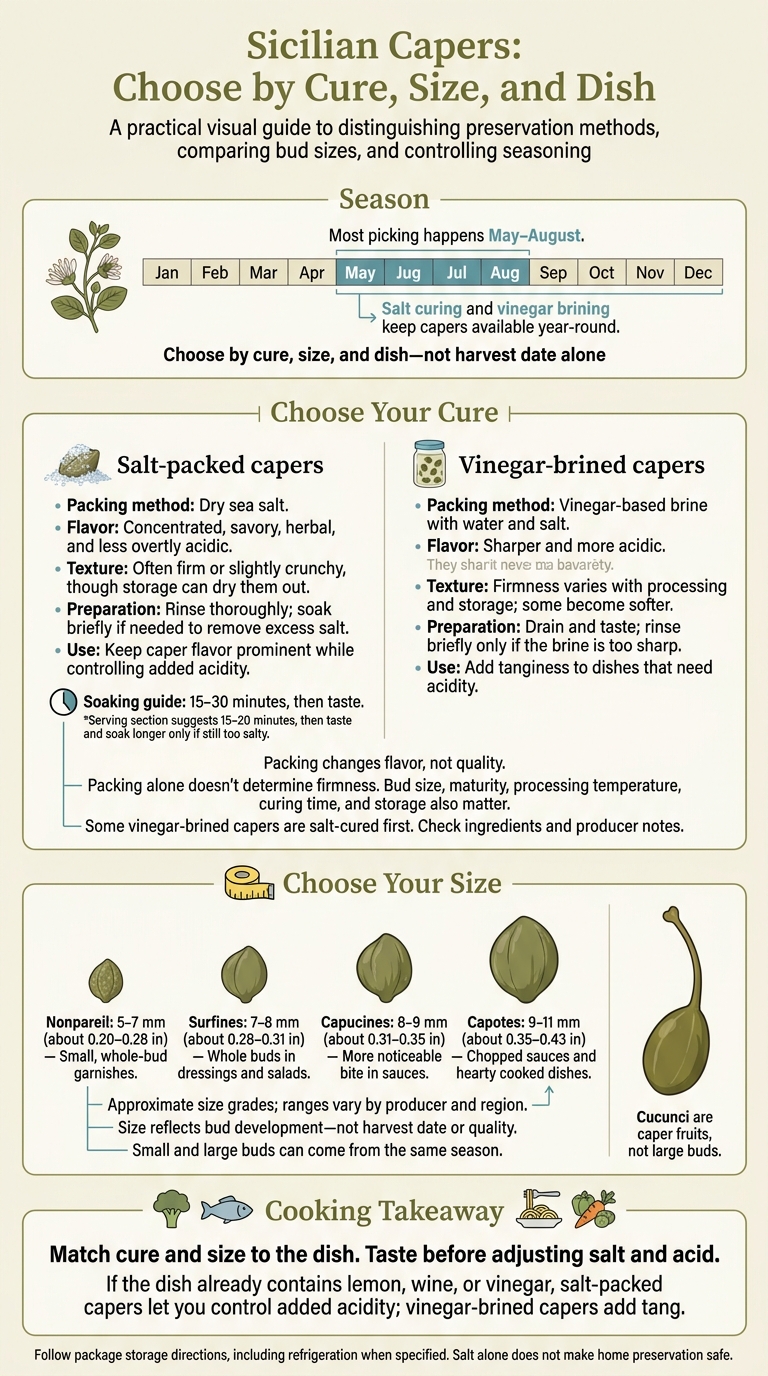
Sicilian Capers: Choose by Cure, Size, and Dish
🫒 HARVESTING CAPERS 🫒 in Sicily - A Flavorful, Seasonal Tradition
sbb-itb-4066b8e
Salt Curing Sicilian Capers
After harvest, Pantelleria’s curing process uses only sea salt, added in stages. The salt draws moisture from the buds to form brine. Lactic fermentation then softens their bitterness and builds savory flavor.
Steps in Salt Curing
Producers clean the buds and sort them by size so they cure evenly. Some accounts also describe a brief surface-drying or cooling step before salting.
The regional specification calls for an initial salt addition equal to 30–40% of the capers’ weight, with mixing over 8–10 days. Producers then drain the capers and add more sea salt - equal to 20–25% of the drained capers’ weight - for further maturation.
The full cure takes roughly 20 days to one month, depending on the method. These are regional production methods, not a home-preservation recipe.
Preparing and Storing Salt-Packed Capers
Rinse off excess salt, then soak the capers in clean water for 15–30 minutes. Taste them before deciding whether to soak them longer.
After opening, follow the package’s storage directions, including refrigeration when specified. Use clean utensils and, if transferring the capers, a food-safe container. Salt alone does not make home preservation safe; use a validated food-safety procedure.
The salt cure also helps explain why salt-packed capers taste different from vinegar-brined ones.
Salt-Packed vs. Vinegar-Brined Capers
After curing, the packing medium helps determine whether capers taste more savory or sharp. It changes flavor, not quality.
| Feature | Salt-packed capers | Vinegar-brined capers |
|---|---|---|
| Packing method | Dry sea salt | Vinegar-based brine with water and salt |
| Flavor | Concentrated, savory, herbal, and less overtly acidic | Sharper and more acidic |
| Texture | Often firm or slightly crunchy, though storage can dry them out | Firmness varies with processing and storage; some become softer |
| Preparation | Rinse thoroughly; soak briefly if needed to remove excess salt | Drain and taste; rinse briefly only if the brine is too sharp |
| Uses | Keep caper flavor prominent while controlling added acidity | Add tanginess to dishes that need acidity |
Packing alone doesn’t determine firmness. Bud size, maturity, processing temperature, curing time, and storage all play a part. Season, bud size, and curing method also work together to shape flavor.
The choice matters most when a dish already contains lemon, wine, or vinegar. Salt-packed capers let you control how much more acidity you add, while vinegar-brined capers can provide a tangy finish.
Some vinegar-brined capers are salt-cured before they’re packed in vinegar. Check the ingredient list and producer notes to find out how they were cured, and taste before adding more salt or acid.
How Harvest Timing and Bud Size Affect Flavor
Once capers are cured and stored, bud size helps you choose how to use them. Size reflects bud development - not harvest date or quality. Growers pick repeatedly, so small and large buds can come from the same season.
Heat, rainfall, water availability, and plant stress can affect moisture and firmness. But these factors don’t produce a reliable early-season versus late-season flavor rule. Choose size for the dish, not as a seasonal ranking.
Choosing Caper Sizes for Cooking
Treat these names as size grades, not seasonal categories. The ranges vary by producer and region.
| Grade | Approximate diameter | Best use |
|---|---|---|
| Nonpareil | 5–7 mm (about 0.20–0.28 in) | Small, whole-bud garnishes |
| Surfines | 7–8 mm (about 0.28–0.31 in) | Whole buds in dressings and salads |
| Capucines | 8–9 mm (about 0.31–0.35 in) | More noticeable bite in sauces |
| Capotes | 9–11 mm (about 0.35–0.43 in) | Chopped sauces and hearty cooked dishes |
Smaller buds generally have a more compact shape and a less noticeable bite. Larger buds offer a firmer bite, and chopping them helps distribute them evenly through a dish. To compare sizes, taste capers from the same producer with the same cure side by side.
Serving Preserved Sicilian Capers
Use the capers’ cure, size, and intensity to guide how you finish a dish. For salt-packed capers, brush off excess salt, soak in cool water for 15–20 minutes, then rinse, drain, and taste. Soak longer only if they’re still too salty. Drain vinegar-brined capers, and rinse only if their tang is too strong.
Pair prepared capers with ingredients that balance their salt and acidity.
Capers With Olive Oil, Seafood, Pasta, and Vegetables
Mix prepared capers with extra virgin olive oil, parsley, and lemon zest, choosing a mild oil for delicate fish or a robust one for tomato dishes.
Spoon over grilled fish, using salt-packed capers for savory depth or vinegar-brined capers for sharper acidity; taste first, then adjust salt and lemon to avoid oversouring the dish.
Stir prepared capers into tomato pasta or puttanesca sauce during the final minutes of cooking; olives and anchovies already contribute salt.
Add capers after roasting potatoes, eggplant, or green beans to keep their briny flavor sharp.
Conclusion: Choose Capers by Cure, Size, and Dish
Match the cure and size to your dish, then taste before adjusting the seasoning.
FAQs
Can I substitute vinegar-brined capers for salt-packed capers?
You can generally swap vinegar-brined and salt-packed capers, but you’ll need to account for salt and acidity.
If you’re using vinegar-brined capers instead of salt-packed capers, you may need to cut back on other acids or added salt to keep the dish balanced.
For the reverse swap, rinse salt-packed capers thoroughly under cold water to remove excess salt.
Does harvest season matter when buying preserved capers?
Yes. Harvest timing affects caper size and flavor. Early-season capers tend to be smaller, firmer, and more intense. Later harvests yield larger, softer buds with a more delicate flavor.
Match your choice to the dish: punchy saltiness for seafood or a subtle, savory finish for vegetables. Pair them with high-quality Big Horn Olive Oil to bring out their natural brightness.
How much olive oil should I use in a caper dressing?
For a caper dressing or marinade, start with 2 parts olive oil to 1 part vinegar for balanced flavor. Combine 1 cup of Big Horn Olive Oil Extra Virgin Olive Oil with 1/2 cup of balsamic or wine vinegar.
Keep the mixture refrigerated. The 2:1 ratio alone does not guarantee food safety.