

Acetic Acid Bacteria in Vinegar Production
Vinegar is what happens when bacteria turn alcohol into acid with oxygen. If I had to boil this topic down fast, that’s the core idea.
Here’s the short version:
- Yeast comes first. It turns sugars into alcohol, often about 5% to 8% ABV.
- Acetic acid bacteria (AAB) come next. With oxygen, they turn that alcohol into acetic acid.
- Oxygen controls the process. No oxygen means weak acid production.
- The main groups are Acetobacter, Gluconobacter, and Komagataeibacter.
- Surface systems take days to weeks and often build more aroma.
- Submerged systems can finish in about 18 to 30 hours and give tighter batch control.
- Most AAB work best at 77°F to 86°F (25°C to 30°C).
- Starting alcohol is often around 6% to 8% (v/v).
- Some strains can produce 15% to 20% acetic acid (w/v) in submerged tanks.
- Strain choice affects acid level, aroma, stability, and aging.
If you make vinegar, study it, or buy premium styles, the big point is simple: vinegar quality depends on the bacteria, the oxygen, and the time.
A quick look at the main differences:
| Topic | Main point |
|---|---|
| First fermentation | Yeast turns sugar into ethanol |
| Second fermentation | AAB turn ethanol into acetic acid |
| Oxygen need | AAB must have oxygen |
| Surface method | Slower, more aroma, more batch variation |
| Submerged method | Faster, more control, less aroma build-up |
| Strain effect | Changes acid yield, taste, and aging behavior |
So when I look at vinegar production, I don’t just see “sour liquid.” I see a two-step fermentation system where microbes, air, and process design decide the final result.
Industrial Production of Acetic Acid ( Vinegar ) - Dr. Deepika Malik | Ph.D. (Microbiology)
sbb-itb-4066b8e
How Acetic Acid Bacteria Produce Vinegar
Once yeast makes ethanol, acetic acid bacteria, or AAB, take over. Their job depends on oxygen. Instead of burning ethanol all the way down to carbon dioxide and water, they stop partway and turn it into acetic acid.
This chemistry happens at the cell membrane. A membrane-bound alcohol dehydrogenase (ADH) changes ethanol into acetaldehyde, and a membrane-bound aldehyde dehydrogenase (ALDH) changes acetaldehyde into acetic acid. In both steps, electrons move into the respiratory chain, which is why oxygen is not optional here. No oxygen, no steady acid production.
Key Genera and Their Roles
The main genera in vinegar production are Acetobacter, Gluconobacter, and Komagataeibacter. Strains once grouped under Gluconacetobacter are now mostly placed within Komagataeibacter. These groups don't behave the same way. They vary in how well they use ethanol, how much acid they can handle, and whether they keep oxidizing past the point you want.
| Genus | Ethanol Oxidation | Acid Tolerance | Best Fit |
|---|---|---|---|
| Acetobacter | Strong; can over-oxidize acetic acid to CO₂ and water if ethanol becomes limiting | High | Wine, spirit, and high-acid vinegars |
| Gluconobacter | Prefers sugar oxidation over ethanol | Lower | Early fermentation stages; fruit vinegars with gluconic acid |
| Komagataeibacter | Strong; highly efficient ethanol-to-acetic acid conversion | Very high | Submerged industrial fermenters; balsamic and wine vinegars |
Those genus-level differences show up most clearly under certain oxygen, temperature, and ethanol conditions.
Komagataeibacter has become a major player in modern submerged vinegar production because it handles acid well and converts ethanol to acetic acid with high efficiency. In optimized submerged fermenters, it can reach acetic acid concentrations of 15% to 20% (w/v). Acetobacter strains still have an important place, but they need tighter process control. If ethanol drops too low while oxygen is still around, they can over-oxidize acetic acid and cut yield.
Conditions That Control AAB Activity
Oxygen control is the big one. Even short breaks in aeration can stop acid production, especially when acidity is already high.
Temperature and ethanol concentration shape performance too. Most vinegar-related AAB work best between 77°F and 86°F (25–30°C). Below that, oxidation slows down. Above it, cell membranes and enzymes can start to break down. Producers often start acetification with base wines or other alcoholic liquids that contain about 6% to 8% (v/v) ethanol. Too little ethanol puts a cap on acid production, while too much can hold the cells back. Fruit and wine substrates also tend to support growth better than neutral spirits.
These species traits and process limits help decide whether vinegar should be made in surface systems or submerged systems.
Fermentation Systems Used in Vinegar Making
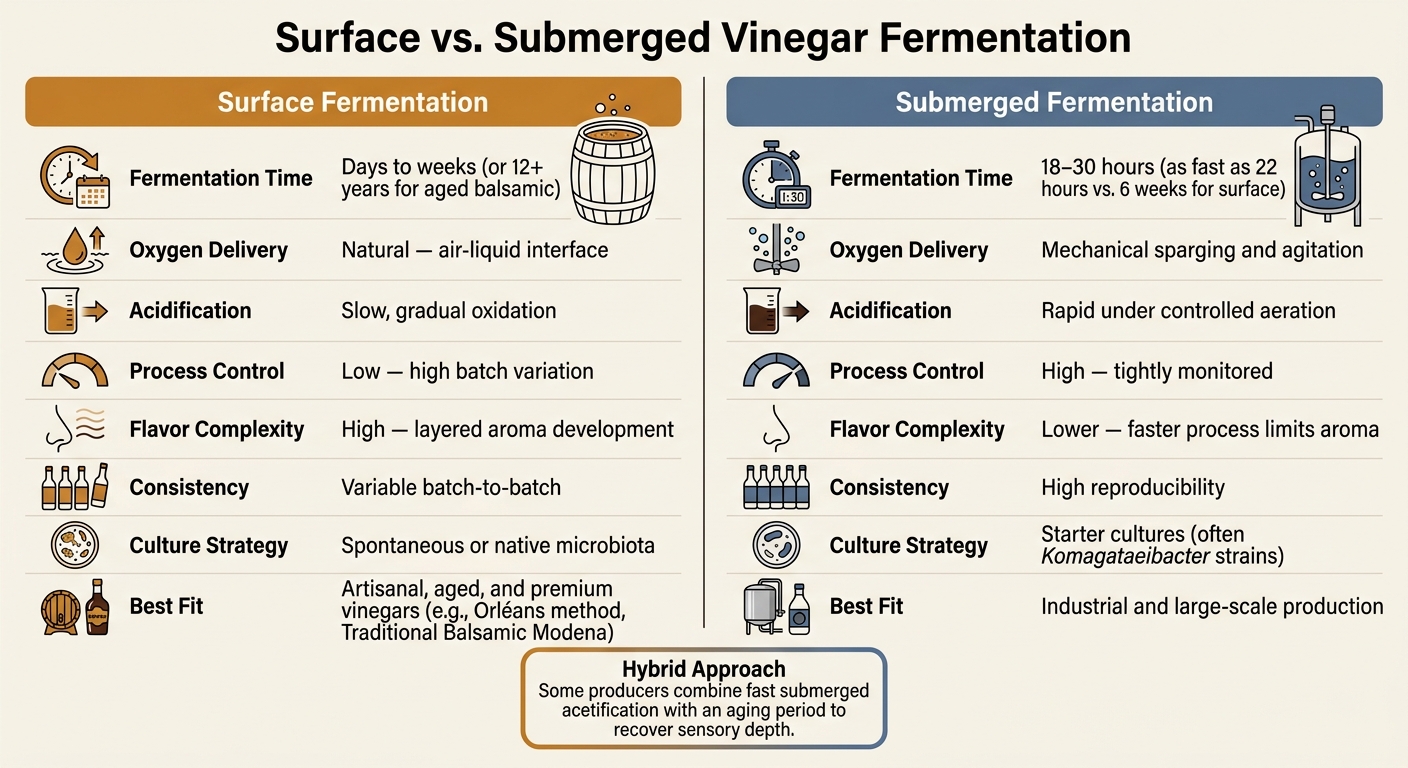
Surface vs. Submerged Vinegar Fermentation: Key Differences
The way vinegar is made has a big effect on taste, consistency, and production time. In practice, the main split is between surface fermentation and submerged fermentation. One leans toward slower flavor buildup. The other is built for speed and control. Those choices also shape aroma and influence how acetic acid bacteria, or AAB, behave during the process.
Surface Fermentation in Traditional Vinegars
In surface fermentation, AAB grow on top of the liquid, right where air meets the substrate. There, they form a cellulose-rich layer often called the mother of vinegar. Because that film sits at the surface, the bacteria get a steady supply of oxygen without mechanical aeration. The process moves slowly, often taking days or weeks, and sometimes much longer in aged vinegars.
A well-known example is the Orléans method. Barrels are filled about two-thirds full, leaving air space above the liquid. Wine is added from below so the surface film stays in place. That slower oxidation tends to build more layered aroma and the softer acid profile often linked with old-style wine vinegars. Traditional balsamic vinegar from Modena takes this idea much further, with 12+ years of barrel aging and repeated cask transfers driven by native AAB.
That sounds romantic, and it is. But it also takes time. If you want volume and tight process control, this isn’t usually the first choice.
Submerged Fermentation in Modern Production
Submerged fermentation takes the opposite route. Instead of letting AAB sit at the surface, the system spreads them through the liquid inside a stainless-steel bioreactor. Oxygen is pumped in through sparging and agitation, which speeds up acetification.
The time difference can be dramatic. Research on orange vinegar found that submerged culture finished acetification in 22 hours instead of 6 weeks for the same vinegar. The catch is simple: less time usually means less aroma development.
In many industrial setups, submerged fermentation cycles last about 18–30 hours, with 24 hours often noted as the best point for wine vinegar under controlled conditions. A lot of producers accept that sensory tradeoff because the payoff is better throughput and steadier batch results. Some split the difference with a hybrid model: fast submerged acetification first, then an aging period to build back some of the lost sensory depth.
Comparing Production Systems and Culture Strategies
| Factor | Surface Fermentation | Submerged Fermentation |
|---|---|---|
| Fermentation time | Days to weeks, or longer for aged styles | Much faster |
| Oxygen delivery | Natural, at the air-liquid interface | Mechanical sparging and agitation |
| Acidification profile | Slower, more gradual oxidation | Rapid acid production under controlled aeration |
| Process control | Lower; more variable | High; tightly monitored |
| Flavor complexity | Higher; slower oxidation builds aroma | Lower; faster process limits development |
| Consistency | Batch-to-batch variation is common | High reproducibility |
| Culture strategy | Often spontaneous or native microbiota | Usually starter cultures |
| Best fit | Artisanal, aged, and premium vinegars | Industrial and large-scale production |
Culture strategy matters just as much as the equipment. Starter cultures cut down on the uncertainty that comes with spontaneous fermentation, so acidification is easier to predict and yields are easier to standardize. Spontaneous fermentation can bring more complexity, but it also brings more variation and a higher risk of contamination.
In other words, these production choices decide what the vinegar is aiming for: depth, speed, or consistency. They also shape which strains leave the biggest mark on the final product, which leads straight into the next issue: which species and strains have the strongest effect on vinegar quality?
How Species and Strains Affect Vinegar Quality
Once the process is under control, the next big quality factor is the strain. AAB strains don't all behave the same way. They vary in acid yield, fermentation speed, and the sensory traits they bring to the final vinegar. And because strain-level differences can be large even within the same species, picking a strain is a quality-control call, not just a lab detail.
Key Species in Research and Production
Two species show up again and again in vinegar research: Acetobacter pasteurianus and Komagataeibacter europaeus. The species you use can shape both fermentation performance and batch-to-batch consistency.
A. pasteurianus is common in industrial fermentation because it handles heat and ethanol stress well. One isolate turned ethanol into acid more efficiently than the comparison strain under the same conditions.
K. europaeus is closely tied to high-acidity vinegars and is known for strong acetic acid tolerance. That makes it a good fit for submerged fermentations and other high-acid settings. In practical terms, these species differences matter when you're asking a simple question: which strains can keep working under high-acid pressure, hold conversion efficiency, and give steady results from batch to batch?
That gap becomes even more obvious when you look at aroma, taste, and how vinegar changes over time.
Effects on Aroma, Taste, Safety, and Aging
Acetic acid is the main compound that defines vinegar, but it isn't the whole story. AAB also make volatile compounds that can add fruity, floral, solvent-like, or harsh notes, depending on the strain and the process conditions. One strain might give a cleaner profile. Another might bring more aromatic depth. So vinegar quality doesn't come from acid alone. It comes from the mix of species, strain, substrate, and aging time.
AAB also matter for safety because they lower pH enough to hold back spoilage microbes. More acidity can mean stronger preservative action, but quality still depends on balance. Aroma, texture, and intended use all matter too.
Connection to Premium Balsamic Vinegar
Traditional balsamic vinegar is one of the clearest examples of how AAB science and long aging work together. Fermentation sets the chemical base through controlled acetic oxidation by selected or native strains. Then years of aging shape that base into more texture, better balance, and deeper aroma.
Traditional Balsamic Vinegar of Modena requires at least 12 years of maturation. Researchers have identified Gluconacetobacter europaeus and Acetobacter malorum as strong starter candidates for this style because of their high acetic acid tolerance and low-pH resistance. In premium balsamic production, strain selection plays a direct role in how well the vinegar matures. It affects not just fermentation performance, but the final quality profile too.
Conclusion: What Research Shows About AAB and Vinegar Quality
AAB are the engine behind vinegar production. They convert ethanol into acetic acid, and that single job affects far more than sourness. It shapes acidity, aroma, flavor, texture, and product stability. That’s why vinegar quality depends not just on raw materials, but also on how the process is run and which strains are doing the work.
Key Takeaways for Understanding Vinegar Quality
At the process level, oxygen is the main lever. In surface fermentation, AAB get oxygen at the liquid-air interface. In submerged fermentation, oxygen comes from aeration and agitation, which pushes production much faster and supports higher output. Submerged systems make acetic acid far faster than surface methods.
Production method and strain choice go hand in hand. Surface culture tends to retain more aroma and phenolic depth, while submerged systems tend to favor acid-tolerant strains that can keep working under harsher conditions. The balance of the microbial community also affects how flavor develops. A review on vinegar microbiota emphasizes that microbial community composition plays a pivotal role in shaping sensory qualities and overall quality.
Species and strain choice matter for other reasons too, especially acid tolerance, risk of overoxidation, and how well the culture performs during aging. In traditional balsamic vinegar, the mix of low pH and high acidity makes the right AAB community central to maturation and stability.
Traditional balsamic vinegar is a good example of how this all comes together. AAB, slow acetification, and aging work as a system, building the depth and character people look for in the final product. In vinegar production, quality comes from the interaction of AAB, oxygen, and time.
FAQs
Why is oxygen so important in vinegar production?
Oxygen matters here because acetic acid bacteria, including the “mother of vinegar” that sits on the liquid’s surface, need air to turn ethanol into acetic acid. That’s what gives vinegar its sharp tang and familiar smell.
Good airflow also helps the batch build more layered flavor over time. If the “mother” breaks apart or the oxygen supply gets cut off, those bacteria can die, and the vinegar may spoil.
What’s the difference between surface and submerged fermentation?
Surface fermentation leaves the liquid exposed to air. That gives acetic acid bacteria room to build a “mother of vinegar” on the surface and turn alcohol into acid at a slower pace. The slower process often helps keep more volatile aromas and more of the product’s regional character.
Submerged fermentation works differently. The culture stays below the liquid, and producers push in strong aeration to speed up acetification. The result is a vinegar with more uniform, consistent acidity, though it can sometimes have less nuance in aroma and less depth of flavor.
How do bacterial strains affect vinegar flavor and quality?
Acetic acid bacteria sit at the heart of vinegar production. They turn ethanol into acetic acid, which gives vinegar its sharp, tangy bite. On top of that, they make other compounds that shape the aroma and add depth and complexity.
The fermentation method matters too. Traditional surface fermentation moves at a slower pace, which helps keep more delicate flavors in place. Industrial submerged fermentation, by contrast, often leads to a sharper, more uniform acidity, but with less nuance.