

African organic standards: study summary
If you buy or sell organic food from Africa, one fact matters most: there is no single Africa-wide organic rule. A product may fit a local, national, regional, private, EU, or USDA system - and those do not mean the same thing.
Here’s the short version:
- Africa does not have one organic standard.
- EAOPS is the main regional standard in East Africa, covering Burundi, Kenya, Rwanda, Tanzania, and Uganda.
- A regional or private organic label does not by itself allow sale as organic in the United States.
- For U.S. sales, the product must meet USDA organic rules and, since March 19, 2024, each imported organic shipment must be tied to a valid electronic NOP Import Certificate.
- In many African countries, where state rules are missing or limited, private certifiers fill the gap.
- Organic labels prove compliance with a named standard, not product quality, origin, aging, taste, or market acceptance everywhere.
- Buyers should check the standard, certifier, scope, operator, and lot records - not just the logo.
- Label thresholds can differ. Under EAOPS, a product labeled “organic” must be at least 95% organic by weight excluding water and salt, while “made with organic ingredient(s)” needs at least 70%.
Put another way: the word “organic” only means something when you know which rulebook is behind it.
For premium packaged foods like olive oil and balsamic vinegar, I’d start with the destination market, then work backward through production, handling, storage, processing, labeling, and shipment records. That is the only safe way to judge whether the claim fits the market where the product will be sold.
This summary pulls the article into one plain point: logos start the conversation, but documents finish it.
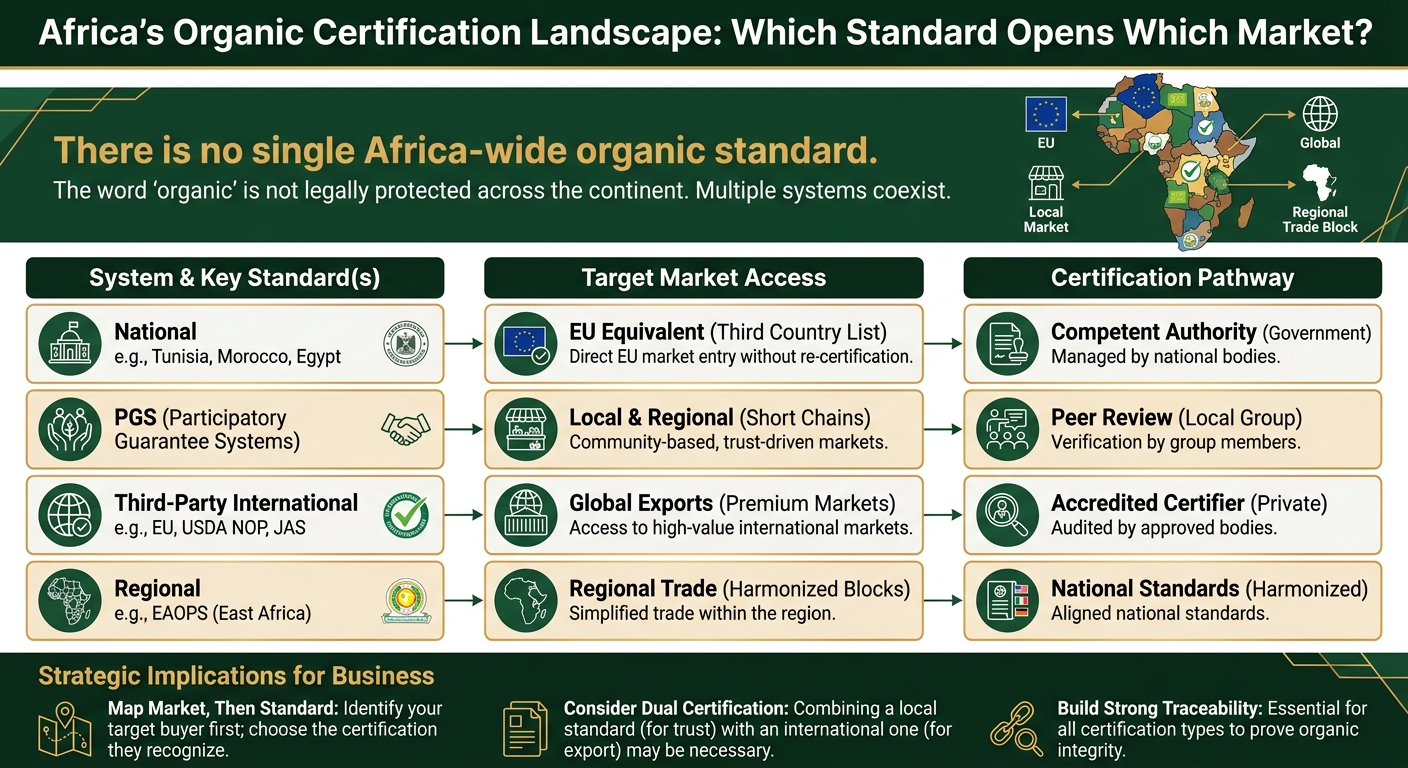
Africa Organic Certification Frameworks: Which Standard Opens Which Market?
Africa's organic certification landscape: national, regional, private, and export layers
Africa's organic sector runs on several overlapping rulebooks at once: national laws, regional standards, private schemes, and import-market rules. In plain English, the label on a product may say "organic", but the rule that actually decides whether that product can be sold often depends on the market it is trying to enter.
The table below breaks those layers apart by who sets the rules, how they are checked, and where they matter most.
| Framework or scheme | Geographic reach | Binding or voluntary status | Assurance method | Main market use |
|---|---|---|---|---|
| Codex organic guidelines | International reference | Generally a reference framework; implementation depends on national law | Government or accredited certification systems applying compatible rules | Policy development, regulatory comparison, and international trade alignment |
| IFOAM standards and principles | International; used by organizations in many countries | Voluntary reference and private-standard foundation | Third-party certification, PGS, or other recognized assurance models depending on the scheme | Standard development, private certification, and sector guidance |
| National organic regulations | Individual countries with enacted frameworks | Legal within the relevant country | Government-approved or accredited certifiers | Domestic sales and, where accepted, trade with foreign buyers |
| East African Organic Products Standard | Regional East African framework covering Burundi, Kenya, Rwanda, Tanzania, and Uganda | Regional standard; use depends on national implementation and market requirements | Certification or other approved assurance arrangements; associated regional mark | East African domestic and regional trade |
| Private organic certification schemes | Country-specific or international | Voluntary, but often required by buyers or destination markets | Independent third-party audit and certification | Export supply chains, retailer programs, and premium market access |
| Participatory Guarantee Systems | Mainly local or regional producer communities | Usually voluntary and market-limited | Peer review, internal controls, and stakeholder participation | Local and direct domestic markets, especially smallholder sales |
| USDA organic regulations (U.S. market requirement) | United States market, including eligible foreign suppliers | Legally required for products marketed as organic in the United States | USDA-accredited certifier, recognized equivalence arrangement, and import documentation | U.S. retail, food service, and ingredient markets |
Where national regulations exist and where private standards fill the gap
National regulation across Africa remains uneven. By the end of 2019, only Tunisia, Morocco, and Uganda had adopted organic policies, while Burkina Faso, Egypt, Ethiopia, Ghana, Kenya, and Madagascar were still developing or considering them. So the map is patchy: some countries have state-backed rules, while others still lean on outside systems.
South Africa shows how this gap works in practice. The country had no official certification system in its national organic-production policy, which left roughly nine private certification bodies to handle inspection and certification.
When national rules are missing or incomplete, private certifiers usually fill the space. And they don't make decisions in a vacuum. In most cases, they apply the rules of the destination market, most often the EU, U.S., or Japanese standards. That means the standard governing an African organic product is often set outside the continent.
So if a producer in Africa wants to sell abroad, the key question often isn't, What does local law say? It's what does the buyer's market require? That's why export supply chains so often depend on outside certifiers and destination-market rules.
Where domestic rules are absent, buyers and sellers usually fall back on private schemes or export-market standards.
How export-market rules control access to U.S. and other foreign buyers
An African national or regional standard by itself does not open the U.S. market. If a product is sold as organic in the United States, it must be certified to the USDA organic regulations or be covered by an applicable USDA-recognized international equivalence arrangement.
The paperwork piece matters too. Since March 19, 2024, each shipment of organic agricultural products imported into the United States must be linked to a valid electronic NOP Import Certificate issued through the USDA system by an accredited certifying agent.
For premium packaged foods, including olive oil and balsamic vinegar sampler sets, sellers need to start with the destination market and work backward from there. That means checking production, processing, bottling, storage, labeling, and ingredient sourcing against the rules that apply in the target market.
sbb-itb-4066b8e
East African Organic Products Standard: the clearest regional framework
Among Africa's regional frameworks, EAOPS is the clearest example of a shared organic rule set. EAOPS (EAS 456:2007) is the East African Community's regional organic standard for Burundi, Kenya, Rwanda, Tanzania, and Uganda. Standards Map describes it as a pioneering regional standard developed through cooperation between organic movements and national standards bodies.
What EAOPS covers and how the East African Organic Mark is used
EAOPS covers production, processing, storage, transport, and labeling. To use the word "organic" on a label, a product must be at least 95% organic by weight, not counting water and salt. If the label says "made with organic ingredient(s)," the product must contain at least 70% organic ingredients. Labels also need to name the responsible operator, include a contact address, and comply with national labeling law.
The East African Organic Mark, also called the Kilimohai mark, shows that a product conforms with EAOPS or with a recognized equivalent route. That can include accepted third-party certification or a permitted Participatory Guarantee System.
Here’s the key point: the mark shows compliance with EAOPS, not blanket organic approval everywhere. In plain English, the logo tells buyers which regional rules were followed. It does not tell them which export market has approved the product. For premium packaged foods, that distinction matters. The main issue is whether the mark covers both the product's origin and the market where it will be sold.
Why regional recognition does not equal automatic export approval
Regional recognition helps build trust inside East Africa, but it doesn't automatically open export markets. The mark can support regional trade, yet export sales still depend on approval in the destination market, such as USDA or EU rules.
Certification, labels, traceability, and what a label actually proves
Once a product carries an organic mark, the next step is simple: figure out what that mark actually proves.
An organic label proves compliance with a specific standard. It does not prove overall quality or market acceptance. That distinction matters. A product can be labeled organic and still fail to meet the rules of the market where you want to sell it.
Behind a solid organic claim is a paper trail. That usually includes an organic management plan, input and field records, harvest and sales logs, and inspection evidence. Operators are also expected to keep a traceability system that shows where a product came from and how it moved through the supply chain. Processors and handlers must also show that organic goods were kept separate from conventional products and protected from mixing or contamination.
Conversion often lasts one to three years, but the rule depends on the standard and the crop. A common rule is two years before sowing annual crops and three years before harvesting perennial crops. EAOPS uses a different baseline: at least one year of compliant management, with no conversion period for land fallowed for at least one year, and a possible extension where earlier pesticide use creates contamination risk. Buyers should always ask which standard applies and what the official conversion start date is, because conversion status is part of the claim they need to check. That’s why the system behind the label matters so much.
Third-party certification, participatory systems, and self-declarations compared
The way an organic claim is verified affects how much outside assurance a buyer gets. Some systems rely on an outside certifier. Others rely more on group controls, peer review, or the producer’s own statement. Same word on the package, very different level of proof.
| Claim structure | How it works | Typical use | Main limitation |
|---|---|---|---|
| Third-party certification | An independent certification body inspects the operator and assesses compliance with a named organic standard or regulation. | Export supply chains, formal retail, and markets requiring recognized certification. | Certification to one standard does not automatically satisfy another market's rules. |
| Group certification / Internal Control System (ICS) | A producer group maintains internal records and controls, while an external body evaluates the group system and samples members. | Smallholder export groups and cooperatives. | Buyers must verify that the specific producer, product, and lot fall within the certified scope. |
| Participatory Guarantee System (PGS) | Farmers, consumers, and other local stakeholders use peer review and agreed standards for local assurance. | Local and domestic markets, especially for smallholders. | Generally more relevant to local or domestic markets than to export transactions. |
| Self-declaration | A producer states that practices conform to a standard without independent third-party certification. | Direct sales, local markets, and other systems that permit self-declaration. | Provides weaker independent assurance; buyers should request records and traceability documents. |
| Regional organic mark | A mark signals that a product or operator has been assessed or declared compliant under the regional standard through an allowed verification pathway. | East African domestic and regional trade. | It does not automatically establish compliance with U.S. or other importing-market organic rules. |
Only the destination market decides whether the claim is valid there.
What buyers and sellers should verify beyond the logo
A logo is just the starting point. Buyers still need to check the standard, certifier, scope, and lot records. Put plainly, the mark opens the door, but the documents do the heavy lifting.
| Label element | What it indicates | What it does not prove | Evidence to request |
|---|---|---|---|
| Organic logo or regional mark | The product is associated with a stated organic standard or verification scheme. | That the claim is accepted in the buyer's destination market or that every product from the seller is certified. | The standard, mark-use authorization, assessment record, and product scope. |
| Certifier name or code | Identifies the organization responsible for conformity assessment. | That the certifier covers the specific product, site, or shipment. | A current certificate, accreditation or recognition details where relevant, verification contact, and validity dates. |
| Standard or regulatory reference | Identifies the rules used to assess production or processing. | Equivalence with U.S., EU, or another importing market's rules. | The full standard reference and confirmation that it satisfies the destination-market requirement. |
| Certified scope and responsible operator | Identifies the named producer, processor, facility, product category, site, and handling activities covered by the claim. | That other products or lots from the same seller are certified. | Scope statement, producer registers, processing records, supplier approval documents, and invoices. |
| Country or place of origin | States where the product or relevant agricultural ingredients originate. | Organic status, farm-level identity, or absence of blended origins. | Origin declarations, supplier records, farm or cooperative documentation, and import documents. |
| Lot or batch number | Creates a link between the packaged product and internal production records. | That the lot is organic unless the records support that classification. | Batch sheets, inventory reconciliation, separation controls, harvest records, and shipping documentation. |
| Certified organic wording | Makes a specific organic claim about the product. | The certifier, standard, validity period, or permitted market by itself. | Certificate, scope statement, label approval where applicable, and current validity dates. |
| In conversion or transition wording | Indicates that production is undergoing a conversion process rather than having full organic status. | That a full organic claim is permitted or that the product is eligible in the buyer's market. | Conversion start date, inspection records, land history, and the applicable labeling rule. |
| PGS or community-verification reference | Indicates that conformity was assessed through participatory or peer-based procedures. | That export or formal retail certification requirements are satisfied. | PGS rules, inspection or peer-review records, membership register, and destination-market acceptance. |
For premium packaged foods - including olive oil and balsamic vinegar - buyers should reconcile the certified input volume with the finished-product volume and confirm that the label’s organic claim matches the certified scope. That sounds technical, but the idea is straightforward: do the numbers and records line up with what’s in the bottle?
For olive oil, buyers should check the source country and producer identity, harvest or pressing details where available, the lot number, storage and blending records, and records showing how certified olives or oil were kept separate from conventional material. For balsamic vinegar, buyers should verify the identity and location of the producer or processor, ingredient origin, batch records, maturation or storage records when relevant, and whether the organic claim applies to all ingredients or only named agricultural components.
Premium branding does not prove organic certification. A logo alone is not enough - checking the standard, certifier, scope, and lot records is what closes the proof chain.
Market use, trade patterns, and key takeaways for premium food buyers and sellers
Domestic and regional sales versus international export sales
The same organic claim does not mean the same thing in every sales channel. What matters is where the product is being sold. Certification rules shift by market. IFOAM reports that many African organic farmers sell locally with no certification at all, while certified operators are much more likely to target export markets. EAOPS can help with regional trade, but sales into the United States still need USDA-compliant certification.
Use the destination market to judge what proof is needed, not just the logo on the pack.
| Sales channel | Likely applicable framework | Assurance route | Documentation burden | Buyer verification priorities |
|---|---|---|---|---|
| Local domestic sales | National rules, private standards, or community norms | Self-claim, local inspection, or PGS | Low to moderate | Producer identity, production practices, and claim basis |
| Formal domestic retail | National regulation and retailer requirements | Independent certification, private scheme, or approved PGS | Moderate | Certifier identity, valid certificate, scope, and lot traceability |
| East African regional trade | EAOPS, national requirements, or equivalent recognized standards | Recognized certification or approved PGS | Moderate to high | Exact standard, authorized mark use, certifier recognition, and movement records |
| Export to the United States | USDA organic regulations and applicable import requirements | Certification by a USDA-accredited certifier; supply-chain documentation | High | USDA-accredited certifier, certificate scope, lot records, and label compliance |
| Export to the EU or other destination markets | Destination-market organic regulation and equivalence or recognition arrangements | Certification accepted under the destination system | High | Destination-market acceptance, certificate validity, and chain-of-custody |
Costs climb fast as trade moves from local sales to export. And smallholders usually feel that pressure the most. Group certification through cooperatives or exporter-managed internal control systems can spread those costs across more people, but only if the records and controls are solid enough to stand up to buyer checks.
What this means for premium packaged foods, including olive oil and balsamic vinegar
For premium foods, organic certification answers one question: does the product meet the organic standard? It does not prove freshness, origin, sensory quality, or food safety.
For olive oil and balsamic vinegar sets, buyers should check the source country, producer identity, lot number, and records showing that certified olives or oil stayed separate from conventional material during storage and processing. That separation matters. Without it, the organic claim starts to wobble.
For balsamic vinegar, buyers should verify the exact product category and any geographic or production claims instead of treating organic as proof of traditional production, Modena origin, aging method, or flavor quality. In plain English: organic is not a shortcut for “premium” in every other sense. Buyers should also confirm the producer’s identity and location, ingredient origin, batch records, and whether the organic claim covers all ingredients or only certain agricultural components.
Conclusion: the main findings buyers and sellers should remember
Africa has more than one organic pathway. It is not a single, unified system. EAOPS is a major regional framework for East Africa, but it applies only to Burundi, Kenya, Rwanda, Tanzania, and Uganda. It also does not automatically meet U.S., EU, or other import-market rules.
Domestic and regional channels may rely on national systems, private standards, or participatory assurance. Export sales are different. They need certification accepted by the destination market, along with detailed records and chain-of-custody controls.
FAQs
Which organic standard applies to my target market?
In the United States, the main organic standard is the USDA National Organic Program (NOP).
The U.S. and the European Union also have an equivalence agreement. That means products certified under EU organic rules can generally be sold as organic in the U.S. without extra certification.
For imports, check that the shipment includes a valid electronic NOP Import Certificate in the USDA Organic Integrity Database.
Does an East African organic label qualify a product for U.S. sale?
No. An East African organic label by itself does not mean a product can be sold as organic in the United States.
To be sold as organic in the U.S., the product must be certified by a USDA-accredited certifier or fall under a formal equivalency agreement. On top of that, organic imports must include an electronic NOP Import Certificate to meet USDA enforcement requirements.
What documents should I verify beyond the organic logo?
Check the label for "Certified Organic by" and the name of the third-party certifier. If the product is imported, look for the certifier code near the logo too, such as IT-BIO-XXX.
You can also verify the status in official databases like the USDA Organic Integrity Database, OFIS, or TRACES. For imported shipments, review the electronic NOP Import Certificate, along with support documents such as invoices, bills of lading, and the place-of-farming statement.