

Circular Economy in Wastewater: Renewable Energy Role
Wastewater can supply water, power, heat, and materials at the same time. In the cases covered here, plants cut grid use with biogas CHP, solar PV, wastewater heat recovery, and microbial fuel cells, while making water reuse easier to afford.
Here’s the short version:
- I found that only 11% of treated wastewater is reused worldwide, leaving about 320 billion m³ per year unused.
- I saw that biogas CHP is the strongest near-term fit for large municipal plants, with power costs around $0.011 to $0.083 per kWh and some sites nearing 90% electric self-supply.
- I found that solar PV can offset a big share of plant demand, including one Iowa site covering about 70% of annual electricity use.
- I saw that wastewater heat recovery can slash building energy use, with one case cutting use by more than 58% and another heat pump system reaching a COP of 4.5.
- I found that olive mill wastewater is hard to treat but rich in recoverable energy, with anaerobic digestion producing 3.7 to 3.8 m³ of biogas per m³ per day and 63% to 64% methane.
- I saw that microbial fuel cells can treat high-strength streams and produce some electricity, but they still fit pilot use more than utility-scale finance.
If you want the plain answer, it’s this: the best wastewater reuse projects pair treatment with on-site energy recovery first. That lowers power costs, cuts emissions, and makes reclaimed water more cost-competitive for irrigation, cooling, and industrial use.
Quick comparison
| Option | Best fit | What it does well | Main limit |
|---|---|---|---|
| Biogas CHP | Large plants with digesters | Makes on-site power and heat from sludge gas | Needs steady sludge volume and capital |
| Solar PV | Plants with open space or high daytime load | Cuts grid electricity use | Only helps when the sun is up unless paired with other systems |
| Wastewater heat recovery | Urban plants near buildings or campuses | Supplies heating and cooling through heat pumps | Needs nearby thermal demand |
| Microbial fuel cells | Niche industrial and agri-food streams | Treats waste and makes some electricity in one step | Output is still low for most finance cases |
So when I step back from all the case studies, one pattern stands out: match the energy system to the waste stream. Municipal sludge fits CHP. Dense urban sites fit heat recovery. High-strength agri-food waste can fit digestion or, in some cases, MFC pilots. That’s the path this article maps out.
converting wastewater treatment plants into resource recovery factories
sbb-itb-4066b8e
Case Studies: Energy Recovery in Municipal Wastewater
Municipal plants show some of the clearest early wins. They have a steady sludge supply, big energy bills, and a steady need for reused energy on-site or nearby.
Biogas from Sludge Digestion and Combined Heat and Power
Anaerobic digestion turns municipal sludge into biogas that plants can use for heat and power on-site. In simple terms, digesters break down organic matter in sewage sludge and release biogas with a heating value of about 600 Btu per cubic foot. That gas can then fuel combined heat and power (CHP) units, which produce electricity and usable heat at the same time.
The numbers are pretty practical. For every 1 million gallons per day (MGD) of flow sent through digesters, a CHP system can produce about 26 kW of electricity and 2.4 MMBtu per day of thermal energy. Across the U.S., the upside is much bigger: if all 544 wastewater plants with digesters and flows above 5 MGD added CHP, they could produce about 340 MW of electricity and avoid 2.3 million metric tons of CO₂ each year.
Cost matters too. Power from these systems usually lands between $0.011 and $0.083 per kWh, which makes it competitive with grid electricity in many U.S. markets.
Plants tend to get the best outcome when they cut energy demand first and add CHP after that. When digestion and energy recovery are sized well for plant loads, some sites can get close to 90% electricity self-sufficiency and 99% thermal self-sufficiency.
Where biogas handles the base load, solar PV can chip away at daytime power use.
Solar-Powered Treatment Plants and Net-Zero Electricity Goals
Solar PV can cut electricity costs at treatment plants, especially in sunnier parts of the country. A few U.S. projects show how different that impact can look from site to site.
| Facility | System Size | Annual Generation | Demand Covered | Estimated Savings |
|---|---|---|---|---|
| Iowa Great Lakes Sanitary District, Milford, IA | 500 kW DC | ~730,000 kWh/yr | ~70% | ~$100,000/yr |
| Town of Sahuarita, AZ | 957 kW DC | ~1.6 million kWh/yr | - | ~$2 million over 25 years |
| Inland Empire Utilities Agency, Chino, CA | 700 kW DC | - | ~14% | ~$0.24–$0.26/kWh net savings in the first 5 years |
At Iowa Great Lakes Sanitary District, a 4,000+ panel, 500 kW DC solar system supplies about 70% of annual plant electricity demand. The projected simple payback is about 7 years. Modeling also shows that solar can do more when paired with other on-site renewable systems. In that setup, solar PV provides around 29% of supply, and the full mix can bring a plant to 100% energy coverage, reaching net-zero energy status.
Electricity is only one side of the equation, though. Wastewater also carries heat, and that opens up another path for energy recovery.
Wastewater Heat Recovery for Buildings and District Energy
Raw and treated wastewater both contain low-grade heat. Heat pumps can pull out that heat, upgrade it, and send it into nearby buildings, campuses, or district heating networks. It's a pretty direct idea: use the steady warmth in wastewater instead of letting it wash away.
Case studies at the building scale make the case well. In Brno, one documented wastewater heat recovery project cut annual building energy use from about 620,475 kWh to 259,151 kWh. That's a drop of more than 58%. In Belgium, a residential demo using sewer heat reached an overall coefficient of performance (COP) of 4.5. That means every 1 kWh of electricity going into the heat pump delivered 4.5 kWh of heat to the building circuit.
In well-tuned systems, wastewater-source heat pumps can cover 90% of a building's heating demand while cutting total heating and cooling energy use by about 59%.
They also have one big edge over air-source systems: temperature stability. Wastewater temperatures swing much less than outdoor air from season to season, so heat pump output stays more steady through the year. That can make system sizing a lot easier for district energy projects.
Case Studies: Agri-Food Wastewater, Including Olive Processing
Compared with municipal plants, agri-food facilities deal with wastewater that is much more concentrated. That pushes treatment loads up, but it also opens the door to more recovery. Olive mills, wineries, and dairy plants all produce effluents with high organic loads and compounds that can be pulled out and used instead of thrown away. Olive mills take this pattern to an extreme, where treatment and recovery are closely tied.
Olive Mill Wastewater as an Energy and Resource Recovery Challenge
Olive mill wastewater (OMW) is a concentrated wastewater with very high COD, notable phenolic content, suspended solids, and residual oils. Reported COD values often fall between 30 and 320 g/L. Total phenolic concentrations are commonly reported at 0.5 to 24 g/L. These polyphenols are toxic to soil microorganisms and can suppress plant germination if the effluent is discharged or land-applied without treatment.
The COD/BOD5 ratio in OMW is around 2.6 to 3.0. In plain terms, that means standard biological treatment tends to struggle unless pretreatment comes first. So yes, OMW is costly and technically hard to manage. But that same heavy organic load is also what makes recovery possible. Those organics can be turned into biogas, electricity, heat, or recovered phenolics.
Microbial Fuel Cells and Integrated Thermal Systems in Olive Processing
One single-chamber, air-cathode MFC treating OMW achieved about 65% COD removal and 49% total phenolic removal, while producing a maximum voltage of about 381 mV. Optimized MFC setups have reported power densities of 1,028 to 1,200 mW/m³, with COD removals of 52% to 76% and phenolic reductions of 56% to 70%. Upflow MFC designs treating salty olive-processing wastewater pushed performance further, reaching about 91% total COD removal, 89% soluble COD removal, and complete phenol removal, with maximum power densities around 439 mW/m².
These systems make the most sense as a middle step in a treatment train. A simple way to think about it:
- First, remove basic solids
- Then, use the MFC stage
- After that, finish with anaerobic digestion or aerobic polishing
When direct electricity recovery is limited, thermal systems and biogas routes are often the more practical choice. Anaerobic digestion of raw OMW at loading rates of 8 kg COD/m³·day produced 3.7 to 3.8 m³ of biogas per m³ per day, with 63% to 64% methane content and 81% to 82% COD removal. Add polyphenol adsorption before AD, and biodegradability can increase from about 34% to about 82%, while methane yields can reach around 287 mL CH₄/g COD.
A separate route uses olive pomace rather than the liquid stream itself. Olive pomace gasification paired with an organic Rankine cycle produced about 240 kW of net electricity from 440 kg/h of biomass input. That converted roughly 12% of the pomace's thermal energy into electricity, with a larger share ending up as usable heat.
Why Circular Wastewater Systems Matter for Premium Olive Oil Brands
For premium olive oil brands, circular wastewater systems help with sustainability reporting, cleaner production, and responsible water reuse.
Comparing Renewable Energy Options in Circular Wastewater Systems
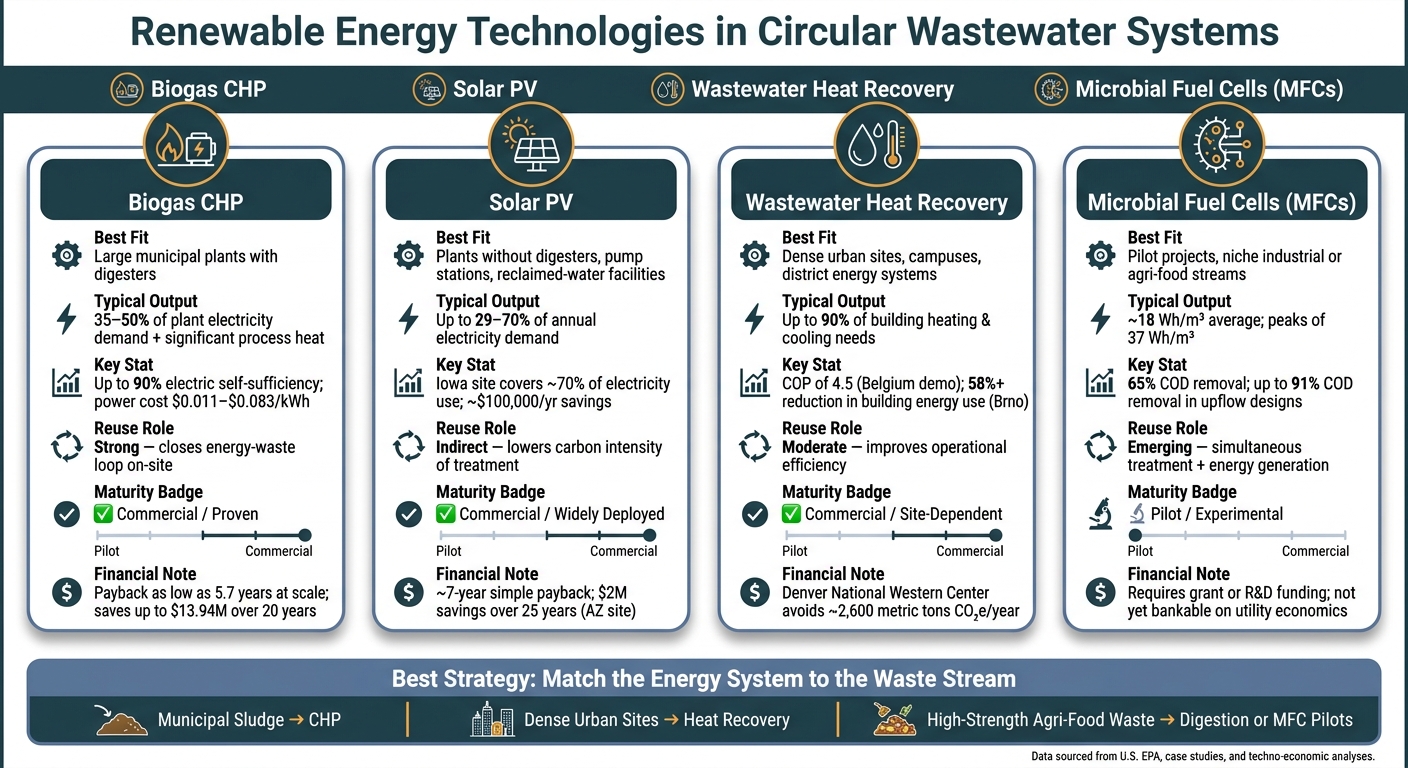
Renewable Energy Technologies in Circular Wastewater Systems: Performance & Fit
No single technology is the right pick for every wastewater site. The best option depends on plant size, the kind of waste stream coming in, available budget, and what kind of energy the facility needs day to day. This comparison looks at the four main options through a simple lens: fit, output, and maturity. The key point isn't choosing the "best" technology in the abstract. It's choosing the one that matches the site's flows, loads, and capital plan. Each option matters because it can improve the economics of reuse by pulling energy back out of waste.
Performance, Scale, and Reuse Fit Across 4 Technologies
| Technology | Best Fit | Typical Output | Reuse Role | Maturity |
|---|---|---|---|---|
| Biogas CHP | Large municipal plants with digesters | About 35–50% of plant electricity demand; significant process heat | Strong - closes the energy-waste loop onsite | Commercial, proven |
| Solar PV | Plants without digesters; pump stations; reclaimed-water facilities | Up to 29% of electricity demand in one net-zero energy model | Indirect - lowers the carbon intensity of treatment | Commercial, widely deployed |
| Wastewater Heat Recovery | Dense urban sites; campuses; district energy systems | Up to 90% of heating and cooling needs for nearby buildings | Moderate - improves efficiency of treatment operations | Commercial, site-dependent |
| Microbial Fuel Cells | Pilot projects; niche industrial or agri-food streams | About 18 Wh/m³ on average, with peaks of 37 Wh/m³ in one pilot system | Emerging - simultaneous treatment and energy generation | Pilot/experimental |
Of the four, biogas CHP is the most established choice for large municipal systems. It works especially well at plants that already have digesters, since it turns digester gas into both electricity and heat while also cutting methane emissions. In one model, CHP supplied 42% of electricity demand. When paired with solar PV, efficiency steps, and small hydropower, the site reached 100% on-site energy coverage.
Solar PV is usually the easiest option to roll out. But its circular role is more indirect. It doesn't recover energy from wastewater itself; instead, it cuts grid electricity use and lowers emissions tied to treatment. That's a good fit when electricity is the main gap. If the site or nearby buildings need heat, wastewater heat recovery can deliver more.
Wastewater heat recovery makes the most sense where there are dense thermal loads nearby. Denver's National Western Center is a good example. It uses 3,000 gallons per minute of wastewater to meet about 90% of heating and cooling demand for more than 1 million square feet, avoiding roughly 2,600 metric tons of CO₂e per year. That's where this option shines: not just at the plant, but across a nearby district or campus.
Microbial Fuel Cells, or MFCs, are still early-stage. They fit best in pilot settings and in niche industrial or agri-food streams where treatment gains may matter more than the amount of electricity produced. Average output is about 18 Wh/m³, with peaks of 37 Wh/m³ in one pilot system. Put simply, MFCs are still more about future promise than near-term utility economics.
Financial and Policy Factors in the U.S.
Performance is only part of the story. Financing often decides whether a project moves ahead.
Scale matters a lot. One techno-economic study found that a CHP system covering 60% of thermal demand saved $13.94 million over 20 years, while a 75% system saved $8.92 million. That gap is a good reminder that bigger systems don't always bring better returns. Fit still matters.
At plants producing more than 2,000,000 m³ of biogas per year, CHP payback can fall as low as 5.7 years, with a net present value of around $709,000. For public utilities, the path to that kind of project often runs through financing structures that help manage capital costs and tax treatment, such as:
- Leases
- PPAs
- Public-private partnerships
- State revolving funds
- Municipal green bonds
Wastewater heat recovery depends heavily on local conditions. Fuel prices matter. Nearby heating and cooling demand matters. If those pieces line up, payback can look attractive. If they don't, the numbers can fall apart fast.
MFCs are in a different category. Right now, they usually need grant support or R&D funding. On utility economics alone, they are not yet bankable.
There's also a reuse angle here that can be easy to miss. When treatment uses less energy, reclaimed water becomes more cost-competitive for irrigation, cooling, and industrial reuse. Federal clean energy programs, state anaerobic digestion incentives, and water-reuse policies can strengthen the business case, especially for biogas CHP and solar PV. The strongest projects line up the right energy source with the right waste stream, the right site load, and the right financing setup.
Conclusion: What the Case Studies Show About Renewable Energy in Wastewater
Circular wastewater systems work best when water reuse and energy recovery are planned together from day one. The best municipal case studies followed that pattern: digestion paired with electricity generation, plus solar during daytime demand. When treatment targets, power use, and resource recovery are handled as one system, each part helps the next. That’s how a plant moves closer to real self-sufficiency instead of just trimming utility bills.
The Columbia Boulevard Wastewater Treatment Plant’s 1.7 MW CHP system shows what biogas can do on-site. It can cut purchased power in a big way. Solar PV builds on that by reducing the grid electricity the plant still needs. Put those pieces together with efficiency upgrades, and large municipal plants have a practical path to net-zero electricity.
That same circular model fits high-strength agri-food wastewater too. In those cases, treatment can be harder, but the recovery upside is often bigger. Heat recovery pushes things further by sending recovered energy to nearby buildings and district energy networks. For smaller industrial and agri-food sites, microbial fuel cells can turn concentrated waste streams into usable energy. A soil-based MFC treating olive mill wastewater achieved over 98% COD removal and nearly 500 mW/m², which points to strong pilot-scale promise. Whether the site is a municipal treatment plant or an olive-processing mill, the takeaway is pretty clear: recover energy first, then reuse water at lower cost.
For Big Horn Olive Oil, backing mills that recover value from wastewater can cut emissions, reduce grid use, and support stronger sustainability reporting.
FAQs
Which wastewater energy option fits my facility best?
Biogas from anaerobic digestion is usually the best fit when wastewater is wet and rich in organic matter, like olive mill wastewater. It can turn that wastewater into methane for on-site electricity and heat. In many cases, you also get nutrient-rich digestate as a byproduct.
If the goal is to burn dry residues instead, biomass is the better match. Put simply: biogas for wet streams, biomass for dry ones.
Why is biogas CHP usually the top choice for large plants?
Biogas combined heat and power (CHP) systems are often the top pick for large olive oil plants because they turn waste into both power and usable heat.
That matters. A lot.
Instead of letting heat go to waste, these systems recover it and put it back to work, which improves energy use across the plant.
Electrical efficiency usually falls between 30% and 40%. With heat recovery, overall efficiency can reach 70% to 90%.
For large facilities, that means more value from wet olive pomace, more on-site energy to run daily operations, and in some cases, extra electricity that can be sent back to the grid.
What keeps microbial fuel cells from wider use today?
Microbial fuel cells run into trouble mostly because olive oil byproducts are hard to break down. Olive mill wastewater contains high levels of phenolic compounds, acids, and organic matter, and those can be toxic to microorganisms. When that happens, treatment efficiency drops.
Olive pomace creates a different problem. Its lignocellulosic structure slows hydrolysis and makes digestion harder, which puts extra strain on the system. Because of that, these setups often need pretreatment, dilution, or co-digestion to stay stable and keep working well.