

Circular Economy in Olive Mill Wastewater Reuse
Olive mill wastewater (OMWW) is a major by-product of olive oil production, with the Mediterranean region accounting for 98% of the 10–30 million cubic meters produced annually. This acidic, phenol-rich liquid poses severe risks to soil, water, and plants if not managed properly. However, circular economy strategies can turn OMWW into a resource rather than waste. Four key methods are:
- Closed-Loop Agricultural Reuse: Treated OMWW is applied as a natural fertilizer in olive orchards, reducing reliance on synthetic fertilizers but requiring careful management to avoid soil salinity issues.
- Open-Loop Industrial Reuse: OMWW is used in making construction materials like bricks, cutting fossil fuel usage during production but facing challenges with water consumption and drying processes.
- Adsorption Treatment: Olive pomace is transformed into activated carbon to remove OMWW pollutants, achieving high contaminant removal rates but involving complex and costly processes.
- Polyphenol Recovery: Valuable antioxidants like hydroxytyrosol are extracted for use in food, cosmetics, and pharmaceuticals, offering high economic returns but requiring advanced and energy-intensive technologies.
Each method has specific strengths and trade-offs, from cost-effectiveness to scalability and potential market applications. Choosing the right approach depends on the olive mill's size, location, and resources.
Adventech | Olive Mill Wastewater Treatment
sbb-itb-4066b8e
1. Closed-Loop Agricultural Reuse in Olive Orchards
One straightforward way to embrace circular economy principles in olive farming is by reusing olive mill wastewater (OMWW) right in the orchards where it originates. This approach transforms what could be an environmental hazard into a valuable resource for soil enrichment. By treating the olive orchard as both the source and destination of OMWW, this method completes a natural nutrient cycle and enhances soil health.
Environmental Performance
When applied in controlled amounts, OMWW serves as a natural fertilizer. For instance, spreading 80 m³/ha (around 8,600 gallons per acre) can deliver approximately 25–50 kg of nitrogen, 15–30 kg of phosphorus, and 80–160 kg of potassium per hectare - substantially cutting down the need for synthetic fertilizers. A long-term study (2001–2024) conducted in eight olive orchards in the Messara Plain, Crete, used 50 liters of fresh OMWW per tree annually - about 10 m³/ha/year (roughly 1,070 gallons per acre). The results showed no negative impact on soil properties while increasing nutrient availability and soil organic matter.
However, there are challenges. High salt levels in OMWW can increase soil salinity over time. Clay-loam soils, with their better cation-exchange capacity, are more effective at buffering against salinity and pH changes. Timing also matters - applying OMWW immediately after production helps prevent phenolic compounds from becoming more toxic and less biodegradable.
Economic Feasibility
For small and family-run olive mills, which dominate the Mediterranean region, this reuse method is a cost-effective solution. It requires minimal investment - basic transport and spreading tools are sufficient - avoiding the expense of industrial treatment systems. OMWW’s nutrient content also reduces the need for chemical fertilizers, cutting costs significantly. As one study highlighted:
"The limited financial capabilities of olive mills make them usually unable to bear the high costs required for the disposal of their wastes."
Additionally, keeping orchards close to mills minimizes transport expenses and ensures the wastewater remains uniform in composition. This makes the process both affordable and practical for smaller operations.
Technological Complexity
The technology needed for this method is intentionally simple. For example, neutralizing OMWW with 11 lbs (5 kg) of lime per ton of olives and allowing a three-hour sedimentation period prepares it for safe application. Another option involves using biobeds - organic filters made of straw, soil, and compost - to treat OMWW on-site. The resulting bio-mixture can then be applied as a soil amendment. While more advanced treatments like ozonation combined with anaerobic digestion or sulfate radical-based advanced oxidation processes (SR-AOPs) can improve wastewater safety, they add complexity and cost.
Scalability
This approach works well for small to medium-sized operations, especially when orchards are near the mills. However, scalability depends heavily on local regulations. Different countries have varying legal limits for OMWW application:
| Country | Max OMWW Application Limit |
|---|---|
| Italy | 8,560 gal/acre/year (three-phase) / 5,340 gal/acre/year (pressure) |
| Portugal | 8,560 gal/acre/year |
| Spain | 5,340 gal/acre/year |
| Greece | 2,140 gal/acre/year |
In Greece, stricter limits mean mills often produce more OMWW than can legally be applied, creating a disposal issue that limits the strategy's effectiveness. In contrast, countries like Italy and Portugal, with more lenient regulations, can handle a larger portion of production waste, making the method more viable for moderate-sized farms. The next strategies will explore other ways to address the gaps left by this approach.
2. Open-Loop Industrial Reuse in Construction Materials
Unlike closed-loop reuse, which keeps OMWW (olive mill wastewater) within agricultural systems, open-loop industrial reuse finds a place for it in construction materials like fired clay bricks. This industrial symbiosis treats OMWW as a secondary raw material, offering a practical solution for the 30 million tons of OMWW produced annually in the Mediterranean region. By directing excess OMWW toward the construction sector, this approach tackles the issue of surplus waste while exploring new ways to recover resources.
Environmental Performance
One of the most immediate environmental benefits of this method is its ability to divert waste. Using OMWW in brick production prevents it from ending up in evaporation ponds, which can lead to groundwater contamination and unpleasant odors. Additionally, when OMWW replaces fresh water in brick-making, the organic solids in the wastewater act as a secondary fuel during kiln firing. This substitution reduces reliance on fossil fuels, cutting the Global Warming Potential (GWP) by up to 3.1% and lowering fossil fuel depletion by 4.3% compared to traditional brick production methods.
However, this process isn’t without its challenges. While OMWW can replace fresh water, overall water consumption during production may actually rise by as much as 7.8%. On top of that, the drying steps required for OMWW-based bricks are energy-intensive, potentially increasing the carbon footprint.
Economic Feasibility
Introducing OMWW to the construction industry brings unique economic considerations. For this process to make environmental sense, the olive mill should ideally be located within 93 miles (150 km) of the brick production facility to achieve GWP reductions. From a cost perspective, transport distances of up to 207 miles (333 km) are manageable, but anything in between these two thresholds risks being financially viable yet environmentally inefficient.
On the upside, OMWW’s organic content has a calorific value of 21–23 MJ/kg, which can partially replace fossil fuels during kiln firing. As Mekki et al. explain:
"Once in the kiln, the remaining solids in the bricks (calorific value 21–23 MJ kg⁻¹) would liberate additional heat, reducing the gross energy from fossil fuel currently required during firing."
This energy offset can help reduce operational costs, but proximity remains key to balancing both economic and environmental goals.
Technological Complexity
Turning liquid OMWW into a usable material for construction is no small feat. The high moisture content poses a significant challenge, as thermal drying is often slowed by a crust that forms on the surface during evaporation. A practical workaround is biomass impregnation, where materials like sawdust are soaked in OMWW, then dried into solid bricks. Laboratory tests have shown that these OMWW-impregnated bricks achieve a heating value of 18 MJ/kg, compared to 16.4 MJ/kg for untreated biomass.
More advanced technologies, such as microfiltration (MF), reverse osmosis (RO), and vacuum membrane distillation (VMD), can concentrate OMWW’s organic load while recovering purified water. These methods are much more efficient than thermal evaporation but require substantial financial investment and specialized infrastructure - resources that most small mills lack.
Scalability
Scaling this approach involves bridging the gap between the agriculture and construction industries, two sectors that rarely collaborate. Complicating matters further, the composition of OMWW varies widely depending on factors like olive variety, ripeness, and the extraction system used. For example, three-phase systems (common in Greece and Italy) produce large amounts of liquid OMWW, making them more suitable for brick production. In contrast, two-phase systems (widespread in Spain) generate a semi-solid slurry that requires different processing methods.
Regulatory standards also need to catch up. Construction material guidelines must account for the chemical variability of OMWW-derived inputs before manufacturers can confidently scale up production. For now, this strategy is likely to remain limited to pilot programs and research collaborations rather than becoming a mainstream industrial practice.
3. Adsorption-Based Treatment Using Olive Pomace–Derived Activated Carbon
Instead of discarding OMWW, it can be repurposed by transforming olive pomace and stones into activated carbon to remove contaminants. Olive pomace and stones, the solid byproducts of oil extraction, are processed into activated carbon or biochar, which is then used to filter pollutants from OMWW. This process reflects the principles of a circular economy by turning waste into a useful resource.
Environmental Performance
This treatment method combines water quality restoration with the reuse of olive byproducts. Adsorption is highly effective for treating OMWW, achieving up to 99.9% removal efficiency for both organic and inorganic pollutants. By comparison, electrocoagulation (EC) alone typically removes only 54–58% of phenols and COD. However, when adsorption is added as a polishing step after EC, removal rates improve to about 62.63% for phenols and 72.88% for total COD. Adsorption pretreatment also significantly enhances OMWW biodegradability, increasing it from 34% to 82%.
For instance, research conducted in June 2025 by the Laboratory of Bioresources (Morocco) and INRAE (France) demonstrated the effectiveness of Amberlite XAD-4 resin in a continuous adsorption column. With a resin bed height of 18.5 cm, this approach achieved an 80% reduction in COD and a 64% reduction in polyphenols, which subsequently improved methane yield during anaerobic digestion to 287 mL CH₄/g COD.
Economic Feasibility
One of the main advantages is the low cost of raw materials. Olive stones and pomace are produced in large amounts - around 500 tons per mill per season - and are typically discarded at a cost. Converting these materials into adsorbents can reduce disposal costs and eliminate the need for expensive commercial activated carbon.
A combined electrocoagulation–adsorption (ECA) system costs approximately $3.92 per cubic meter of treated wastewater, with energy consumption at about 14.31 kWh/m³. However, replacing adsorbents is a recurring expense. Phenol separation costs in similar systems range between $0.92 and $14.93 per gram of phenols, depending on the adsorbent's durability.
Technological Complexity
Producing activated carbon from olive byproducts involves several steps: cleaning, drying at 105°F (40°C), carbonizing at temperatures between 400°F and 1,110°F (200–600°C) for one to five hours, followed by grinding and sieving into particle sizes of 0.003–0.012 inches (0.075–0.3 mm). Each step directly affects the material's adsorption capacity.
Given the complex composition of OMWW - with COD levels reaching up to 220 g/L and phenolic compounds ranging between 4 and 6 g/L - adsorption works best as part of a multi-stage system rather than a standalone solution. Typically, treatments are sequenced as EC followed by adsorption or adsorption followed by anaerobic digestion, depending on the desired outcome.
Scalability
Although olive pomace is widely available and benefits from existing logistics, the primary challenge lies in building infrastructure to consistently produce high-quality adsorbent material and integrate it into local treatment systems. Another consideration is the seasonal nature of OMWW production, which occurs over just three to four months each year. Facilities must plan for off-season operations, such as processing other agricultural wastes or scaling down capacity.
Larger centralized systems can reduce costs through economies of scale. According to the "six-tenths-factor rule", higher-capacity installations generally incur lower costs per unit of throughput, making regional treatment hubs more cost-effective than smaller on-site systems. This approach aligns with the broader integrated strategies explored in this article.
4. High-Value Polyphenol and Antioxidant Recovery
This method takes a step beyond simply improving water quality, focusing instead on extracting valuable compounds from olive mill wastewater (OMWW). By doing so, it transforms OMWW into a resource with commercial potential. For instance, each liter of OMWW can yield approximately 1.2 g of hydroxytyrosol and 0.4 g of flavonoids - both in high demand across the food, pharmaceutical, and cosmetic industries.
Environmental Performance
Using sequential membrane filtration techniques - like ultrafiltration (UF), nanofiltration (NF), and reverse osmosis (RO) - can reduce the organic load (COD) by 95–97%, while concentrating bioactive compounds in the retentate. Instead of being discarded, this retentate becomes a usable product. As Alberto Alfano from the Department of Experimental Medicine explains:
"The application of molecules (NF retentate) may sustain the wastewater treatment costs by improving the overall environmental impact in olive mill processing."
However, energy usage is a key consideration. The initial stages of concentration consume more than 0.70 kWh per kilogram of water removed, which adds to the carbon footprint. Still, this approach offsets its environmental costs by converting pollutants into valuable products, complementing other reuse strategies.
Economic Feasibility
The financial benefits of recovering polyphenols align with the principles of a circular economy. For example, purified hydroxytyrosol supplements can sell for as much as $57 per gram, while olive leaf extracts (oleuropein) are priced between $1.10 and $18.70 per gram. When phenolic compounds are sold at prices ranging from $3.30 to $11 per kilogram, the recovery process becomes economically appealing, potentially achieving an 8% internal rate of return (IRR).
One critical factor in cost management is the lifespan of the resin used for phenol separation. Dimitris P. Zagklis from the Laboratory of Transport Phenomena and Physicochemical Hydrodynamics highlights:
"The lifespan of the resin proved to be the single most important aspect that determines the phenols separation cost."
If the resin lasts for 100 cycles, the cost of separation can drop to about $0.92 per gram. But with only 5 cycles, costs can soar to approximately $14.93 per gram.
Technological Complexity
Turning OMWW into valuable extracts involves several detailed steps. A typical high-recovery process includes:
- Pre-acidification: Adjusting the pH to 2.0 to release hydroxytyrosol and reduce protein interference.
- Delipidization and solvent extraction: Removing fats and isolating target compounds.
- Resin-based purification: Achieving recovery rates of 80% for hydroxytyrosol and 61% for total phenols, while eliminating 88–97% of carbohydrates.
The choice of solvent is another key factor. Ethanol/salt-based aqueous two-phase extraction (ATPE) can recover up to 6.6 mg of hydroxytyrosol per gram, outperforming conventional ethyl acetate extraction, which yields 3.2 mg/g. Additionally, pre-treating OMWW with a flocculation agent like celite (at 0.5–2% w/v) before membrane filtration can boost polyphenol recovery to around 65%, compared to 40% with centrifugation.
Scalability
The wide-ranging applications of recovered polyphenols in industries like food, pharmaceuticals, and cosmetics offer significant market opportunities. These compounds can be used as natural preservatives, anti-inflammatory agents, and anti-aging ingredients. However, scaling up requires considerable investment in equipment such as membrane systems, resin technology, and solvent recovery units. Current recovery systems can achieve efficiencies of around 94%.
To maximize economic returns, integrating polyphenol recovery with other downstream processes - like biogas production or biofertilizer generation - can further improve the overall cost-effectiveness. The next section will compare the strengths and challenges of this and other strategies.
Pros and Cons of Each Reuse Strategy
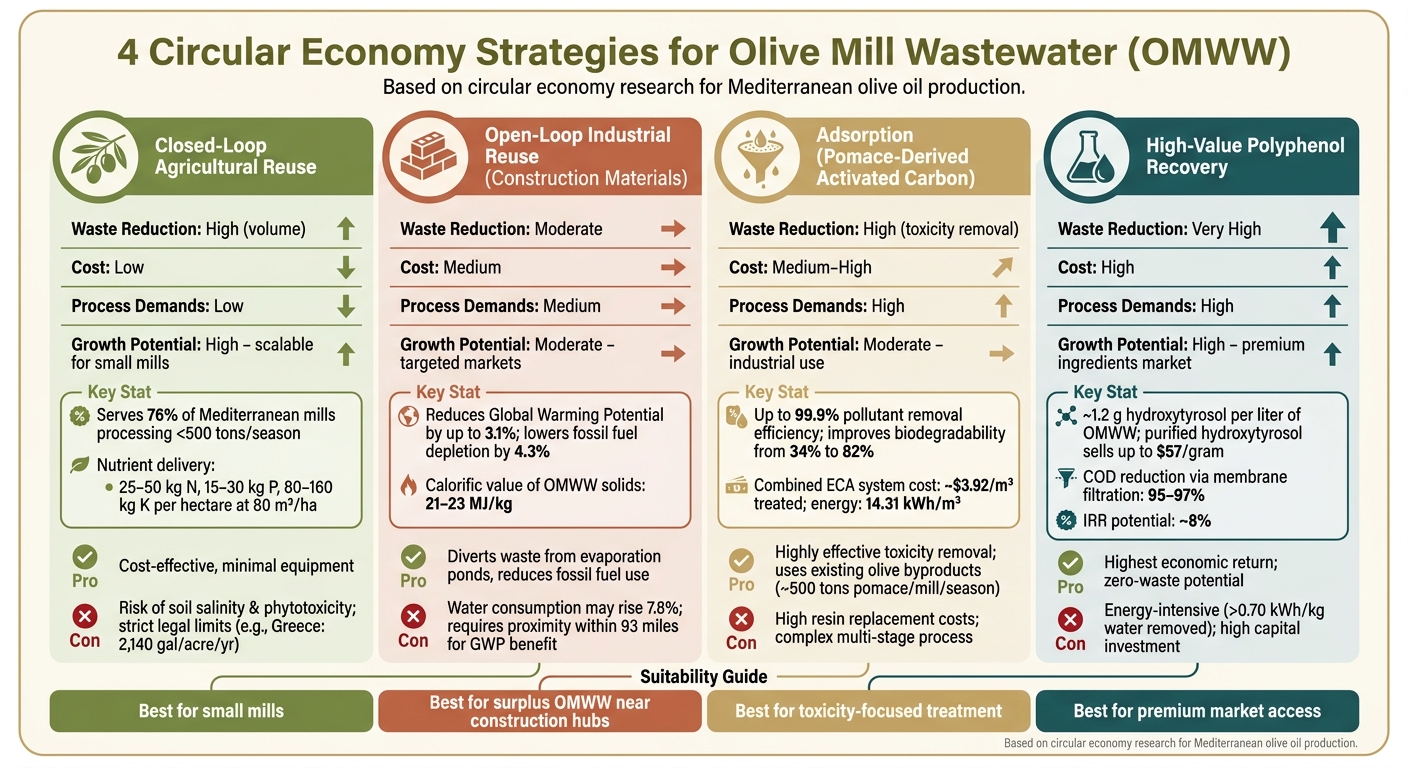
4 Circular Economy Strategies for Olive Mill Wastewater (OMWW): Pros, Cons & Key Metrics
Transforming olive mill wastewater (OMWW) from waste into a resource aligns with the principles of a circular economy. However, each reuse strategy comes with its own set of trade-offs. The most suitable approach depends on factors like the scale of operation, budget, and desired outcomes - there’s no one-size-fits-all solution.
Here’s a breakdown of the key trade-offs for each reuse strategy:
| Reuse Strategy | Waste Reduction | Cost | Process Demands | Growth Potential |
|---|---|---|---|---|
| Closed-Loop Agricultural Reuse | High (volume) | Low | Low | High – scalable for small mills |
| Open-Loop Industrial Reuse | Moderate | Medium | Medium | Moderate – targeted markets |
| Adsorption (Pomace-Derived Activated Carbon) | High (toxicity) | Medium–High | High | Moderate – industrial use |
| High-Value Polyphenol Recovery | Very High | High | High | High – premium ingredients market |
Closed-Loop Agricultural Reuse
This strategy is straightforward and cost-effective, making it especially attractive to the 76% of Mediterranean olive mills that process fewer than 500 tons of olives per season. However, there’s a significant downside: the risk of phytotoxicity and groundwater contamination. For instance, in Italy, regulations cap land application at around 26–42 cubic yards per acre annually.
Open-Loop Industrial Reuse
Using OMWW in industrial applications, like construction materials, strikes a balance. It prevents waste from ending up in landfills and creates secondary products. However, the economic returns are modest, and market demand for these materials remains somewhat limited.
Adsorption Using Pomace-Derived Activated Carbon
This method stands out for its ability to effectively remove toxic phenols from OMWW. The challenge lies in the high costs associated with resin replacement, which can make the process less appealing for widespread adoption.
High-Value Polyphenol Recovery
Recovering polyphenols is the most technically complex and expensive strategy, but it offers the greatest potential for high-value applications, such as premium ingredient markets. Professor Zakaria Al-Qodah from Al-Balqa Applied University highlights its benefits:
"The proposed approach led to zero waste with a closed water cycle development."
However, this method isn’t without its challenges. As noted in the Sustainability Journal:
"The most circular solution is not ever the best environmental choice."
High energy consumption during membrane concentration and solvent processes can offset some of the environmental benefits, making it less ideal in certain scenarios.
These trade-offs emphasize the diverse opportunities - and challenges - of circular economy strategies in addressing OMWW management. Each method requires careful consideration to balance environmental, economic, and technical factors.
Conclusion
Each approach to reusing OMWW comes with its own advantages, depending on the scale of operations, budget constraints, and environmental goals. For smaller mills with limited resources, land application offers a simple and cost-effective solution, provided it is done within legal limits. On the other hand, larger producers might explore open-loop industrial reuse or invest in polyphenol recovery, which can yield considerable economic benefits. These options highlight the importance of tailoring strategies to fit the specific needs of each operation.
At its core, the goal is simple: turn OMWW from a waste product into a resource. As Iosif E. Kapellakis from the Department of Civil Engineering at Neapolis University Pafos aptly puts it:
"The wastewater produced by an olive tree during its olive fruit processing should return directly to that olive tree."
This idea of returning resources to their origins embodies the essence of a circular economy.
For premium olive oil brands like Big Horn Olive Oil, managing OMWW responsibly not only supports environmental efforts but also strengthens the brand's commitment to quality - from the orchard to the final product. Thoughtful OMWW practices ensure that the integrity of premium products is upheld throughout the process.
Even adopting just one reuse strategy - whether it’s land application, industrial reuse, or polyphenol recovery - can make a meaningful difference in reducing environmental impact. By embracing these circular economy principles, producers can help secure a sustainable future, ensuring that every step from orchard to bottle reflects care and responsibility.
FAQs
How do olive mills choose the best OMWW reuse method?
Olive mills carefully assess a mix of operational, environmental, and economic factors when deciding how to manage olive mill wastewater (OMWW). Popular approaches include direct land application, which helps return nutrients to the soil, and more advanced methods such as ozonation, anaerobic digestion, and membrane filtration to prepare the wastewater for irrigation. By using multi-criteria frameworks, mills can weigh costs, sustainability goals, and regulatory standards to find the most effective reuse strategy. Big Horn Olive Oil embodies these principles, showcasing a dedication to both quality and health.
Is land-applying treated OMWW safe for olive orchards long term?
Research indicates that using treated olive mill wastewater (OMWW) on orchards can be a safe and effective option when managed carefully. This approach can improve soil by increasing nutrients and organic matter. However, overuse or poor management could lead to soil and groundwater contamination. Sticking to recommended application rates and timing is key to maintaining safety and aligning with circular economy practices.
What makes polyphenol recovery from OMWW so expensive to scale?
Scaling up the recovery of polyphenols from olive mill wastewater comes with hefty costs, largely due to the waste's complex and non-biodegradable nature, which makes extraction tricky. The process typically relies on energy-heavy techniques such as acidification, solvent extraction, and membrane filtration. On top of that, seasonal fluctuations in waste production, the dispersed locations of olive mills, and the requirement for specialized infrastructure to prevent membrane fouling add further to the expenses.