

How Circular Wastewater Policies Impact Olive Oil Industry
Circular wastewater rules are changing olive oil production: mills that reuse or treat olive mill wastewater well can cut risk, lower outside disposal needs, and open paths to water, energy, or by-product recovery.
If I boil the article down, here’s the answer:
- Olive mill wastewater (OMWW) is hard to handle because it is acidic and packed with organic matter, oils, and phenols.
- Old disposal methods are losing ground due to stricter EU, national, and regional rules.
- Policy now pushes reuse and recovery first, with disposal treated as the last step.
- Producer choices now depend on local limits for land spreading, pretreatment, storage, testing, and reuse.
- Common circular routes include orchard application, fertigation, water recycling, polyphenol recovery, and biogas production.
- Costs can be high, often from $0.30 to $11.60 per m³, so mills need a clear rule-by-rule plan before buying equipment.
- The business effect is simple: poor OMWW handling can lead to fines, shutdown risk, buyer concern, and brand damage.
A few numbers stand out:
- OMWW is usually 83% to 94% water, but the rest carries the main pollution load.
- COD can exceed 126 to 216 g/L, with some cases reaching 300 g O₂/L.
- BOD can reach 30 to 48 g/L.
- Some advanced systems can recover up to 95% of wastewater for reuse.
- Spain and Italy both use land-application caps such as 50 m³/ha/year, with some Italian continuous-cycle mills allowed up to 80 m³/ha/year.
Here’s the core takeaway for me: this is no longer just a waste issue. It is a compliance, cost, and market issue at the same time. If I run or source from an olive mill, I need to know which rules apply, what reuse path is allowed, what testing is required, and whether recovery can offset part of the treatment bill.
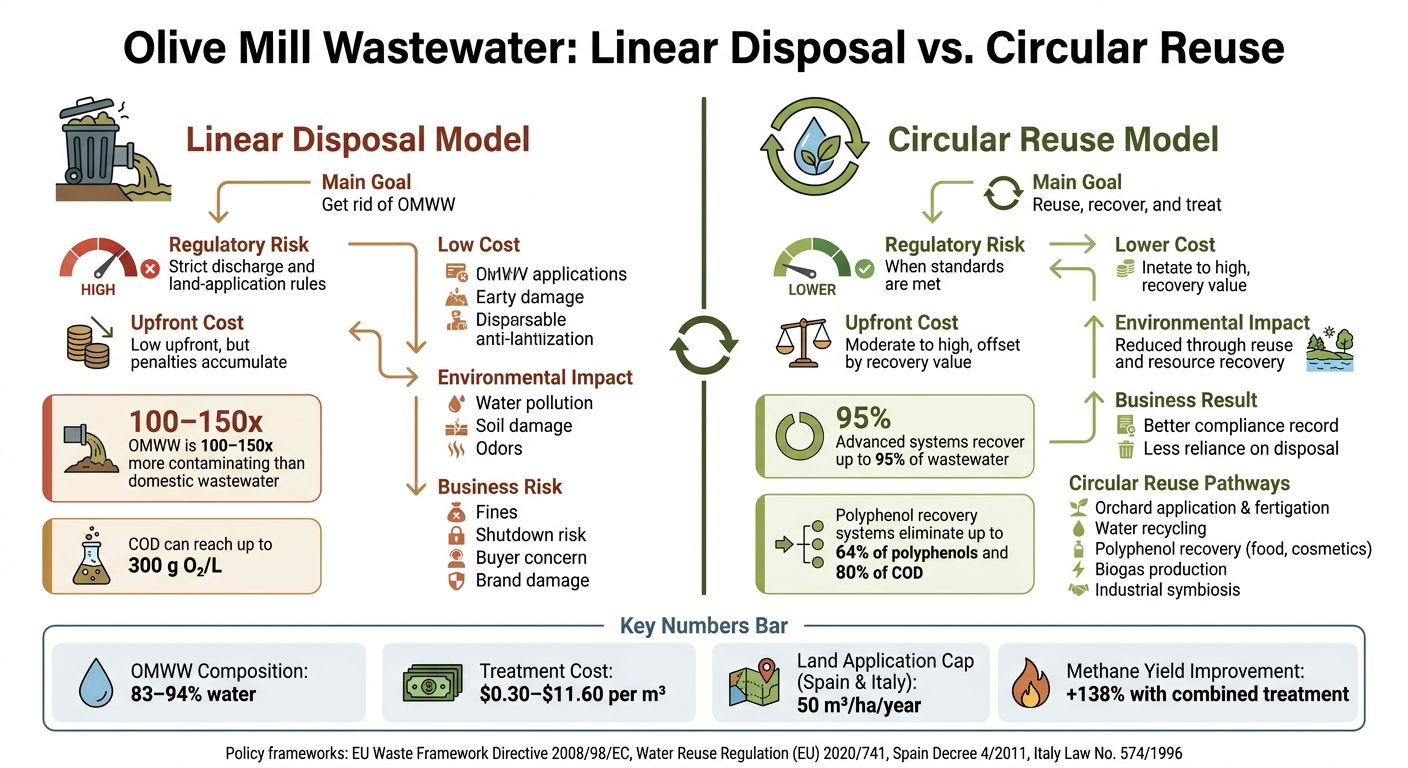
Olive Mill Wastewater: Linear Disposal vs. Circular Reuse at a Glance
Quick Comparison
| Area | Old disposal model | Circular model |
|---|---|---|
| Main goal | Get rid of OMWW | Reuse, recover, and treat |
| Rule pressure | High | Lower when standards are met |
| Mill setup | Storage, hauling, disposal | Pretreatment, reuse, recovery systems |
| Main risks | Water and soil harm, odor, fines | Higher upfront spend, more process control |
| Business result | More exposure to penalties and buyer concern | Better compliance record and less reliance on disposal |
That’s the big picture: policy is turning OMWW from a mill headache into a controlled input or recovery stream - if the producer can meet the rules.
sbb-itb-4066b8e
The Core Problem: Why Older Wastewater Management Methods Fall Short
Older OMWW systems are struggling under today’s rules because they were built to get rid of wastewater, not put it back to use.
Compliance, Pollution, and Reputation Risks Under Non-Circular Systems
This isn’t just an engineering issue anymore. It’s a rules-and-risk issue.
OMWW is high-strength wastewater. It can be 100 to 150 times more contaminating than domestic wastewater, with COD values reaching up to 300 g O₂/L and phenolic content ranging from 0.5 to 24 g/L. That’s a huge load. And when mills discharge it untreated or leave it in poorly managed evaporation ponds, the damage shows up fast.
Studies from Morocco found groundwater near evaporation basins with COD at 400 mg O₂/L and polyphenols at 180 mg/L.
The business side matters too. If a producer sells into quality-focused or export-oriented markets, poor wastewater handling can hurt the brand. Pollution links, odor complaints, or rule violations can damage how buyers, neighbors, and regulators see the mill. For a mill trying to position itself as premium or sustainability-conscious, that kind of stain is tough to wash off. So the discussion is moving away from simple disposal and toward reuse shaped by policy.
High Treatment Costs and Technical Limits for Many Mills
There’s another hard truth: no single cheap system can hit every discharge target for every mill.
To cut COD, suspended solids, and phenols down to discharge or reuse standards, mills usually need a multi-step setup. That can include anaerobic digestion, membrane filtration, and oxidation. In plain English, it’s not one machine and done. It’s a chain of processes, and each one adds cost.
Reported treatment costs range from roughly $0.30 to $11.60 per cubic meter depending on the technology. Annual costs for treating 1,000 cubic meters can run from about $10,250 to $101,250 based on process intensity.
For small or seasonal mills, that math can be rough. Expensive equipment may sit idle for much of the year, which makes the investment hard to justify. And that’s exactly why many mills are looking harder at circular paths that recover something useful instead of just paying to clean up waste.
Linear Disposal vs. Circular Reuse
| Dimension | Linear Disposal | Circular Reuse |
|---|---|---|
| Regulatory risk | High, especially where discharge and land-application rules are strict | Lower if reuse, recovery, and pretreatment meet local standards |
| Upfront cost | Low upfront, but often shifts costs to future compliance or penalties | Moderate to high upfront |
| Operating cost | Low to moderate until violations or hauling costs arise | Moderate to high, depending on treatment system and recovery |
| Environmental impact | Higher risk of water pollution, soil damage, and odors | Lower impact through reuse, treatment, or resource recovery |
Linear disposal may look cheaper at first glance. But over time, it can bring more compliance pressure and more brand risk. That gap is a big reason circular rules are starting to shape how mills invest and run day to day.
The Policy Shift: Which Rules Are Pushing Circular Wastewater Use
Mills across the EU now operate under rules that make simple disposal harder to defend. The policy direction is clear: prevent waste where possible, reuse more, and treat disposal as the last option. In practice, that starts with EU law and then filters down into permits, discharge caps, and reuse conditions at the national and regional level.
EU and Regional Policy Frameworks That Support Reuse and Recovery
Several EU rules set the baseline.
The Waste Framework Directive 2008/98/EC, as amended by Directive 2018/851, sets out the waste hierarchy: prevention first, then reuse, recycling, recovery, and disposal last. For olive mill wastewater, or OMWW, one legal issue matters a lot: can it be treated as a by-product instead of waste? Under the Waste Framework Directive, OMWW can qualify as a by-product only when it can be used safely, directly, and with minimal processing. If that test is met, land application or use as a soil amendment may fall under less restrictive rules.
The Urban Waste Water Treatment Directive 91/271/EEC adds pressure from another angle. OMWW can carry a highly concentrated organic load, so mills that send it to municipal treatment plants often face pre-treatment demands or extra charges. That changes the math fast. What looks like a simple discharge route can turn into a cost problem.
The Water Reuse Regulation (EU) 2020/741, applicable from June 26, 2023, pushes the issue further by setting minimum quality classes for reclaimed water used in agriculture. Those classes include microbiological limits such as E. coli ≤ 10 CFU/100 mL for Class A and ≤ 100 CFU/100 mL for Class B. In plain terms, these thresholds now help decide whether treated OMWW stays in the waste stream or can move into reuse.
How National Rules in Olive-Growing Regions Shape Producer Decisions
At the national level, Spain and Italy both offer legal routes for controlled land application of OMWW. But the details are different enough that mills can't just copy a plan from one region and use it in another.
In Spain, Andalusia's Decree 4/2011 directly refers to Waste Framework Directive Article 5(1) to support treating OMWW as a by-product for agronomic use. The decree sets a cap of 50 m³ per hectare per year, requires a formal Effluent Management Plan, and creates exclusion zones. Spreading is banned within 500 meters of urban areas and within 100 meters of drinking water protection zones.
In Italy, Law No. 574/1996 and regional measures such as Sicily's regional decree no. 61 of January 17, 2007 allow the agronomic use of "vegetation waters." The limits are 50 m³/ha/year for traditional press systems and 80 m³/ha/year for continuous-cycle mills. Mills also need technical documentation and coordination with regional authorities.
These local limits affect more than paperwork. They shape storage capacity, application timing, transport plans, and whether treatment is needed before reuse. That's why mills need to line up reuse plans with local rules before they spend money on equipment. In many cases, those legal limits are what decide which treatment and reuse routes are even possible.
The Solutions: How Circular Wastewater Policies Change Olive Oil Mill Operations
Once the rules are in place, mills have to turn compliance into day-to-day operations. Circular wastewater policy changes OMWW from a disposal problem into something mills may be able to use. In practice, those rules shape what can happen on-site and what has to be treated or sent out.
Controlled Land Application, Fertigation, and Orchard Reuse
With local limits in place, controlled land application can send water and nutrients back to orchards. Field studies show that applying OMWW at regulated loading rates - keeping organic load below 500 kg BOD₅ per hectare per day - can increase nutrient availability and maintain soil organic matter without adverse effects on soil properties.
For mills, that shifts OMWW into a managed input instead of a waste stream. But it only works when there is a formal application plan and soil monitoring to back it up. In plain terms, you can't just spread it and hope for the best. The policy framework matters because it sets the limits and the checks.
When land application is capped or just not practical, mills usually have to look at recovery instead.
Resource Recovery, Water Recycling, and Industrial Symbiosis
Beyond land application, circular policy pushes mills to recover specific materials from OMWW. The main targets are polyphenols, biogas, and recycled water. OMWW contains polyphenols that can be recovered for food, cosmetic, and energy uses.
One study using a combined adsorption and anaerobic digestion process showed strong treatment results. The system eliminated up to 64% of polyphenols and 80% of COD, increased biodegradability from 34% to 82%, and reached methane yields of 287 ± 2 NmL CH₄/g COD - a 138% improvement over raw OMWW.
That matters for operations because recovery is no longer just about waste reduction. It can also feed other markets and processes. Industrial symbiosis pushes that idea a step further, with recovered extracts supplying food, cosmetic, and bioplastic uses.
These routes usually need tighter treatment than simple settling or storage.
Why Advanced Treatment Systems Are Becoming More Common
Stricter reuse and discharge criteria are pushing mills toward advanced treatment. A common setup combines membrane filtration with advanced oxidation. The data helps explain why mills are making that move.
After coagulation and flocculation, solar photo-Fenton treatment removed more than 94% of COD and eliminated the phenolic fraction in tested OMWW. Combined UF/NF membrane systems removed up to 95% of COD and 90% of conductivity, while concentrating 93% of total phenolics in the retentate for possible recovery.
That mix gives mills three things at once: reuse options, material recovery, and a clearer path to discharge compliance. For operators, that's the whole point.
What Producers Should Do Next
Build a Policy-to-Action Plan for Wastewater Compliance
After producers identify reuse options, the next step is simple in theory but detailed in practice: build a compliance plan that fits local rules. The first move should be a regulatory mapping exercise, or a line-by-line review of the rules that apply.
In plain English, that means listing every rule tied to the operation at the EU, national, and regional level. This includes discharge limits, land application caps, by-product classification, and monitoring requirements. National land-application caps differ a lot from one country to another, so mills need to pin down local limits before they plan any reuse route.
From there, producers should turn those rules into mill-level requirements. That includes maximum annual volumes, required pre-treatment steps, and testing schedules for COD, BOD, and phenols. Those items shouldn't sit in a separate memo or get lost in email. They need to be built into an environmental management system (EMS) with documented procedures, clear ownership, and records ready for inspection.
That’s where policy stops being abstract and starts turning into day-to-day action.
Policy Drivers, Producer Steps, and Business Outcomes
The table below connects policy drivers to producer actions and likely business results.
| Policy Driver | Recommended Producer Action | Expected Business Outcome |
|---|---|---|
| EU water rules | Invest in pre-treatment to meet reuse or discharge standards; track COD and BOD against legal thresholds | Lower risk of discharge violations; reduced freshwater consumption |
| National land application decrees (Italy, Portugal, Greece) | Develop an effluent management plan; schedule applications within legal volume caps; conduct soil and groundwater monitoring | Reduced disposal fees; improved soil fertility; compliance documentation |
| Regional effluent management requirements | Implement pre-treatment (pH adjustment, sedimentation); train field staff on safe application and spill response | Fewer regulatory incidents; stronger permit renewal position |
| EU Circular Economy and Bioeconomy strategies | Explore partnering with nearby industries; collaborate with research institutes on valorization pilots | New revenue from recovered by-products; stronger buyer confidence |
| By-product classification rules | Document OMWW flows, treatment steps, and end uses in EMS; integrate into supplier codes of conduct | Clearer audit trail; easier access to markets that require environmental transparency |
Conclusion: Circular Policy Turns Wastewater From a Liability Into a Resource
Once compliance is mapped, the business case gets easier to handle. Older OMWW disposal practices can bring serious environmental and financial risk. Fines, forced shutdowns, and reputational damage are all on the table when discharge or land application rules are missed. Circular policies change that picture. When OMWW is treated as a resource through reuse and recovery, producers can improve compliance while also cutting costs.
Early action gives producers more than regulatory protection. It can improve day-to-day resilience, reduce reliance on outside disposal services, and help create a documented sustainability story that downstream buyers increasingly want to see, including specialty retailers and premium brands in the U.S. For buyers, sourcing from mills with documented circular OMWW practices can support stronger supply-chain integrity.
FAQs
How can a mill tell if OMWW qualifies as a by-product rather than waste?
A mill can treat olive mill wastewater (OMWW) as a by-product when it can be processed for reuse in a circular economy, such as turning it into biofertilizers, biopolymers, or energy through anaerobic digestion.
But there’s a catch: OMWW also needs treatment before it can be used safely. In plain English, that means lowering phytotoxic phenolic compounds and keeping salt levels under control, so the final material can work for uses like irrigation or soil amendment without causing harm.
What treatment option makes the most sense for a small or seasonal olive mill?
For a small, seasonal olive mill, anaerobic digestion is often the best waste-to-energy option. It can turn by-products like pomace into biogas, which gives the mill a practical way to get some use out of its waste.
For wastewater, UASB reactors are a strong fit. They can stay operational during idle periods and use a simple, low-energy design. Simple composting can also work well as a lower-cost option, as long as it is managed with care.
What records and testing do mills need to stay compliant with reuse rules?
Mills need to keep detailed records and technical documents for every recycling and waste management process. That includes waste audits that track byproduct volume, composition, and seasonal shifts.
If a mill reuses treated wastewater or recycled byproducts, it should test them on a regular basis. The main checks include phenol levels, total suspended solids, sulfates, electrical conductivity, and soil conditions like salt buildup and mineral levels.