

Common Mistakes When Seasoning with Olive Oil
When seasoning your cookware with olive oil, it’s easy to make missteps that lead to sticky finishes, uneven coatings, or even damaged pans. Here’s what you need to know:
- Overheating: Olive oil has a smoke point of 350°F to 410°F. Heating it beyond this range can break down its structure, leading to harmful byproducts and a bitter taste.
- Using Too Much Oil: Excess oil creates a gummy, uneven layer. A thin, even coating - just a teaspoon or less - is all you need.
- Wrong Pan Type: Olive oil isn’t ideal for cast iron due to its lower smoke point. Use oils like grapeseed or canola for better results.
For best results, control heat carefully, apply thin layers, and choose oils suited to your cookware. High-quality extra virgin olive oil (EVOO) works well for lighter seasoning and everyday cooking, thanks to its stability and flavor. However, it’s not the best choice for heavy-duty pan seasoning.
Follow these tips to avoid common pitfalls and keep your cookware in top shape.
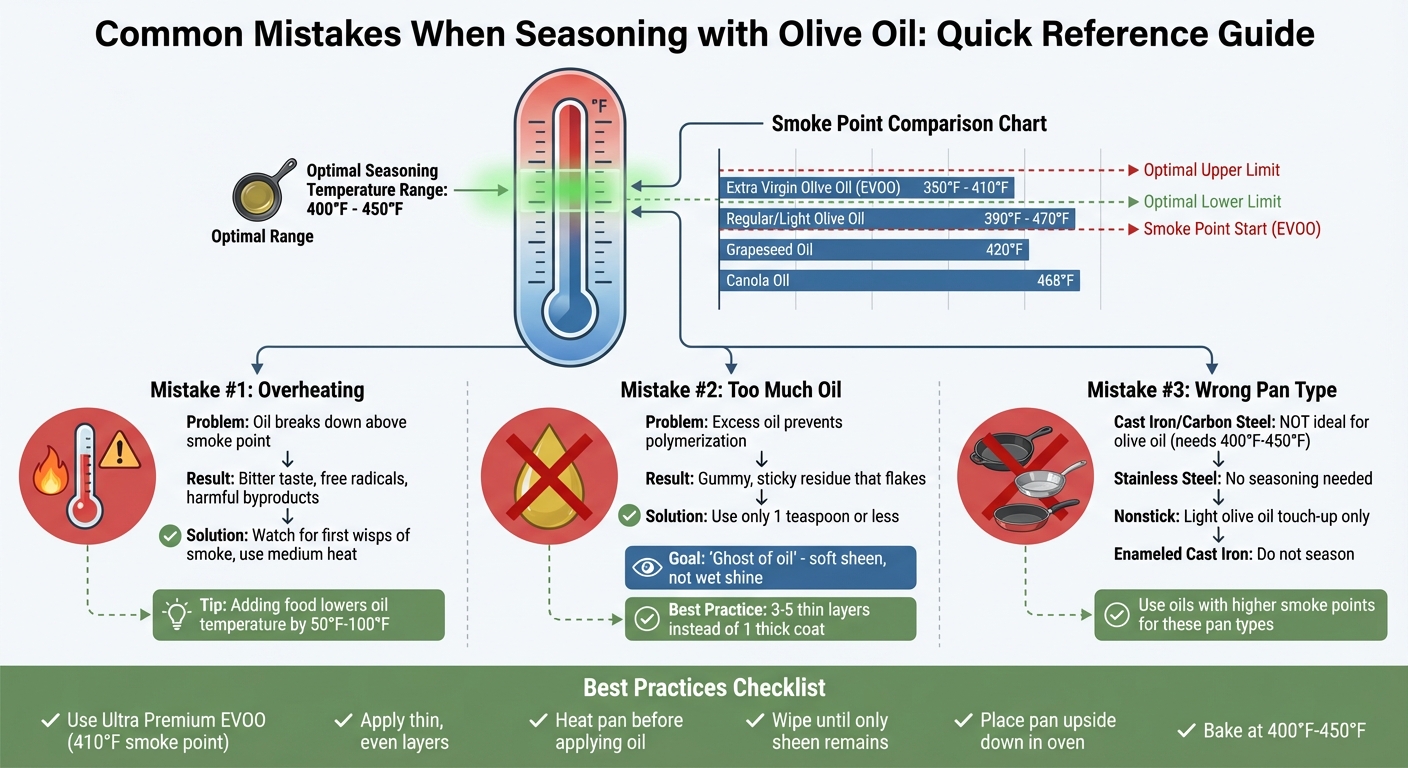
Olive Oil Smoke Points and Pan Seasoning Guide
Mistake #1: Overheating Olive Oil
Understanding Olive Oil's Smoke Point
The smoke point is the temperature at which oil starts to break down and emit visible smoke. For extra virgin olive oil (EVOO), this typically ranges from 350°F to 410°F. Regular or light olive oil can handle slightly higher temperatures, between 390°F and 470°F.
When olive oil exceeds its smoke point, its fat molecules break down into glycerol and fatty acids. The glycerol then further degrades into acrolein, which gives food an unpleasant, bitter flavor. Kathy McManus, Director of the Department of Nutrition at Brigham and Women’s Hospital, explains:
The reason you want to avoid burning the oil is that it will spoil the taste of the food, and some of the (EVOO's) healthy properties may be destroyed.
Overheating also produces free radicals and harmful byproducts, which have been linked to long-term health concerns.
It’s important to note that smoke point isn’t the only factor that determines an oil’s stability. Extra virgin olive oil, despite its lower smoke point compared to some refined oils, is often more stable because of its monounsaturated fats and protective polyphenols, which resist oxidation better. However, once the oil reaches its smoke point, these beneficial antioxidants and Vitamin E begin to break down. This chemical shift highlights the importance of careful temperature control when cooking with olive oil.
How to Monitor and Control Heat
To keep olive oil from overheating, it’s crucial to manage heat carefully and look for signs of trouble.
One of the easiest ways to avoid overheating is to pay attention to visual cues. Bill Briwa, Senior Chef-Instructor at the Culinary Institute of America, advises:
When you see the first few wisps of smoke indicating the maximum safe temperature, you then have two choices. You can take the pan off the heat. Or you can add some food.
It’s also helpful to distinguish between steam (which is white and odorless) and smoke (which is darker and has a sharp smell). For oven seasoning, stick to temperatures between 400°F and 450°F, and use an oven thermometer to ensure accuracy since oven dials can be unreliable. On the stovetop, medium heat is usually safest - most home burners don’t exceed 350°F even on high. However, an empty pan can quickly overheat, so adding food promptly helps. Food introduced to a hot pan can lower the oil’s temperature by 50°F to 100°F, keeping it within a safer range.
Deep Dive: How to Season Cast Iron the Right Way (No Myths)
Mistake #2: Using Too Much Olive Oil
Too much olive oil can interfere with proper polymerization, resulting in a soft, gummy layer that may wrinkle or flake off over time. Daniel Gritzer, Editorial Director at Serious Eats, explains that even a small excess can pool during seasoning, creating hardened droplets or turning sticky if the pan sits unused for a few days. When oil doesn’t polymerize, it oxidizes, leaving behind a tacky residue that’s tough to clean.
How Much Olive Oil Is Enough?
The issue isn’t the type of oil but how much you’re using. For most pans, just a teaspoon or less is sufficient to coat the surface evenly without leaving any extra behind. The goal is what experts call a “ghost of oil” - a subtle sheen rather than a glossy, wet appearance. Mo Maruf, Founder of KitchPrep, advises:
Thick films tend to wrinkle and turn gummy. The right look after wiping is a soft sheen, not a wet shine.
For deep seasoning, it’s better to build 3 to 5 thin layers instead of applying one thick coat. Each layer should look nearly dry before it heads into the oven. For regular touch-ups, a pea-sized amount of oil should do the trick.
Techniques for Even Application
Once you’ve measured the right amount of oil, use these steps to ensure an even coating. Start by heating the pan on the stovetop for a few minutes to evaporate any moisture; this helps the oil stick better. Then, use a folded paper towel or lint-free cloth to rub the oil into the surface until it looks wet. Immediately wipe off any visible oil with a clean paper towel, leaving behind only a faint sheen - no pools or drips.
Place the pan upside down on the center oven rack to allow gravity to pull off any excess oil, preventing hardened droplets from forming. If your pan ever feels sticky, scrub it with hot water, dry it thoroughly, and bake it upside down at 400°F to 450°F for an hour to restore the hardened oil layer.
sbb-itb-4066b8e
Mistake #3: Not Considering the Type of Pan
The type of pan you’re working with plays a huge role in how olive oil interacts during seasoning. Different materials respond in unique ways, and not all are suited for olive oil. Ignoring this can lead to sticky surfaces, uneven coatings, or even damage to your cookware.
Why Olive Oil Falls Short for Cast Iron
Cast iron and carbon steel pans need oils that can form a tough, polymerized layer when heated. Olive oil, while a kitchen staple, isn’t the best choice for this job because of its lower smoke point. Most olive oils start breaking down between 325°F and 375°F, which is below the 400°F to 450°F range needed for proper seasoning. For comparison, grapeseed oil has a smoke point around 420°F, and canola oil can go up to 468°F.
When olive oil is heated past its smoke point, it doesn’t bond well with the pan. Instead, it breaks down, leaving behind a sticky residue rather than the smooth, protective layer you want. Amanda Tarlton sums it up perfectly:
Olive oil might be a go-to for cooking, but it isn't so great for seasoning a cast iron skillet. This is due to its lower smoking point... once you start cooking with it, if you heat the skillet to higher than its smoke point, the oil will start to degrade.
And it’s not just about the sticky mess. Overheating olive oil can release free radicals, which may pose health risks. If you’re set on using olive oil, opt for refined or “light” olive oil, which has a higher smoke point of up to 470°F.
Tailoring Your Approach for Other Pan Types
Not all pans need the same care, and some don’t require seasoning at all. Here’s how to handle different materials:
- Stainless Steel: These pans don’t need seasoning, as they naturally develop a fond that enhances cooking. If you want a temporary barrier, preheat the pan and apply a thin layer of oil at around 450°F.
- Nonstick Pans: Seasoning isn’t necessary here either, but rubbing a small amount of olive oil onto the surface with a paper towel can help prolong its lifespan. Avoid aerosol sprays, though - they often contain additives like lecithin, which can leave a gummy residue and damage the nonstick coating.
- Enameled Cast Iron and Hard-Anodized Aluminum: These pans come with protective coatings, so seasoning can actually harm them. Stick to their intended use without adding oils for seasoning.
Understanding how your pan material interacts with olive oil can save you from frustration and keep your cookware in great shape.
Choosing the Right Olive Oil for Seasoning
Once you’ve identified common seasoning mistakes, the next step is selecting the perfect oil to match your cooking style. For lighter seasoning and everyday use, a high-quality olive oil can make all the difference.
Why Extra Virgin Olive Oil (EVOO) Stands Out
When it comes to olive oil, Extra Virgin Olive Oil (EVOO) consistently outshines refined options. Unlike refined oils, which lose nutrients during processing, EVOO is made through cold pressing - no heat or chemicals involved. This process preserves its natural antioxidants, healthy fats, and nutrients, making it a powerhouse for both flavor and health.
EVOO boasts impressive health benefits, including support for heart health and reduced inflammation. It’s packed with over 20 types of polyphenols, which are plant-based antioxidants that protect your heart, and it contains oleic acid, a monounsaturated fat that makes up about 73% of the oil. According to Julia Zumpano, a Registered Dietitian at Cleveland Clinic:
No other oils can provide as many benefits as extra virgin olive oil can. It's the far superior oil.
A long-term study spanning 28 years revealed that higher olive oil consumption is associated with a 19% lower risk of death from cardiovascular disease and a 17% lower risk of death from cancer. Experts suggest consuming 1 to 4 tablespoons of EVOO daily to maximize its health benefits.
Ultra Premium EVOO takes quality a step further. Cold-pressed within two hours of harvest, it retains maximum antioxidants and oleic acid, ensuring peak freshness and nutritional value. This category, pioneered by Veronica Foods, surpasses global standards for purity and quality. Big Horn Olive Oil specializes in these Ultra Premium Extra Virgin Olive Oils, offering varieties like Picual and Coratina, which maintain a high smoke point of around 410°F.
EVOO is also incredibly stable for cooking. Bill Briwa, Senior Chef-Instructor at the Culinary Institute of America, emphasizes its resilience:
Extra virgin olive oil is really pretty resilient.
Studies show EVOO remains stable even when exposed to 356°F for six hours, producing the lowest levels of harmful polar compounds compared to other oils.
And let’s not forget the flavor factor - premium EVOO can elevate your dishes, especially when infused with unique flavors.
Infused Olive Oils: A Flavorful Touch
Infused olive oils are the secret weapon for adding a burst of flavor to your cooking. While a neutral, high-quality EVOO is ideal for seasoning your cookware, infused oils shine when used in cooking or as a finishing touch.
Big Horn Olive Oil offers a range of infused varieties that can transform your dishes. Drizzle them over salads, pasta, or grilled vegetables for an extra layer of flavor. For cooking, heating infused oils can enhance their taste even further. Bold, peppery EVOOs are perfect for red meats and tomato-based recipes, while delicate, fruity oils work beautifully in baked goods or with poultry.
To keep your premium oils at their best, store them in a cool, dark place, away from heat and sunlight. Proper storage ensures their flavors and nutrients stay intact over time.
Conclusion
Effective seasoning hinges on avoiding overheating, using the right amount of oil, and selecting an appropriate pan. These small but critical steps ensure your cookware performs at its best. Overheating damages the seasoning layer, while using too much or an unsuitable oil can hinder proper polymerization.
A great solution? High-quality Extra Virgin Olive Oil (EVOO). With its optimal smoke point of around 410°F, Ultra Premium EVOO offers the stability needed for successful seasoning. As Karen Hart explains:
A quality EVOO is going to have a smoking point... of 410 degrees Fahrenheit. EVOO's smoking point is optimal because it is recommended that the oil you use for seasoning has a smoking above 400 degrees Fahrenheit.
Chef Bill Briwa also highlights the importance of temperature control, noting that the first hint of smoke signals the oil is at its limit. He advises lowering the heat or adding food immediately to avoid overheating. Adding food helps stabilize the temperature, keeping the oil within a safe range.
For top-tier results, Big Horn Olive Oil's Ultra Premium EVOOs are an excellent choice. Cold-pressed within two hours of harvest, their oils, like Picual and Coratina, retain antioxidants and deliver the high smoke point necessary for seasoning. Whether you're working with cast iron or other cookware, these oils make the process smoother and more effective.
The key to long-lasting, high-performing cookware lies in thin, even layers, proper heat control, and quality oil. Check out Big Horn Olive Oil's collection to discover the perfect EVOO for your kitchen.
FAQs
How can I tell if olive oil is overheating while seasoning a pan?
When olive oil gets too hot during seasoning, you'll usually spot thin wisps of smoke coming from the pan. This signals that the oil has hit its smoke point. You might also notice a burnt or sharp smell, which means the oil is breaking down and is no longer good to use. To prevent this, stick to moderate heat and keep a close eye on the oil while seasoning.
What’s the best way to evenly coat cookware with olive oil for seasoning?
To prepare your cookware for seasoning, begin by applying a small amount of olive oil to the surface. Take a clean cloth or paper towel and spread the oil in a thin, even layer over the entire area, including the sides and edges. This step ensures all parts of the cookware are coated while avoiding excess oil that could lead to pooling or sticky spots.
Once the oil is evenly distributed, gently wipe away any excess to prevent buildup. A light coating is essential for creating a smooth, non-stick finish and proper seasoning. Opting for a high-quality olive oil, such as the Ultra Premium Extra Virgin Olive Oils from Big Horn Olive Oil, can help maintain your cookware and deliver excellent results.
Why isn’t olive oil ideal for seasoning cast iron pans?
When it comes to seasoning cast iron pans, olive oil isn't the ideal option due to its relatively low smoke point. During the high-heat seasoning process, olive oil can break down, releasing free radicals that may compromise the seasoning layer and potentially impact the pan's long-term performance.
For seasoning, oils with a higher smoke point are a better choice. That said, olive oil still shines in the kitchen for cooking and adding flavor to your dishes. High-quality options, like those from Big Horn Olive Oil, can bring a rich and fresh taste to your meals while offering added health benefits.