

Deep Eutectic Solvents in Olive Pomace Extraction
Most of the olive’s phenolics do not end up in olive oil. About 98% stay in the pomace. That’s why I’d look at olive pomace as a source of compounds like hydroxytyrosol, oleuropein, luteolin, and maslinic acid, not just as mill waste.
If I had to boil this article down fast, it’s this:
- DES and NADES can pull phenolics from olive pomace with less solvent risk than many standard solvents
- The solvent mix matters most, especially choline chloride paired with glycerol, lactic acid, or citric acid
- Water content is a big control point: about 20% water often helps by lowering viscosity
- Best working range is usually around 122°F to 176°F (50°C to 80°C)
- Assisted methods like HAE, MAE, UAE, ASE, and HHPAE can cut extraction time to about 5 to 30 minutes
-
A good starting setup is:
- pomace dried to below 10% moisture
- ground to about 1 mm
- 1:10 g/mL solid-to-liquid ratio
- extraction for 10 to 30 minutes
- The main scale-up issues are thick solvent flow, compound recovery from the solvent, reuse, and approval for food or pharma use
Here’s the plain-English version: I can tune DES to match the phenolics I want, but the same solvent traits that help extraction can also make pumping, separation, and cleanup harder later.
A few numbers stand out:
- Olive pomace is about 35% to 40% of the olive mass processed
- About 4 tons of pomace can come from 1 ton of olive oil
- Choline chloride + glycerol tends to work well for oleuropein
- Choline chloride + citric acid often gives high total phenolic content
- Choline chloride + lactic acid often does well for antioxidant activity
- In one case, ASE at 100 bar and 122°F gave 5.3 mg TE/g vs. 3.8 mg TE/g from maceration
| What I’d focus on | Simple takeaway |
|---|---|
| Raw material | Pomace holds most of the olive phenolics |
| Best solvent choices | Choline chloride mixes are the main starting point |
| Main process fix | Add ~20% water to cut viscosity |
| Best temp window | 122°F to 176°F |
| Main lab methods | HAE, MAE, UAE, ASE, HHPAE |
| Biggest limit at scale | Thick liquids and hard solvent-product separation |
So if you want the short answer: DES are a strong option for olive pomace phenolic extraction, but lab success does not automatically turn into plant-scale use. The process works best when I match the solvent to the target compound, keep viscosity under control, and set up recovery steps early.
How Deep Eutectic Solvents Work
DES Basics: Composition, Polarity, Viscosity, and Selectivity
A DES forms when you mix a hydrogen bond acceptor (HBA) with a hydrogen bond donor (HBD) at a set ratio. Common ratios like 1:1 or 1:2 let hydrogen bonding disrupt the crystal lattice, which drops the melting point and turns the mixture into a liquid solvent.
That mix ratio matters a lot. Change the HBA/HBD pair, and you change the solvent’s polarity, viscosity, and selectivity. In plain terms, you can tune a DES to better pull out polar olive phenolics like hydroxytyrosol, oleuropein, and tyrosol.
The big drawback is viscosity. If the solvent is too thick, mass transfer from pomace to solvent slows down. One common fix is adding about 20% water, which can lower viscosity and surface tension without breaking the hydrogen-bond network. Heating also helps. A range of 122–176°F (50–80°C) improves flow and makes extraction easier.
NADES are DES made from natural metabolites such as sugars, organic acids, and amino acids. That makes them useful in food and nutraceutical extraction, since they can reduce or even remove the need for solvent-removal steps.
Put simply, these properties shape which DES pair works best for each olive phenolic.
Why DES Work Well for Olive-Derived Bioactive Extraction
DES work well here because they are tunable. Some HBA/HBD pairs are simply a better fit for certain olive phenolics than others. They also have negligible vapor pressure, are non-flammable, and can be highly biodegradable. For example, choline chloride is 93% biodegradable within 14 days.
Different pairings tend to favor different compounds from olive pomace:
| HBA | HBD | Extraction Strength for Phenolics |
|---|---|---|
| Choline Chloride | Glycerol | Superior for oleuropein |
| Choline Chloride | Lactic Acid | Effective for antioxidant activity recovery |
| Choline Chloride | Citric Acid | High total phenolic content |
| Choline Chloride | Urea | Generally lower efficiency for phenolics |
Before any final mixture is used for food or pharmaceutical purposes, test it for toxicity.
sbb-itb-4066b8e
Prof Ana Rita Duarte - Innovation in extraction processes using natural deep eutectic systems
DES Formulations and Extraction Methods for Olive Pomace
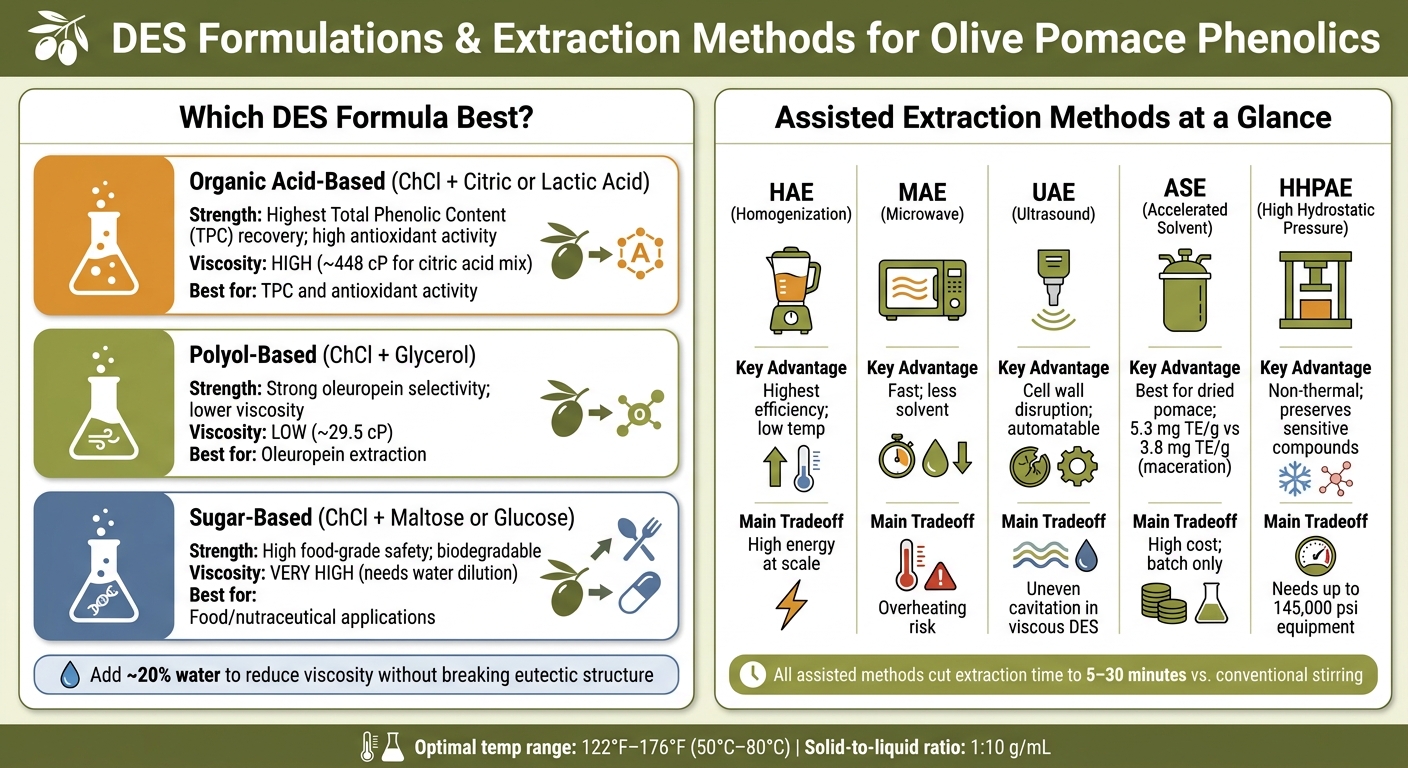
DES Formulations & Extraction Methods for Olive Pomace Phenolics
Common DES Formulations Used for Phenolic Recovery
After tuning a DES, the next step is picking the formula and extraction setup that fit the phenolics you want to pull out. In olive pomace work, choline chloride (ChCl) is the most common hydrogen bond acceptor. From there, the biggest performance shift usually comes from the hydrogen bond donor (HBD).
| DES Type | Components | Strengths | Limitations |
|---|---|---|---|
| Organic acid-based | ChCl + citric or lactic acid | Highest TPC recovery; high antioxidant activity | Higher viscosity; citric acid mixtures can reach about 448 cP |
| Polyol-based | ChCl + glycerol | Strong oleuropein selectivity; lower viscosity (~29.5 cP) | Less effective for some acidic phenols |
| Sugar-based | ChCl + maltose or glucose | High food-grade safety; biodegradable | Very high viscosity; needs water dilution |
That choice matters more than it might seem at first glance. Organic acid-based DES often give the highest total phenolic content, but they can get thick fast. Polyol-based systems, like ChCl + glycerol, flow much more easily and show strong oleuropein selectivity, though they may not work as well for some acidic phenols. Sugar-based DES are attractive from a food-safety angle, but their high viscosity can make them hard to handle unless you dilute them.
A simple fix is to add water. Adding about 20% water helps make viscous DES easier to use during extraction without breaking the eutectic structure.
Extraction Methods That Improve Yield and Cut Processing Time
Once the solvent is set, the extraction method decides how much of that solvent's upside you actually get. This is especially important with viscous DES, where mass transfer can slow everything down. Assisted methods help get around that problem by shortening extraction time to about 5–30 minutes and cutting solvent use compared with conventional stirring.
Homogenization-assisted extraction (HAE) is often the first method people look at. It uses high-shear mixing to boost contact between the solvent and plant material. Another plus: it runs at low temperatures, which helps protect heat-sensitive compounds. The catch is scale. High-shear mixing can draw a lot of power in larger batches.
| Method | Main Advantage | Key Tradeoff at Scale |
|---|---|---|
| HAE (Homogenization) | Highest reported efficiency; low temperature | High energy use for large-batch shearing |
| MAE (Microwave) | Fast heating; reduced solvent volume | Risk of overheating and degradation |
| UAE (Ultrasound) | Disrupts cell walls; high automation potential | Uniform cavitation is difficult in viscous, large-scale DES |
| ASE (Accelerated Solvent Extraction) | Best for dried pomace | High equipment cost; batch-style processing |
| HHPAE (High Hydrostatic Pressure) | Non-thermal; preserves heat-sensitive compounds | Requires specialized equipment for pressures up to about 145,000 psi (1,000 MPa) |
Each method has its own sweet spot. MAE is fast and uses less solvent, but too much heat can damage the target compounds. UAE helps break cell walls and can fit well into automated setups, though getting even cavitation in thick, large-scale DES systems is tough. ASE tends to work best with dried pomace, but the equipment is expensive and the process is still batch-based. HHPAE avoids heat, which is useful for sensitive compounds, but it needs specialized high-pressure equipment that can reach about 145,000 psi (1,000 MPa).
For lab and pilot work, HAE is usually the strongest default. If speed is the main goal, MAE or UAE often make more sense. ASE is better saved for dried pomace. In one study, ASE at 100 bar and 122°F (50°C) produced 5.3 mg TE/g, compared with 3.8 mg TE/g for conventional maceration.
How to Optimize the Extraction Workflow
Key Process Variables: Water Content, Temperature, Time, and Solid-to-Liquid Ratio
Once you've picked the DES and the extraction method, the next job is dialing in the run conditions. At this stage, solvent formulation and water content usually have the biggest effect on yield.
| Variable | Yield impact | Practical Target |
|---|---|---|
| Solvent formulation | High | Match DES polarity to the target phenolic profile |
| Water content | High | About 20% v/v |
| Temperature | Medium-High | 122°F–176°F (50°C–80°C); avoid extended exposure above 176°F (80°C) |
| Particle size | Medium | About 1 mm (900 µm) for consistent solvent penetration |
| Solid-to-liquid ratio | Medium | 1:10 g/mL as a practical starting point |
| Extraction time | Low-Medium | Yields typically plateau after 20–30 minutes in assisted systems |
Temperature does a lot of work here. It affects viscosity, solubility, and compound stability. As temperature goes up, DES viscosity drops and diffusivity improves. That can help extraction. But there’s a tradeoff: long exposure above 176°F (80°C) can damage sensitive phenolics such as oleuropein. If you're using microwave extraction, keep conditions at or below 800 W and 176°F (80°C) to limit degradation and byproduct formation.
Particle size also matters more than people sometimes expect. Grinding pomace to about 1 mm increases surface area and helps the solvent move through the material more evenly. Paired with a 1:10 g/mL solid-to-liquid ratio, it gives you a solid starting point before you start fine-tuning the rest.
A Step-by-Step Optimization Sequence for Lab and Pilot Work
- Select your DES formulation first: Match the DES to the target phenolic profile.
- Prepare and dry the pomace: Dry raw pomace at 95°F–122°F (35°C–50°C) until moisture drops below 10%, then grind it to about 1 mm. If you're working with exhausted olive pomace that has already been dried and degreased, you can skip straight to grinding.
- Adjust the DES with water before extraction: Prepare the DES, then add about 20% water by volume. This is especially important for organic acid-based formulations, where viscosity can get very high without dilution.
- Run the assisted extraction: Run the selected assisted extraction at 122°F–176°F (50°C–80°C) for 10–30 minutes. Keep the solid-to-liquid ratio at 1:10 g/mL, and record time, temperature, and power settings carefully.
- Recover and analyze the extract: After extraction, centrifuge the mixture at about 1,000 rpm for 10 minutes, then filter it through a 0.45 µm membrane to recover the phenolic-rich liquid phase. If you need to dilute the extract for analysis, use ethanol instead of water. It helps reduce the formation of acetals from sensitive compounds like oleacein.
Change one variable per run so you can see what’s actually driving yield. That makes the data much easier to read and keeps your optimization work from turning into guesswork.
Applications, Scale-Up Limits, and Final Takeaways
Where Olive Pomace Extracts Can Be Used
Once extraction is dialed in, the next step is simple: where do these extracts earn their keep? Olive pomace extracts have use across functional foods, nutraceuticals, pharmaceuticals, and cosmetics because of their antioxidant and antimicrobial activity.
In food manufacturing, they can work as natural antioxidants, gelling agents, and stabilizers, which helps improve oxidative stability in foods. That gives food makers a plant-based option for product protection without leaning as hard on synthetic additives.
Some compounds stand out more than others. Hydroxytyrosol and oleocanthal are especially useful for antioxidant and anti-inflammatory uses. In cosmetics, hydroxytyrosol and tyrosol fit well in antioxidant-rich creams, in part because they remain stable under changes in light and temperature.
That said, good use cases alone don't guarantee market success. Commercial use comes down to whether the extraction process can deal with the limits that come with DES.
Scale-Up Challenges: Viscosity, Recovery, Reusability, and Compliance
The same adjustable viscosity and polarity that make DES useful in lab work can become a headache in industrial settings. High viscosity slows mass transfer and makes pumping and day-to-day handling harder at scale.
Here’s where the tradeoffs show up most clearly:
| Operational Aspect | Strengths | Limitations |
|---|---|---|
| Extraction power | High solubilization strength for polar and non-polar phenolics | Strong DES-solute affinity can make purification difficult |
| Handling | Low volatility, non-flammable, and adjustable polarity | High viscosity hinders mass transfer and industrial pumping |
| Sustainability | Biodegradable, non-toxic components; recyclable | Recovery and reusability at scale require complex separation, such as resins or anti-solvents |
| Process integration | Works well with MAE, UAE, and thermal treatments | Higher temperatures can reduce viscosity but may degrade heat-sensitive bioactives |
| Compliance | Components are often food-grade or pharmaceutically acceptable | Final eutectic mixtures require toxicity testing for regulatory approval |
This is the core tension. DES can pull out a strong mix of phenolics, but getting those compounds back out of the solvent cleanly and cheaply is another story. And while heating can make the fluid easier to move, that fix can come at a cost if the target compounds are heat-sensitive.
Conclusion: Key Points to Remember About DES in Olive Pomace Extraction
Put together, these use cases and process limits shape the practical role of DES in olive pomace recovery. DES and NADES offer a green route to recover bioactive phenolics, and they often do better than conventional water or 70% ethanol mixtures when looking at total phenolic content and antioxidant activity.
The big hurdle now is scale. Wider industrial use still depends on solving three stubborn issues: viscosity, recovery, and regulatory approval.
FAQs
Why is olive pomace rich in phenolics?
Olive pomace is rich in phenolics because about 98% to 99% of the olives’ total phenolic content stays in the pomace after olive oil extraction.
During processing, these compounds - including phenolic acids, alcohols, secoiridoids, lignans, and flavones - remain in the solid by-product instead of moving into the oil. In plain terms, most of the olives’ phenolics end up in the leftover solid material.
These compounds are natural secondary metabolites linked to antioxidant, anti-inflammatory, and antimicrobial activity.
How do I choose the right DES?
Pick your natural deep eutectic solvent (NADES) based on both the extraction method you plan to use and the bioactive compounds you want to isolate. In many cases, choline chloride-based mixtures work especially well.
For homogenization or ultrasound-assisted extraction, mixtures of choline chloride with citric acid or lactic acid are a strong choice for phenolic recovery. If you're using microwave-assisted extraction or high hydrostatic pressure-assisted extraction, choline chloride with caffeic acid or lactic acid tends to give the best results.
One more practical tip: adding about 20% water by volume can improve performance.
What makes DES hard to scale up?
Scaling up deep eutectic solvents for industrial use isn't simple. The biggest hurdle is safety testing. Even when the starting ingredients are seen as non-toxic, the final solvent can behave differently, so it may still need careful toxicity studies before companies can use it at scale.
There’s also a process issue. Current extraction methods can take a long time, which makes large-scale use harder and can drive up energy demand. That means more work is still needed to make these systems faster and less energy-intensive in industrial settings.