

EU Olive Oil Controls: Audit Failures and Fixes
I’d start audit prep with three checks: connect each lot’s records, balance stock quantities, and verify label claims. If you can’t confirm a lot’s identity or support its claims, hold it until you resolve the gap.
Here’s my checklist:
- Trace each lot both ways: from suppliers through tanks and blends to bottles and business customers.
- Reconcile stock by category: compare entry and withdrawal registers with physical quantities, and explain differences.
- Check labels against lot records: review category, origin, artwork, lot codes, and packing-plant identification where required.
- Retest the fixes: preserve original entries and have a second qualified employee review the lot file.
EU rules require at least one conformity check annually per 1,000 metric tons marketed - about 2.2 million pounds. That minimum applies to national inspection programs, not each business. I’d also confirm the local authority’s requirements: <u>internal checks don’t replace official procedures</u>.
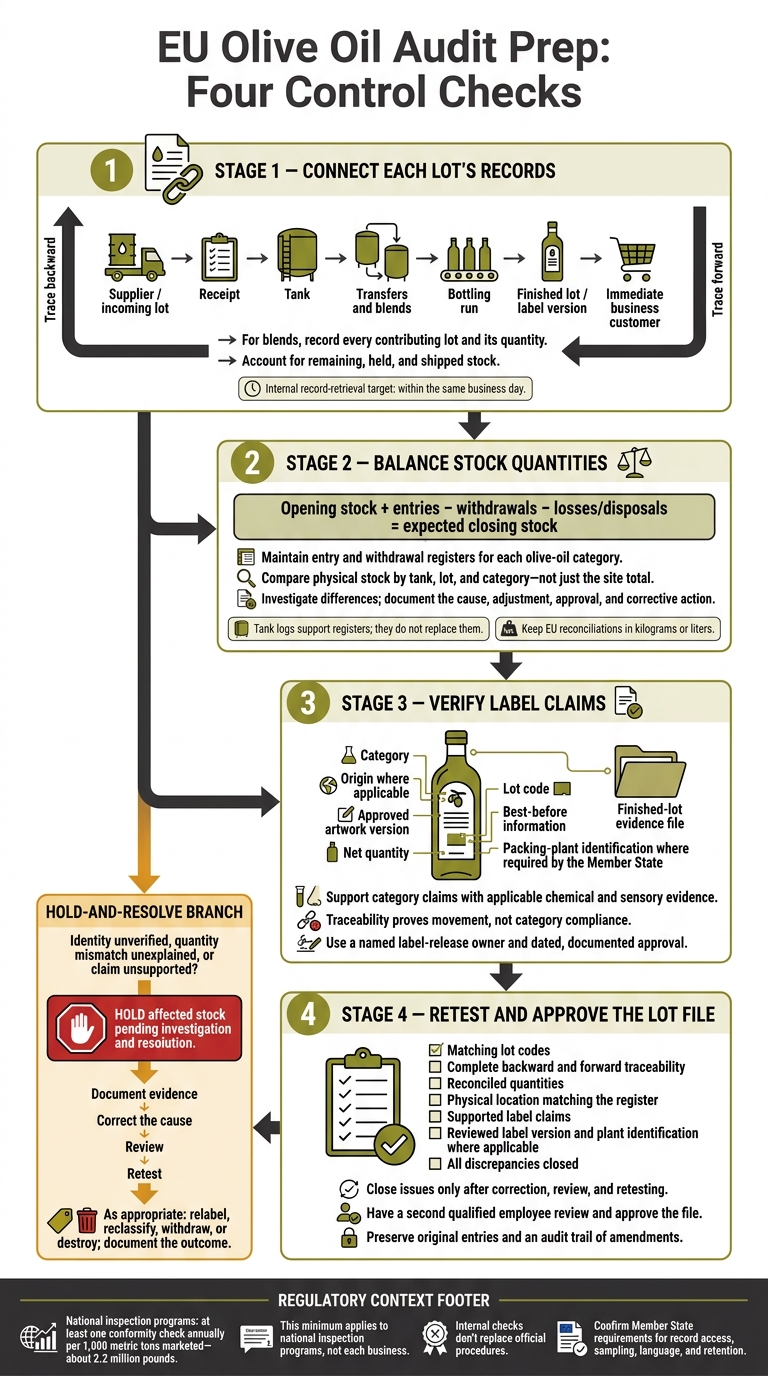
EU Olive Oil Audit Prep: Four Control Checks
Special Report 01/2026: Control systems for olive oil in the EU
sbb-itb-4066b8e
Missing Lot Links: Restore Traceability
A shipment record alone doesn’t prove which oil is in each bottle. Gaps between receipt, tank, and bottling records can break identity tracking and recall control. Every handoff needs to connect in one record chain.
Connect Receiving, Transfers, and Bottling Records
Link the supplier’s name and address, receipt date and quantity, incoming lot, tank assignment, transfer and blend records, bottling run, finished lot, and invoice or delivery reference. For blends, record every contributing lot and its quantity, not just the final tank number. Add the label version to the bottling record and the customer to the shipment record.
Small businesses can use linked spreadsheets or controlled paper forms. Use the same distinct identifiers throughout. Keep original entries and date any corrections.
If a link is missing, compare delivery documents, tank readings, production sheets, and invoices. Matching dates or quantities alone don’t prove the connection. Document the evidence you checked and any gaps that remain. Hold the stock until you verify its identity and support for its claims. Address the root cause with a required field, staff training, or a second-person review.
Then test the records in both directions.
Test Traceability in Both Directions
Choose a finished lot that includes a blend or a recent process change. Trace it backward from the bottle or case label through bottling, tanks, and transfers to every incoming lot and supplier. Set an internal target to retrieve the records within the same business day. Check filled volume against source withdrawals, rejected units, retained samples, documented losses, and remaining oil.
Next, trace an incoming lot forward to every tank, blend, finished lot, and immediate business customer. Account for all stock, whether remaining, held, or shipped.
Log each discrepancy with expected and actual quantities, the evidence checked, the responsible person, and the corrective action. Don’t treat unexplained differences as routine loss. Repeat the test.
Incomplete Registers and Storage Logs: Reconcile Stock
Once lot links are in place, check that the quantities balance, too.
Missing dates, quantities, or category names break the stock balance. Keep category-specific records: “olive oil” alone is not enough when the rules distinguish extra virgin, virgin, or other categories. The register must also match the stock physically present.
Complete Entry and Withdrawal Registers
Regulation (EU) 2022/2105 requires operators from the mill through the bottling stage to maintain entry and withdrawal registers for each olive-oil category they hold. Use a separate register or a clearly marked section for each category. Record the date, quantity, category, counterparty, lot ID, location, supporting document reference, and employee ID of the person entering the data.
Check incoming quantities against supplier invoices and delivery notes. Check withdrawals against sales invoices, dispatch documents, bottling orders, and disposal records. Reconcile after each movement and at month-end using this calculation:
Opening stock + entries − withdrawals − losses/disposals = expected closing stock.
For every adjustment, keep the original value, corrected value, reason, date, and approver. Do not overwrite the original entry.
Match Tank Records to Physical Stock
Tank logs support the required registers; they do not replace them. Link each tank, tote, drum, or warehouse location to its lots, category, origin, quantity, transfers, and responsible employee. Keep a version-controlled tank map, along with cleaning, changeover, and temperature logs, as supporting files - not separate EU registers - unless national law requires more.
Measure physical stock using calibrated scales, tank gauges, dip measurements, or another documented method. Record the date, method, and employee. Then compare quantities by tank, lot, and category, not just the site total.
Investigate differences by checking transfer tickets, sampling, bottling losses, leaks, measurement error, and entry errors. Keep each discrepancy open until you have documented the cause, quantity adjustment, approval, and corrective action. An unexplained mismatch may hide a transfer or category mix-up.
Keep EU reconciliations in kilograms or liters. You can add pounds or U.S. gallons for convenience, but do not replace the metric values. Unexplained mismatches often point to label or category errors, so check whether the lot was misclassified or mislabeled when the numbers do not match.
Label and Category Mismatches: Check Claims
Once quantities balance, check that each lot’s label claims match the oil. Even a documented lot can fail this check. Traceability proves movement, not category compliance.
Check Category and Origin Records
Compare the label’s category wording with the supplier declaration, specification, analytical results, and sensory evidence. Make sure that evidence applies to the finished lot. An “extra virgin” claim needs support from the applicable chemical and sensory characteristics. Supplier reputation or acidity alone isn’t enough.
For extra virgin and virgin olive oil, check origin statements against harvest, mill, supplier, and blend records. Don’t reuse origin wording from an earlier lot or supplier without checking it. The legal name and, where applicable, the origin statement must appear in the product’s principal field of vision.
If the evidence doesn’t support the claim, put the lot on hold. Verify sample identity and chain of custody, and confirm the test method. Then relabel, reclassify, withdraw, or destroy the lot, and document the outcome.
If the claim is wrong, check the lot code and plant identification on the package next.
Check Lot Codes and Plant Identification
Compare the approved artwork revision with the production order, label issue log, and finished packaging. Include container and case codes linked to the bottling run. Check the category, origin, net quantity, lot code, and best-before information.
Where the Member State requires an approved packing-plant code, check the assigned alphanumeric identification against the approval notice. An internal plant code doesn’t meet this requirement.
Assign a named label-release owner with authority to block production or shipment. Keep dated approval that records the artwork version, finished lot, evidence reviewed, decision, and any corrective action. Don’t release stock based on an informal email approval.
After claims are cleared, use the pre-inspection checklist to close any remaining record gaps.
Pre-Inspection Checklist
Once you’ve fixed traceability, stock, and label issues, review the files one last time to check that the fixes hold up under inspection. Verify product identity, quantity balance, label support, and closed corrective actions. Internal checks don’t replace the relevant Member State authority’s procedures. Before inspection, confirm its requirements for record access, sampling, language, and retention.
Resolve Gaps and Gather Records
Track issues in a corrective-action log. Address those that could break backward or forward traceability, category identity, or label support first. For each issue, record the affected lots, discrepancy, risk level, assigned owner, completion date, corrective action, and closure evidence. Close an issue only after the records have been corrected, reviewed, and retested.
Keep one controlled file per lot code. Include receiving, transfer, blending, bottling, labeling, origin, dispatch, and corrective-action records. Preserve original entries and keep an audit trail of amendments. The inspection file must also include the current entry and withdrawal registers for each category.
Before inspection starts, check each finished lot against its file.
Confirm Each Finished Lot Is Ready
For each finished lot, check that:
- The lot code matches across production, storage, label, and dispatch records.
- Backward and forward traceability is complete.
- Quantities reconcile, including any losses or adjustments.
- The physical location matches the register.
- Records support the category, origin, and other label claims.
- The label version and plant identification have been reviewed, where applicable.
- All discrepancies are closed.
Have a second qualified employee review and approve the file. Keep the evidence accessible and the original records unchanged.
FAQs
How long should I keep olive oil audit records?
Keep olive oil audit records for at least two years beyond the product’s shelf life. For organic olive oil, retain relevant documents - including traceability records needed for inspections - for at least five years.
Store both digital and physical backups so you can easily retrieve records during an audit.
What should I do if a traceability gap affects shipped oil?
Stop any further movement of the affected lot. Verify that its original lot code stayed with it through repackaging. Immediately collect receiving records, batch or production records, and storage and transport temperature logs or other storage logs. Trace the lot forward to identify exactly which customers or consignees received it.
If you can’t access these records promptly, address the gap before inspection. Make sure you can document the affected lot’s oil category, origin, and packaging activities.
When should I retest a lot’s extra virgin status?
Retest the oil whenever it changes hands or moves through the supply chain to check that it still meets its original classification. A packing plant receiving bulk oil labeled extra virgin, for example, must verify and document that the oil meets those specifications before bottling it.
Aging, poor storage, and long shipping times can lower oil quality. Retesting helps confirm that the oil still qualifies as extra virgin before it reaches store shelves.