

EU Regulations on Olive Oil Traceability Explained
If an EU olive oil label names an origin, that claim is supposed to match records that inspectors can trace back through the supply chain.
I’d sum it up like this: EU rules tie origin, category, and batch records together. For extra virgin and virgin olive oil, origin labeling is required. For checks, EU countries must do at least 1 conformity check per 1,000 tonnes of olive oil marketed each year, including exports.
Here’s the short version:
- I see the EU system as a record chain, not one public database
- Each business must identify its immediate supplier and immediate buyer
- Extra virgin and virgin olive oils must show an origin statement
- Blend labels must use set wording such as
blend of olive oils of European Union origin - Inspectors can review labels, lab tests, and sensory panel results
- The system still has weak spots, especially with cross-border data sharing and uneven checks
For me, the main takeaway is simple: the label is not just packaging text. It is a claim that should line up with mill logs, purchase records, batch codes, and dispatch records. That does not mean every bottle is problem-free. But it does mean there is a legal trail behind many EU-origin claims.
A quick snapshot:
| Topic | What it means |
|---|---|
| Traceability base rule | Businesses record who they bought from and sold to |
| Origin labeling | Required for extra virgin and virgin olive oil |
| Blend wording | Must follow fixed EU label phrases |
| Compliance checks | At least 1 per 1,000 tonnes each year |
| Main limit | Records sit across many businesses and countries |
If you buy premium olive oil in the U.S., I’d look first for a named origin, a clear category, and a lot code. Those three details give inspectors - and buyers - a way to check what the bottle says against the records behind it.
Special Report 01/2026: Control systems for olive oil in the EU
sbb-itb-4066b8e
How the EU Traceability System Works in Practice
How EU Olive Oil Traceability Works: From Grove to Shelf
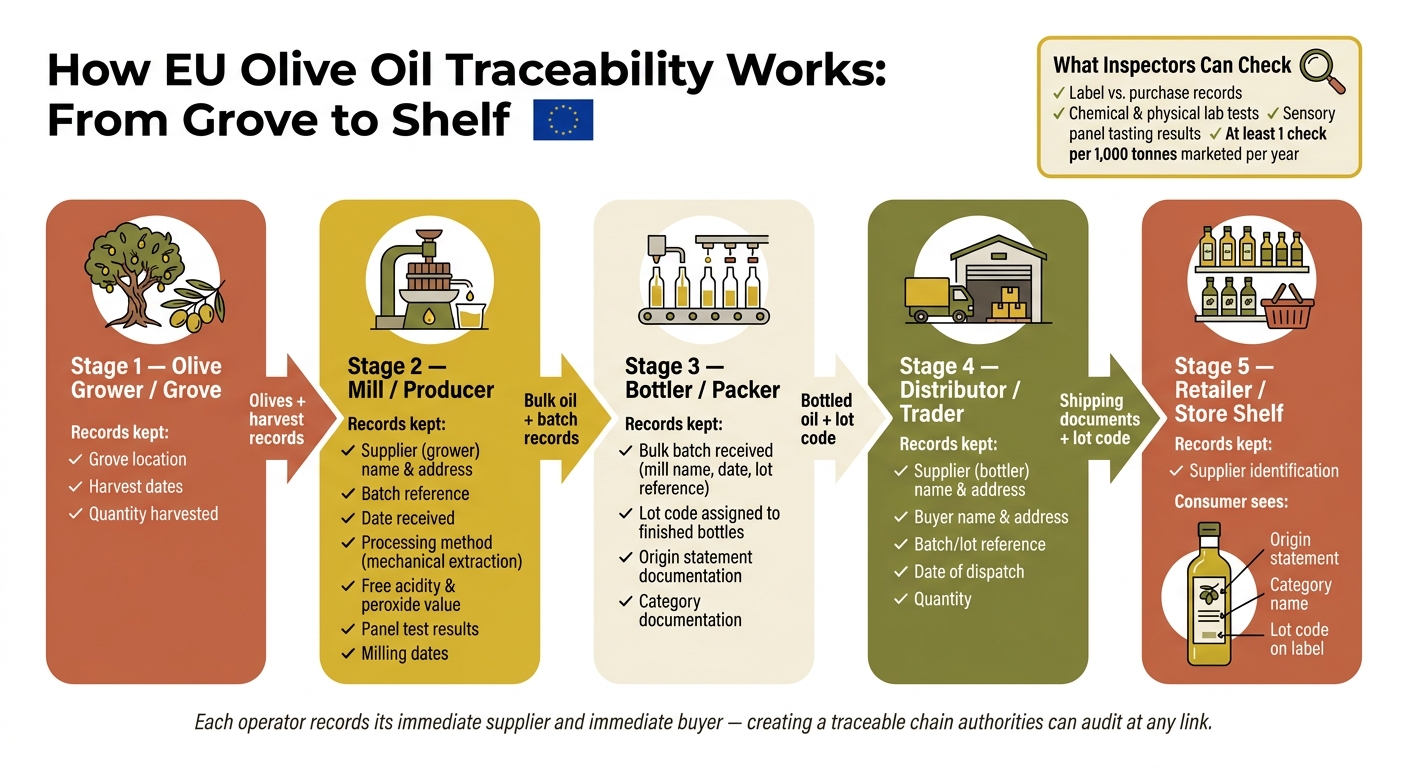
In practice, this system works through linked business records, not one public database. EU traceability is a chain of records kept by each company in the supply chain. Mills, storage sites, bottlers, and traders each keep their own entry and exit logs. When authorities inspect a product, they trace it back by checking those records across each operator.
Immediate Supplier and Buyer Records
Each business must identify its immediate supplier and immediate customer for every batch of olive oil it handles. A mill records which growers supplied the olives and which bottler or cooperative received the bulk oil. A bottler records which mill delivered the oil and which distributors received the finished bottles. Retailers must identify their supplier, not individual shoppers.
What Producers, Bottlers, and Sellers Must Document
Operators must log incoming and outgoing batches and keep records that support category and origin claims. The records themselves are fairly simple. What matters is how they connect.
| Record Type | Key Data Points |
|---|---|
| Incoming | Product type, quantity, supplier name and address, batch or lot reference, date of receipt |
| Outgoing | Product type, quantity, buyer name and address, batch or lot reference, date of dispatch |
| Category support | Panel test results, free acidity, peroxide value, linked to each batch |
| Origin support | Harvest records, grove locations, supplier declarations, milling dates |
These records must stay current and be available to inspectors on request. Bottlers connect each lot code to the bulk batch used, and that’s what makes label claims traceable. In plain English, an inspector can start with a bottle on a store shelf, trace it back to the tank it came from, and then trace it further back to the mill and harvest region. Digital registers can also help flag volume mismatches. Those records then support the label claims discussed next.
What Olive Oil Labels Must Tell Consumers
The label is a regulated claim. So when inspectors want to test traceability, this is usually where they start.
Origin Labeling for Extra Virgin and Virgin Olive Oil
EU rules require origin labeling for extra virgin and virgin olive oil, but they do not allow origin claims on refined olive oil or olive-pomace oil. For refined and pomace categories, labels focus on the category name, storage conditions, and other required particulars.
For extra virgin and virgin olive oils, the label must show the place of origin in clear, permanent text. In most cases, that means naming a single EU Member State, the European Union, or a single non-EU country. For example: Product of Spain or Product of Tunisia.
If harvesting and milling took place in different countries, EU rules call for a two-part origin statement. For example: extra virgin olive oil obtained in Italy from olives harvested in Greece.
For blends from more than one country, EU rules use set wording:
| Blend Type | Required Label Wording |
|---|---|
| All EU origins | blend of olive oils of European Union origin |
| All non-EU origins | blend of olive oils not of European Union origin |
| Mixed EU and non-EU origins | blend of olive oils of European Union origin and not of European Union origin |
Those phrases are broad, but the paper trail behind them can't be vague. Each batch in the blend still has to be traceable back to its own origin in the producer's records.
How Label Statements Link to Traceability Records
Every statement on the label - origin, category, harvest year, and other required particulars - needs documentary support. If it's printed on the bottle, it has to be backed up.
The category name extra virgin olive oil must appear with the standard description superior category olive oil obtained directly from olives and solely by mechanical means. That mechanical-extraction statement must match the mill's processing records. The origin statement must also line up with purchase records, delivery notes, and mill logs.
In plain terms, the label is the public-facing summary of the traceability file. Inspectors compare it with purchase, delivery, and mill records. If the label and the records don't match, enforcement follows.
For U.S. buyers, a compliant EU label is a sign that the origin claim has documented support.
How EU Authorities Check Compliance and Where the Rules Are Heading
Conformity Checks by EU Member States
Once labels and records are in place, authorities don’t just take them at face value. They check them through official conformity reviews.
Under Commission Implementing Regulation (EU) 2022/2105, Member States must carry out at least one conformity check per 1,000 tonnes of olive oil marketed each year, including exports.
These checks are risk-based. In plain English, that means officials spend more time on products and operators that look more likely to have issues. The risk factors can include the category of oil, its price compared with other vegetable oils, blending and packing operations, country of origin, and lot size. If a case involves more than one country, authorities can ask another Member State for records and samples.
A single check can cover several things at once:
- Label review
- Chemical and physical tests
- Sensory panel tasting to confirm the declared category
Member States then send their results to the European Commission each year by May 31 for the prior calendar year.
Current Gaps and Efforts Toward Stronger Digital Traceability
A lot of this system depends on records lining up across borders. That’s why digital tools matter so much. The legal setup is in place, but some Member States do not always hit the minimum check level or run every required analysis. On top of that, national systems do not always exchange data smoothly across borders.
The EU’s Information Management System for Official Controls (IMSOC) is the main digital platform for sharing official-control data between countries. Work is also under way to line up national registers and sampling methods, so authorities in different countries are judging the same kind of data in the same way.
What Quality-Focused Shoppers Should Look For in a Brand
For U.S. shoppers buying imported olive oil, this EU enforcement system adds an extra layer of confidence. It’s not a magic shield, but it does mean there are checks behind the label.
When you’re scanning a bottle, a few details matter most:
- A named origin
- A specific category
- A lot or batch code that matches the label
Those details may seem small. But when a product can be traced back through records and batches, it’s a lot easier for authorities to verify what’s in the bottle.
Conclusion: What These Rules Mean for Producers and Consumers
EU olive oil traceability makes label claims easier to check. In plain English, a claim on the bottle should match records tied back to the source. Inspectors can review those records, and the label shows origin statements they can verify.
Mandatory origin labeling for extra virgin and virgin olive oils brings that paperwork right to the shelf label. The label has to state origin in the required form, so what a shopper reads connects to the supply-chain file behind the bottle.
For U.S. shoppers buying EU-origin olive oil, the upside is simple: origin and category claims are supported by traceable records that authorities can inspect. Brands that keep clear records on origin, batch data, and bottling dates line up well with this transparency-first approach. Still, that trust depends on steady enforcement.
The system is still changing. Blends that move through several intermediaries are tougher to trace. Producers can do more than the minimum by using digital records, joining certification schemes, and clearly listing bottling and best-before dates. Those steps can help build more trust.
Stronger traceability helps protect honest producers and gives consumers more reason to trust the bottle.
FAQs
How can I verify an olive oil’s origin claim?
Check the label to see where the olives were harvested and where the oil was extracted. If you want oil tied to a specific place, look for PDO or PGI seals. Those marks show the oil follows strict regional production standards.
Some bottles also include QR codes that link to production records, harvest notes, and chemical analyses. That extra detail can help back up the oil’s origin and quality.
What does a lot code tell me about traceability?
A lot code is an ID number that helps producers and regulators trace a specific bottle of olive oil back to its source.
With that code, they can check key details like the harvest, grove location, milling, and bottling data. It also helps confirm claims about acidity levels, harvest dates, category, and authenticity.
Are EU olive oil checks strong enough to prevent fraud?
The EU has a strong system in place to deter fraud. It includes annual checks, labeling rules, record-keeping, and risk-based inspections. Problems are also reported through RASFF.
Even so, fraud is still a challenge. Cross-border alerts have gone up, often linked to market pressure, such as climate-related harvest impacts. And enforcement can differ from one member state to another.