

EU Olive Oil Certification: National vs EU Roles
Here’s the short answer: the EU writes the olive oil rules, but each member state checks bottles, runs tests, reviews labels, and issues penalties. So if you buy imported extra virgin olive oil, the label depends on both EU law and how well the country enforced it before export.
I’d boil it down like this:
- The EU sets the legal standard for categories like extra virgin and for label rules.
- National authorities do the hands-on work: inspections, sampling, lab analysis, sensory panels, traceability checks, and fines.
- The European Commission reviews national systems, while EU fraud bodies help with cross-border cases.
- Enforcement is uneven across countries, which matters if you source premium imported olive oil.
- About 1 in 3 conformity checks find some kind of non-compliance, according to the article’s cited audit findings.
- Age, storage, and shipping can lower quality, even if the oil left Europe meeting the extra virgin grade.
If you’re a U.S. buyer or retailer, the main point is simple: an EU label is a legal starting point, not the last check you should rely on. I’d still want harvest timing, lab data, traceability records, and storage details before I put much weight on an extra virgin claim.
Quick Comparison
| Area | National Authorities | EU Institutions |
|---|---|---|
| Rule-making | Apply the rules at home | Write and update EU olive oil rules |
| Inspections | Check producers, bottlers, importers, and retailers | Review how national systems work |
| Testing | Take samples and send them to official labs and sensory panels | Set approved test methods and control framework |
| Labels | Check category, origin, dates, and required wording | Set label rules |
| Penalties | Fine, relabel, block, or withdraw products under national law | No routine bottle-level penalties |
| Cross-border cases | Start the case and enforce at home | Coordinate through EU fraud and information channels |
That’s the split in plain English: Brussels sets the framework; national agencies enforce it bottle by bottle.
sbb-itb-4066b8e
National Authorities: The Frontline Enforcers
At the national level, EU olive oil rules stop being abstract and start looking like boots-on-the-ground enforcement. This is where the day-to-day work happens: inspections, sampling, lab tests, and label reviews.
Inspections, sampling, and lab testing
NCAs use both routine and risk-based inspections across the supply chain, including producers, bottlers, importers, and retailers. In plain English, not every operator gets the same level of attention. Higher-risk businesses - such as large bottlers, traders dealing in blends, or importers tied to past fraud concerns - tend to face closer scrutiny.
When inspectors collect samples, those samples go to accredited official laboratories for chemical analysis and sensory panel testing. The goal is simple: confirm whether the oil actually qualifies as extra virgin. Timing matters here too. Test results must be ready before the oil’s best-before date. And if the primary sample fails, the whole batch can be treated as non-compliant.
EU law also sets a floor for how often these checks must happen: at least one conformity check per year for every 1,000 metric tons of olive oil placed on the market in a Member State.
Label checks, penalties, and corrective action
NCAs don’t stop at the oil itself. They also dig into the label.
Inspectors check whether the category designation, origin claims, best-before date, bottler’s name and address, and storage conditions are correct and complete. If a PDO or PGI claim appears, authorities also verify that the product matches the relevant product specifications.
When something is off, NCAs have teeth. They can:
- Order product withdrawals
- Require relabeling
- Block suspect batches
- Impose administrative fines
- Refer serious cases for criminal prosecution
National control plans and uneven enforcement across countries
Each Member State sets its own national control plan for official controls, so olive oil enforcement doesn’t look the same everywhere. Some countries run specialized units and stronger lab programs. Others test less often.
The setup can vary as well. Belgium, for example, gives olive oil conformity checks to an economic-fraud unit instead of a standard food safety agency. For U.S. buyers sourcing imported extra virgin olive oil, that difference matters. An "extra virgin" claim may be backed more heavily in one Member State than in another, depending on which national authorities oversee production or bottling.
That national layer operates within a broader EU system, with the Commission handling audits and coordination.
EU Institutions: Rule-Setters, Coordinators, and Auditors
The European Commission writes the EU rulebook for olive oil, while the European Court of Auditors (ECA) checks how well Member States put that rulebook into practice. The Commission does not replace national enforcers. It sets the rules, watches how Member States apply them, and reviews controls when enforcement falls short. You can see that split most clearly when the rule-maker, the auditor, and national authorities are viewed side by side.
EU rule-making for olive oil standards
The European Commission is the main EU body for olive oil rule-making. Commission Delegated Regulation (EU) 2022/2104 sets olive oil marketing standards and replaced Regulation 2568/91. Inside the Commission, the agriculture department handles marketing standards, including what extra virgin means in legal terms and what has to appear on a label. The health and food safety department oversees the system for official controls across the food chain, olive oil included, through Regulation (EU) 2017/625.
Because these rules apply directly across all EU Member States, a producer in Spain and a bottler in Greece work from the same rulebook.
Oversight of national systems and reporting
Writing the rules is only part of the job. The Commission also tracks whether Member States are applying them. Each Member State submits annual reports on its multi-annual national control plans, or MANCPs, showing how many checks took place, what non-compliance was found, and what enforcement actions followed. The Commission reviews those reports and can ask for clarification or corrective action when sampling is weak or when the data does not line up.
Even with that reporting system, the ECA has said the Commission still has only "partial visibility" into how national olive oil controls work in practice. That line matters. It shows that, on paper, the system may look aligned, but at EU level there are still blind spots.
Audits, coordination, and cross-border fraud response
The Commission does more than read reports. Its audit services also carry out on-site audits of national control systems. That means checking procedures, visiting competent authorities, and seeing whether inspections are risk-based and properly documented. The ECA has also run performance audits and pointed to split agency roles, limited use of sensory analysis, and weak follow-up when fraud is suspected.
When fraud moves across borders, coordination at EU level becomes a big deal. The EU Agri-Food Fraud Network (FFN) links national liaison bodies with the Commission, OLAF, Europol, and the Commission's Knowledge Centre for Food Fraud and Quality, which sits in the Joint Research Centre, so they can share intelligence and coordinate investigations. In Operation OPSON XIII (2023–2024), led by OLAF and Europol, authorities seized about €91 million worth of fraudulent food products, including large amounts of adulterated oils.
These bodies are not acting on their own. They help national authorities connect the dots and work together across borders, where a single-country response can fall apart fast.
The next step is a side-by-side look at who does what, and where the overlap starts.
National vs EU Roles: Side-by-Side Comparison
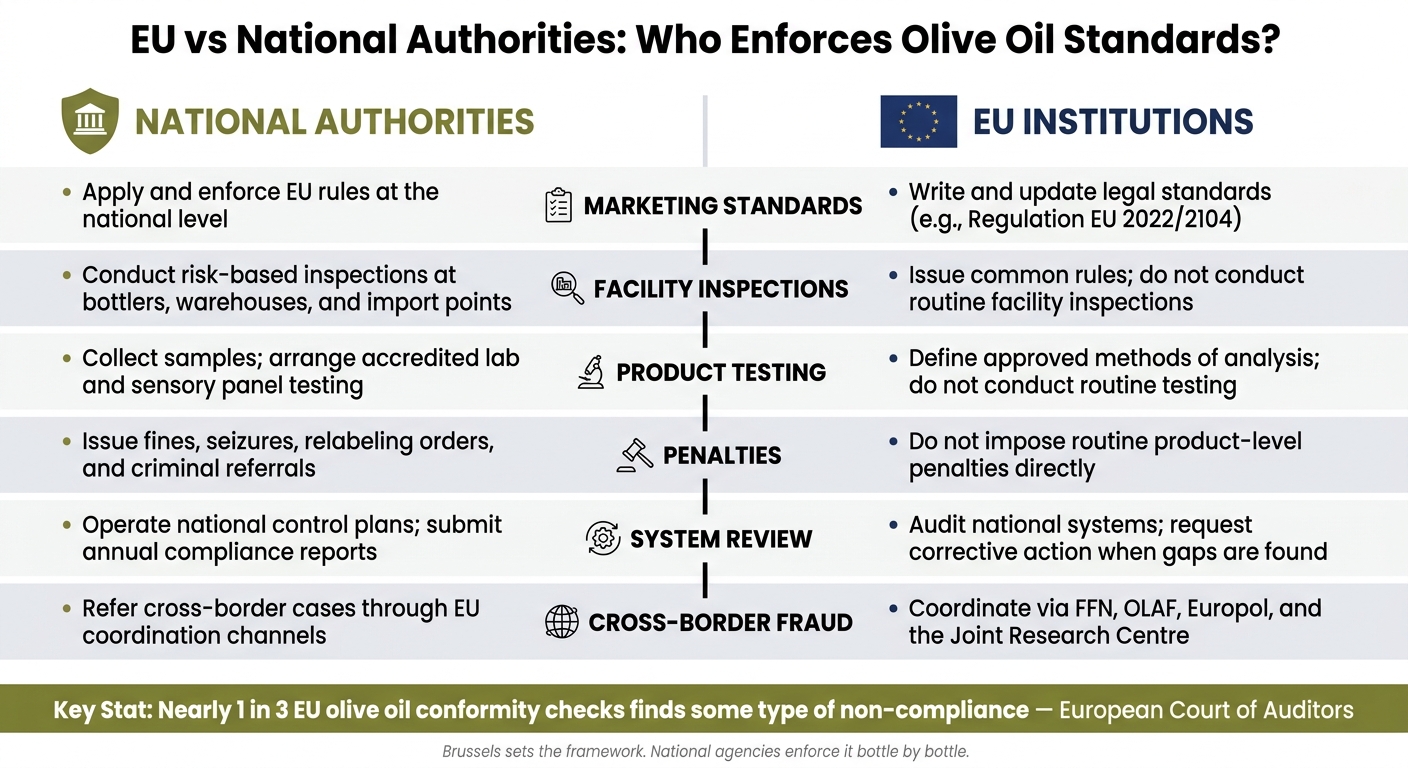
EU vs National Authorities: Who Enforces Olive Oil Standards?
Who does what in olive oil enforcement
In day-to-day enforcement, the split is pretty simple: the EU sets the rules, and national authorities carry them out. That setup runs through most parts of olive oil oversight.
| Function | National Authorities | EU Institutions |
|---|---|---|
| Set and update marketing standards | Apply and enforce rules at home | Set the legal framework through EU regulations |
| Inspect facilities and products | Perform risk-based inspections at bottling plants, warehouses, import points, and other distribution channels | Issue common rules and coordinate standards |
| Collect samples and test products | Collect samples and arrange accredited lab testing | Define approved methods of analysis |
| Impose penalties | Apply fines, seizures, and corrective orders under national law | Do not impose routine product-level penalties directly |
| Review control systems | Run national control systems | Review, assess, and oversee national systems |
| Cross-border coordination | Refer cross-border cases through EU channels | Provide the cooperation framework and coordination mechanisms |
Where responsibilities overlap
The lines can blur a bit, especially in fraud prevention, data reporting, and cross-border follow-up. That’s where both levels have to work together.
Say a national authority finds a mislabeled product, but the operator listed on the label is based in another Member State. In that case, the country that found the issue must refer the matter through EU channels. The penalty still comes from the national side. But the fact-checking and coordination move through the EU system.
Reporting works in a similar way. National authorities gather the data, and the Commission uses that information to monitor how well the system is working. If sampling rates are too low, penalties are rarely used, or lab capacity is thin, the Commission can press for corrective action. One side gathers the facts. The other checks whether the control system is doing its job.
That split plays a big part in how imported bottles earn trust.
What This Means for U.S. Buyers and Premium Olive Oil Retailers
How enforcement affects trust in imported extra virgin olive oil
For U.S. buyers, the main issue isn't whether EU rules exist. It's whether those rules were enforced before the bottle left Europe. A label is only as trustworthy as the checks behind it, and that comes down to how closely the producer's country applied EU rules before shipment.
The risk isn't theoretical. The European Court of Auditors found that nearly one in three olive oil conformity checks turns up some type of non-compliance, and some Member States fail to meet minimum check targets or do not carry out the lab analyses they are supposed to perform. In one audit sample of 24 retail olive oil products, four could not be traced back to the origin listed on the label. So yes, EU certification sets a strong legal starting point. But the trust you place in that bottle still depends on steady enforcement at the country level.
Age also changes the picture. Most non-compliance cases seem to come from aging, poor storage, or long shipping times, not outright fraud. Put simply, an oil can leave the producer as genuine extra virgin olive oil and still arrive on a U.S. shelf below that grade.
Why this matters for Big Horn Olive Oil
That's why retailers need more than a label claim. For Big Horn Olive Oil, strict freshness standards, traceability, and supplier records help lower the chance that the oil declines before it reaches the shelf. It also helps to source from producers in countries with steady controls and to ask for conformity check records, lab results, and traceability documents. That gives retailers another layer of proof when public enforcement doesn't always catch everything.
Key points to carry forward
Three takeaways matter here:
- Member States do the hands-on work: inspections, sampling, lab testing, label checks, traceability reviews, and penalties all happen at the national level.
- EU institutions set the system and review it: they write the standards, audit national systems, and coordinate cross-border fraud responses.
- Public oversight is the floor, not the finish line: U.S. buyers and retailers looking for dependable extra virgin olive oil should see EU certification as a starting point, then check for harvest dates, traceability, and lab data to cover gaps that enforcement does not always close.
FAQs
Who certifies olive oil in the EU?
In the EU, olive oil certification and enforcement under PDO/PGI rules are split between national authorities and EU oversight.
Producers start by applying through their national authorities. Those authorities handle inspections and conformity checks, including lab analysis and sensory testing.
The European Commission then reviews registrations. National agencies also police misuse of protected names, and customs can seize non-compliant goods.
Why does enforcement vary by country?
Enforcement varies because EU olive oil rules are carried out by individual Member States, and that means the day-to-day approach can look different from one country to the next.
Some countries use advanced electronic registers that allow real-time monitoring and mass-balance checks. Others still depend on manual tracking, which is slower and often harder to check at a glance.
National authorities also decide their own risk-based inspection levels. On paper, that makes sense. In practice, it can leave gaps.
Cross-border fraud investigations can vary as well. When more than one country is involved, coordination between national agencies may be slow or uneven, which can make cases harder to follow through.
What should U.S. buyers verify beyond the label?
U.S. buyers should look for a recent harvest date, ideally within the past 12 to 24 months, to help make sure the oil is fresh. Labels like PDO, PGI, or USDA Organic can also point to established quality standards.
It also helps to confirm the product’s origin, the extraction method - preferably cold-extracted - and the packaging. Dark glass bottles or tins are often a better choice because they help protect the oil from light.
For more transparency, check official databases like eAmbrosia or GIview.