

How EVOO Phenols Modulate Cytokine Signals
EVOO phenols can change inflammatory signals in lab studies, but eating EVOO does not guarantee lower cytokine levels. The practical takeaway: replace butter or other added fats high in saturated fat with EVOO rather than simply adding more oil.
The research follows 6 steps, from digestion and changes in cell signaling to cytokine release and immune regulation. But human results are mixed, and a change in gene activity, blood cytokines, CRP, or oxidized LDL does not by itself prove better health.
There’s also no established anti-inflammatory serving size. Choose an Arbequina Extra Virgin Olive Oil with a recent harvest date, store it away from heat and light, and avoid heating it until it smokes. EVOO is a cooking fat - not a treatment for elevated cytokines.
6 Steps Linking EVOO Phenols to Cytokine Production
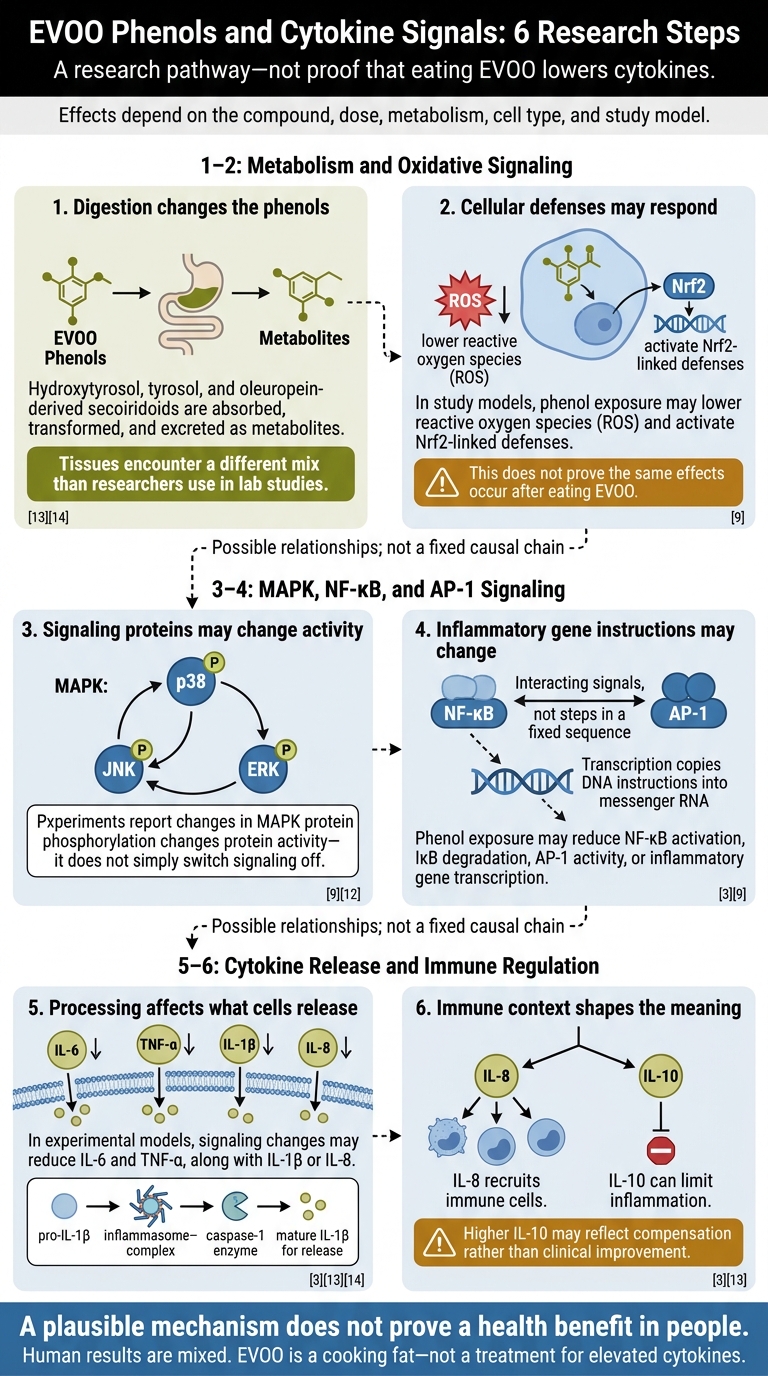
EVOO Phenols and Cytokine Signals: 6 Research Steps
These six steps trace how EVOO phenols may move from digestion to changes in cytokine production. Effects depend on the compound, dose, metabolism, cell type, and study model.
Steps 1–2: Metabolism and Oxidative Signaling
Step 1: Digestion changes the phenols. Hydroxytyrosol, tyrosol, and oleuropein-derived secoiridoids are absorbed, transformed, and excreted as metabolites. That means tissues encounter a different mix than researchers use in lab studies.
Step 2: Cellular defenses may respond. In study models, phenol exposure may lower reactive oxygen species (ROS) and activate Nrf2-linked defenses. But those findings don’t prove that eating EVOO produces the same effects.
Steps 3–4: MAPK, NF-κB, and AP-1 Signaling
Step 3: Signaling proteins may change activity. Experiments report changes in the phosphorylation of MAPK proteins, including p38, JNK, and ERK. Phosphorylation changes protein activity - it doesn’t simply switch signaling off.
Step 4: Inflammatory gene instructions may change. Phenol exposure may reduce NF-κB activation, IκB degradation, AP-1 activity, or inflammatory gene transcription - the copying of DNA instructions into messenger RNA. NF-κB and AP-1 often change together, so think of them as interacting signals rather than steps in a fixed sequence.
These signaling changes can affect what cells produce next.
Steps 5–6: Cytokine Release and Immune Regulation
Step 5: Processing affects what cells release. In experimental models, these signaling changes may reduce IL-6 and TNF-α, along with IL-1β or IL-8. IL-1β requires another processing step: cells first make pro-IL-1β, which inflammasome–caspase-1 activity then converts into mature IL-1β for release.
Step 6: The immune context shapes what the changes mean. IL-8 recruits immune cells, while IL-10 can limit inflammation. Higher IL-10 may reflect compensation rather than clinical improvement.
sbb-itb-4066b8e
What Inflammatory Markers Can Tell Us
When these pathways shift, researchers check for changes in cytokines, CRP, and oxidative markers. One lower reading does not prove lower disease risk. Cytokines track immune signaling, CRP reflects inflammation throughout the body, and oxidized lipids reflect oxidative stress. They’re related, but they don’t measure the same thing.
Here’s how to read the markers reported in studies.
| Marker | Biological role | Reported change | Where seen | Limit |
|---|---|---|---|---|
| IL-6 | Supports immune responses and tissue repair | Mixed results | Cell, ex vivo, and dietary studies | Meaning depends on context. |
| TNF-α | Promotes inflammatory signaling | Often unchanged in human trials | Cell, ex vivo, and dietary studies | Dietary effects cannot always be traced to phenols. |
| IL-1β | Drives innate immune responses | Lower in experiments; unchanged in one acute trial | Models and stimulated blood-cell testing | No confirmed effect on blood levels from routine intake. |
| IL-8 | Recruits immune cells | Lower | Selected ex vivo intestinal and blood-cell assays | Does not establish lower circulating levels. |
| IL-10 | Limits immune activation | Depends on context | Ex vivo and gene-expression experiments | The direction of change alone does not establish benefit. |
| CRP/hs-CRP | Liver-made marker of systemic inflammation | Lower or unchanged | Human trials and meta-analyses | Nonspecific; affected by diet and health factors. |
| Oxidized LDL | Reflects oxidative changes to LDL | Lower in some interventions | Human dietary studies | Not a cytokine assay or proof of fewer cardiovascular events. |
The test used also shapes what a result means.
IL-6 and TNF-α: Gene Activity, Release, and Blood Levels
Gene activity, protein release, and blood levels are different measurements. Gene-expression tests measure messenger RNA. Secretion assays measure released protein, while circulating measurements track concentrations in the blood. Blood levels also depend on tissue source, clearance, infection, medications, body composition, and sampling time.
Whole-diet studies cannot separate the effects of phenols from changes in fat intake, weight, or other foods. The same caution applies to IL-1β, IL-8, and IL-10: results from models often go beyond what blood measurements have shown.
IL-1β, IL-8, and IL-10: Effects Depend on Context
Lower IL-1β and IL-8 in stimulated models help explain how a response may work. They don’t prove that routine EVOO intake lowers these markers in the blood.
Likewise, increased IL-10 production in lipopolysaccharide-stimulated whole blood after high-polyphenol olive oil is an ex vivo finding. It does not prove higher blood IL-10 levels or a clinical benefit.
CRP and Oxidized Lipids: Indirect Measures
Look at the comparison group, study duration, sample type, and clinical outcomes - not just one improved marker. For home cooks, the focus is what EVOO replaces: swap saturated-fat-rich added fats for EVOO that is not stale, rather than chasing a specific cytokine result from one bottle.
How to Choose, Store, and Cook With EVOO
How you handle EVOO helps preserve the phenols studied for their effects on cytokines. There’s no established anti-inflammatory serving size, because studies use different oils, doses, and outcomes.
Check Harvest Dates and Batch Tests
Check the bottle’s harvest date, origin, and producer information. A best-by date won’t tell you when the olives were harvested. Aim to use the oil within about 15–18 months of harvest, depending on how it’s stored.
For phenol claims, ask for a dated batch report that lists the testing method, units, and compounds measured. Olive variety, ripeness, processing, storage, and assay method all affect the results. A premium label isn’t a substitute for dated test results.
Protect EVOO From Heat, Light, and Air
Choose dark glass or opaque packaging, and keep the bottle tightly capped in a cool, dark cabinet away from the stove, oven, and windows. These steps help protect its phenols. The International Olive Council recommends storage at 55–77°F (13–25°C) and buying an amount you’ll use within roughly 1–3 months after opening.
Use EVOO in Place of Saturated-Fat-Rich Added Fats
In the kitchen, focus on replacement rather than quantity alone. Use EVOO instead of added fats rich in saturated fat, rather than simply adding more calories.
EVOO works for sautéing, roasting, and pan-cooking. Avoid heating it until it smokes, heating an empty pan, or reheating the oil repeatedly. After cooking, add a drizzle of unheated EVOO.
Conclusion: What the Research Supports
Research suggests that EVOO phenols can change cytokine production in cell models. The effects depend on the compound, dose, and cell type. Researchers have studied signals including IL-6, TNF-α, IL-1β, IL-8, and IL-10. A plausible mechanism does not prove a health benefit in people.
The evidence falls into three levels: lab mechanisms, human biomarkers, and clinical outcomes.
| Evidence level | What research supports | What it cannot establish |
|---|---|---|
| Laboratory mechanisms | Phenols can alter oxidative signaling and MAPK, NF-κB, and AP-1 activity, which may reduce cytokine production. | An effective dietary dose or a health benefit in people. |
| Human biomarkers | Trials may show changes in CRP, hs-CRP, IL-6, and ox-LDL, but results are mixed. | Symptom improvement or disease prevention. |
| Clinical outcomes | Long-term interventions can assess health outcomes. | Evidence does not support EVOO as a standalone treatment for elevated cytokines or inflammatory disease. |
For home cooks, the best-supported advice is to replace butter or other added fats high in saturated fat with recently produced, properly stored EVOO - not to use it as a promised cytokine therapy.
FAQs
Can EVOO phenols weaken healthy immune responses?
Research suggests that phenols in extra virgin olive oil (EVOO) help curb excessive or chronic production of pro-inflammatory cytokines rather than weaken healthy immune responses.
Compounds such as hydroxytyrosol, oleocanthal, and oleuropein inhibit signaling pathways like NF-κB, which help regulate inflammatory markers such as IL-6, TNF-alpha, and IL-1beta. This action helps manage inflammation while supporting the body’s natural defenses and internal balance.
Does bitter EVOO always contain more phenols?
Not always. High-phenolic extra virgin olive oil often tastes bitter and leaves a peppery feeling in your throat. But taste alone can’t tell you its exact phenol content.
Phenolic levels depend on the olive variety, harvest timing, processing, and storage. They can vary even between batches. For the most accurate assessment, check the label for lab-verified polyphenol counts in mg/kg rather than relying on taste alone.
Should I test my cytokines after switching to EVOO?
Probably not. Studies show that EVOO phenols can reduce cytokines such as TNF-α and IL-6. But cytokines in the blood break down quickly, and their levels change daily. A single test may reflect timing or other factors - not your diet change.
Current evidence supports consistent use of quality, high-phenolic EVOO and proper storage rather than cytokine testing to assess its effects. If you have a medical condition, talk with your clinician before testing.