

How Fair Trade Olive Oil Empowers Farmers
Fair trade olive oil helps small-scale farmers earn fairer incomes, face climate challenges, and access better markets. Most olive farms are family-run and under 12 acres, yet farmers only receive 15% of the retail price, while retailers take 50%. Climate change further threatens production, with extreme weather reducing yields and quality. Fair trade ensures minimum prices, promotes farmer cooperatives, and supports sustainable farming methods. This approach improves farmers' livelihoods, encourages eco-friendly practices, and preserves olive farming traditions. By choosing fair trade olive oil, consumers directly support these efforts while enjoying higher-quality, traceable products.
Fair Trade Olive Oil - From Farm to Table
sbb-itb-4066b8e
Challenges Facing Small-Scale Olive Farmers
Small olive farmers face a web of challenges that overlap and intensify, making it increasingly hard to maintain their livelihoods.
Unstable Income and Price Pressure
For many small olive farmers, income is anything but steady. They are price-takers, meaning they have little to no control over the prices they receive. Bulk commodity markets dictate these prices, often ignoring the actual costs of sustainable olive farming. Large buyers, leveraging algorithmic pricing, drive prices down, leaving farmers with tough choices: sell at a loss or compromise on quality just to survive.
The numbers paint a stark picture. Farmers typically see only a small portion of the final retail price, with most of the profits going to processors and retailers. For example, in Tunisia's Elles region, production costs average $1,156.45 per hectare, but gross income per hectare ranges from just $1,233.87 to $2,056.45. This slim margin leaves little room for unexpected challenges.
Climate and Weather Risks
Climate change is making an already tough situation worse. The Mediterranean region has warmed by 1.4°C since the late 19th century, and projections suggest potential yield declines of up to 45%, with global production expected to drop by 26% during the 2023–24 season.
Extreme weather events don't just reduce yields - they also impact the quality of the oil. For instance, storms can knock olives off trees prematurely. Once on the ground, the olives' acidity levels rise quickly, disqualifying the oil from being labeled as Extra Virgin Olive Oil (EVOO). A vivid example occurred in November 2025, when Storm Claudia caused 40% of Spain's olive crop to go to waste, leading to a €0.90 ($1.04) per liter increase in high-quality olive oil prices.
"If it doesn't rain in Spain, you have a problem with olive oil." - Daniel Danés, Founder, Titin
Small farmers feel the brunt of these challenges. They often lack the funds to invest in advanced irrigation systems or climate-smart technologies, leaving them at the mercy of unpredictable rainfall patterns.
Limited Market Access and Bargaining Power
Even when small farmers produce top-notch olive oil, reaching the right buyers is a significant hurdle. Premium markets demand investments in processing equipment, certified packaging, and export logistics - expenses that many small-scale farmers simply cannot afford.
Without these resources, farmers are forced to rely on middlemen and bulk buyers, who dictate terms. This means farmers lose the chance to brand their products, share their stories, or charge prices that reflect the true quality of their oil. A 2023 initiative in Tunisia's Elles region highlights this issue. Local growers, with support from the Olive Institute (IO) and ICARDA, identified the closure of agricultural extension units and a lack of collaboration as key barriers to reaching better markets. Their solution? Forming a Mutual Agricultural Services Company (SMSA) to produce branded, certified oil under a Controlled Designation of Origin (CDO).
Unfortunately, such collective efforts are rare. For most small farmers working independently, fragmented production and information gaps keep them locked out of the markets where their oil could truly shine. These challenges underscore the importance of fair trade practices in supporting and protecting small olive farmers.
How Fair Trade Practices Help Olive Farmers
Fair trade practices provide olive farmers with practical ways to tackle challenges like unpredictable incomes, environmental pressures, and limited market access.
Guaranteed Prices and Income Stability
One of the core benefits of fair trade is the establishment of a price floor, ensuring farmers earn a steady income that at least covers their production costs. It also reduces transaction expenses by fostering long-term relationships with reliable buyers.
Take the Elles region in Tunisia as an example. Here, olive oil crafted using traditional, high-quality methods sells for about $5.48 per liter - roughly $0.64 more per liter than oil from neighboring areas. That seemingly small difference can mean the ability to reinvest in the farm instead of just breaking even.
"Participation in POs can bring significant benefits to farmers, such as increased bargaining power, greater income stability, fairer relationships with trading partners, and more efficient access to markets." - Agricultural and Food Economics
But fair trade doesn't stop at income stability. It also promotes farming methods that are better for the land and the environment.
Responsible Farming and Land Care
Fair trade supports not just farmers' incomes but also sustainable farming techniques. These include composting olive by-products to enrich the soil, intercropping within olive groves for biodiversity, and manual harvesting methods that preserve tree health and oil quality.
Water management is another critical area, especially in semi-arid regions. Traditional methods like jessour - terraced earthworks designed to capture and store rainfall - help farmers reduce reliance on expensive irrigation systems. This method not only protects against erosion but also ensures a steady yield during dry spells.
| Practice | Key Benefit |
|---|---|
| Composting | Recycles olive by-products; enriches soil |
| Intercropping | Boosts biodiversity; diversifies income |
| Manual Harvesting | Protects trees; preserves oil quality |
| Traditional Water Harvesting | Prevents erosion; stabilizes production |
By combining these techniques with collective organization, farmers can improve both their livelihoods and the environment.
Stronger Farmer Organizations
When farmers unite, their collective power grows. Cooperatives give them better market leverage and stronger negotiating positions. For example, in June 2023, olive growers in Tunisia's Elles region - backed by ICARDA and the Olive Institute - formed a Mutual Agricultural Services Company (SMSA). This move secured a Controlled Designation of Origin (CDO) for ten local olive varieties. Through this structure, farmers can share costly equipment, maintain high-quality standards, and deal directly with premium buyers, cutting out middlemen who often claim much of the profit.
"The establishment of an Olive Growers' Association is geared toward empowering olive growers, fostering collaboration and access to resources, knowledge exchange, collective decision-making, and co-learning in sustainable food systems." - Frontiers in Sustainable Food Systems
Globally, the Fairtrade network connects around 1.7 million farmers and workers across 73 countries. Nearly 90% of its members are part of Small Producer Organizations. This collective strength amplifies the voices of individual farmers, giving them influence they couldn't achieve on their own.
The Impact of Fair Trade Olive Oil
Higher Incomes and Local Economic Growth
Fair trade initiatives play a key role in increasing incomes and driving local economic progress. According to Fairtrade International, nearly 90% of studies on long-term outcomes reported at least some positive impact - this includes higher incomes for farmers, improved farm revenues, and greater income stability.
"Almost 90 percent of studies that looked at the longer term outcome of economic gains found at least some positive contribution of Fairtrade, including higher incomes for farmers, improved farm revenues and higher net returns, and greater income stability." - Fairtrade International
These financial benefits not only improve livelihoods but also create a foundation for addressing environmental challenges and preserving cultural practices.
Building Resilience Against Climate Risks
Fair trade olive oil production encourages farmers to adopt sustainable practices that reduce water usage and manage waste more effectively. This matters because the agricultural phase of olive oil production accounts for 83% of its total climate change impact, with fertilizer use contributing 51% and irrigation 19%. By transitioning from three-phase to two-phase olive oil extraction systems, fair trade significantly lowers water consumption and prevents the improper disposal of toxic olive mill wastewater.
In Spain's Estepa region, farmers who embraced sustainable practices like integrated farming and environmental stewardship earned an extra $200 per ton compared to conventional producers. This demonstrates that environmentally conscious farming can be both profitable and sustainable.
Traditional rain-fed olive groves, often found on mountainous slopes, are naturally equipped to handle environmental stress. These groves also produce high-polyphenol oil, known for its health benefits. Fair trade's commitment to covering production costs allows farmers to maintain these groves instead of resorting to intensive farming methods that harm soil and water resources.
Beyond financial and environmental benefits, fair trade also plays a critical role in preserving the cultural heritage of olive farming.
Keeping Farming Traditions Alive
Fair trade premiums provide the financial support needed to sustain traditional farming practices, which are essential for maintaining the unique quality and identity of olive oil. For example, in June 2023, stakeholders in the Elles community of Northwest Tunisia collaborated to create an agroecological business model. This model focuses on protecting indigenous olive varieties and ancient irrigation systems.
The proposed CDO (Collective Designation of Origin) not only certifies the quality of the oil but also safeguards local traditions. Additionally, the El Hilga harvest festival serves as both a platform for direct sales and a celebration of cultural heritage. By covering the higher labor costs associated with traditional methods, fair trade ensures that centuries-old knowledge remains a living practice rather than a fading memory.
How Consumer Choices Support Olive Farmers
Fair Trade Olive Oil: Who Gets Paid & Who Should
Traceability and Supply Chain Transparency
When you buy olive oil, you're doing more than just selecting a kitchen staple - you’re supporting sustainable food production. Fair trade systems amplify this impact by providing clear insight into the oil’s origins and the farmers who produce it. This level of transparency is crucial, especially since revenue distribution across the supply chain tends to be heavily skewed.
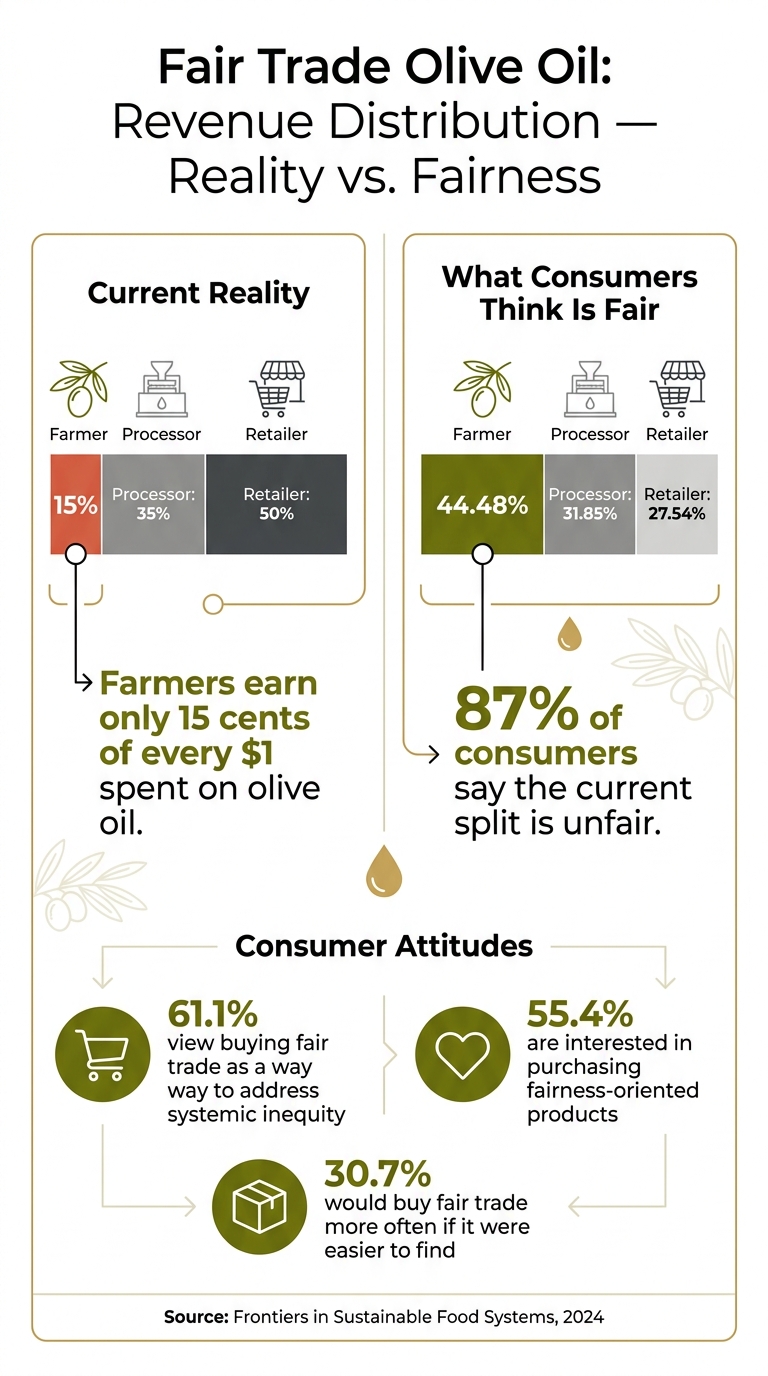
Farmers typically receive only about 15% of the retail price for olive oil sold in supermarkets. Compare that to what consumers believe is fair: a share of 44.48% - nearly three times what farmers currently earn.
| Stakeholder | Actual Revenue Share | Consumer Suggested "Fair" Share |
|---|---|---|
| Farmer | 15% | 44.48% |
| Processor | 35% | 31.85% |
| Retailer | 50% | 27.54% |
| (Source: Frontiers in Sustainable Food Systems, 2024) |
By choosing products with traceability and quality certifications, consumers actively support responsibly produced olive oil. This transparency doesn’t just inform purchasing decisions - it also builds trust with buyers who prioritize ethics.
The Role of Premium Buyers
While individual choices matter, companies that source ethically are also key players in driving change. For instance, Big Horn Olive Oil focuses on Ultra Premium Extra Virgin Olive Oil. By collaborating with growers committed to sustainable practices - like careful harvesting, proper milling, and responsible land management - these partnerships create consistent demand for high-quality olive oil. This, in turn, gives farmers more predictable income and stability.
"Commercial practices among food chain actors should be trustful and respectful (no discrimination, respected labour rights, etc.)" - Frontiers in Sustainable Food Systems
Such long-term buyer relationships help shield farmers from the price swings that often plague small-scale producers. These commitments ensure that farmers can plan ahead, invest in their operations, and improve their livelihoods.
Balancing Price and Fair Pay for Farmers
One frequent concern is that fair trade or premium olive oil might cost more. While this can sometimes be the case, the price difference is often smaller than expected. Fair pricing is designed to cover the production costs for everyone involved in the supply chain.
"A fair price is a price that covers the production costs of each chain actor." - Frontiers in Sustainable Food Systems
Consumer attitudes reflect a growing willingness to pay for fairness. According to, 61.1% of consumers view buying fair trade products as a direct way to address systemic inequities. Additionally, 55.4% express interest in purchasing fairness-oriented products when available, and 30.7% say they’d buy them more often if they were easier to find. This demand sends a clear message to retailers and brands: stocking ethically sourced olive oil isn’t just a niche effort - it’s a response to real consumer expectations, ultimately helping to improve farmers’ livelihoods.
Conclusion: Supporting Farmers Through Fair Trade Olive Oil
Small-scale olive farmers face tough challenges - unstable pricing, climate risks, and limited bargaining power - capturing a mere 15% of the retail price while retailers pocket 50%. Fair trade practices step in to address these issues by ensuring fair prices, strengthening cooperatives, and improving supply chain transparency.
The numbers speak volumes: 87% of consumers believe this revenue split is unfair, and 68.3% agree that buying fair trade products improves farmers' working conditions. This isn't just a niche concern; it's a growing expectation from everyday shoppers.
Making thoughtful choices as a consumer can drive meaningful change. Opting for products with traceability, geographical origin labels, and verified quality standards ensures that more revenue reaches the farmers who work tirelessly to produce these goods. Brands like Big Horn Olive Oil set an example by sourcing Ultra Premium Extra Virgin Olive Oil with full traceability, milling within 2–4 hours of harvest, and adhering to chemical standards far stricter than typical industry limits.
"Unlike other producers, we aim for full transparency about how our olive oils are sourced and what our extraction processes are." - Big Horn Olive Oil
Fair trade olive oil isn't just an ethical choice; it's a commitment to quality. When farmers receive fair compensation and access to better resources, they can focus on producing exceptional oil. Supporting fair trade means helping to sustain traditional olive farming practices and ensuring a brighter future for farmers - one bottle at a time.
FAQs
How can I tell if an olive oil is truly fair trade?
To spot fair trade olive oil, look for packaging that features trusted fair trade certification labels. These labels indicate the product has undergone independent audits to verify compliance with fair trade standards. Some bottles may also include QR codes or RFID tags, offering additional details such as the farm's location, harvest dates, and processing methods. Brands committed to fair trade practices focus on transparency, ensuring their supply chain supports fair wages, safe working conditions, and equitable income for farmers.
Does fair trade olive oil cost a lot more?
Fair trade olive oil doesn’t have to break the bank. By ensuring a fairer revenue distribution - farmers typically receive about 27.66% of the revenue compared to just 15% in traditional systems - and reducing unnecessary middlemen, companies like Big Horn Olive Oil make it possible to enjoy premium, ethically sourced olive oil at reasonable prices. For example, a bottle can cost just $8.99. This approach not only guarantees fair pay for farmers but also delivers high-quality olive oil to your table.
What labels prove an olive oil is traceable and high quality?
When selecting olive oil, pay attention to certifications that indicate quality and traceability. Look for labels like the European Union's PDO (Protected Designation of Origin) and PGI (Protected Geographic Indication), or the COOC (California Olive Oil Council) seal. These marks ensure the oil meets strict standards. Also, check for a specific harvest date - freshness is key. Features like batch codes or QR codes can provide additional details about the oil's origin and production process, giving you confidence in your choice.