

Free Fatty Acids in Olive Oil: What They Indicate
Here’s the short answer: free fatty acids (FFA) tell me how much the oil broke down before bottling, not how sour it will taste. In olive oil, extra virgin must be at or below 0.8% FFA, and lower numbers like 0.2% to 0.4% often point to better fruit handling and shorter time between harvest and milling.
If I’m checking an olive oil label or lab sheet, this is what matters most:
- FFA is a lab number, not a flavor note
- It does not measure pH
- It does not create sour taste
- Higher FFA often points to bruised olives, delays, heat, or poor storage
- Lower FFA can mean the fruit was handled with more care
- FFA alone is not enough to judge taste, purity, or overall grade
A simple way to read the number:
| FFA level | What I’d usually take it to mean |
|---|---|
| 0.2%–0.4% | Often linked with tight handling and early milling |
| Up to 0.8% | Can still qualify as extra virgin if it also passes sensory and other lab checks |
| 0.8%+ | Too high for extra virgin |
| 2.0%+ | Falls into lower-grade categories and may need refining |
The big point is simple: FFA is a quality clue, not the whole story. I’d read it next to the harvest date, storage, sensory notes, peroxide value, and UV test results to get a more complete view of the oil.
EVOO Chemistry: Free Fatty Acids and Smoke Point
sbb-itb-4066b8e
Free Fatty Acids and Extra Virgin Olive Oil Standards
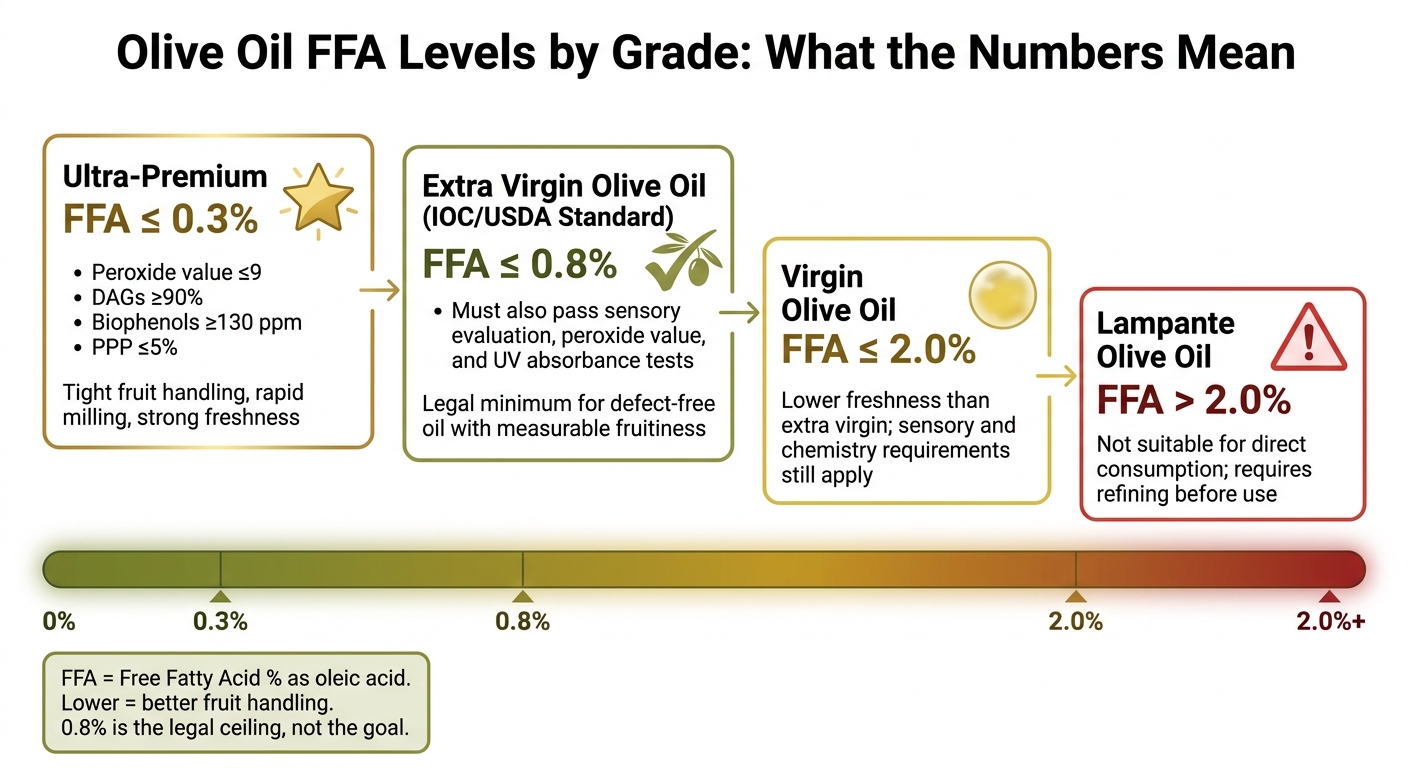
Olive Oil FFA Levels by Grade: What the Numbers Mean
Extra Virgin Olive Oil Must Be at or Below 0.8% Free Acidity
0.8% is the legal cutoff for extra virgin. Under IOC, Codex, and USDA standards, extra virgin olive oil must be at or below 0.8% free acidity.
But that number, by itself, doesn’t make an oil extra virgin. The oil also has to pass sensory checks, which means no detectable defects and some fruitiness. In the U.S. standard, that means no detectable defects and some fruitiness. Labs also check other chemistry markers, including peroxide value and UV absorbance, as part of the full grading process.
Inside that 0.8% cap, lower numbers usually point to fresher olives and faster milling. That’s where handling starts to matter.
Lower FFA Numbers Point to Better Fruit Handling
The 0.8% limit is a ceiling, not a goal. An oil around 0.5% is solid. An oil at 0.3% or lower usually points to top-tier fruit handling.
Big Horn Olive Oil Ultra Premium oils aim for 0.3% free acidity or less, with olives milled soon after harvest and third-party lab testing used to verify the result.
FFA Limits by Olive Oil Quality Category: A Comparison
Here’s how the main grades stack up.
| Category | Maximum FFA (% as oleic acid) | Other Chemistry Checks | What the Limit Generally Signals |
|---|---|---|---|
| Extra Virgin (IOC/USDA Standard) | ≤0.8% | Sensory evaluation; peroxide value and UV absorbance | Minimum threshold for defect-free oil with measurable fruitiness |
| Ultra-premium benchmark | ≤0.3% | Peroxide value ≤9; DAGs ≥90%; biophenols ≥130 ppm; PPP ≤5% | Tight fruit handling, rapid milling, and strong freshness markers |
| Virgin Olive Oil | ≤2.0% | Sensory and chemistry requirements still apply | Lower freshness than extra virgin |
| Lampante Olive Oil | >2.0% | Fails sensory or chemical standards | Not suitable for direct consumption; requires refining before use |
FFA is one quality signal. The next section looks at what higher numbers can mean for shelf life and oxidation.
What Free Fatty Acids Reveal About Quality, Shelf Life, and Authenticity
Once an oil is above the 0.8% cutoff, FFA still tells you a lot about how the olives were treated before and after milling.
Higher FFA Often Means the Olives Were Damaged or Delayed
When olive fruit cells stay intact, the oil inside has more protection. But bruising, decay, or pest damage can break those cells open. That gives lipases and microbes a chance to split triglycerides into free fatty acids.
Delays before milling make things worse. Enzymes keep working after harvest, and warm, packed bins speed up that breakdown. That's why mills that care about quality try to crush olives within a few hours of picking.
So FFA isn't just about clearing a legal threshold. It also gives you a read on handling quality.
Higher FFA Can Mean Shorter Shelf Life and Faster Oxidation
Higher FFA often points to lower stability. Why? Because it usually reflects earlier fruit damage and weaker handling. Olives that were damaged or stored badly before milling may also have lower levels of polyphenols and tocopherols, which leaves the oil more open to rancidity from day one.
Storage studies back this up. Free acidity often rises along with peroxide value and UV indices. On the other hand, a well-made low-FFA oil that is stored the right way can hold onto its brightness for much longer.
High FFA can warn you about poor handling, but it can't prove authenticity by itself. It can help with authenticity screening by showing handling quality, but it cannot confirm origin or purity on its own.
Common Causes of Elevated FFA and Their Quality Impact
The main drivers of high FFA are easier to understand when you group them by where the damage took place.
| Cause | Why FFA Rises | Likely Effect on Shelf Life | Sensory or Chemistry Consequences |
|---|---|---|---|
| Bruised fruit or olives picked from the ground | Cell damage and microbial decay intensify hydrolysis | Significantly shortened; oxidation begins sooner | Fusty, musty, or winey-vinegary defects; elevated peroxide value |
| Pest or disease damage (e.g., olive fruit fly) | Skin punctures allow microorganisms to enter and speed breakdown | Shortened; antioxidant content often lower | Rancid or fermented off-notes; may fail sensory panel |
| Long delays before milling or warm, unventilated storage | Enzymatic activity and heat accelerate fermentation and hydrolysis | Reduced; flavor degrades faster | Loss of fresh fruitiness; fusty or musty defects; higher K232 and K268 values |
| Poor post-extraction storage (heat, light, oxygen) | Ongoing oxidation speeds staleness and raises peroxide values | Degrades faster in storage | Flat, stale flavor; less freshness |
FFA is one clue. To make sense of it, you have to read it next to taste and lab results.
How Free Fatty Acids Affect Taste, Cooking, and Lab Testing
FFA Do Not Create Sour Flavor, But They Often Track With Defects
The same handling issues that push FFA up can also affect flavor and how the oil behaves in the kitchen. Higher FFA does not make olive oil taste sour. But it often shows up alongside the same fruit damage, delays, and storage problems that lead to defects. A U.S. grading manual describes FFA as a basic indicator of fruit handling before milling.
On a spec sheet, 0.5%–0.6% FFA in an oil sold as extra virgin is worth a closer look, even though it still sits below the 0.8% legal limit.
Higher FFA Can Lower Stability and Cooking Performance
Higher FFA usually points to lower oxidative stability. In plain English, the oil tends to break down faster when exposed to heat, air, and light. It may also start smoking sooner in the pan. Oils with low FFA and strong polyphenol content tend to hold up better in day-to-day cooking.
That’s why FFA makes the most sense when you read it alongside other clues, such as:
- harvest date
- sensory notes
- other lab markers
Looking at FFA by itself only tells part of the story.
How Labs Measure FFA and Report the Result
Labs measure FFA with titration and report the result as a percent of oleic acid. That number matters, but it shouldn’t stand on its own. Read it together with sensory results and other chemistry markers.
Once you know what the number is saying, the lab report becomes a lot more useful.
How to Use FFA Numbers When Judging Olive Oil
FFA tells you how much of the olive fat broke down before the oil was bottled. That can reflect fruit damage, delays before milling, and storage conditions. But here's the catch: FFA does not tell you, by itself, how the oil will taste. An oil can post a low FFA number and still have sensory defects. So the number works best as a quick filter, not a final verdict.
A good starting point is the 0.8% cutoff for extra virgin olive oil. From there, lower numbers can hint at fresher handling. Recent retail EVOO testing found that many premium oils fell mostly between 0.19% and 0.27%. Oils in the 0.2%–0.4% range are often linked with fresher fruit and tighter handling during production.
The easiest way to read FFA is simple: check the grade, look at the number, and then look at the bottle's full story.
| Layer | What to check | Why it matters |
|---|---|---|
| Certification | Extra virgin label | Confirms the oil meets the baseline extra virgin standard and sensory tests. |
| FFA value | FFA level | Lower values generally point to better fruit care and processing. |
| Context | Harvest date, packaging, storage | Helps show whether the oil's freshness is being preserved. |
That last part matters more than many shoppers think. A recent harvest date - ideally within the past 12 to 18 months for well-stored oils - is a good sign. If a bottle makes a big deal about low acidity but skips the harvest date or origin, take a step back. FFA alone does not prove authenticity or better taste.
The best habit is to read FFA alongside harvest freshness, storage practices, and sensory quality, especially fruitiness and the absence of defects.
FAQs
Can low FFA still mean poor olive oil?
Yes. Low free fatty acidity (FFA) is a good sign that the olives were handled well and that the oil is fresh. But it tells only part of the story.
An olive oil can still have sensory defects, including rancid, musty, or other off-flavors, even when its FFA is low. A proper quality check also looks at other chemical markers and professional sensory evaluation.
How can I find FFA on a bottle or lab report?
Look for a Certificate of Analysis (COA). Some producers post it on their website, while others link to it with a QR code on the bottle label.
On the report, FFA usually appears as a percentage of oleic acid. For extra virgin olive oil, that number should be 0.8% or less. Many premium oils come in even lower, often around 0.5% or less.
What other tests matter besides FFA?
FFA matters, but it’s only one piece of the olive oil quality puzzle.
To check whether an oil is genuine and high grade, it should also go through chemical and sensory testing.
Some of the main tests include:
- Peroxide Value
- UV absorbance
- fatty acid profiling
- wax content
- sensory evaluation for defects such as rancidity or mustiness