

Greek Olive Curing: Regional Variations Explained
Greek olives can taste wildly different for one simple reason: the cure changes everything. In this guide, I’d boil it down like this: Kalamata is bold and tangy, Amfissa is milder and softer, Throumpa is dry, wrinkled, and dense, Cretan tsakistes are cracked and lemony, and Halkidiki is green, firm, and mild.
If I were picking by use, I’d keep it simple:
- For Greek salad or pasta: Kalamata
- For mild snacking or cheese boards: Amfissa or Halkidiki
- For dense, salty, wrinkled olives: Throumpa of Thassos
- For a lemon-and-herb table olive: Cretan tsakistes
- For stuffing: Halkidiki
What drives those differences?
- Harvest stage: green, semi-ripe, or black
- Cure type: brine, dry salt, cracked-and-brined, or alkali-assisted brine
- Salt level: from light home brines to 8%–12% brines and about 15% dry salt
- Time: from about 3–6 weeks for tsakistes to 4–6 months for Kalamata, and up to 9 months for some Amfissa styles
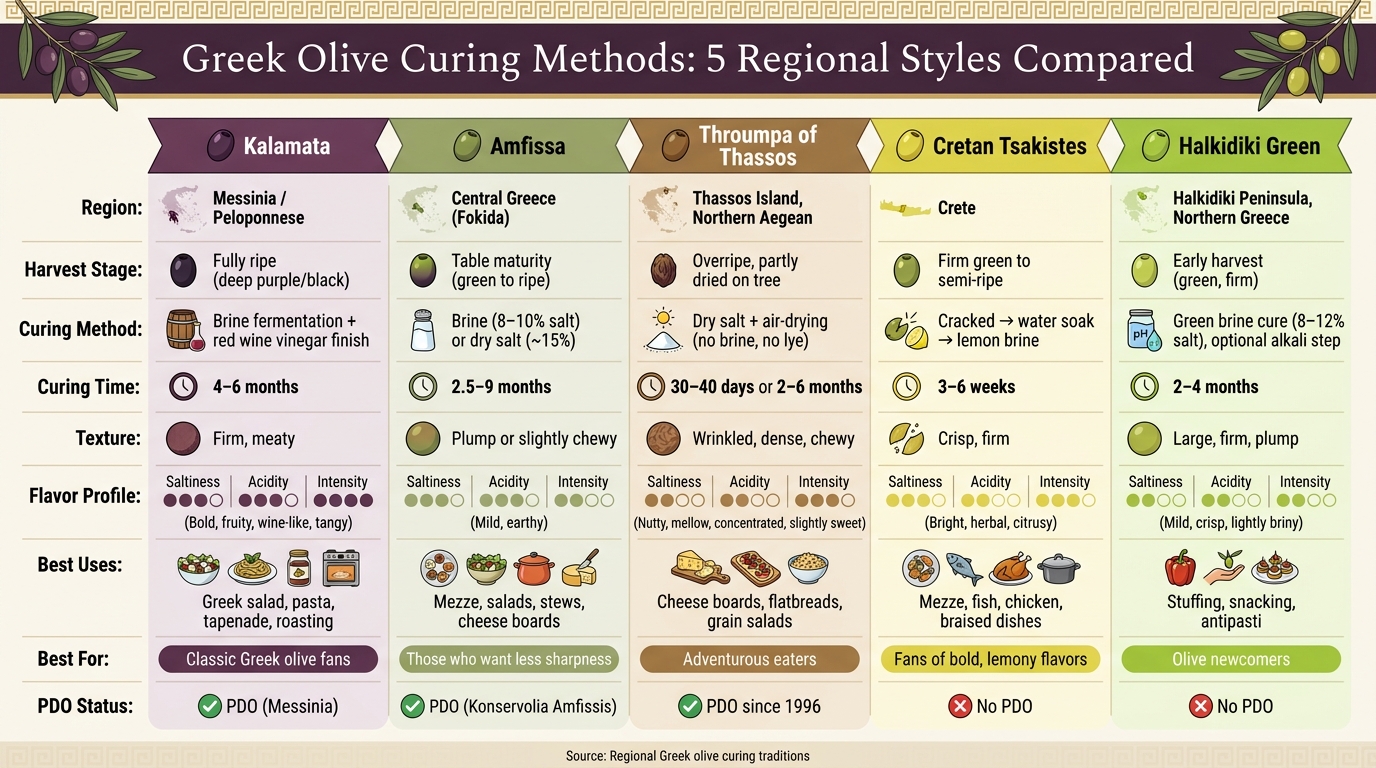
Greek Olive Curing Methods: 5 Regional Styles Compared
How to Cure and Preserve Your Own Olives
sbb-itb-4066b8e
Quick Comparison
| Style | How it’s cured | Usual time | Texture | Main flavor | Best use |
|---|---|---|---|---|---|
| Kalamata | Brine fermentation, often with vinegar finish | 4–6 months | Firm, meaty | Salty, fruity, tangy | Salads, pasta, roasting |
| Amfissa | Brine or dry salt | 2.5–9 months | Plump or slightly chewy | Mild, earthy | Mezze, salads, stews |
| Throumpa of Thassos | Dry salt and air-drying | 30–40 days or 2–6 months | Wrinkled, dense | Nutty, mellow, concentrated | Cheese boards, flatbreads, grain dishes |
| Cretan tsakistes | Cracked, soaked, then brined with lemon | 3–6 weeks | Crisp, firm | Citrusy, herbal, lightly bitter | Mezze, fish, chicken |
| Halkidiki green | Green brine cure, sometimes with alkali step | 2–4 months | Large, firm, plump | Mild, green, lightly salty | Stuffing, snacking, antipasti |
Bottom line: if you want the strongest briny hit, I’d go with Kalamata. If you want less tang, I’d pick Amfissa or Halkidiki. If you want a drier olive with no extra liquid, Throumpa stands out. And if you want a crisp olive with lemon notes, tsakistes are the one I’d serve.
Here’s the short version of how each Greek region shapes the olive in the jar and on the plate.
1. Kalamata (Messinia/Peloponnese) Brine-Cured Olives
Olive variety & harvest stage
The Kalamon cultivar, known around the world as Kalamata, grows mainly in Messinia in the Peloponnese. These olives are picked fully ripe, not green. By harvest time - usually November and December - they're medium to large, almond-shaped, deep purple to almost black, with smooth skin and thick, meaty flesh. Kalamata olives from designated Messinia zones carry PDO status.
Curing method & time
Kalamata olives are made through slow brine fermentation, not lye curing. After harvest, producers usually score or slit the olives, then place them in an 8%–10% brine - about 80–100 g of salt per liter of water. From there, time does the heavy lifting. The fermentation slowly pulls down bitterness and builds that sharp, tangy edge Kalamata is known for. In most cases, the process takes about 4–6 months, though the exact timing depends on conditions and the producer.
After fermentation, producers often finish the olives by adding red wine vinegar to the brine at about 4%–6% acidity. That step helps keep the acidity in check and gives the flavor a brighter snap. A thin layer of oil is also often added on top to keep air out.
Flavor & texture
Kalamata olives have a big, direct flavor: fruity, salty, bold, and lightly bitter, with a wine-like tang. Sensory analysis points to salty, sour, and bitter notes, along with fruit flavors that can bring to mind plum or blackberry. The texture is firm and meaty, which is one reason they work so well whole, chopped, or blended into spreads.
Best culinary uses
Kalamata olives fit easily into a lot of dishes. They work well in:
- Greek salad
- puttanesca
- olive bread
- tapenade
- roasted fish and chicken
They pair especially well with oregano, lemon zest, garlic, capers, lamb, and salty cheeses like feta or Pecorino. And don't toss the brine. Its salt and acidity make it handy as a marinade for chicken or pork.
As the most widely recognized Greek cured olive, Kalamata works as the benchmark for the regional styles that follow. Its brined profile makes the differences in those next styles easier to spot.
2. Amfissa/Konservolia (Central Greece) Brine- or Dry-Salt-Cured Olives
Olive variety & harvest stage
The Konservolia cultivar, usually sold as Amfissa, comes from Central Greece, with strong roots in Amfissa, Itea, and Delphi in Fokida. It has PDO status as Konservolia Amfissis.
If Kalamata is the bold standard, Amfissa is the gentler, more flexible option. These olives are picked at table-olive maturity. Greener fruit is usually used for firmer brined olives, while riper fruit is used for softer dry-salt styles. Next to Kalamata, Amfissa is milder, broader in style, and less sharply briny.
Curing method & time
Amfissa olives are made in two main styles: plump brined olives and wrinkled, more concentrated dry-salt olives. Most are brine-cured in saltwater with 8% to 10% salt, while dry-salt versions use salt at about 15% of the fruit's weight.
Curing time varies by color, temperature, salt level, and the flavor the producer wants. Green olives usually cure for 2.5 to 6 months. Black olives usually take 3 to 9 months.
Flavor & texture
Amfissa olives are mild, meaty, and low in bitterness. Brine-cured versions stay plump and moist, with a tender bite and light fruitiness. Dry-salted versions are firmer and a little chewy, with a deeper, more rustic olive taste.
They can taste more intense than Kalamata's tangy brine, but the effect is different. It’s less about sharpness and more about concentration.
Best culinary uses
Amfissa’s mild profile makes it easy to use across a lot of dishes. Brine-cured olives fit well on mezze platters, in salads, and on cheese boards. Dry-salted ones are a better match for dishes that need a denser olive flavor.
Amfissa lands somewhere between Kalamata’s bold brined style and Greece’s more intense dry-cured olives. That middle ground helps frame the sharper northern dry-salt styles coming next.
3. Throumpa of Thassos (Northern Aegean) Dry-Salt-Cured Olives
Olive variety & harvest stage
If Amfissa leans soft and mild, Throumpa goes in a drier, more concentrated direction. Throumpa olives, also spelled Throuba, come from Thassos island in Greece’s northern Aegean. In Greece, Thassos is the variety’s main home.
What makes them stand out is what happens before harvest. As the olives ripen, Phoma oleae helps break down oleuropein, so the fruit loses much of its bitterness while still on the tree. Growers leave the olives in place until they turn black, wrinkle, and partly dry out. By the time they’re picked, they’re already mild enough to eat straight from the branch, which is rare in olive production around the world.
Curing method & time
After harvest, producers pack the olives in coarse sea salt and let them air-dry. There’s no brine, no lye, and no heat. That simple method pushes the olives toward depth and concentration instead of tang.
Timing can vary quite a bit. Some producers finish the process in 30 to 40 days of air-drying after salting, while others cure them for 2 to 6 months, depending on how intense they want the flavor to be. Throumpa of Thassos has held PDO status since 1996, so only olives from this island, made with these methods, can use the name.
Flavor & texture
These olives are wrinkled, dense, and chewy. They feel less like a plump table olive and more like a savory dried fruit. The flavor is sweet-nutty, earthy, and mellow, with much less tang than Kalamata and none of the grassy edge you get from green Halkidiki olives. There’s still a little bitterness, but it reads more as depth than sharpness.
That dry, concentrated style makes Throumpa handy in dishes where extra liquid can throw things off. If you’re used to brine-cured olives, they can seem surprisingly gentle - almost like a savory olive raisin.
Best culinary uses
Since there’s no brine, Throumpa olives won’t water down salads or sauces. Their dry flesh also keeps tapenade thick instead of loose or watery. Blended with garlic, capers, and a bold extra virgin olive oil, they make a concentrated spread with a clean texture.
They also work well in a few other places:
- On cheese boards with sheep’s milk cheeses and honey
- Scattered over flatbreads or pizza
- Stirred into lentil or grain salads when you want a deep, savory note
Use less added salt.
4. Cretan Tsakistes (Crete) Cracked Brined Olives
Olive variety & harvest stage
If Thassos is all about dry salt and concentration, Crete goes the other way. Here, the olives are cracked first and then cured in brine for a fresher, sharper finish. Cretan tsakistes are made from firm green to semi-ripe olives with hard pits and dense flesh, which lets them take the crack without falling apart. Once an olive is cracked, even a small blemish or bit of insect damage can turn into a problem, so fruit selection matters a lot.
Crete leans toward a faster cure that keeps the olives tasting fresh rather than dark and heavy.
Curing method & time
The olives are lightly cracked with a stone, the flat side of a knife, or a small wooden mallet. The goal is simple: split the skin and flesh, but leave the pit whole. That single crack helps the olive take in water and brine much faster, and it also gives tsakistes their well-known bite.
After cracking, the olives sit in water for 6 to 8 days. During that time, the water is changed every day or every other day until most of the sharp bitterness has washed out. Then they go into brine. A lighter brine - about 1 heaping tablespoon of salt per gallon of water - is common in home-style Cretan tsakistes, though some recipes call for a stronger mix of around 105 grams of rock salt per liter of water.
Lemon juice goes into the brine, and a thin layer of olive oil is poured on top to help keep air out. The full cure usually takes about 3 to 6 weeks, though some batches are left for 40 to 42 days for a deeper taste. They should be kept in a cool, dark place, since lower temperatures slow the cure.
Flavor & texture
Where Thassos shrinks and concentrates the fruit, Crete keeps it crisp and fragrant. Tsakistes come out firm and crisp, with bright citrus notes, light herbal character, and only mild bitterness. Next to the darker, wine-like Kalamata style, they taste fresher and more lemon-forward.
Many old-style recipes build on that profile with garlic, crushed coriander seed, and lemon. Some also add lemon leaves or slices for extra aroma.
Best culinary uses
That fresh, aromatic style makes tsakistes a nice contrast to Greece’s denser cured olives. They work especially well as a mezze olive, served with feta, cured meats, and crusty bread. Their firm texture also holds up nicely in Greek salad with tomatoes, cucumbers, and onion, finished with extra virgin olive oil.
They’re also good in:
- Braised chicken or fish
- Baked dishes with lemon and herbs
- Grain pilafs
- Tapenade with capers and garlic for a brighter spread than Kalamata
That citrusy profile sets up Halkidiki’s larger green brined olives, which use a similar saltwater cure but give you a different fruit and texture.
5. Halkidiki Green Brined Olives
Olive variety & harvest stage
Halkidiki olives come from the Halkidiki peninsula in northern Greece. They’re picked early, while they’re still green and firm, before full ripening begins. That early timing helps keep their bright color and thick, dense flesh.
This matters in the jar and on the plate. Halkidiki olives are among Greece’s largest table olives, with a high flesh-to-stone ratio, which is why they’re so often used for stuffing. Instead of the darker, more concentrated regional styles, Halkidiki stays big, green, and firm. The result is a brined olive built more for a plump bite than for deep intensity.
Curing method & time
Producers usually de-bitter the olives briefly, then place them in brine with 8% to 12% salt for 2 to 4 months. Some producers use an alkali step and water changes first.
Flavor & texture
Halkidiki olives are plump, firm, and lightly briny, with a mild fruity aroma and gentle bitterness. If Kalamata brings tang and Throumpa brings density, Halkidiki goes in a different direction. It tastes fresh, green, and lightly saline.
That softer profile is exactly why these olives often show up stuffed or served with lighter food. They add texture and salt without taking over the whole dish.
Best culinary uses
Their large size and mild flavor make them a natural fit for stuffing with almonds, peppers, garlic, or cheese, and for mezze, salads, and antipasti.
They also pair well with:
- feta
- citrus
- fresh herbs
- roasted vegetables
- grilled fish
It’s smart to rinse them first if you want to cut some of the salt. Put all of this together, and Halkidiki sits at the mild end of Greek olive curing. It stands out as Greece’s clearest large, green brined style.
Flavor, Pairing, and Pros and Cons by Style
Taken together, these olive styles differ most in salt, acidity, texture, and overall punch.
If you want a dominant olive flavor, go with Kalamata. If you prefer something milder with more of a salt-led bite, Amfissa or Halkidiki work well. And when you want the olive itself to be the star, Throumpa or tsakistes make the strongest impression.
A small drizzle of Big Horn Olive Oil EVOO or a touch of aged balsamic can soften brined olives without drowning them out.
Here’s the side-by-side view:
| Style | Saltiness | Acidity | Intensity | Best Uses | Best for |
|---|---|---|---|---|---|
| Kalamata | Medium-high | Medium-high | Bold, fruity, wine-like | Greek salad, pasta, meze, roasting | Classic Greek olive fans |
| Amfissa/Konservolia | Medium | Lower | Mild, earthy | Bread, grilled vegetables, stews, simple meze | Those who want less sharpness |
| Throumpa of Thassos | Medium | Low to medium | Intense, concentrated, slightly sweet | Cheese boards, wine pairings, rustic salads | Enthusiasts and adventurous eaters |
| Cretan tsakistes | Medium-high | Medium | Bright, herbal, citrusy | Snacking, meze, roasted dishes | Fans of bold, aromatic, lemony flavors |
| Halkidiki green | Medium | Lower to medium | Mild, crisp | Snacking, antipasti, stuffed olive platters | Olive newcomers |
One simple rule helps a lot: use less added salt and acid when cooking with Kalamata or tsakistes. With Throumpa, think more about balancing richness than adding sharpness.
Use the table above to match each style to the dishes where it fits best.
Conclusion
Greek olive curing isn't one single custom. It's a group of regional methods shaped by the olive type, how ripe the fruit is at harvest, how salt is used, how long fermentation lasts, and whether vinegar, herbs, or oil are added at the end. Kalamata, Throumpa, and tsakistes show this clearly. Region and curing method give each olive its own texture, acidity, and intensity. That's the difference home cooks notice in the jar and on the plate.
In the kitchen, the takeaway is simple: match the olive to the moment. Bold, rich dishes call for Kalamata. Casual snacking and cheese boards pair well with Halkidiki or Amfissa. If you want something rustic and intense, reach for Throumpa. And if you're after a bright, herbal note in a marinade or appetizer bowl, Cretan tsakistes do the job. A light drizzle of Big Horn Olive Oil EVOO can finish any of these styles without covering up their flavor.
Start with the styles you know, then taste outward from there.
FAQs
How does curing change olive flavor?
Curing turns fresh, inedible olives into something you’d actually want to eat. It removes oleuropein, the compound behind the olive’s sharp natural bitterness. As that bitterness fades, the olive’s own layered flavor starts to come through.
With brine curing, the olives also ferment in saltwater. That gives them a bolder, savory, tangy taste. Over time, the curing process softens the texture too, and the olives can take on other flavors like herbs, garlic, and citrus.
Which Greek olive is best for snacking?
It comes down to the texture and taste you like most.
Green olives are firmer and have a milder flavor. Fully ripe black olives are softer, richer, and a little sweeter.
For the best results, pick olives that are firm and free of blemishes, then cure them in a salt brine. After that, you can add dried oregano, garlic, or lemon. Finish with a drizzle of extra virgin olive oil.
Why are some Greek olives wrinkled?
Wrinkled olives usually point to damage or lower quality, so producers often pull them out during sorting. That helps keep one bad piece of fruit from affecting the rest of the batch.
Sun-drying can cause trouble too. If the skin dries too fast, it can seal moisture inside the olive. And that’s where things can go wrong.
For curing, producers look for firm, blemish-free olives. Shriveled fruit gets removed to protect flavor and overall quality.