

Health Benefits of Tagines with EVOO
Yes - when I make a tagine with extra virgin olive oil, keep the heat low, and serve the sauce, I end up with a meal that fits a heart-smart eating pattern and helps my body use more nutrients from the vegetables.
Here’s the short version:
- EVOO brings mostly monounsaturated fat, which is linked with better cholesterol patterns when it replaces butter or animal fat.
- Tagines cook low and covered, which helps the oil hold onto part of its polyphenols instead of burning through them.
- The sauce matters: it carries oil, polyphenols, and carotenoids across the whole dish.
- Vegetables, legumes, spices, and lean protein make the meal line up well with a Mediterranean-style pattern.
- Amount matters: about 1–2 tablespoons of EVOO per serving is a useful range in many tagines.
- Research is strong on the overall pattern: in PREDIMED, 7,447 high-risk adults following a Mediterranean diet with about 3–4 tablespoons of EVOO per day had about a 30% lower risk of major cardiovascular events than the low-fat control group.
I’d boil the full article down to this: a tagine made with EVOO is not “healthy” just because olive oil is in it. It works best when I swap out saturated fat, cook gently at around 275–325°F or a low simmer, and build the dish around plants.
If I want the most from the oil, I choose extra virgin olive oil with a peppery, slightly bitter taste, use the lid, and avoid draining off the cooking liquid at the end.
| What matters | Simple takeaway |
|---|---|
| Type of fat | Use EVOO instead of butter, ghee, or animal fat |
| Heat | Keep it low and covered |
| Ingredients | Lean on vegetables, beans, and lean protein |
| Sauce | Serve it, don’t skim it off |
| Amount | Aim for 1–2 tbsp per serving |
| Oil choice | Pick high-polyphenol EVOO when possible |
That’s the core case for EVOO tagines: better fat profile, some antioxidant retention during cooking, and better use of fat-soluble nutrients from the meal.
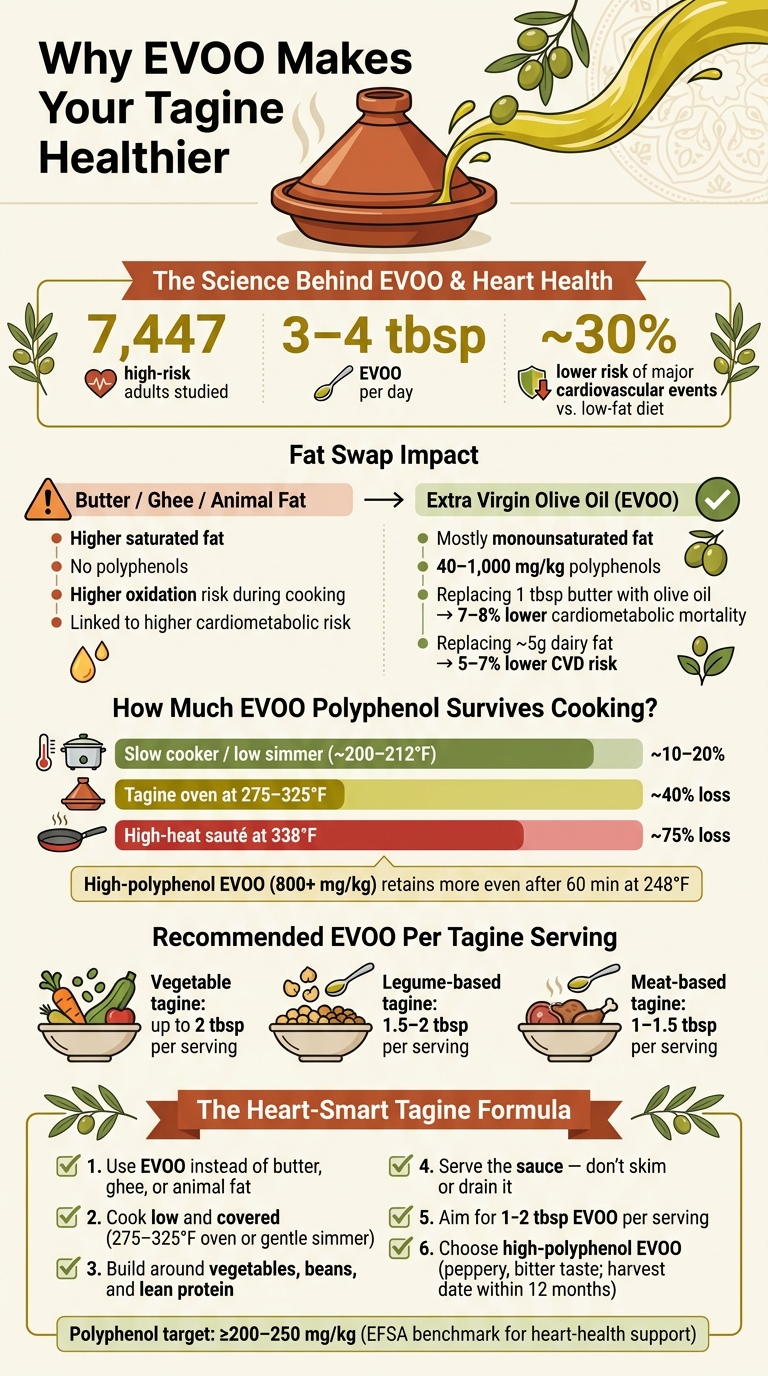
EVOO Tagine vs. Saturated Fat Tagine: Health Benefits Compared
What research says about EVOO and heart health
Key findings from Mediterranean diet and EVOO studies
The strongest human data comes from PREDIMED. In that study, 7,447 older adults with high cardiovascular risk followed a Mediterranean diet that included about 3–4 tablespoons of EVOO per day. They had about a 30% lower risk of major cardiovascular events than people in the low-fat control group. Longer follow-up work and U.S. cohort data point the same way.
Across studies, the most steady patterns are pretty clear: lower blood pressure, better lipid profiles, and less oxidation. Some studies also found higher HDL cholesterol. And when researchers compared oils, high-polyphenol EVOO tended to do a bit better than lower-polyphenol olive oils for oxidized LDL and inflammation markers. That sets up the next issue: what happens to those upsides when EVOO is used in a slow, covered tagine.
Why swapping saturated fats for EVOO matters in tagines
This is one of the biggest reasons tagines matter here. A 2021 prospective analysis of 521,120 individuals found that replacing 1 tablespoon per day of butter with olive oil was linked to 7% to 8% lower cardiometabolic mortality. In other research, replacing margarine or dairy fat with olive oil at about 5 g per day was tied to 5% to 7% lower CVD and coronary heart disease risk.
For tagines, that has a simple takeaway. If a recipe uses butter or another saturated fat, using EVOO as the main fat shifts the dish away from saturated fat and toward monounsaturated fat. That lines up better with the heart-healthy pattern seen in Mediterranean diet research. The effect makes the most sense when the rest of the tagine is built around vegetables, legumes, herbs, and lean protein.
How tagine ingredients add to the cardiovascular profile
A well-made tagine already checks a lot of the right boxes. Beans, vegetables, herbs, and moderate portions of lean meat add fiber, potassium, and micronutrients, while keeping the meal less tied to highly processed ingredients. EVOO helps carry flavor through the dish and supports the absorption of fat-soluble nutrients, while the meal as a whole stays closer to the eating pattern linked with lower cardiovascular risk in Mediterranean diet research.
A meta-analysis on the Mediterranean diet and CVD found that the diet’s protective effect is tied most strongly to olive oil, fruits, vegetables, and legumes working together, not to one ingredient alone. That mix is also part of why tagines are such a good fit for EVOO’s antioxidants.
sbb-itb-4066b8e
Antioxidants in EVOO and what happens when you cook a tagine
Key EVOO polyphenols and their antioxidant and anti-inflammatory effects
The main issue is simple: how much of EVOO’s helpful compounds make it through a tagine’s slow cook?
EVOO matters for more than its fat makeup. It also contains polyphenols, usually in the range of 40 to 1,000 mg/kg, depending on the olive variety, harvest timing, freshness, and processing. Some of the best-known are oleocanthal and oleacein.
These compounds do different jobs. Oleocanthal has anti-inflammatory activity that works in an ibuprofen-like way, while oleacein, hydroxytyrosol, and tyrosol help protect LDL from oxidation.
What studies show about polyphenol retention at moderate heat
Heat does reduce EVOO’s polyphenols. But it doesn’t wipe them out.
Research shows that home sautéing lowers polyphenols by about 40% at 248°F and about 75% at 338°F. Even so, the oil can still meet European health criteria after cooking. That’s an important point, because “reduced” and “gone” are not the same thing.
Starting level matters too. When the initial phenolic content was high - above 800 mg/kg - and cooking stayed around 248°F for 60 minutes, the oil still kept a large share of its phenolic content after heating. Put plainly: high-polyphenol EVOO holds up better during long cooking.
Why slow, covered cooking can protect flavor and useful compounds
This is where a tagine has an edge. The covered pot traps steam, limits oxygen exposure, and keeps the sauce at a gentler heat. That setup is easier on EVOO than hotter, open-pan cooking.
The other part is the food itself. Broth, tomatoes, and vegetables help buffer the heat, and EVOO polyphenols move into the sauce and the solid ingredients. So the antioxidants don’t just stay in the oil - they spread through the whole dish.
That shift matters for nutrition too, because it also shapes how the body takes in the meal’s fat-soluble nutrients.
How tagines with EVOO affect nutrient use in the finished meal
Better absorption of fat-soluble vitamins and carotenoids
Because EVOO stays in the sauce, it helps your body use more of the fat-soluble nutrients in the vegetables. That matters in a tagine, where carrots, tomatoes, peppers, and leafy greens bring in beta-carotene, lycopene, and vitamins A, E, and K. On their own, though, these compounds don’t absorb well. They need fat.
EVOO helps on two fronts. It pulls carotenoids out of plant cell walls and dissolves them into the cooking fat, which makes them easier for the gut to absorb. In tomato-based dishes, EVOO can greatly increase the amount of lycopene and beta-carotene available for absorption. Human trials also show higher blood lycopene levels after cooking tomatoes with olive oil.
Slow simmering helps this process along. As the tagine cooks, carotenoids get more time to move into the oil. And it doesn’t take much fat to make a difference. About 1–2 tablespoons of EVOO per meal supports absorption of fat-soluble nutrients.
That same sauce then carries those compounds across the whole dish, not just the vegetables sitting at the bottom of the pot.
How the sauce spreads antioxidants across the dish
The sauce does more than add flavor. It spreads EVOO polyphenols and vegetable carotenoids throughout the tagine. Think of it like a shuttle: the oil picks up compounds from the vegetables, then coats everything else in the pot.
One sofrito study makes this pretty clear. After cooking, the oil fraction contained roughly 139 µg/g of total carotenoids - almost the same as raw tomato at about 150 µg/g - even though EVOO starts with almost no carotenoids of its own. In plain terms, the oil became loaded with compounds that came from the vegetables.
That enriched oil is then eaten with every part of the meal, which spreads the nutrient gain beyond the vegetables themselves. So if you serve the tagine with all of its sauce, instead of draining or skimming it, you keep more of that benefit.
EVOO tagine versus tagine made with a saturated-fat-rich cooking fat
The contrast stands out even more when EVOO is compared with saturated-fat-rich cooking fats. Butter, ghee, and animal fats add little or no polyphenols, and they come with a higher risk of oxidation during long cooking. EVOO, on the other hand, adds polyphenols along with a healthier fat profile.
That means an EVOO-based tagine doesn’t just cook the ingredients. It helps the finished dish deliver more usable nutrients from them.
How to choose and use EVOO for a healthier tagine
How much EVOO to use per serving based on Mediterranean research
Getting the upside from EVOO starts with using enough of it and not cooking it too hard. PREDIMED used at least 4 tablespoons per day of EVOO, or about 50 mL, which gives home cooks a handy point of reference.
For tagines, 1–2 tablespoons of EVOO per serving is a solid place to start. The right amount depends on what’s in the pot.
- Vegetable-only tagines: go up to 2 tablespoons per serving. That can help with fullness and with absorbing fat-soluble vitamins and carotenoids.
- Legume-based tagines: dishes with chickpeas or lentils tend to work well at 1.5–2 tablespoons per serving.
- Meat-based tagines: since the meat adds some fat of its own, 1–1.5 tablespoons per serving is often enough.
Cooking ranges and methods that work in US kitchens
Once you’ve picked the oil, the next step is simple: cook gently. Tagine-style cooking pairs well with EVOO because it relies on low, covered, moist heat. EVOO that’s rich in polyphenols can hold on to most of those compounds during short cooking at moderate heat. Push the heat higher or cook much longer, and losses tend to climb.
In a US kitchen, there are three dependable ways to do this. On the stovetop, warm the EVOO and cook your aromatics over medium heat until you get a light sizzle, not smoke. Then add the rest of the ingredients and liquid, lower the heat, and let it simmer gently for 45 to 90 minutes, based on the recipe.
In the oven, cook the tagine covered at 275°F to 325°F. That steady, enclosed heat comes pretty close to the feel of clay-pot cooking.
A slow cooker works too. On the "low" setting, liquid usually stays around 200°F to 212°F. Under those gentle, moist conditions, polyphenol loss is often said to be only about 10% to 20%.
What to look for when choosing a high-polyphenol EVOO
Not every EVOO will behave the same way in a tagine. If you want strong flavor along with a good antioxidant profile, look for a few plain signs on the bottle.
Choose an oil with a harvest date from the last 12 months, dark glass or other opaque packaging, and extra virgin, cold-extracted labeling. Flavor matters too. A bit of bitterness and a peppery finish usually point to higher phenolic content.
If lab numbers are listed, aim for at least 200 to 250 mg/kg of total polyphenols. That lines up with European Food Safety Authority benchmarks tied to heart-health support.
For cooks shopping for oils with those traits, Big Horn Olive Oil offers Ultra Premium EVOO options such as Picual and Coratina, cold-pressed within 2 hours of harvesting.
Conclusion: The case for slow-cooked tagines with high-quality EVOO
The research points in the same direction: EVOO can support heart health and help retain antioxidants in tagines. Pair it with vegetables, legumes, and spices, and you get a meal that fits neatly into a Mediterranean-style way of eating.
For home cooks, the formula is simple: use fresh, high-polyphenol EVOO, cook low and slow with the lid on, and build the dish around vegetables, legumes, and lean protein.
5 Incredible Health Benefits of Virgin Olive Oil
FAQs
Can I use EVOO in a tagine without damaging its nutrients?
Yes. EVOO works well in a tagine and still keeps much of its nutritional value. Good-quality EVOO holds up to heat thanks to its monounsaturated fats and antioxidants. Its smoke point is often 410°F or higher.
That said, some polyphenols can drop during longer cooking. Even so, much of the oil’s value stays in place. If you want the best mix of nutrients and flavor, cook over moderate heat and drizzle a little fresh EVOO on just before serving.
Why is the sauce important in an EVOO tagine?
The sauce matters because it brings the meat, vegetables, and spices together into one balanced dish. As the tagine cooks low and slow, the conical lid sends moisture back into the pot, which helps the sauce reduce into a rich, layered base.
Using high-quality Big Horn Olive Oil in the sauce also adds nutritional value. It helps the body absorb fat-soluble vitamins and antioxidants from the vegetables.
How much EVOO should I use in a healthy tagine?
Aim for 1.5 to 3 tablespoons a day of high-quality extra virgin olive oil, especially if you're swapping out saturated fats like butter or margarine.
EVOO is a good fit for slow-simmered tagines. Then finish with a light drizzle right before serving to help keep more of its antioxidants and flavor. Go with a high-quality, cold-pressed oil to get the full mix of polyphenols and monounsaturated fats.