

Health Benefits of Sautéing with EVOO
Yes - EVOO is a smart oil for sautéing. When I keep the heat at medium or medium-low, extra virgin olive oil still holds onto many of its antioxidants, helps my body absorb nutrients from vegetables, and gives me a better fat choice than butter or shortening.
Here’s the short version:
- Moderate heat works: Home sautéing often stays around 250–330°F, which is below the usual EVOO smoke point of about 410°F.
- Some polyphenols are lost, not all: Studies in the article report drops of about 40% at 248°F and 75% at 338°F, but antioxidant activity still remains.
- Vegetables can help: Cooking EVOO with foods like onion, carrot, celery, and garlic can slow oxidation in the oil.
- It supports heart health: EVOO is rich in monounsaturated fat, mainly oleic acid, and fits U.S. advice to swap saturated fat for unsaturated plant oils.
- It helps nutrient uptake: Cooking tomatoes with olive oil increased blood lycopene in one trial, while tomatoes cooked without oil did not show the same jump.
- The best way to use it: I preheat the pan briefly, add 1–2 tablespoons, watch for a light shimmer, and avoid smoke.
Bottom line: sautéing with EVOO does change the oil, but it does not strip away everything that makes it a good pick. If I avoid overheating it, EVOO still adds heart-friendly fats, leftover antioxidants, and better absorption of fat-soluble plant nutrients.
That’s the main idea of this guide: how heat changes EVOO, what stays, what drops, and how to cook with it in a way that keeps more of the good stuff.
It’s OK to sauté with EVOO!
sbb-itb-4066b8e
How Heat Affects EVOO During Sautéing
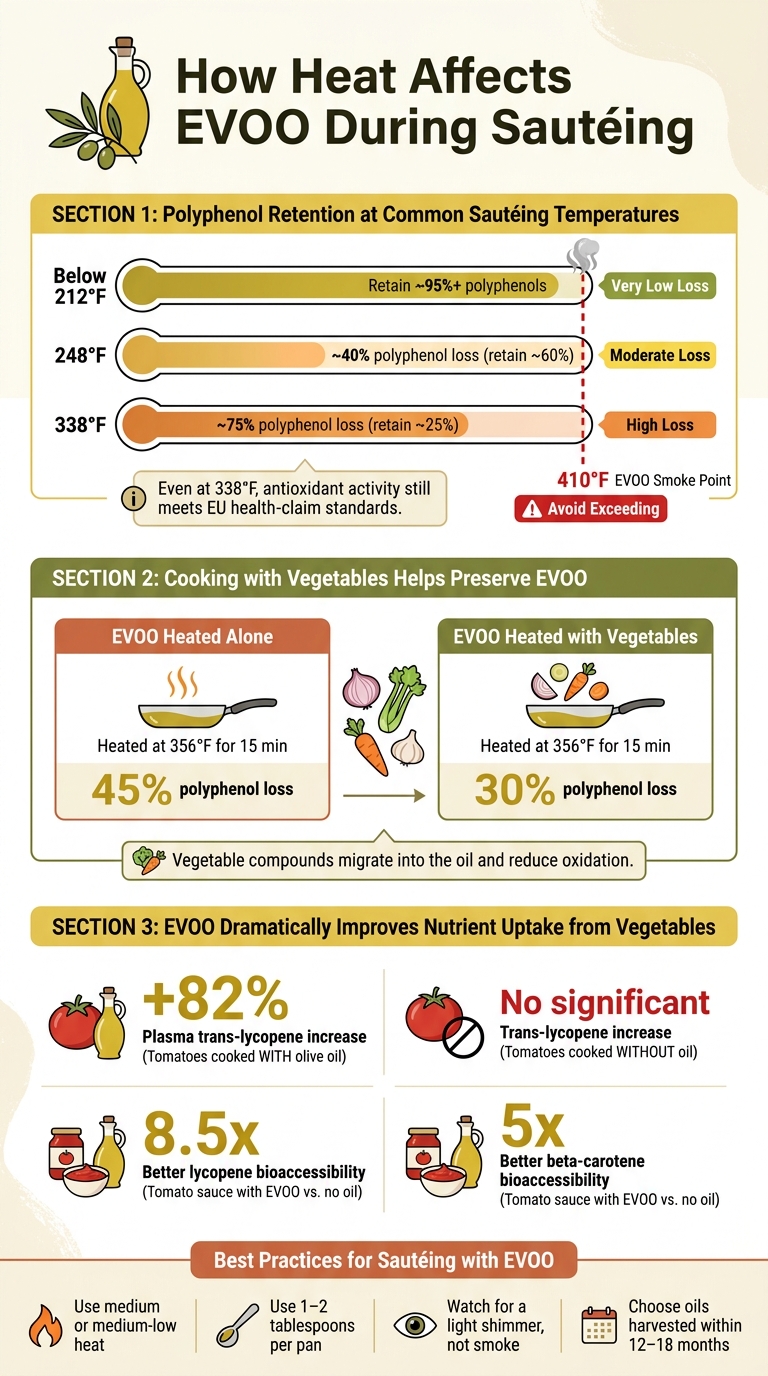
How Heat Affects EVOO: Polyphenol Retention & Health Benefits at a Glance
Heat does change EVOO. But in normal home sautéing, it still keeps a lot of what makes it useful in the first place. The key is simple: how hot the oil gets, and how long it stays there.
What Happens to Polyphenols, Antioxidants, and Healthy Fats
Polyphenols do drop when EVOO is heated. Research on home sautéing found that polyphenol content falls by about 40% at 248°F and around 75% at 338°F compared with raw EVOO. Even so, total antioxidant levels still stay within ranges that meet EU health-claim standards.
That sounds like a big loss, and part of it is. But the full picture is a bit less dramatic.
In one study, EVOO heated at 356°F for 15 minutes lost about 45% of its polyphenols when heated by itself. When that same oil was heated with onion, celery, carrot, and garlic, the loss dropped to about 30%. Compounds from the vegetables moved into the oil and reduced oxidation. In plain English: sautéing EVOO with vegetables can help slow polyphenol loss, which is a useful edge in day-to-day cooking.
EVOO also holds up well because of its fat profile. Its oleic acid is fairly stable under heat and resists oxidation better than polyunsaturated fats during sautéing.
Why Moderate Heat Works Better Than High Heat
Moderate heat gives EVOO a better shot at holding onto its antioxidants. Studies show losses are small below about 212°F, more noticeable between 212°F and 320°F, and faster above about 338°F, especially when cooking runs long.
The easiest warning sign is smoke. Once the oil starts smoking, you've crossed into a zone where it's overheating and starting to break down.
High-quality EVOO usually has a smoke point of about 410°F. That gives you a decent cushion for normal home sautéing, which often falls around 250–330°F. So if you keep the heat in that range and avoid dragging out the cook time, you help preserve more polyphenols, protect flavor, and cut down on unwanted oxidation compounds.
Common Myths About Cooking with EVOO
One of the biggest myths is that EVOO loses all of its good properties as soon as it hits a hot pan. That's not what the research shows.
Reviews of the science keep landing in the same place: EVOO still retains a meaningful level of antioxidant activity after cooking, especially under standard sautéing conditions. One research synthesis found that olive oil antioxidants are fairly resistant to heat, with major amounts still present even after heating to 428°F.
A pan-frying study tells a similar story. It found that total phenolic retention in virgin olive oil stayed in the 70% to 80% range after the first frying session. Even after eight straight frying sessions, the oil still had measurable antioxidant content.
Reviews and industry guidance also line up here: EVOO is stable enough for daily sautéing and roasting as long as you don't push it past its smoke point. So yes, sautéing changes EVOO. But it doesn't wipe it out. It still keeps enough protective compounds to matter in everyday cooking, which is a big part of why sautéed EVOO is useful for more than taste alone.
Health Benefits of Sautéing with EVOO
Because EVOO stays stable under moderate heat, it can still do a lot of good in the pan.
Heart Health, Cholesterol, and Inflammation
EVOO is closely tied to heart health. When you swap butter, lard, or other saturated fats for EVOO, you improve the fat makeup of the meal. That kind of swap is linked to better cardiovascular outcomes.
Its phenolics also play a part. They help move cholesterol out of cells and help protect HDL from oxidative damage.
And these effects don't disappear once heat enters the picture. One study found that a meal made with high-polyphenol EVOO lowered after-meal inflammation markers such as sICAM-1 and sVCAM-1 compared with refined olive oil. So if EVOO is your go-to fat for daily sautéing, instead of saturated fats, it can help support a heart-healthy way of eating over time.
That same oil also helps your body get more out of the vegetables cooked in it.
Better Nutrient Absorption from Vegetables
One of the easiest benefits to miss is how EVOO helps with nutrient absorption. Some plant compounds, including carotenoids and lycopene, are fat-soluble. In plain English, that means your body needs dietary fat to absorb them well, and EVOO works well as that carrier.
The numbers here are hard to ignore. In a randomized crossover trial with 11 subjects, tomatoes cooked in olive oil led to an 82% increase in plasma trans-lycopene and a 40% increase in cis-lycopene. Tomatoes cooked without oil showed no significant trans-lycopene increase. Another study on tomato sauce found that cooking with EVOO improved lycopene bioaccessibility by about 8.5-fold and beta-carotene by about 5-fold compared with tomato sauce made without oil.
So when you sauté vegetables in EVOO, you're not just making dinner taste better. You're also improving carotenoid uptake compared with fat-free cooking. A tomato-based pasta sauce, or a skillet of peppers and onions cooked in EVOO, can help you get more nutritional value from the vegetables themselves.
How Cooked EVOO Still Delivers Protective Compounds
Sautéing changes the final dish in an interesting way: some compounds move from the oil into the food, and some move from the vegetables into the oil.
During sautéing, some of EVOO's phenolics transfer into the food while vegetable compounds move into the oil, which helps make the finished dish more protective overall. Research on sofrito-style cooking found that garlic, onion, and tomato release their own polyphenols and carotenoids into the oil during sautéing, adding to the shared antioxidant content of the final dish.
So even though some heat-sensitive compounds decrease, the meal doesn't end up empty-handed. In everyday dishes like sautéed zucchini or a simple tomato-garlic sauce, the final food can still contain a mix of EVOO's remaining phenolics along with compounds drawn out from the vegetables.
How to Sauté with EVOO Without Losing Its Benefits
Temperature, Timing, and Visual Cues to Watch For
EVOO can handle sautéing just fine. The key is controlling the pan, not skipping the oil.
Heat matters most here. The compounds linked to heart health and nutrient absorption hold up better when the heat stays in check. So stick with medium or medium-low heat and keep the pan below the smoke point. Moderate heat helps preserve more of EVOO’s protective compounds.
Start by preheating a heavy-bottomed stainless steel or cast-iron skillet for 1–2 minutes. Then add 1–2 tablespoons of EVOO. You’re looking for a light shimmer. If you see smoke or notice a harsh smell, the pan is too hot.
Add onions first. Add garlic only during the last 30–60 seconds. Garlic can go from fragrant to burnt in a flash, so if it starts browning too fast, turn the heat down or add a small splash of broth or water.
Why Oil Quality and Freshness Matter
Once the heat is under control, freshness becomes the next big thing to watch.
Fresh, high-polyphenol EVOO tends to hold up better in the pan. It also brings more flavor to the dish, even after cooking. That matters more than people think. A good oil doesn’t just survive the pan; it still shows up on the plate.
When you shop, check for a harvest date and aim for oils harvested within the last 12–18 months. Dark glass or tin is the better pick because it helps protect freshness.
A fresh oil should smell grassy or fruity, with a clean peppery finish. If it smells flat, rancid, or waxy, it’s past its best.
Raw vs. Sautéed EVOO: Key Differences
Raw and sautéed EVOO do different jobs, and both have a place in a healthy kitchen.
Raw EVOO keeps more polyphenols and gives you the boldest flavor. That makes it a good fit for dressings, drizzling, and finishing dishes. Sautéed EVOO gives up some polyphenols during cooking, but it still keeps substantial antioxidant activity. It also helps your body absorb fat-soluble nutrients from vegetables.
A simple way to get both: cook with EVOO, then finish the dish with a small drizzle of fresh EVOO.
Conclusion: EVOO Is a Sound Choice for Sautéing
The main point is simple: EVOO works well in a home kitchen. Its high monounsaturated fat content and natural antioxidants help it hold up during everyday cooking, and moderate sautéing doesn't wipe out those strengths.
Use medium or medium-low heat. Pick a fresh Arbequina extra virgin olive oil with a recent harvest date. That gives you a cooking fat that supports heart health and helps your body absorb nutrients.
That day-to-day upside also connects to long-term heart health. Large trials link EVOO-rich Mediterranean diets with fewer cardiovascular events. That benefit still holds after sautéing.
When you use EVOO at moderate heat, it keeps enough protective compounds to make sautéing a healthy part of daily cooking.
FAQs
Can I reuse EVOO after sautéing?
It’s usually best not to reuse extra virgin olive oil after sautéing. Once you heat it, the flavor starts to fade and some of its nutritional quality drops too.
For the best taste and the most antioxidant value, use Big Horn Olive Oil Ultra Premium EVOO for one cooking session, then switch to fresh oil for a finishing drizzle.
Does infused EVOO work for sautéing?
Yes. You can use infused extra virgin olive oil for sautéing.
Big Horn Olive Oil says its Ultra Premium EVOOs stay stable at common sautéing temperatures, around 248°F to 320°F, and have smoke points of 410°F or higher.
For the best flavor and nutritional quality, cook over medium heat and don’t let the oil get too hot.
How do I know if EVOO got too hot?
If you notice thin wisps of smoke coming off the pan, or the oil itself starts smoking, your EVOO is too hot. At that point, it has hit its smoke point, which can change the taste and lower the oil’s quality.
A simple way to avoid that: heat the pan for about 60 seconds first, then add the oil. Once the oil starts to shimmer, it’s ready for your ingredients. If it begins to smoke, turn the heat down right away or swap in new oil.