

How Aging Impacts Balsamic Vinegar Flavor
Aging is the secret behind balsamic vinegar’s rich flavor and syrupy texture. Over years in wooden barrels, the vinegar thickens as water evaporates, while oxidation softens its sharpness into a balanced sweetness. Each barrel type - oak, cherry, chestnut, and others - adds unique flavor notes like vanilla, fruit, or spice.
Here’s the breakdown:
- Young (0–3 years): Thin, sharp, fruity. Best for marinades and dressings using wine vinegars.
- Mid-aged (12 years): Smooth, balanced, with hints of cherry and leather.
- Long-aged (25+ years): Thick, velvety, with flavors of caramel, dried fruit, and spice.
When buying, look for “Aceto Balsamico Tradizionale DOP” for authentic, long-aged vinegar. Store it in a cool, dark place, and use sparingly as a finishing touch - not for cooking. A few drops can transform cheese, fruit, or even ice cream into something extraordinary.
How DOP (Traditional) Balsamic Vinegar is Made
sbb-itb-4066b8e
How Aging Changes Balsamic Vinegar
As balsamic vinegar ages in wooden barrels, it undergoes a fascinating transformation. Over the years, its flavor, texture, and aroma evolve, creating the rich complexity that makes it so prized.
The Role of Oxidation and Evaporation
Two key processes - evaporation and micro-oxidation - drive these changes. In the porous wooden barrels, about 10% of the water content evaporates annually. This natural loss concentrates the sugars and acids, meaning that from 100 liters of grape must, only about 15 liters of vinegar remain after 12 years of aging. At the same time, micro-oxidation occurs, softening the vinegar's sharp acidity and allowing a harmonious sweetness to emerge.
Wood Barrel Aging and Flavor Infusion
The barrels themselves play an active role in shaping the vinegar's character. Traditional production uses a "batteria", a series of 5 to 10 barrels made from different types of wood, each contributing its own unique flavor.
"As the vinegar matures, it absorbs the wood's essences, contributing to its complex flavor profile." - vomFASS
Here's how different woods influence the vinegar:
| Wood Type | Flavor/Aroma Contribution |
|---|---|
| Oak | Adds woody depth and vanilla notes |
| Cherry | Brings a delicate, fruity sweetness |
| Chestnut | Provides tannins and deepens the color |
| Juniper | Infuses pungent, spicy, and resinous tones |
| Mulberry | Offers subtle sweetness and promotes oxygenation |
| Ash | Neutral, focusing on concentration rather than flavor |
By rotating through these barrels, the vinegar develops a layered complexity. Beyond the wood's influence, the environment around the barrels also plays a role in its maturation.
Seasonal Temperature Changes and Maturation
In Modena, where traditional balsamic vinegar is produced, the storage environment amplifies the aging process. Instead of cool cellars, barrels are stored in attics, where they are exposed to seasonal temperature shifts. During the summer, the heat speeds up fermentation and acetification, while the cold winter months provide a period of rest, allowing the flavors to meld. This natural rhythm, repeated over many years, is essential to achieving the deep, nuanced character of aged balsamic vinegar.
How Flavor Changes at Each Aging Stage
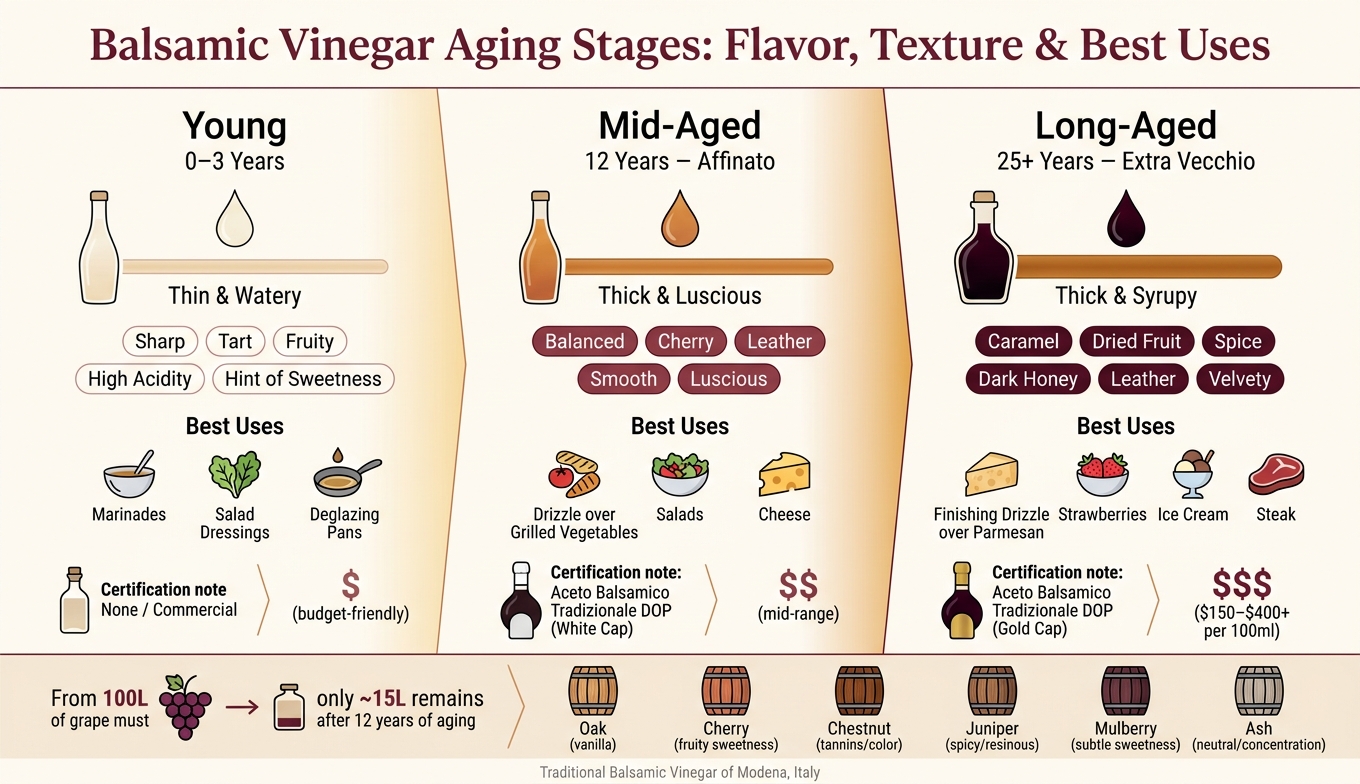
Balsamic Vinegar Aging Stages: Flavor, Texture & Best Uses
Each stage of aging brings out a new personality in balsamic vinegar, showcasing its transformation from a bold, youthful spirit to a refined, mature masterpiece. The changes in flavor, texture, and aroma are anything but subtle - they're a complete evolution.
Young Balsamic Vinegar: Sharp and Fruity
In its early years, balsamic vinegar is all about high acidity and a thin, watery consistency. Its tart, sharp flavor has just a hint of sweetness, making it vibrant but lacking the depth that comes with age. This youthful zest makes it perfect for marinades, salad dressings, or deglazing pans. Over time, the vinegar’s sharpness begins to soften, paving the way for more complexity.
Mid-Aged Balsamic Vinegar: Balanced Sweetness and Acidity
By the time it reaches the 12-year mark, known as affinato, the vinegar has mellowed considerably. The sharp edges smooth out, giving way to a balanced sweetness and a thicker, more luscious texture. Subtle hints of cherry and leather start to emerge. As Olive Lane Oils explains:
"The aging process softens the sharpness often found in young or flavored varieties." - Olive Lane Oils
This stage of balsamic vinegar is incredibly versatile. It’s just as at home drizzled over grilled vegetables or paired with fresh harvest extra virgin olive oil as it is finishing a salad. This balance of sweetness and acidity sets the stage for the rich complexity of older varieties.
Long-Aged Balsamic Vinegar: Rich and Refined
After 25 years or more, balsamic vinegar earns its extra vecchio status, and the transformation is remarkable. The texture becomes thick, almost syrupy, and velvety smooth. The sharp acidity of its youth is replaced by a mellow sweetness, layered with flavors like dried fruit, caramel, leather, spice, and dark honey. As asmr.education describes:
"At this stage, the vinegar has developed an almost syrupy consistency and an extraordinary layering of flavors, ranging from dried fruit and caramel to leather, spice, and dark honey." - asmr.education
This is not the vinegar for cooking - heat would dull its intricate aromatics. Instead, use it sparingly as a finishing touch. Just a few drops over aged Parmesan, fresh strawberries, or even vanilla ice cream can transform a dish. With bottles of extra vecchio ranging from $150 to over $400 per 100 ml, it’s a true testament to decades of artistry.
How to Spot High-Quality Aged Balsamic Vinegar
Understanding the hallmarks of aged balsamic vinegar can help you make a more informed choice. By focusing on its appearance, aroma, and taste - and paying attention to label details - you can separate authentic aged balsamic from lower-quality alternatives.
Color and Density
The first thing to notice is the color. High-quality aged balsamic vinegar has a rich, deep brown to almost black shade. This comes naturally from years of aging in wooden barrels, not from artificial caramel coloring. Its consistency is just as telling. True aged balsamic is thick and syrupy due to the slow evaporation process that concentrates the grape must. To test it, pour a small amount onto a spoon - it should coat the surface evenly and drip slowly, much like warm syrup. If it’s watery or runs too quickly, it may indicate artificial thickeners or insufficient aging.
Always check the ingredient list for authenticity. Genuine aged balsamic vinegar will list only "grape must" or "cooked grape must" (mosto cotto). Be wary of additions like caramel color, sugars, or thickeners such as guar gum or xanthan gum, as these are signs of a lower-quality product.
Aroma and Taste Depth
The aroma of a high-quality aged balsamic is another giveaway. You’ll notice a rich, layered scent with hints of dried fruit, caramel, and subtle wood notes, thanks to the oak, chestnut, or cherry barrels used during aging. This complexity carries over to its taste, which balances natural sweetness with a velvety texture. The sweetness is developed over time, not artificially added.
As asmr.education explains:
"The flavor profile is nothing like what most people associate with balsamic vinegar. There is no harsh acidity, no thin wateriness. Instead, there is a velvety density and a sweetness that feels earned rather than added."
If the vinegar’s aroma is flat or the flavor feels overly sharp and one-dimensional, it’s likely a younger or mass-produced version, lacking the key differences between balsamic and red wine vinegar that define premium quality. Beyond these sensory cues, the product’s label can provide critical details about its authenticity and aging process.
Reading Labels and Aging Designations
Labels are your best resource when evaluating aged balsamic vinegar. Here’s how to decode them:
| Label Term | What It Means | Minimum Aging |
|---|---|---|
| Aceto Balsamico Tradizionale DOP | Made entirely from cooked grape must and strictly regulated | 12 years (Affinato) or 25 years (Extra Vecchio) |
| Balsamic Vinegar of Modena IGP | A blend of grape must and wine vinegar, with some regulation | 60 days (or 3+ years for "Aged" varieties) |
| Condimento | Not officially certified; quality can vary widely | Often 3–7 years |
The cap color can also indicate aging. In Modena, white caps signify Affinato (12 years), while gold caps mark Extra Vecchio (25 years). In Reggio Emilia, caps are color-coded red, silver, and gold to show aging levels.
As Andrew Wheeler points out in Serious Eats:
"If wine vinegar is the first ingredient, you're looking at generic vinegar sweetened with balsamic must, not balsamic must balanced with a little vinegar."
Lastly, check for the producer’s name and address. Authentic balsamic vinegar from Modena will clearly state this information. Brands like Big Horn Olive Oil's Traditional 18-Year Aged Dark Balsamic Vinegar and Molto Denissimo 25-Year Aged Dark Balsamic Vinegar are prime examples of products sourced directly from Modena, offering genuine quality and transparency.
Aging Duration and Its Effect on Flavor
The length of aging plays a crucial role in shaping the flavor profile of balsamic vinegar, adding layers of depth and richness over time.
Short-Term vs. Long-Term Aging
The aging process is one of the key factors that sets commercial balsamic vinegar apart from its traditional counterpart.
Commercial balsamic vinegar is typically aged for less than three years. This results in a product that is lighter, with a sharper acidity and a thinner consistency. It’s perfect for everyday uses like salad dressings, marinades, or glazes. On the other hand, traditional balsamic vinegar is aged for a minimum of 12 years to earn the Aceto Balsamico Tradizionale DOP designation. The premium Extra Vecchio varieties can age for 25 years or more, achieving a rich, syrupy texture and a complex sweetness.
| Feature | Commercial Balsamic | Traditional Aged Balsamic |
|---|---|---|
| Aging Duration | Less than 3 years | 12 to 25+ years |
| Ingredients | May include caramel or thickeners | 100% cooked grape must |
| Best Use | Everyday cooking, glazes | Finishing drizzle for cheese, fruit, or meat |
When Extended Aging Yields Smaller Changes
The most significant flavor changes occur during the 12-to-25-year aging window. During this time, the vinegar evolves from being sharp and acidic to becoming dense, sweet, and layered with flavor. Natural evaporation thickens the grape must, while the barrel rotation process infuses the vinegar with unique aromatic notes.
Once balsamic vinegar surpasses the 25-year mark, the changes become subtler. The flavor refines rather than transforms, making the 12-to-25-year period the sweet spot for noticeable flavor development. Extremely aged vinegars, some exceeding 100 years, are so concentrated that only a drop or two is needed. These are often paired with simple yet luxurious accompaniments like Parmigiano-Reggiano or fresh strawberries.
This aging process is beautifully illustrated by offerings from high-quality producers.
Examples of Aged Balsamic Vinegar
Take Big Horn Olive Oil's products as an example. Their Traditional 18-Year Aged Dark Balsamic Vinegar ($8.99), sourced from Modena, Italy, showcases a syrupy texture and a balanced sweetness. It’s perfect for drizzling over cheese, fruit, or roasted vegetables.
For those seeking even greater depth, their Molto Denissimo 25-Year Aged Dark Balsamic Vinegar ($12.99) offers a luxurious experience. Meeting the Extra Vecchio standard, this vinegar boasts a thicker consistency and a flavor profile enriched with notes of caramel, dried fruit, and wood. The $4 price difference reflects the added aging, which enhances its richness and complexity.
How to Store Aged Balsamic Vinegar
When you’ve invested in aged balsamic vinegar - be it an 18-year or 25-year variety - proper storage is essential to maintain its rich, complex flavors. Treating it with care ensures that the meticulous aging process isn’t wasted.
Best Storage Conditions
Keep aged balsamic vinegar in a cool, dark pantry, away from heat and light. Temperature stability is crucial; aim for a range between 50°F and 68°F to prevent flavor degradation. Fluctuations can dull the intricate profile that makes aged balsamic so special.
Light exposure is another enemy. UV light can break down the aromatic compounds that give the vinegar its depth. That’s why most high-quality balsamic producers use dark or amber glass bottles, which block up to 99.8% of UV-A radiation. Always store it in its original bottle to maintain this protection.
To prevent oxidation, seal the bottle tightly after each use. For frequent use, consider using a vacuum pump stopper to remove excess air. A handy trick is to pour a small amount into a smaller bottle for daily use, keeping the main supply sealed and stored properly.
Avoid refrigerating aged balsamic vinegar. Cold temperatures can lead to condensation inside the bottle, diluting its acidity and muting its signature aromas. Proper storage not only preserves its flavor but also extends its shelf life.
How Long Aged Balsamic Vinegar Lasts
Aged balsamic vinegar is unique among pantry staples, thanks to its high acidity (pH 2.4 to 3.4), which naturally prevents bacterial growth.
"When stored properly, aged balsamic vinegar can last almost indefinitely. Its quality and flavor can even improve with age, much like a fine wine." - Redstone Olive Oil
Traditional DOP balsamic vinegar, once opened, can retain its quality for 3 to 5 years if stored correctly. On the other hand, commercial balsamic-style vinegars typically last only 6 to 12 months after opening. This difference comes down to their composition: traditional balsamic has higher polyphenol levels and no artificial thickeners, while commercial versions often do.
Here’s a quick comparison:
| Feature | Traditional DOP Balsamic | Commercial Balsamic-Style |
|---|---|---|
| Unopened Shelf Life | 5–12 years | 2–3 years |
| Opened Shelf Life | 3–5 years | 6–12 months |
| Stability Factors | High polyphenols (>100 g/L) | Low polyphenols (~18 g/L) |
Natural sediment or slight cloudiness - sometimes referred to as the "mother" - is harmless and can be strained out if desired. However, watch out for warning signs like visible mold, a rancid smell, or a watery texture. These issues are rare when the vinegar is stored correctly.
At Big Horn Olive Oil, we ensure our aged balsamic vinegars are kept under ideal conditions to preserve their depth and character, so you can enjoy them at their finest.
Conclusion: Getting the Most Out of Aged Balsamic Vinegar
Aging transforms balsamic vinegar into a rich and complex condiment, building layers of flavor over 12 to 25+ years. The result? A dense, syrupy vinegar with naturally balanced sweetness and acidity that can enhance anything it touches.
Drizzle just a few drops over Parmigiano-Reggiano, fresh strawberries, or a perfectly grilled steak, and watch the dish come alive. But remember: aged balsamic vinegar is best used as a finishing ingredient. Exposing it to high heat can mute the delicate flavors that took decades to develop, so use it sparingly and with care.
When selecting a bottle, look for DOP or IGP certification and "grape must" as the main ingredient. These markers ensure the vinegar was traditionally crafted in Modena or Reggio Emilia, Italy. For example, Big Horn Olive Oil offers the Traditional 18-Year Aged Dark Balsamic Vinegar ($8.99) and the Molto Denissimo 25-Year Aged Dark Balsamic Vinegar ($12.99), both sourced directly from Modena. These products reflect the dedication to authenticity and craftsmanship discussed throughout this article.
Once you experience the depth and harmony of a properly aged balsamic vinegar, it transforms every dish into something extraordinary.
FAQs
Why does aged balsamic get thicker over time?
Aged balsamic vinegar becomes thicker as it matures due to the natural evaporation of water during the aging process. As the water content decreases, the grape must becomes more concentrated, giving the vinegar a denser, syrup-like texture. This process also deepens the flavor, resulting in a rich and smooth vinegar that elevates both its taste and quality.
How can I tell real aged balsamic from one with additives?
Real aged balsamic vinegar stands out with its rich, glossy brown hue, thick and syrupy consistency, and a layered aroma that hints at fruit, wood, and vanilla. To ensure authenticity, look for the DOP seal, which guarantees it has been aged for at least 12 years. Also, check the ingredients list - it should contain only 100% grape must, with no caramel or other additives sneaking in.
What are the best foods to finish with long-aged balsamic?
Long-aged balsamic vinegar is a perfect match for foods like aged cheeses, fresh fruits, and desserts - especially vanilla ice cream. Its deep, layered flavors bring out the best in both savory and sweet dishes, making it an excellent choice for adding that final touch of flavor.