

How Olive Mills Keep Village Economies Moving
Olive mills support village jobs - but where the money goes matters more than where the mill stands. When I buy local oil, I check who grew, milled, and bottled it - not just the address on the label.
Here’s how I follow the money:
- Harvest and milling: Growers, crews, truckers, and mill staff earn income. The article recommends crushing olives within 2–4 hours, making delivery planning a priority.
- Storage and sales: Bottling, packing, shops, and restaurants add work. Local bottling adds costs and sales risk, too.
- Ownership and purchasing: Payments to local workers and suppliers help keep income nearby.
- Risk and returns: Delivery slots, buyer agreements, and payment terms help limit disruptions. By-products bring income only when sales cover their costs.
My takeaway: <u>check the harvest date, origin, mill, and bottling location</u>. Those details help trace the oil, but only records of sourcing and payments show how much income stays in the village.
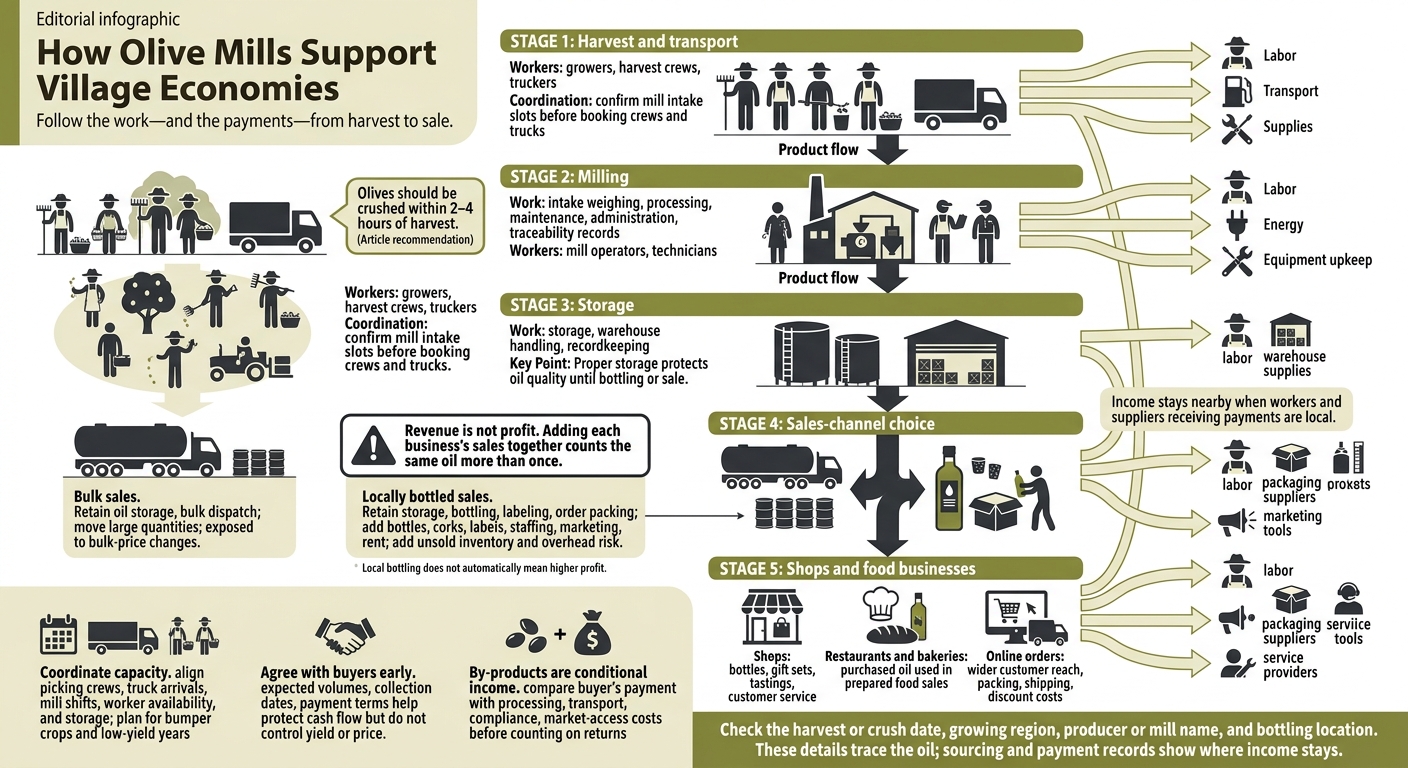
How Olive Mills Support Village Economies
Record olive harvest in Tunisia but little revenue
sbb-itb-4066b8e
Harvest and Milling: Local Work and Services
Once olives arrive at the mill, work shifts from picking to transport, processing, and recordkeeping.
Growers and Truckers Bring Olives to the Mill
Harvest crews and truckers need the mill’s intake schedule before picking starts. Olives should be crushed within 2 to 4 hours of harvest, so drivers and intake crews have a tight window to work with. Keeping that schedule on track supports growers’ income and pays workers and transport providers.
Careful handling, intake weighing, and scheduled deliveries protect the fruit and keep the processing line moving. Growers should confirm an intake slot with the mill before booking crews and trucks.
Mills Employ Workers and Buy Local Services
Harvest brings seasonal jobs, but mill work doesn’t end with crushing. Maintenance, storage, administration, and traceability records keep people working afterward.
Each crop provides income for harvest crews, truckers, mill operators, technicians, and warehouse staff as olives move from the field to storage.
How Mill Ownership Affects Local Income
Follow the payments, not just the ownership. Private mills can pay growers and suppliers directly, while owners may put profits back into equipment and facilities. That spending supports wages, local suppliers, and maintenance businesses.
Small regional mills also help farms without export capital reach buyers, often through distributor partnerships. Local payments continue beyond crushing, through storage, bottling, packaging, and sales.
Storage and Sales: Work Beyond the Mill
Storage, Bottling, and Packaging Create More Work
Proper storage protects oil quality until bottling or sale. Bottling, labeling, and packing also provide work for suppliers, warehouse staff, and shippers. Using local services keeps more of that spending in the village.
How Bulk and Bottled Sales Divide Revenue
The sales channel chosen after milling determines where work stays and who pays the costs. Bulk sales move larger volumes through another buyer’s network. Local bottling keeps more work nearby, but it also adds costs, staffing needs, and sales risk.
| Factor | Bulk sales | Locally bottled sales |
|---|---|---|
| Local tasks retained | Oil storage and bulk dispatch | Storage, bottling, labeling, and order packing |
| Operating costs | Storage, handling, and transport | Bottles, corks, labels, staffing, marketing, and rent |
| Finding customers and handling orders | Finding buyers and managing supply agreements | Finding customers, managing inventory, and handling service |
| Volume and risk | Can move large quantities; exposed to bulk-price changes | Depends on customer demand; adds unsold inventory and overhead risk |
Revenue is not profit. Each business pays its own costs from its sales. Adding every business’s sales together would count the same oil more than once as it moves through the chain.
| Participant | Revenue source | Expenses paid from revenue |
|---|---|---|
| Growers | Olives sold | Orchard care, harvest labor, transport |
| Milling | Processing fees or oil sales | Labor, energy, equipment upkeep, storage |
| Packaging | Bottling and packing services, where charged separately | Containers, labels, labor, equipment |
| Retail | Bottles and gift sets | Oil inventory, wages, rent, marketing |
| Food service | Prepared food sales | Oil and other ingredients, kitchen labor, premises |
These revenue splits carry through to shops and restaurants.
Shops and Food Businesses Turn Oil Into Sales
Specialty shops employ staff to run tastings, explain flavor profiles, and suggest pairings and uses. Markets and specialty shops earn income from bottles and gift sets. Restaurants and bakeries use purchased oil in the food they sell.
At Big Horn Olive Oil, employee Ego Onunaku points to restaurant demand:
"We have a lot of restaurants that actually buy from us to make their product, because they know it's high quality, and because you can just taste it in the flavor."
- Ego Onunaku, Employee, Big Horn Olive Oil
Online orders reach more customers but add packing, shipping, and discount costs.
Those sales patterns also shape how mills handle seasonal risk.
By-Products and Planning Help Communities Handle Risk
When By-Products Can Generate Income
Treat by-product income as a possibility, not a guaranteed return. Profit depends on local processing, transport, compliance, and market-access costs. Compare what the buyer will pay with the full cost before counting on that revenue. When by-product income is uncertain, keeping harvests on schedule matters even more.
Harvest Scheduling and Sales Options Reduce Disruptions
Beyond by-product income, scheduling helps protect against lost earnings. Plan deliveries around processing capacity, not just picking capacity. The narrow harvest window makes delivery timing critical. Growers, mill owners, and truckers should coordinate picking crews, truck arrivals, and mill shifts. Before harvest, check worker availability, trucking, and storage capacity. Adjust delivery slots when those limits change.
Plan for bumper crops and low-yield years alike. What happens if arrivals exceed daily capacity - or low yields bring in too little revenue to cover planned costs? Small regional mills may need buyer commitments and clear payment terms before harvest to protect cash flow. Agree on expected volumes, collection dates, and payment terms with buyers early. These steps reduce disruptions, but they don’t control yield or price.
Conclusion: What an Olive Oil Purchase Supports
From harvest to shelf, one bottle can support several village workers: growers, truckers, mill workers, packers, and shop staff. Buying local olive oil can also support bottling, shipping, and food-service jobs. How much income stays local depends on where the work happens, who owns the businesses, and which suppliers get paid. Only documented sourcing shows where that income stays.
Check Harvest Dates, Origin, and Producer Details
Look for a harvest or crush date, the growing region, the producer or mill name, and the bottling location. These details help verify how recently the oil was made and where it comes from, but they don't show village-level income.
FAQs
How can I verify that my olive oil purchase supports village jobs?
Choose olive oil with traceable origins and a clear commitment to quality. Check the packaging for a harvest date, ideally within the past 3 months. Clear dating often points to a direct connection with the producer.
Look for PDO, PGI, or COOC certification seals as signs of genuine origin and high production standards. Batch codes or QR codes can also help you trace the olives to the grove or cooperative where they were grown.
How do poor harvests affect businesses beyond the mill?
Poor harvests hurt more than the mill. Lower yields can leave farmers unable to cover rising production costs - or push them into debt. Transporters, packagers, and marketers also lose income when production falls.
The effects reach local restaurants and hotels, too. Businesses that rely on the region’s agricultural identity and olive oil tourism may draw fewer visitors, further weakening the rural economy.
When does local bottling make financial sense?
Local bottling makes financial sense when producers can shift from volatile, low-margin bulk sales to premium products. By processing, bottling, and marketing locally - often through cooperatives - producers can share costs, get better prices, and keep more profit in the community.
This approach also supports quality and traceability, which consumers and restaurants will pay more for. That helps producers and retail partners cope with unpredictable harvests and market swings.