

Study Summary: Women in Olive Oil Employment
My main takeaway: women’s work in olive oil production does not tell us what they earn - or who controls the money. I look at paid jobs, unpaid family labor, cooperative membership, wages, and decision-making separately. If you’re checking a claim, look for the country, year, worker group, and pay measure.
A Moroccan program trained more than 300 women and 50 men, but those counts do not show higher wages or control over income.
Here’s how I read the findings:
- Work: Women contribute across production, but unpaid labor can be missing from job records.
- Pay: The supplied data cannot establish sector-wide wage gaps or support reliable country rankings.
- Power: Cooperative membership and training do not, by themselves, prove paid work or decision-making rights.
- Rural income: Household gains do not show what women personally receive or control.
I also keep <u>oil quality separate from job conditions</u>. To assess employment, I need matched wage data, hours, contracts, and records showing who receives payments and makes decisions.
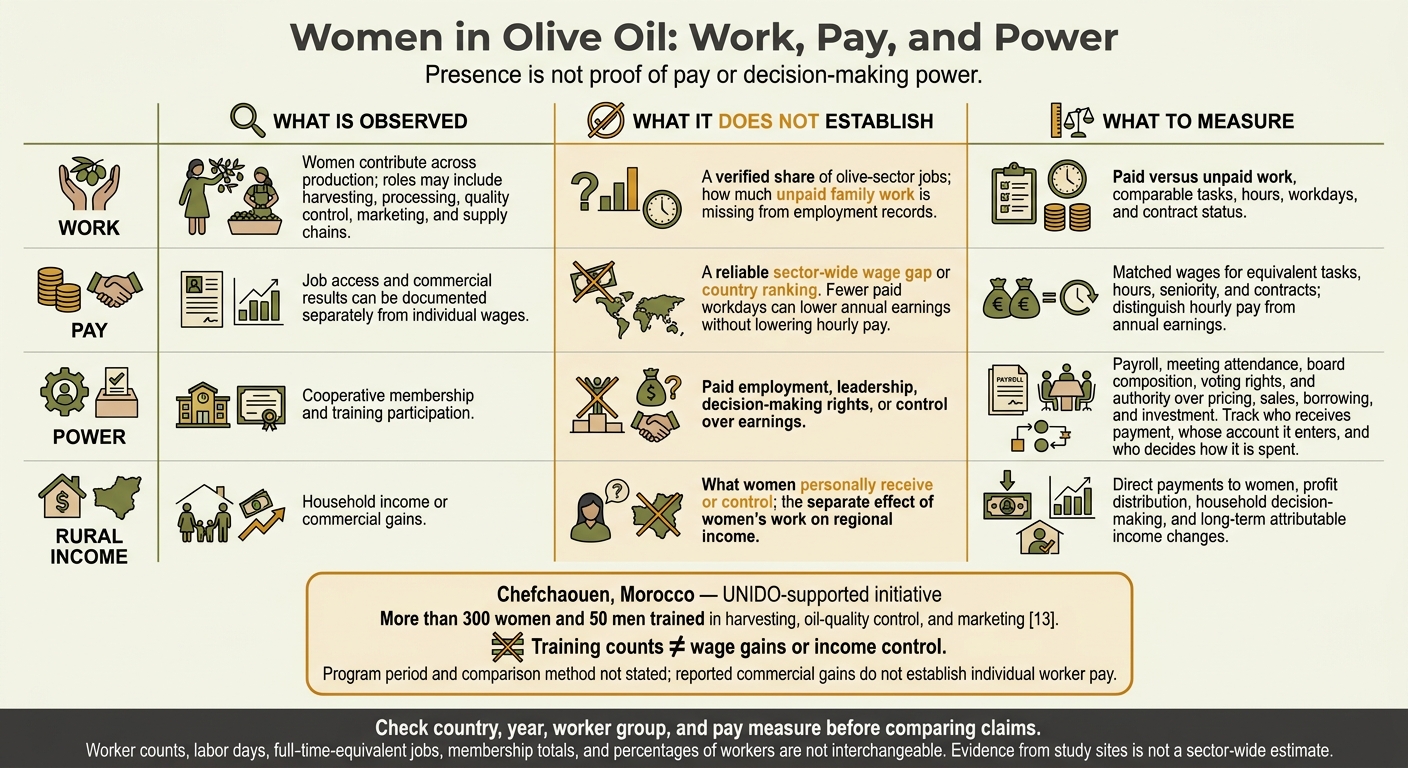
Women in Olive Oil: Work, Pay, and Power
Women’s Roles Across Olive Oil Production
Spanish olive cooperatives offer roles in processing, quality control, marketing, and supply chains that women may hold. But those roles alone don’t tell us whether women are members, what they earn, or whether they control their earnings.
Spain: Olive-Sector and Farm Employment
Spain shows the gap between visible work and documented employment. The evidence presented here does not support a verified estimate of women’s share of olive-sector or farm jobs.
Unpaid Family Work and Gaps in Labor Records
The evidence does not separate unpaid family labor from self-employment. That leaves women’s unpaid production work unclear and makes comparisons of women’s labor shares less reliable.
Country Comparisons and Data Limits
Differences in data coverage and reference periods prevent reliable comparisons across countries.
sbb-itb-4066b8e
Cooperatives, Pay, and Control Over Earnings
Women’s Membership in Andalusian Cooperatives
The Andalusian evidence does not name the cooperatives or report membership categories, the study year, sample size, or denominator. Without those details, the membership figures cannot be compared.
To assess financial gains, follow the money: who receives payment, whose account it enters, and who decides how to spend it. Compare membership records with payroll, meeting attendance, board composition, and women’s reported rights to make decisions about pricing, sales, borrowing, and investment. Membership matters only when it brings paid work, decision rights, or control over earnings.
Access to Training, Equipment, and Markets
Chefchaouen, Morocco: A UNIDO-supported olive-oil initiative trained more than 300 women and 50 men in harvesting, oil-quality control, and marketing. The source does not state the program period or comparison method, so reported commercial gains do not establish wage gains or income control for women.
Assess access to equipment, credit, training, and markets separately. Then check measured results: paid workdays, wages, profit distribution, or direct payments to women. Training may improve management, but it does not prove paid employment or higher wages. Likewise, commercial gains alone do not show that women received higher pay or gained direct control over income.
Wage Gaps and Access to Jobs
Separate access to jobs from pay by comparing wages across job types, hours, and contract status. The supplied evidence does not provide a reliable wage-gap estimate for Andalusian olive cooperatives. Fewer paid workdays can mean lower annual earnings without lower hourly pay.
| Location | Workers | Pay evidence | Comparability limits |
|---|---|---|---|
| Andalusia, Spain | Employees | No wage-gap estimate | Job types, seniority, contracts, and unpaid labor are not broken out; membership counts do not show pay. |
| Chefchaouen, Morocco | Women producers and entrepreneurs receiving training | Program earnings, not individual wages | Commercial results do not establish worker pay. |
Rural Livelihoods and Regional Income
Paid Work, Household Income, and Bargaining Power
Pay differences affect workers - and how much income stays in rural households. Agricultural cooperatives can keep more value locally by returning profits to members and sharing processing and certification costs. For women, the key question is whether this translates into paid work, direct income, or more say in household decisions.
Morocco: Workdays and Job Conditions
The material provides no Morocco-specific data on workdays, wages, or contract terms in olive production. It therefore cannot support a firm claim about the stability of women’s seasonal jobs or household income.
Conclusion: Findings and Evidence Gaps
Women work throughout the olive oil production chain. But uneven records do not establish equal pay, authority in cooperatives, or control over livelihood income. Paid-job counts leave out unpaid family work. Seasonal work can reduce annual earnings and job security. Job segregation and care duties can also limit access to equipment, training, and leadership.
The evidence is strongest on women’s presence, but weaker on pay and power.
Evidence Review and Research Priorities
Evidence strength depends on study design, sample quality, clear definitions, and whether a study measures the claim being made. Ratings apply to the study sites - not the whole olive oil sector. The table separates supported claims from questions that remain unanswered.
| Claim | Supporting study type | Geographic scope | Evidence strength | What remains unknown |
|---|---|---|---|---|
| Women perform harvest and support tasks. | Field interviews and labor studies | Moroccan study sites | Moderate locally | How much unpaid work is excluded? |
| Women may receive lower pay for comparable seasonal work. | Wage and agricultural labor studies | Tunisia and selected Andalusian sites | Moderate locally | Do gaps persist for equivalent tasks, hours, and contracts? |
| Membership does not guarantee leadership or authority. | Cooperative surveys and mill studies | Andalusia and Spain | Moderate for membership; limited for effects | Who controls votes, budgets, and sales proceeds? |
| Women’s work may support rural livelihoods, but its separate effect on regional income is unclear. | Regional-development evidence | Producing regions studied | Uncertain | What income changes are attributable to women’s work? |
These measures are not interchangeable: worker counts, labor days, full-time-equivalent jobs, membership totals, and percentages of workers. Missing female-specific data and limited matched wage comparisons prevent reliable sector-wide estimates.
The gaps concern how work is measured, not just how many numbers are available. They also set the direction for future research.
Future studies should track comparable tasks, hours, wages, contracts, household income, cooperative voting and leadership, and who receives and controls earnings. Time-use surveys should distinguish paid work from unpaid family labor and care duties. Claims about regional income need long-term data.
FAQs
How can unpaid olive-production work be counted fairly?
Family members account for 83% to 99% of operations on many farms. Giving unpaid family labor its due starts with recognizing that contribution. Fair trade models focus on transparency and equitable revenue distribution. Traceability systems and third-party certifications help document labor contributions and ensure prices reflect production costs.
Farmer cooperatives let growers pool resources and negotiate better terms. This helps keep the value of family labor with farmers rather than intermediaries.
What would prove a gender wage gap in olive production?
Evidence includes pay differences for the same work, such as women and migrant workers earning less than their counterparts. Transparent supply chain data, third-party social audits, and payroll records document wage rates, hours worked, and worker demographics.
These records are often verified through certifications like Fairtrade or SA8000. They help compare compensation with regional averages and legal standards to identify systemic pay disparities.
How can cooperatives give women more control over earnings?
Cooperatives pool resources so members can access processing, bottling, and marketing services - and rely less on bulk buyers who pay low prices. Profits go directly back to members through stable, value-driven pricing and payments based on quality.
By bargaining together, women gain more negotiating power. Fair-wage standards also help ensure equitable pay, so women aren't left out of better terms.