

How PDO Protects Olive Oil Origins
PDO (Protected Designation of Origin) certification ensures that olive oil is genuinely tied to its claimed region, adhering to strict production rules. Established by the European Union in 1992, PDO guarantees that every stage of production - from growing olives to bottling - occurs in a specific area, reflecting its local environment, methods, and quality standards. This certification combats olive oil fraud, such as mislabeling or mixing with cheaper oils, and helps consumers identify trustworthy products through the red and yellow PDO seal.
Key Points:
- What PDO Does: Verifies olive oil’s geographic origin and production practices.
- Why It Matters: Prevents fraud and ensures high-quality oil.
- Strict Standards: Requires all production steps to occur in the designated region.
- Consumer Benefits: Provides traceability, reliable quality, and transparency.
- PDO vs. PGI: PDO demands stricter regional ties than PGI certification.
PDO certification safeguards olive oil integrity, offering consumers confidence in what they buy while supporting producers who meet these rigorous standards.
What is PDO Certification?
How PDO Certification is Defined
Protected Designation of Origin (PDO) represents the European Union's most stringent food quality program. It requires that production, processing, and preparation take place entirely within a specific region, following traditional methods unique to that area, much like the traditional Solera method used for authentic balsamic. This is especially important when it comes to olive oil.
Under EU law, Regulation (EU) 2024/1143 standardizes the rules for food, wine, and spirits, ensuring high-quality standards while simplifying the registration process. PDO designations are treated as intellectual property rights, safeguarding authentic product names from being copied, misused, or diluted with lower-quality substitutes. Enforcement of these protections falls to national authorities in each EU member state, who take action against illegal marketing and confiscate counterfeit goods when necessary.
This framework does more than set geographical and production boundaries - it plays a key role in preserving the authenticity and value of agricultural and food products.
PDO's Function in Food and Agriculture
Beyond defining production rules, PDO certification upholds the reputation and integrity of regional foods. It legally restricts the use of protected names, even when paired with terms like "style", "type", or "method." Only products genuinely made in the designated region can carry the name, ensuring that the reputation of authentic regional specialties isn't exploited by inferior imitations.
"EU quality policy aims to protect the names of specific products to promote their unique characteristics, linked to their geographical origin as well as traditional know-how." This expertise is also evident in the production of white balsamic vinegar, which follows similar regional aging traditions.
– European Commission
For producers, PDO certification fosters fair competition and allows them to command higher prices for their high-quality goods. Consumers, on the other hand, can rely on the yellow and red PDO seal as a mark of authenticity and trust. Under the new 2024 regulation, producers can also include environmental, economic, or social sustainability practices in their product guidelines, adding further value to PDO certification and ensuring the origins of olive oil are thoroughly protected.
sbb-itb-4066b8e
PDO Requirements for Olive Oil Production
Geographical and Production Requirements
To achieve PDO certification, every step of the olive oil production process - cultivation, extraction, processing, and bottling - must occur entirely within the specified region. This ensures a direct connection between the oil and its place of origin. Importantly, the boundaries of these regions are strictly defined. Some PDO areas even span multiple countries, such as the "Istra" PDO, which includes parts of Croatian and Slovenian Istria.
As of late 2024, there are 110 registered PDO olive oils across eight countries. Each PDO region has its own set of rules, and producers are prohibited from using olives or oil sourced from outside the designated area.
Regional cultivars are another key requirement. For instance, Greek PDO olive oils are often made from Koroneiki or Tsounati olives, as specified by their regulations. The oil's characteristics must be tied to the region's unique environment, which includes factors like soil, climate, and the traditional knowledge passed down through generations.
These strict geographical rules set the stage for equally demanding quality standards.
Quality Standards and Production Methods
PDO certification goes beyond geography, imposing stringent quality requirements. Oils with PDO status must meet higher standards than standard EVOO. For example, while regular EVOO permits free fatty acidity up to 0.8%, many PDO-certified oils require levels below 0.5% or even 0.3%. One standout example is PDO Viannos in Greece, known for producing oils with acidity levels often below 0.3%.
Harvesting and extraction methods are also tightly regulated. Olives must be picked directly from the tree, either by hand or with gentle mechanical tools. Fallen olives are strictly prohibited due to their rapid quality degradation. Furthermore, only mechanical extraction methods are allowed - chemical or high-heat processes are banned to ensure the oil retains its natural properties. Some PDOs, like "Olive de Nice", even limit harvest yields to a maximum of six tons per hectare.
Each batch of PDO olive oil undergoes blind sensory evaluations by certified tasters. If any defects, such as fustiness, mustiness, or winey-vinegary flavors, are detected, the oil is immediately disqualified. Producers are also required to maintain meticulous records, tracking everything from individual trees to harvest dates and milling details. This ensures complete traceability for every bottle.
These rigorous standards and methods protect the integrity of the oil, preserving its connection to the land and its distinctive qualities from tree to bottle.
PDO vs. PGI: Safeguarding Culinary Heritage
PDO vs PGI: Key Differences
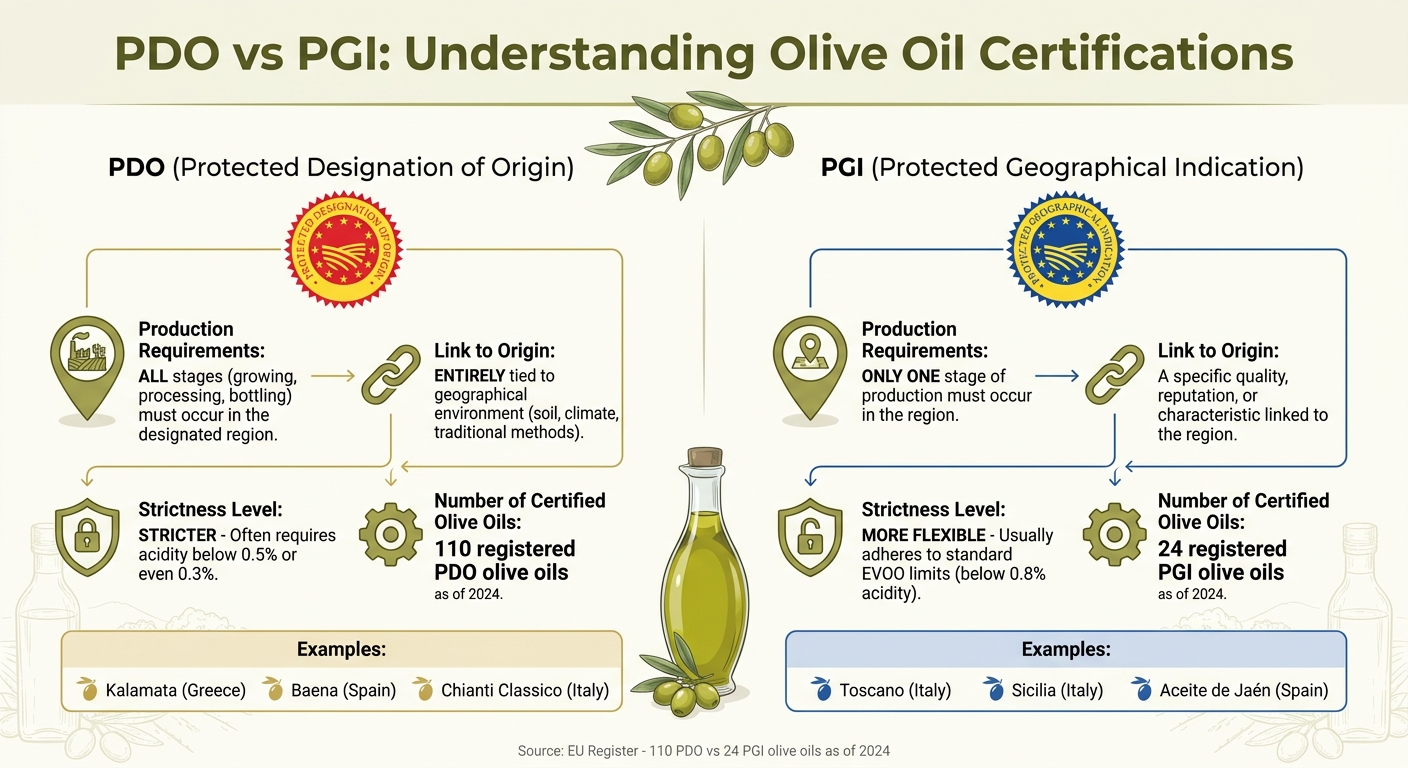
PDO vs PGI Olive Oil Certification Comparison Chart
PDO (Protected Designation of Origin) and PGI (Protected Geographical Indication) are two certifications designed to protect the origins of geographically linked foods, including olive oil. Similar protections apply to other staples, such as traditional balsamic vinegar. While both aim to ensure authenticity, they differ in how strictly they tie production to a specific region. These differences are crucial when evaluating the standards of authenticity for olive oil.
For PDO certification, every stage of production - from growing and harvesting the olives to processing the oil and bottling - must take place within the designated region. This strict requirement ensures complete traceability and bolsters authenticity. PGI certification, however, is less stringent. It mandates that only one stage of production occurs in the specified region. For instance, PGI olive oil might use olives grown locally, but the processing or bottling could happen elsewhere.
Another key distinction lies in the connection to the region. PDO certification demands that the oil’s qualities are entirely tied to the geographical environment, including natural elements like soil and climate, as well as traditional methods. PGI certification, by contrast, only requires that a specific quality, reputation, or characteristic is linked to the region, though the connection doesn’t have to be as direct.
Visually, PDO and PGI products can be identified by their seals: red and yellow for PDO and blue and yellow for PGI. Currently, the European register lists 110 PDO-certified olive oils but only 24 PGI-certified ones, reflecting the stricter standards of PDO certification. These differences highlight PDO’s stronger emphasis on preserving the authenticity of olive oil.
Comparison Table: PDO vs PGI
| Feature | PDO (Protected Designation of Origin) | PGI (Protected Geographical Indication) |
|---|---|---|
| Seal Color | Red and Yellow | Blue and Yellow |
| Production Requirements | All stages (growing, processing, bottling) must occur in the region | Only one stage of production must occur in the region |
| Link to Origin | Entirely tied to the geographical environment (soil, climate, methods) | A specific quality, reputation, or characteristic linked to the region |
| Strictness | Stricter, often with lower acidity limits than EU standards | More flexible; processing or bottling can occur outside the region |
| Common Acidity | Often below 0.5% or even 0.3% | Usually adheres to standard EVOO limits (below 0.8%) |
| Olive Oil Examples | Kalamata (Greece), Baena (Spain), Chianti Classico (Italy) | Toscano (Italy), Sicilia (Italy), Aceite de Jaén (Spain) |
Benefits of PDO for Traceability and Authenticity
PDO certification plays a crucial role in addressing the trust issues caused by frequent fraud in extra virgin olive oil labeling. With so many mislabeled products on the market, it’s often hard for consumers to feel confident about what they’re buying. PDO certification helps solve this problem by offering third-party validation that an olive oil meets strict standards for both its origin and production methods. This is made possible through comprehensive traceability protocols.
How PDO Ensures Traceability
PDO certification requires meticulous documentation at every step - from the olive grove to the final bottled product. Since all stages of production (growing, harvesting, processing, and bottling) must take place within the specified region, it becomes possible to trace the oil back to its exact source. This level of traceability is supported by standardized practices like EN ISO 5555 and the use of tamper-proof packaging to protect the product’s integrity all the way to the consumer.
For shoppers, the PDO seal simplifies the process of verifying authenticity. Instead of having to research producers or interpret ambiguous labeling, they can trust the seal as proof that the oil genuinely comes from the region stated on the bottle. This is especially important for premium oils tied to specific regions known for their unique flavor profiles. Alongside this traceability, PDO certification also implements strict quality controls to ensure authenticity.
How PDO Protects Authenticity
PDO regulations go beyond traceability by enforcing rigorous quality checks to prevent counterfeit products from entering the market. These standards include both chemical and sensory evaluations aligned with international and EU regulations. For example, to qualify as Extra Virgin Olive Oil under PDO standards, the oil must meet specific criteria: a defect-free median score of 0, a fruity median score above 0, and a maximum free acidity of 0.8%.
Additional safeguards include testing for chemical markers like stigmastadienes (≤ 0.05 mg/kg) and conducting blind sensory evaluations by trained tasting panels. If a panel cannot confirm the oil’s declared category, national authorities are required to perform further assessments using other approved panels. These multiple layers of scrutiny make it extremely difficult for counterfeit products to carry a PDO seal.
"Certifications exist to bridge that gap. They provide third-party verification that an oil meets specific standards whether for quality, origin, or production methods." - Erica Booth, Author
This combination of traceability and authenticity measures is key to preserving the quality of olive oil. At Big Horn Olive Oil, we adhere to these strict PDO standards to ensure that every bottle of extra virgin olive oil reflects its regional origins while meeting the highest benchmarks for quality.
Major PDO Olive Oil Regions and Examples
PDO certification spans across Europe, with each region's unique combination of climate, soil, and traditional production methods shaping the distinct flavors of olive oil - often referred to as "terroir". This diversity highlights PDO's commitment to preserving not just the origin but also the specific qualities that make each olive oil special. Let’s dive into some notable examples of PDO olive oils and what makes them stand out.
Examples of PDO Olive Oils
The Mediterranean is home to some of the most celebrated PDO olive oil regions. Take Kalamata in Greece, for instance, where every step - from growing the olives to bottling the oil - happens within the designated area. In Italy, regions like Chianti Classico and Terra di Bari are known for their dedication to traditional practices. Terra di Bari, in particular, showcases chemical profiles that reflect the unique Apulian microclimate. Similarly, Sicily's Val di Mazara is a shining example of authentic regional production.
Spain and Portugal also contribute to this rich tapestry of PDO olive oils. Spain's Aceite de la Rioja and Portugal's Azeite de Moura stand out for their distinctive qualities, built on generations of expertise and traditional methods.
PDO and Ultra Premium Olive Oils
PDO standards go beyond just regional identity - they also align with the rigorous benchmarks required for ultra-premium olive oils. At Big Horn Olive Oil, we carefully select oils that meet these high standards, ensuring every bottle reflects its authentic origins and unparalleled quality. The PDO framework guarantees that the oils meet strict purity and traditional production criteria.
"PDO regulations are often stricter than general EU laws regarding acidity and defects. For example, while standard EVOO can have 0.8% acidity, many PDO regions require it to be below 0.5% or 0.3%." - O-Liv
This link between PDO certification and ultra-premium quality helps consumers choose oils that not only showcase true regional character but also deliver exceptional health benefits.
Conclusion
PDO certification plays a crucial role in preserving age-old traditions while protecting the unique character of each region. By ensuring that every stage of production happens within a designated geographic area and follows time-honored methods, PDO safeguards the heritage and integrity of products that might otherwise fall victim to fraud or mislabeling. For consumers, this means every bottle comes with the assurance of meeting strict quality standards.
This certification also serves as a trusted guarantee, addressing issues like olive oils falsely labeled as "extra virgin", which may be diluted with cheaper oils or misrepresented in terms of grade or origin. The PDO seal stands as a mark of authenticity, offering transparency that generic labels often fail to provide.
At Big Horn Olive Oil, we proudly adhere to these rigorous PDO standards. This commitment ensures that our ultra-premium oils deliver exceptional flavor, health benefits, and a true reflection of their regional roots.
Choosing PDO-certified olive oil is more than a purchase - it's a way to support traditional producers, protect agricultural heritage, and ensure that what's on the label aligns with what's in the bottle. Each bottle embodies the rich legacy of Mediterranean olive cultivation, offering authenticity, traceability, and a deep connection to tradition.
FAQs
How can I verify a PDO seal is real?
To ensure a PDO seal is genuine, confirm that it has been certified by recognized monitoring organizations. These organizations verify that every stage of production takes place within the specified region and follows established traditional practices. Also, check for traceability elements, like chemical and sensory tests performed by authorized bodies, as these validate both its authenticity and quality.
Does PDO always mean better-tasting olive oil?
PDO certification might not always mean the olive oil will taste better, but it does ensure traceability, traditional production methods, and regional authenticity. These elements often play a role in delivering higher quality and flavor. However, the taste can still depend on individual preferences and other variables.
Why is bottling required inside the PDO region?
Bottling within the PDO region ensures the olive oil's genuineness, traceability, and high standards. It confirms that every stage of production takes place in the specified area, adhering to strict guidelines and helping to prevent counterfeiting. This approach safeguards both the product’s integrity and the reputation of its origin.