

Impact of U.S. Tariffs on Spanish Olive Oil
The U.S. tariffs on Spanish olive oil have disrupted Spain's exports and forced producers to change how they do business. Here’s the key takeaway: Spanish olive oil exports to the U.S. dropped sharply due to tariffs, pushing producers to shift strategies like exporting in bulk, bottling in the U.S., and targeting new markets.
- Timeline: Starting in 2019, a 25% tariff hit bottled Spanish olive oil due to a trade dispute. After a brief suspension, new tariffs were introduced in 2025, peaking at 20%, but were struck down in 2026. A 10% global tariff is now active until July 2026.
- Impact: Spanish exports to the U.S. fell, leading to surplus and price drops domestically. Smaller producers are struggling the most, while larger companies adapt by relocating bottling operations or forming partnerships.
- Solutions: Producers are diversifying markets (Asia, Middle East), focusing on bulk exports, and emphasizing traditional favorites and premium olive oil with certifications.
The U.S. remains a vital market, but tariffs have reshaped Spain's olive oil industry. Producers are working to stay competitive while managing costs and exploring alternative markets.
Spain's agriculture sector braces for Trump tariffs
sbb-itb-4066b8e
U.S. Tariffs on Spanish Olive Oil: Background and Details
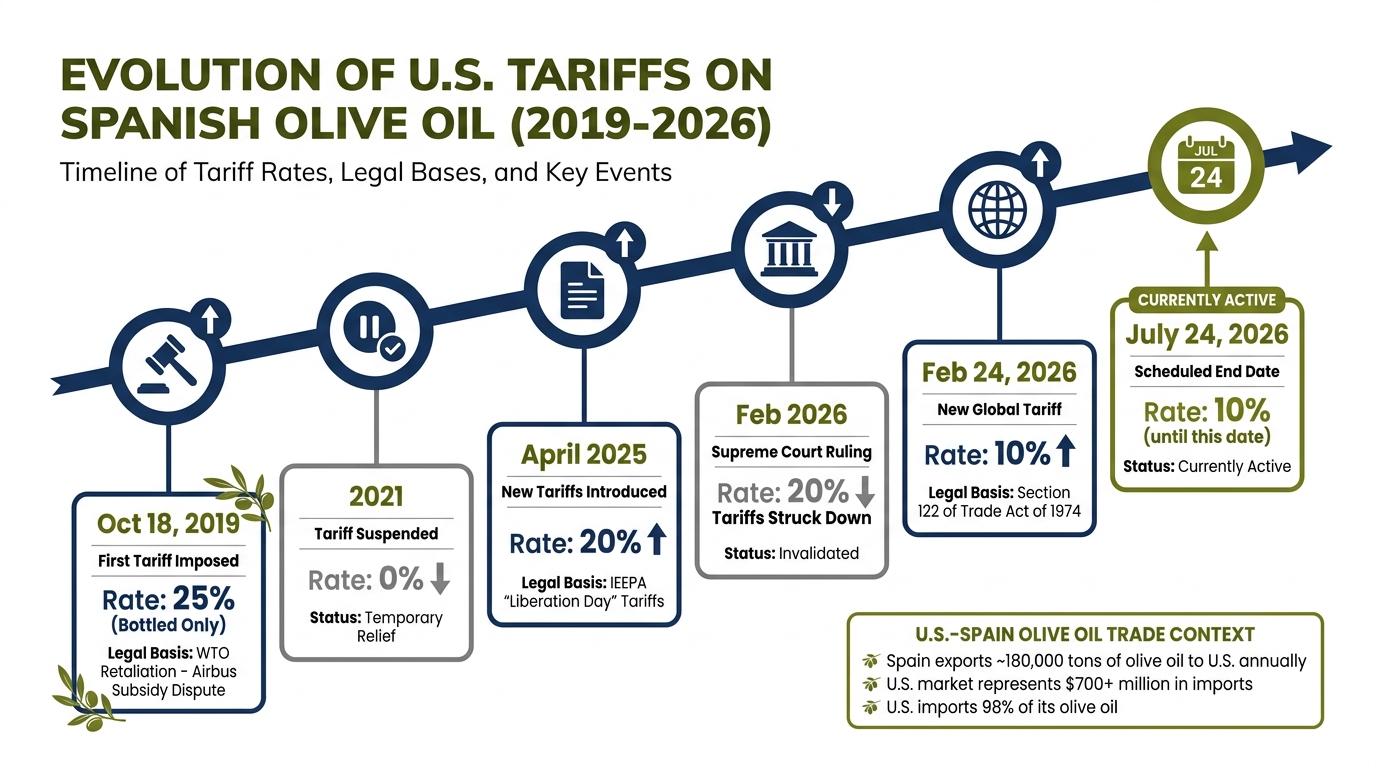
Timeline of U.S. Tariffs on Spanish Olive Oil 2019-2026
Why the Tariffs Were Imposed
The U.S. tariffs on Spanish olive oil are rooted in long-standing trade disputes. The first significant move came on October 18, 2019, when a 25% tariff was placed on bottled Spanish olive oil. This action was part of a broader retaliation in a World Trade Organization dispute concerning alleged illegal subsidies provided by the EU to Airbus.
After the initial 25% tariff was suspended in 2021, new tariffs were introduced in April 2025 as part of efforts to address the U.S. trade deficit. These 20% tariffs, enacted under the International Emergency Economic Powers Act (IEEPA), were later invalidated by a Supreme Court ruling in February 2026. Following this, the U.S. administration implemented a 10% global tariff under Section 122 of the Trade Act of 1974, which is set to remain in place until July 24, 2026.
Tariff Rates and Affected Products
Here’s a breakdown of the key developments in the tariff rates on Spanish olive oil:
| Implementation Date | Tariff Rate | Legal Basis | Status (April 2026) |
|---|---|---|---|
| October 18, 2019 | 25% (bottled only) | WTO retaliation (Airbus subsidy dispute) | Suspended in 2021 |
| April 2025 | 20% | IEEPA "Liberation Day" tariffs | Struck down Feb 2026 |
| February 24, 2026 | 10% | Section 122 global tariff | Currently active |
Currently, Spanish olive oil is subject to a 10% tariff under Section 122, alongside the Most Favored Nation duty of roughly 3.4 cents per kilogram for virgin olive oil. This creates a pricing disadvantage for Spanish producers, especially as competing suppliers like Turkey and Morocco faced only the 10% tariff under previous rules, while regions such as Tunisia experienced even higher rates.
A critical distinction lies between bottled and bulk shipments. To avoid the higher costs associated with bottled olive oil, many Spanish exporters have shifted to sending bulk shipments and bottling the oil within the U.S. This strategy helps reduce import expenses tied to tariffs.
Spain exports around 180,000 tons of olive oil to the U.S. annually, with the American market representing over $700 million in imports each year. Given that the U.S. imports 98% of its olive oil and accounts for about 15% of global consumption, these tariffs have significant ripple effects throughout the supply chain.
"It is worth noting that approximately 95% of the olive oil consumed in the U.S. is imported, so such policies will affect end users." - Cristóbal Valdés, CEO, Deoleo
These shifting tariff policies have forced Spanish producers to rethink their strategies, adapting to maintain their presence in the U.S. market despite the challenges.
Challenges Faced by Spanish Olive Oil Producers
Spanish olive oil producers are grappling with fluctuating tariffs that have created significant hurdles. These challenges threaten their ability to compete in the U.S. market and maintain long-term stability.
Higher Costs and Reduced Market Competitiveness
The tariff structure has put Spanish producers at a steep disadvantage. In earlier tariff periods, Spanish olive oil faced rates as high as 20%, while competitors like Turkey and Morocco only dealt with 10% tariffs. This uneven playing field has shifted market dynamics and made it harder for Spanish producers to compete.
Adding to the complexity, bottled olive oil is subject to higher tariffs than bulk shipments, prompting many producers to rethink their export strategies. Some have resorted to relocating bottling operations to other countries to avoid the higher costs. However, this isn’t a simple fix - it’s a costly and logistically challenging move.
The tariff situation has also created a domestic surplus in Spain. With exports becoming less competitive, producers are often forced to sell their excess oil at lower prices just to clear storage space for new harvests. Journalist Vidal Maté highlighted the dire situation:
"The plummeting prices have meant it is no longer profitable to harvest olives in rain-fed orchards".
Some cooperatives report that as much as 30% of their storage is now occupied by unsold, older olive oil, further straining resources. While large companies have the flexibility to adapt, smaller producers find it much harder to absorb these costs or make the necessary operational changes.
Effects on Small-Scale Producers
Small-scale producers are particularly vulnerable to these challenges. Unlike larger firms that can relocate bottling operations to skirt higher tariffs, smaller producers often lack the financial means and infrastructure to do so. They remain tied to local production and bottling, meaning they bear the brunt of the increased costs.
For producers who focus on exporting premium, branded bottled olive oil, the shift toward bulk shipments presents additional challenges. Bulk exports often compromise quality control and traceability - two critical factors for maintaining the reputation of authentic Spanish olive oil. This shift also erodes their ability to command higher prices for their products.
Given the industry’s importance to Spain - valued at €6 billion and making up 12% of the country’s agri-food exports - the government introduced a €14.1 billion ($15.7 billion) aid package in April 2025 to support affected sectors. However, many smaller producers struggle to access these funds due to complex administrative requirements, leaving them with limited options to weather the financial strain.
Damage to Long-Term Market Relationships
The unpredictable nature of tariff policies has made long-term planning nearly impossible for Spanish exporters. Jaime Fernández, International Commercial Director for Grupo Osborne, explained:
"The uncertainty is there, and it complicates our medium-and long-term planning, investments and commercial development".
This lack of stability undermines producers’ ability to commit to long-term contracts or confidently invest in growing their presence in the U.S. market.
Meanwhile, U.S. retailers and distributors are increasingly turning to suppliers from Turkey, Morocco, and Tunisia to avoid the higher tariffs on Spanish products. Rafael Pico Lapuente, Director General of ASOLIVA, voiced his concern:
"I wouldn't like it if, in this negotiation, food products like olive oil were used as mere bargaining chips in order to get a better deal for Europe's industrial products".
The risk of permanently losing market share is very real. Professor Javier Díaz-Giménez of IESE Business School summed up the situation:
"If I was the CEO of any company with a high exposure to the United States… I would have sent my entire sales team to find other markets".
If this trend continues, the U.S. - a critical channel for Spanish olive oil exports - may no longer be a viable market for many producers. Even if tariffs are reduced or eliminated in the future, rebuilding these relationships and regaining lost ground will be an uphill battle.
Solutions and Adaptation Strategies
Despite the challenges posed by U.S. tariffs, Spanish producers are finding ways to adapt by shifting their focus to new markets, premium products, and strategic partnerships.
Expanding to Alternative Markets
To reduce reliance on the U.S. market, Spanish producers are actively exploring opportunities in Asia and the Middle East, particularly in the Gulf region. These areas are seeing a rise in demand for Mediterranean diet staples, making them attractive destinations for exports. Closer to home, European markets are also becoming a priority, offering more stable sales channels.
Producers are also turning to innovation to stand out in these new markets. For example, some are introducing specialty products like olives stuffed with salmon or cheese to cater to niche consumer preferences in Asia and Europe. Gabriel Cabello, President of Andalusia's Federation of Agricultural Cooperatives, emphasized the importance of this shift:
"We were out of market and we had to do different things, we had to try and minimise the risk".
These strategies not only help producers diversify their customer base but also create opportunities to enhance product offerings and strengthen their global presence.
Focusing on Premium Products and Branding
Alongside exploring new markets, targeting premium segments has become a key approach for Spanish producers. This strategy is particularly effective in the U.S., where consumers in high-end retail channels value authenticity and quality over cost.
By emphasizing unique regional flavors - like the fruity and pungent profiles of Andalusian Hojiblanca olives - producers can differentiate their products from lower-cost alternatives. Certifications like DOP (Protected Designation of Origin) and IGP (Protected Geographical Indication) further reinforce the quality of these products, allowing them to command higher prices. Agro consultant Juan Vilar highlighted the resilience of quality-focused consumers:
"A 20% tariff won't stop olive oil sales".
This focus on premium branding helps Spanish producers maintain their foothold in the U.S. market, even with increased costs.
Partnerships with U.S. Businesses
Forming partnerships with U.S. companies has proven to be another effective way for Spanish producers to navigate tariff challenges. By collaborating with local businesses, they can sidestep higher packaged-goods tariffs and maintain their presence in the market. For instance, exporting olive oil in bulk and bottling it within the U.S. allows producers to avoid many of the tariffs applied to packaged products. Antonio Luque, CEO of Dcoop, acknowledged this strategy:
"In the medium to long term, we may have to make more investments in the United States, which are investments that will be made there instead of Europe".
Collaborations with companies like Big Horn Olive Oil provide Spanish producers with access to established U.S. distribution networks and co-branding opportunities. These partnerships allow Spanish cooperatives to offer authentic Ultra Premium EVOO while sharing logistics and reducing individual costs. For smaller producers, this approach makes entering the U.S. market more feasible, even in the face of tariff-related challenges.
How Big Horn Olive Oil Supports High-Quality Products
Focus on Quality and Freshness
Big Horn Olive Oil prioritizes exceptional standards in crafting its Extra Virgin Olive Oil (EVOO). Following strict production practices, the oil is extracted exclusively from the first cold press using mechanical methods, ensuring it retains its natural properties. This careful process helps the EVOO achieve exceptionally low acidity levels - often around 0.1%, far below the 0.8% maximum standard. To maintain freshness, the company minimizes exposure to light, heat, and oxygen throughout production. Additionally, they ensure customers receive oils within three months of harvest, delivering a product at peak quality.
Partnership Opportunities
Big Horn Olive Oil combines its focus on quality with innovative strategies to navigate international trade challenges. By importing olive oil in bulk rather than in pre-bottled form, the company helps Spanish producers benefit from reduced tariff rates. The oil is then bottled in the United States, significantly lowering costs tied to tariffs. This approach is especially valuable for smaller Spanish cooperatives, such as those in Andalusia - a region known for its 60 million olive trees and renowned varieties like Hojiblanca.
Through this model, Big Horn Olive Oil not only supports Spanish producers in overcoming trade barriers but also connects them with specialty retail markets that value authenticity and certifications like DOP and IGP. This partnership framework strengthens market access for producers, enabling them to maintain strong relationships with U.S. buyers despite trade challenges.
Conclusion
U.S. tariffs have significantly increased costs for Spanish olive oil, leading to losses of more than €280 million (about $310 million) in Spain's table olive sector since 2018. This situation has put Spain's market share in the U.S. - a major olive oil consumer but a minor producer - at risk. The economic impact calls for quick and strategic adjustments from Spanish producers.
To mitigate these challenges, producers are shifting strategies. Bulk exports and bottling within the U.S. are helping to sidestep tariffs on packaged goods, while premium certifications like DOP and IGP support higher price points in niche markets. Despite the tariffs, demand for high-quality extra virgin olive oil (EVOO) remains strong. Current market prices hover around $4.20–$4.40 per kilogram, a far cry from the historic highs of $8.30–$10.00 per kilogram. Miguel Colmenero, Commercial Director at Wikifarmer, notes:
"The 20% tariffs over a cost of 3.8 EUR/Kg should not create a huge barrier for US consumers... This year's real price driver will come from the high-quality EVOO, which seems to be shorter than expected".
Spanish producers are embracing domestic bottling, premium branding, and partnerships with U.S. businesses to tackle these tariff-related hurdles. By combining their expertise in olive cultivation with American bottling facilities, they can offer competitive prices while maintaining authenticity and traceability. This approach also opens doors for smaller cooperatives to enter specialty retail markets that value certified, origin-protected products. The olive oil industry has faced tough times before, and a mix of innovation and commitment to quality provides a clear path forward in the face of these challenges.
FAQs
How do U.S. olive oil tariffs affect what I pay at the store?
The U.S. has imposed tariffs on olive oil imports, including a steep 46% tariff on Spanish olive oil set to take effect by 2025. These tariffs are driving up costs for producers selling to the U.S., which translates to higher prices on store shelves and fewer premium olive oil options for consumers. As a result, shoppers are feeling the pinch both in their wallets and in the variety of products available.
Does bottling Spanish olive oil in the U.S. change its quality or authenticity?
Bottling Spanish olive oil in the U.S. doesn’t compromise its quality or origin, as long as the production process and labeling adhere to proper standards. That said, factors like U.S. tariffs and trade disruptions can play a role in shaping market access and pricing, which might affect how readily consumers can find it.
Which markets could replace the U.S. for Spanish olive oil exports?
Spanish olive oil producers are seeking new markets to counter the impact of U.S. tariffs, which have significantly reduced exports. Some of the most promising alternatives include regions like the European Union, Asia, the Middle East, and Africa, where interest in high-quality olive oil is on the rise.
Countries such as China, Japan, and Gulf Cooperation Council (GCC) nations stand out as key opportunities due to increasing consumption in these areas. Diversifying export destinations has become a critical strategy for maintaining export levels during this period of trade uncertainty.