

Impact of Waste Laws on Olive Oil Producers
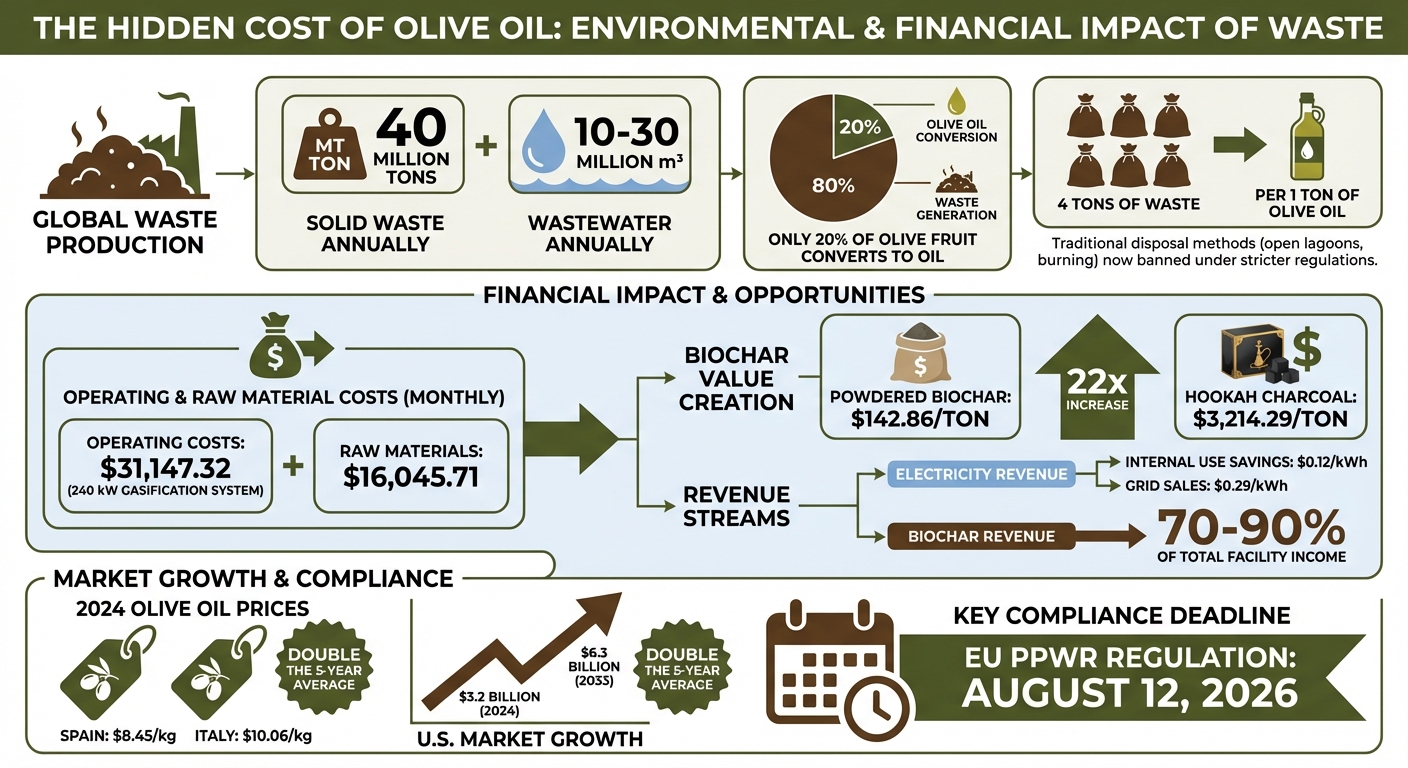
Producing olive oil generates massive waste - up to 40 million tons of solid waste and 10–30 million m³ of wastewater annually. This waste includes olive pomace (solid residues) and olive mill wastewater (OMWW), a toxic liquid that harms soil, water, and ecosystems. Stricter waste laws now ban traditional disposal methods like open lagoons, forcing producers to adopt costly treatment systems.
Key Waste Issues:
- OMWW: High in pollutants like phenolic compounds, making it harmful to plants and challenging to treat.
- Pomace: Often burned, causing air pollution.
Regulations and Financial Pressures:
- EU: Unified rules like the Packaging and Packaging Waste Regulation (PPWR) require recyclability and waste reduction by August 2026.
- US: Decentralized state-level enforcement focuses on general sustainability goals.
Solutions:
- Gasification: Converts pomace into electricity and biochar, with biochar selling for up to $3,214.29/ton.
- Zero Liquid Discharge (ZLD): Recovers water from OMWW for irrigation.
- Biorefinery Valorization: Extracts valuable compounds like polyphenols from waste.
Modernizing waste management is expensive but necessary. Producers can turn waste into profit by adopting advanced systems, reducing compliance costs, and generating new revenue streams.
Olive Oil Waste Statistics and Financial Impact on Producers
Olive mill waste (OMW) management
sbb-itb-4066b8e
Types of Waste from Olive Oil Production
The production of olive oil generates two primary types of waste, both of which pose significant challenges for disposal. These are olive mill wastewater (OMWW) and olive pomace. OMWW is a liquid byproduct made up of fruit residues, washing water, and process water. On the other hand, olive pomace is the solid material consisting of pulp and skin left behind after the initial oil extraction. If the pomace undergoes further extraction using hexane, the remaining material is referred to as olive cake.
Olive Mill Wastewater (OMWW) Explained
OMWW is far from ordinary wastewater. It contains a complex mix of sugars, organic acids, polyalcohols, pectins, colloids, tannins, lipids, and even heavy metals. What makes it particularly problematic is its extremely high levels of Chemical Oxygen Demand (COD) and Biological Oxygen Demand (BOD), which classify it as a persistent pollutant.
A major issue with OMWW is its phenolic compounds. These compounds not only give the wastewater antimicrobial properties but also make it phytotoxic - harmful to plants. This dual challenge complicates treatment because the antimicrobial nature disrupts biological processes in standard wastewater treatment systems. As noted in Scientific Reports:
"Its high content of BOD, COD, and phenolic compounds makes its treatment complex and costly. Moreover, OMWW is phytotoxic and exhibits selective antimicrobial effects due to its polyphenol content." – Scientific Reports
Because of its phytotoxicity, OMWW cannot be directly applied to soil without undergoing proper treatment. These characteristics make OMWW a serious environmental concern, as outlined below.
Environmental Damage from Olive Oil Waste
When OMWW is discharged without proper controls, it can discolor natural water bodies and contaminate both surface and groundwater systems. The high levels of polyphenols in the wastewater further disrupt aquatic ecosystems by altering microbial balances.
Storage of OMWW in open lagoons has additional consequences. Methane and other greenhouse gases are released during anaerobic decomposition, contributing to climate change. The lagoons also produce unpleasant odors and can attract pests, especially when dried crusts form on the surface. Similarly, burning olive pomace without adequate controls can lead to air pollution due to particulate emissions. Untreated waste also harms soil health, with its acidity and phenolic content inhibiting crop growth and causing long-term degradation.
Waste Management Laws Affecting Olive Oil Producers
Olive oil producers face a patchwork of waste management laws depending on where they operate. While the European Union has adopted unified regulations, the United States relies on a combination of federal guidelines and state-level enforcement. These contrasting approaches create unique hurdles for producers on either side of the Atlantic.
European Union Waste Regulations
The European Union has implemented comprehensive waste management rules that directly impact olive oil production. One key regulation, the Packaging and Packaging Waste Regulation (PPWR), specifically Regulation (EU) 2025/40, will take effect on August 12, 2026, across all EU member states. Under this law, food companies, including olive oil producers, are considered "manufacturers" if their packaging is designed or marketed under their trademark. This designation places a heavy compliance burden on olive oil brands.
Producers must meet detailed requirements that address recyclability, the use of recycled plastic content, compostability, and waste minimization. The regulation also introduces Extended Producer Responsibility (EPR), which holds companies accountable for the entire lifecycle of their packaging. As noted by Keller and Heckman LLP:
"The 'Producer' (which may be either the manufacturer, importer, or distributor) will have EPR obligations under the PPWR for packaging... that they make available for the first time on the territory of an EU Member State."
Additionally, manufacturers must complete conformity assessments, issue an EU Declaration of Conformity, and maintain technical documentation for five years for single-use packaging and ten years for reusable packaging. Beyond packaging, the EU encourages waste reduction through initiatives like the LIFE program and promotes circular economy practices, which aim to repurpose by-products rather than discard them. These regulations require producers to adapt both operationally and financially.
United States Waste Disposal Laws
In contrast, the United States employs a decentralized approach to waste management. Federal guidelines emphasize a waste hierarchy that prioritizes prevention, reduction, and reuse over disposal methods like incineration or landfilling. However, enforcement is largely left to state and local authorities, resulting in varying requirements across regions.
U.S. olive oil producers typically focus on broader sustainability goals rather than adhering to a unified compliance deadline like the EU's August 2026 mandate. Agricultural waste, including olive mill wastewater and pomace, is regulated under general environmental protection laws. Specific treatment standards for these by-products depend on state environmental agencies and local water quality regulations. This decentralized framework leads to significant differences in enforcement and compliance requirements.
Regional Differences in Enforcement
Enforcement practices vary widely, both within and outside the EU. Although EU member states follow the same overarching regulations, local enforcement approaches can differ, influencing how compliance is achieved. Meanwhile, Mediterranean countries outside the EU, such as Jordan, have their own legislation governing the treatment of olive mill wastewater.
These regional variations create challenges for producers operating in multiple locations. Navigating different regulatory frameworks, documentation requirements, and reporting timelines can increase operational costs and complicate waste management practices. These challenges will be explored further in the next section.
How Waste Laws Affect Producer Finances and Operations
Compliance Costs
Managing waste comes with a hefty price tag for producers. Take olive oil production, for instance - creating just one ton of olive oil produces around four tons of waste. This is especially challenging for small and medium-sized producers. Traditional, cheaper disposal methods like open lagoons, land spreading, or even open burning are now increasingly restricted by stricter environmental regulations. As a result, producers are left with costly alternatives, such as energy-intensive pomace drying, while also losing potential revenue from waste that goes unused.
Guillermo Garcia-Garcia, Antonio Pérez, and Mónica Calero from the University of Granada's Department of Chemical Engineering highlighted the issue:
"The olive oil sector currently generates large amounts of waste materials that not only provide no economic benefits, but also generates environmental impacts as well as economic costs."
To illustrate, consider a 240 kW electricity generation system that uses pelletized olive pomace. The operating costs for such a system can reach about $31,147.32 per month, with raw materials alone accounting for approximately $16,045.71. These financial strains are further complicated by operational challenges that disrupt daily workflows.
Day-to-Day Challenges
Beyond the financial burden, waste laws create significant operational difficulties. For example, the unique properties of olive mill wastewater (OMWW) make its treatment particularly tricky, requiring constant adjustments to production processes. Producers must carefully manage reduced water usage while ensuring the safe handling of hazardous waste.
Seasonal production adds another layer of difficulty. Olive harvests only occur during specific months, but waste treatment systems need to run year-round to remain economically viable. This mismatch often forces producers to co-process other biomass materials, such as corn cobs or wood chips, during off-peak times. While laboratory-scale technologies exist for extracting valuable compounds from waste, these systems haven’t been widely adopted at an industrial level, leaving many producers stuck with outdated disposal methods that eat into their profits.
As regulations grow stricter, producers are under increasing pressure to modernize. This means upgrading facilities, revising production processes, and maintaining detailed records - steps that are now critical for staying competitive in the market. These challenges highlight the urgent need for producers to implement more efficient waste management solutions to meet both environmental and economic demands.
Methods for Managing Olive Oil Waste
Modern Waste Treatment Techniques
Advanced technologies are transforming olive oil waste into opportunities for profit while addressing environmental concerns. For instance, integrated gasification systems can convert solid olive pomace into syngas, which is then used to generate electricity. A key byproduct of this process is biochar, which has its own market value. A pilot system handling 970 lbs of biomass per hour can produce 240 kW of electricity.
Another innovative solution is zero liquid discharge (ZLD) technology, which tackles wastewater issues. This system uses the leftover heat from energy production to evaporate olive mill wastewater, recovering pure water that can be repurposed for irrigation - a game-changer for areas facing water shortages. Additionally, biorefinery valorization uses a multi-stage hydrothermal process (operating between 86°F and 158°F) to extract valuable compounds like polyphenols and inositol before converting the remaining material into energy.
Financially, these methods can be highly rewarding. For example, powdered biochar sells for about $142.86 per ton, but when processed into hookah charcoal, its value skyrockets to approximately $3,214.29 per ton. In some cases, biochar revenue can contribute to 70–90% of the total income from waste treatment systems. Electricity savings also add up, with internal consumption saving $0.12 per kWh and selling surplus power to the grid generating $0.29 per kWh under feed-in tariffs.
These advancements are paving the way for more sustainable and profitable waste management practices.
Adopting Sustainable Production Methods
Producers can further improve sustainability by making operational changes alongside adopting advanced technologies. One effective strategy is pelletizing pomace to reduce moisture levels, which improves the efficiency of gasification processes. Additionally, recovering residual heat is critical. For example, hot water at temperatures of 194–203°F from Organic Rankine Cycle (ORC) systems can be repurposed to evaporate wastewater, achieving zero liquid discharge and reclaiming water for irrigation.
Maximizing by-product value is another key approach. Instead of using biochar for simple combustion, it can be processed into briquettes or activated carbon substitutes, which significantly increase profitability. Similarly, hydrothermal processes that rely solely on water as a reagent reduce the need for chemicals, minimizing environmental impact while maintaining efficiency.
Policy Changes and Producer Support
Technical innovations have been supported by evolving policies that encourage sustainable practices. Regulations promoting a circular economy push producers toward adopting waste-to-energy systems. Feed-in tariffs, for example, make these systems economically viable by offering grid sales that can yield 2.5 to 3 times more revenue than on-site electricity use. The European Union's LIFE program has also funded projects like the PROSODOL Project (LIFE07/ENV/GR/00280), which focuses on strategies to protect soil from olive mill waste disposal.
Research funding has been another driving force. Programs like the Marie Skłodowska-Curie Actions (MSCA) provide grants for developing sustainable waste management solutions. For instance, Guillermo Garcia-Garcia received an MSCA Postdoctoral Fellowship (Grant ID: 101052284) to study hydrothermal treatment methods for extracting valuable compounds like polyphenols and inositol from olive cake. Producers are encouraged to explore local feed-in tariffs and regional support initiatives to help offset the costs of compliance and modernization.
At Big Horn Olive Oil, we are committed to adopting innovative waste management practices that combine environmental responsibility with operational efficiency.
Conclusion
Waste management laws play a vital role in safeguarding the environment from the harmful effects of waste generated by olive oil production. Conventional disposal methods, such as spreading wastewater on land or burning pomace, often lead to severe problems like groundwater contamination and air pollution. However, these regulations also bring financial challenges for producers, who must balance compliance costs with rising operational expenses. This tension highlights the potential for turning waste into an opportunity through innovative solutions.
With only about 20% of the olive fruit converted into oil, the remaining biomass presents a major chance for rethinking waste. Instead of viewing it as a disposal issue, producers can adopt biorefinery techniques to extract valuable compounds like polyphenols and inositol. As Guillermo Garcia-Garcia from the University of Granada explains:
"Current waste management practices in the olive sector have a significant environmental impact and provide little economic benefit to olive oil producers".
The financial landscape also offers a compelling reason for change. In 2024, olive oil prices have soared, reaching approximately $8.45 per kg in Spain and $10.06 per kg in Italy - double the five-year average. This creates an opportunity for producers to modernize their waste management systems. Technologies such as integrated gasification can transform compliance costs into revenue streams, with biochar sales contributing 70–90% of total facility income. These advancements turn waste management into a strategic asset.
Sustainability is no longer optional for long-term success. In drought-prone areas, water recovery systems like Zero Liquid Discharge are essential, while waste valorization offers a way to diversify income and reduce risks tied to poor harvests or climate issues. Modern methods like hydrothermal processing and gasification not only ensure compliance with environmental laws but also open doors to significant revenue from by-products. Additionally, the U.S. olive oil market is expected to grow from $3.2 billion in 2024 to $6.3 billion by 2033, giving eco-conscious producers a clear path to tapping into this expanding market.
Balancing environmental stewardship with profitability is the key to thriving in the olive oil industry. By embracing forward-thinking waste management strategies, producers can meet regulatory demands while creating resilient, profitable operations for the years ahead.
FAQs
What are the safest ways to treat OMWW without harming soil or groundwater?
Treating olive mill wastewater (OMWW) responsibly is all about minimizing environmental impact while making the most of its potential resources. Some effective approaches include:
- Anaerobic digestion: This process not only cuts down on harmful emissions but also produces biogas, a renewable energy source, and recycles nutrients back into the system.
- Biogas production and microalgae systems: These methods help convert OMWW into energy or biomass, reducing waste and offering practical uses.
- Extracting valuable compounds: OMWW contains substances like hydroxytyrosol, which can be recovered and used in various industries.
When OMWW is applied in agriculture, careful management is crucial. Controlling how much and when it’s applied ensures soil health is preserved and prevents groundwater contamination.
How can small olive oil producers afford waste compliance upgrades?
Small olive oil producers can tackle waste compliance costs by exploring smart strategies. One option is investing in waste valorization technologies, which transform waste into reusable resources, cutting down on disposal costs. Producers can also look into financial support through government programs or cooperative partnerships to help manage expenses. For those seeking simpler approaches, traditional methods like composting can be budget-friendly - though they require careful oversight to prevent environmental risks. By blending modern techniques, external support, and teamwork, small producers can make these upgrades more manageable.
Which waste-to-profit option pays back fastest: gasification, ZLD, or biorefinery?
When comparing options for managing olive pomace, biomass gasification stands out as the quickest way to see financial returns. This process transforms olive pomace into energy and biochar, enabling efficient on-site heat and power production. By doing so, it significantly lowers energy expenses.
On the other hand, alternatives like Zero Liquid Discharge (ZLD) systems and biorefineries often come with steeper initial costs and take longer to pay off. Their complexity makes them less appealing for those seeking faster financial benefits. For those prioritizing quicker returns, gasification is often the go-to choice.