

JAS Certification for Balsamic Vinegar
If you're planning to sell balsamic vinegar in Japan, obtaining JAS (Japanese Agricultural Standards) certification is mandatory, especially for organic products. Even if your product meets USDA or EU organic standards, the JAS seal is required to label it as "organic" in Japan. Here's what you need to know:
- Organic Requirements: At least 95% of ingredients (excluding water and salt) must be certified organic. GMOs, ionizing radiation, and most synthetic additives are prohibited.
- Facility Standards: Every step in the production chain, including storage and packaging, must meet JAS standards. Facilities must prevent contamination and maintain organic integrity.
- Labeling Rules: Labels must be in Japanese, include the Organic JAS logo (if applicable), and meet detailed requirements for ingredients, origin, and nutritional information.
- Certification Process: Producers must work with a MAFF-accredited certification body. The process involves document submission, on-site inspections, and ongoing audits. Certification fees include application, inspection, and annual maintenance costs.
- Export Documentation: Products must meet Japan's strict import standards, including submitting an export certificate for organic goods.
JAS certification ensures compliance with Japan's regulations and helps build trust with Japanese consumers. Whether you're a producer or exporter, understanding these requirements is key to accessing Japan's market.
Requirements for JAS Certification
Organic Production Standards
The Organic JAS framework has strict rules about what can and can't go into your balsamic vinegar. At least 95% of your ingredients (excluding water and salt) must be certified organic agricultural products or organic processed foods of plant origin. This means the grape must must come from certified organic vineyards.
Chemically synthesized food additives and processing aids are strictly prohibited, except for a small list of permitted substances outlined in JAS notifications. Additionally, ionizing radiation and GMOs are completely banned - recombinant DNA technology cannot be used in any part of production or ingredient sourcing. The revised standards for Organic Processed Foods under JAS took effect on July 31, 2024, so it's crucial to align your practices with these updated guidelines.
"The organic JAS logo can only be applied by registered business entities that have been certified by the Accredited certification body to verify that organic foods are produced in compliance with JAS." – Ministry of Agriculture, Forestry and Fisheries (MAFF)
You'll also need to designate a qualified production process manager to oversee compliance with JAS technical criteria. This person ensures systems are in place to prevent contamination, keeping your organic balsamic vinegar separate from non-organic products and away from prohibited substances during storage and processing. On top of that, there are specific facility and process requirements to protect product integrity.
Facility and Process Standards
JAS certification goes beyond ingredients - your entire production chain must meet its standards. Every entity involved, from grape farmers to processors, repackers, and storage providers, must hold JAS certification. If you use third-party facilities for storage or bottling, they too must be certified to maintain the organic status of your product.
Your production facility must meet specific environmental requirements. For traditional balsamic vinegar, natural temperature variations are essential for proper aging. Facilities need adequate ventilation and must rely on seasonal changes rather than artificial climate control. Additionally, wooden casks and barrels used in production must be individually numbered and clearly marked for tracking.
Technical details of production are also tightly regulated. For example, the fresh must must be cooked at atmospheric pressure in open vats at a minimum of 176°F (80°C) for at least 30 minutes. Fermentation is limited to using "mother vinegar", and other additives or preserved must are generally not allowed. Before your product can be certified, it must pass analytical and sensory evaluations to confirm its density, acidity, and flavor meet the required standards.
Traceability and Record-Keeping
Accurate and thorough record-keeping is just as important as meeting production standards. You need to document every step of the process, starting with the raw materials. This includes tracking grape varieties like Lambrusco or Trebbiano and verifying their technical specifications. For example, the grapes must produce a must with at least 15° of standard sugar content, and the maximum yield of grape in must intended for concentration is capped at 70%.
Detailed logs are required for all processing steps, including cooking temperatures, durations, and fermentation timelines. Aging containers must have unique identifiers, and batch-specific analytical and sensory test results need to be recorded.
Finally, your product's packaging must include a numbered seal that cannot be reused, ensuring its integrity all the way to the consumer. These records are critical for passing certification audits and maintaining quality control, so keep everything well-organized and easily accessible for inspectors.
sbb-itb-4066b8e
How to Obtain JAS Certification
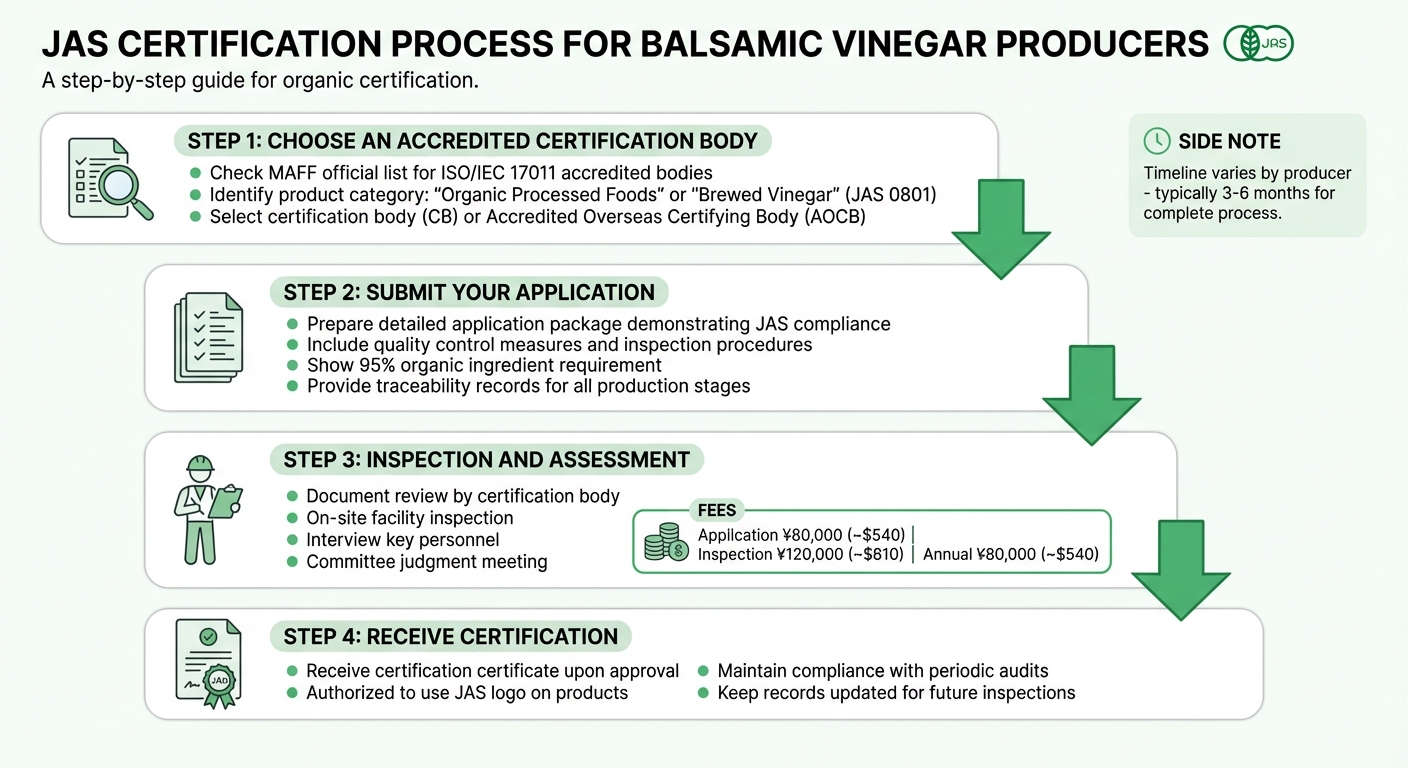
JAS Certification Process for Balsamic Vinegar Exporters
Choosing an Accredited Certification Body
The first step is to check the Ministry of Agriculture, Forestry, and Fisheries (MAFF) official list for certification bodies accredited under ISO/IEC 17011 for your specific product category. These certification bodies are evaluated through technical assessments conducted by the Food and Agricultural Materials Inspection Center (FAMIC).
Identify the appropriate JAS category for your product. For instance, organic balsamic vinegar falls under "Organic Processed Foods", while conventional balsamic vinegar aligns with the "Brewed Vinegar" standard (JAS 0801). Once you've determined your category, select a certification body (CB) accredited for that specific type of product. If you're located outside Japan, look for an Accredited Overseas Certifying Body (AOCB) in your region. This makes inspections and communication more straightforward.
For producers in Europe, CCPB in Bologna, Italy, is an MAFF-recognized certification body. They provide Italian producers with the necessary application forms and detailed information on exporting organic products to Japan. Reach out to your chosen CB to request essential technical documents, such as "Technical Standards for Certification", "Inspection Methods", and "Formats and methods of grade labeling". Additionally, check if your country has an organic equivalence agreement with Japan. Countries like the U.S., EU, and Switzerland have such arrangements, which can simplify the process if you're already certified under local organic standards.
Once you've selected your certification body, it's time to prepare your application.
Submitting Your Application
Prepare a detailed application package that demonstrates how your production process meets JAS technical standards. Include documentation on quality control measures, inspection procedures, and how the JAS seal will be applied to your products.
The required documents will vary depending on whether you're certifying under the "Brewed Vinegar" (JAS 0801) or "Organic Processed Food" (JAS 1606) standards. For organic certification, you must show that at least 95% of your product's ingredients are organic and comply with the approved list of processing substances. Provide traceability records and documentation for all production stages. If you're already USDA organic certified, you can use a TM-11 Export Certificate under the US-Japan Organic Equivalence Arrangement to simplify the process.
Submit your documents as they are completed. If you're unsure about templates or which standards apply to your product, contact MAFF's Standards and Conformity Assessment Policy Office at jas_soudan@maff.go.jp.
Once your application is accepted, the inspection phase begins.
Inspection and Assessment
After submitting your application, the certification body reviews your documents thoroughly. They may request additional information or corrections. Once your paperwork is approved, an inspector will schedule an on-site visit to your production facilities.
During the inspection, the inspector will interview key personnel and review your production process from start to finish. This includes examining how you maintain "organic integrity", from sourcing raw materials to packaging and shipping the final product. The inspector's findings are then presented to a "judgment meeting", where a committee decides whether to grant certification.
Certification fees include the following:
- New application fee: ¥80,000 (around $540)
- Initial inspection fee: ¥120,000 (around $810)
- Annual maintenance fee: ¥80,000 (around $540)
If your application is denied, the certification body will provide detailed reasons for rejection. You can reapply after addressing the issues they identify.
Once the inspection and evaluation process is successfully completed, you can move on to receiving your certification.
Receiving Certification
When your application is approved, and all fees are paid, you will receive your certification certificate. This document confirms that your production process complies with JAS standards and authorizes you to use the JAS logo on your products.
To maintain your certification, you must adhere to JAS standards and pay the annual maintenance fee. Certification bodies will perform periodic audits to ensure ongoing compliance, so it's essential to keep your records and traceability documentation updated and readily available for future inspections.
Production Standards for Certified Balsamic Vinegar
These standards build on JAS guidelines, ensuring a product that aligns with both traditional methods and strict regulatory requirements.
Ingredient Sourcing and Processing
JAS certification requires that ingredients adhere to traditional Italian specifications. Approved grape varieties include Lambrusco, Sangiovese, Trebbiano, Albana, Ancellotta, Fortana, Montuni, as well as Sauvignon, Sgavetta, Berzemino, and Occhio di Gatta .
For PGI (Protected Geographic Indication) balsamic vinegar, the recipe must include 20% to 90% grape must and 10% to 80% wine vinegar. On the other hand, PDO (Protected Designation of Origin) standards demand 100% cooked grape must with no additives. PGI allows the addition of up to 2% caramel for color consistency, but no other ingredients.
Traditional Balsamic Vinegar requires cooking the grape must in open vats at a minimum temperature of 176°F (80°C) for at least 30 minutes . PGI standards also specify the inclusion of vinegar aged for at least 10 years, without setting a precise percentage. Additionally, all primary ingredients must meet organic certification requirements.
Once the ingredients are prepared, the product undergoes strict aging and testing protocols to ensure quality.
Aging and Quality Control
Aging plays a vital role in meeting JAS standards. Traditional Balsamic Vinegar (PDO) must mature for a minimum of 12 years, while the "Extravecchio" designation requires at least 25 years of aging . PGI Balsamic Vinegar of Modena has a shorter aging requirement, with a minimum of 60 days in wooden barrels, and the "Aged" label applies to products matured for at least 3 years.
Aging facilities must ensure natural ventilation and maintain environmental conditions conducive to proper maturation . The wooden barrels used cannot introduce any prohibited substances or additives, especially for products adhering to organic JAS standards . During the aging process, approximately 10% of the grape must evaporates annually, concentrating the flavors.
Quality control involves both analytical and sensory evaluations to confirm specific attributes. The final product must meet a density of at least 1.240 at 68°F (20°C) and maintain a total acidity of no less than 4.5 grams of acetic acid per 100 grams. Every stage of production is meticulously documented to meet JAS traceability standards, including the movement of vinegar between wooden casks . A detailed log, often referred to as a vinegar loft record, is maintained to track barrel transfers for audit purposes .
Labeling and Export Requirements
When selling JAS-certified balsamic vinegar in Japan, getting the labeling and documentation right is non-negotiable. These steps ensure compliance with Japanese food safety laws and protect consumers.
JAS Product Labeling Rules
Labels must be written entirely in Japanese and clearly visible on the packaging, as mandated by the JAS Law and Food Sanitation Law. Each label needs to include:
- Product name
- Full list of ingredients and any food additives
- Either the Recommended Last Consumption Date or the Date of Minimum Durability
- Preservation methods
- Country of origin
- Manufacturer or importer’s name and address
Additionally, nutritional information, such as energy content and nutrient details, is required under the Health Promotion Law.
For organic products, the Organic JAS logo must appear on the label. Without this logo, the term "organic" cannot be used, even if the product holds certifications from other countries. For balsamic vinegar, this means using either the Organic JAS logo for organic products or the General JAS logo for those meeting standard quality requirements. U.S. and international exporters are encouraged to collaborate closely with Japanese agents or importers to ensure the labeling is correct. Often, labels are finalized at the point of sale or after customs clearance.
Proper labeling is just one part of the process. Export documentation is equally critical for meeting Japan's import standards.
Export Documentation
Under organic equivalence agreements, exporters must secure a government-issued export certificate. For products labeled as organic, the balsamic vinegar must contain at least 95% organic content, and the correct export certificate must be submitted.
These equivalence agreements, established between Japan and countries like the U.S., EU, and Canada, streamline the process. Products certified under a home country’s organic standards can be sold as organic in Japan without undergoing a separate JAS audit, as long as all necessary paperwork is filed. Alternatively, producers can get certified directly by an Accredited Overseas Certifying Body, allowing them to add the JAS logo at the production site before shipping. In cases where a product arrives in Japan without the JAS logo but includes a valid export certificate, a certified Japanese importer can apply the appropriate JAS logo before the product reaches consumers.
JAS vs. Other Organic Certifications
Comparing Certification Standards
The JAS certification system stands apart from USDA Organic and EU Organic certifications, though equivalence arrangements between these programs allow products to access multiple markets globally. One notable distinction is that JAS strictly prohibits the use of potassium chloride, while USDA and EU systems permit it under specific conditions.
Another difference lies in the conversion period for crops. JAS requires a two-year conversion for most crops, whereas USDA and EU standards mandate three years. However, this shorter timeline doesn’t imply that JAS certification is simpler. It involves stringent environmental checks, including testing for prohibited substances in the surrounding environment and banning the use of mosquito coils in fields.
For balsamic vinegar exports, meeting the 95% organic content threshold is essential. Products must meet this standard to comply with international market requirements. For instance, USDA-certified "Made With Organic" products, which contain 70–95% organic ingredients, cannot be labeled as organic in Japan under JAS rules. Additionally, exporting to Japan requires a USDA Export Certificate (Form TM-11), while imports into the U.S. need an NOP Import Certificate from the GLOBAL Organic Integrity Database.
"The equivalence arrangement grants USDA certified organic products access to Japan and JAS-certified products entry into the U.S. market without additional certification." - USDA Agricultural Marketing Service
Producers aiming for multiple markets often adopt a "super-organic" approach, adhering to the strictest rules across all certification systems. For balsamic vinegar, this means avoiding substances like potassium chloride and maintaining meticulous documentation to satisfy all requirements.
Certification Comparison Table
The table below highlights key differences between JAS, USDA Organic, and EU Organic certifications:
| Feature | JAS (Japan) | USDA Organic (USA) | EU Organic (Europe) |
|---|---|---|---|
| Conversion Period | 2 years for most crops | 3 years | 3 years for annuals |
| Organic Content for Label | 95% or higher | 95% for "Organic"; 70–95% for "Made with..." | 95% or higher |
| Potassium Chloride | Prohibited | Allowed under specific conditions | Restricted/Limited |
| Soil Management Focus | Traditional composting (bokashi) | Crop rotation and cover crops | Soil as a living ecosystem |
| Primary Market | Japan | United States | European Union |
| Secondary Market | United States (via equivalence) | Japan, EU (via equivalence) | United States (via equivalence) |
Conclusion
JAS certification offers balsamic vinegar producers a gateway to the Japanese market, signifying both safety and quality on a global scale. Overseen by the Ministry of Agriculture, Forestry and Fisheries (MAFF), this third-party certification ensures products meet strict technical standards that often surpass international norms.
The U.S.-Japan organic equivalence arrangement, implemented on January 1, 2014, simplifies market access for producers already certified under USDA standards. With a USDA Export Certificate (Form TM-11) and a partnership with a JAS-certified importer, U.S. producers can enter the Japanese market without incurring additional fees or undergoing duplicate inspections. However, products must contain at least 95% organic content to qualify for organic labeling in both countries.
Beyond regulatory compliance, JAS certification enhances market credibility. As noted by the Japan Oilseed Processors Association, "Compliance with JAS standards for quality means that the plant in question possesses a high technical level for manufacturing products with outstanding quality". This reputation for excellence extends globally, fostering trust in business relationships.
For consumers, JAS certification combined with PDO or PGI designations offers a unique assurance of both organic integrity and traditional production methods. At Big Horn Olive Oil, our balsamic vinegars from Modena, Italy - such as the Traditional 18-Year Aged Dark Balsamic Vinegar and Molto Denissimo 25-Year Aged Dark Balsamic Vinegar - reflect this dedication to quality. These certifications guarantee products that meet the highest standards for those who value authenticity and excellence.
Whether you're a producer navigating certification requirements or a consumer searching for premium balsamic vinegar, understanding JAS standards empowers you to make informed choices that emphasize quality and authenticity in an interconnected marketplace.
FAQs
Do I need JAS certification if my balsamic vinegar is already USDA or EU organic?
If your balsamic vinegar has USDA Organic or EU Organic certification, there's no need for JAS certification. Thanks to the organic equivalence agreement between the U.S. and Japan, products certified under either standard can be marketed as organic in both countries without requiring extra certification.
What documents do I need to prove organic status when exporting balsamic vinegar to Japan?
To export balsamic vinegar to Japan as organic, obtaining Japanese Agricultural Standards (JAS) certification is essential. This involves certification by a body accredited and recognized by MAFF (Ministry of Agriculture, Forestry and Fisheries). Additionally, products must feature the JAS organic logo on their labels. Ensure all labeling adheres strictly to JAS standards to fulfill export regulations.
Can a Japanese importer apply the Organic JAS logo after the product arrives?
No, a Japanese importer cannot add the Organic JAS logo to a product once it arrives in Japan. The product must already be certified under the JAS system and display the logo before being exported. However, U.S. exporters have the option to work with Japanese importers to ensure the JAS seal is applied before the product is shipped, using pre-arranged agreements.