

Top 5 Labeling Technologies for Olive Oil Security
Olive oil fraud is a growing issue, especially as prices rise and the market expands. Counterfeit products and mislabeling cost the industry billions annually. To tackle this, producers are turning to advanced labeling technologies that provide quick, reliable ways to verify product origin, quality, and handling. These methods not only deter fraud but also empower consumers with transparent details about their purchase.
Here are the top five labeling technologies reshaping olive oil security:
- QR Code Traceability: Simple, cost-effective, and tamper-resistant. QR codes link to detailed product data, such as harvest dates and certifications. Setup costs are low, making this an accessible option for many producers.
- Blockchain-Integrated Labels: Adds a secure, unchangeable layer to QR codes. Consumers can verify authenticity in seconds, with batch-specific information stored on a digital ledger.
- NFC Smart Labels: Tap-and-go technology that combines physical and digital security. Embedded chips update records if tampered with and provide instant verification.
- Holographic Security Labels: Eye-catching and tough to replicate. These 3D designs offer visual proof of integrity and often include hidden elements like UV-sensitive inks.
- PCR DNA Authentication: Molecular-level verification using genetic markers to confirm olive variety and origin. Highly precise but currently costlier and suited for premium products.
Quick Comparison:
| Technology | Tamper-Proof Features | Traceability | Cost Range |
|---|---|---|---|
| QR Code Traceability | Unique serials, tamper-evident | Batch-level, detailed info | $0.01–$0.15/label |
| Blockchain-Integrated | Immutable ledger, peel-off layer | End-to-end digital tracking | Moderate to high |
| NFC Smart Labels | Embedded chips, real-time updates | Instant authentication | Moderate |
| Holographic Security Labels | Visible damage if tampered | Visual only, no digital data | Low to moderate |
| PCR DNA Authentication | Genetic fingerprinting | High precision, lab-confirmed | High |
These tools not only protect against counterfeiting but also build trust by offering verified details about the product. For producers, combining these methods can safeguard their brand and justify premium pricing.
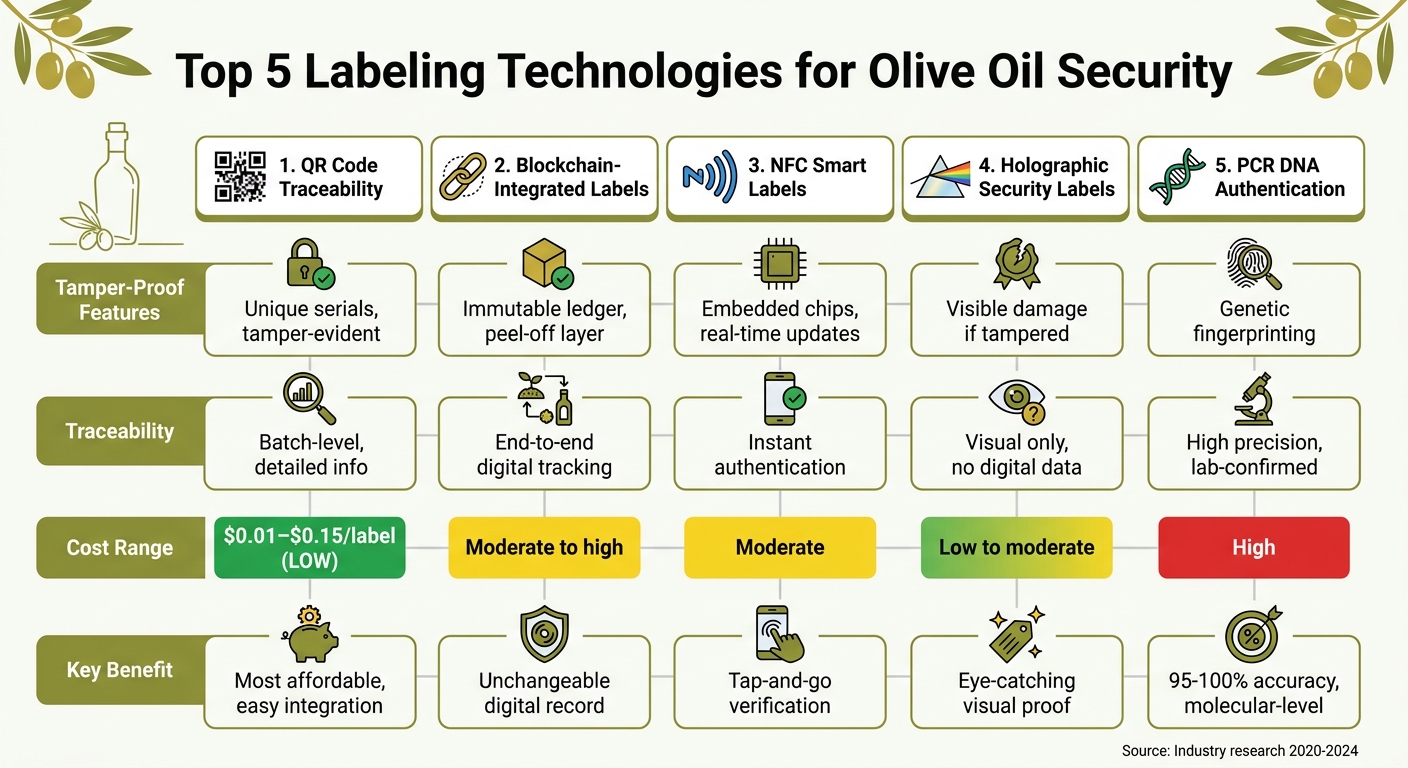
Comparison of 5 Olive Oil Security Labeling Technologies
How to Spot Real Extra Virgin Olive Oil (Before You Get Tricked Again)
sbb-itb-4066b8e
1. QR Code Traceability Labels
QR code labels store product details in a compact, scannable format that’s accessible through any smartphone. These codes link to a secure database containing essential product information, making them an invaluable tool for premium brands like Big Horn Olive Oil, which prioritize quality and authenticity. Let’s break down the key benefits of this technology, including its tamper-resistant features, supply chain visibility, ease of implementation, and affordability.
Tamper-resistant Features
Each QR code is uniquely serialized, ensuring it corresponds to a specific product. When scanned, the system checks if the code has been used before, creating a digital trail that can quickly identify duplicate or unauthorized scans. Advanced systems often pair QR codes with physical protections like holograms or special inks that reveal tampering, adding an extra layer of security.
Supply Chain Transparency
Scanning a QR code gives consumers direct access to detailed product information, such as the origin of ingredients, harvest dates, storage conditions, and certifications. This transparency is making a real impact. For example, the International Olive Council reported a 40% drop in counterfeit cases after a 2022 pilot program. Additionally, a 2023 Nielsen survey found that 78% of consumers are willing to pay more for products with traceable origins.
Simple Integration with Existing Systems
QR codes are easy to incorporate into current production setups. Most producers can print these codes using standard label printers, while a cloud-based system handles data storage and scan verification. From initial planning to full deployment - including database setup, label design, staff training, and testing - the entire process typically takes just 3 to 4 months.
Affordable for Producers
When it comes to cost, QR codes are one of the most budget-friendly security measures available. Static QR labels cost between $0.01 and $0.03 per unit, while tamper-evident dynamic labels range from $0.05 to $0.15 per unit when produced at scale. Setting up the necessary database infrastructure costs between $500 and $5,000, with monthly hosting fees of $100 to $500. With the heightened focus on supply chain transparency after the pandemic, adoption of QR labels by premium olive oil producers has surged by 250% between 2020 and 2024.
2. Blockchain-Integrated Labels
Blockchain integration takes the QR code's traceability to a whole new level, offering a secure, tamper-proof digital record for every bottle. With this technology, a simple label becomes a powerful tool against counterfeiting. When consumers scan the unique QR code on a bottle, they can instantly confirm whether it’s authentic or fake.
Tamper-Proof Features
Here’s how it works: once a QR code is scanned, the system flags it as used. If anyone tries to scan it again, it’s immediately identified as counterfeit. This leverages blockchain’s unchangeable ledger to ensure that once a bottle is marked as opened, no duplicate can claim legitimacy.
"If the blockchain register does not contain the QR code, the bottle is shown as 'no info, beware, no info, consume at your own risk!'" - Enrique Lizaso, CTO of BlockTac
To add another layer of security, the QR code is hidden under a peel-away top layer, making pre-purchase scans impossible.
Traceability and Transparency
Blockchain labels go beyond vague marketing buzzwords. Instead of generic claims like "artisanal" or "packed in Italy", consumers get batch-specific details. They can see exactly where the olives were harvested, the pressing date, lab results (like acidity and polyphenol levels), and even storage tips. This is a game-changer in an industry plagued by fraud, which costs Europe an estimated $1.6 billion annually in market losses. For premium olive oils, where freshness and origin are directly tied to quality, this system provides instant, verifiable proof instead of relying solely on brand reputation.
Simple Integration with Current Systems
What makes this technology even more appealing is its ease of use. Producers don’t need expensive new equipment - standard smartphones are enough to register products. Consumers, in turn, can verify authenticity in seconds. Plus, blockchain-enabled labels can link to dynamic digital pages that update with information like harvest data, awards, and tasting notes. This eliminates the need to redesign packaging for every batch.
Cost Considerations for Producers
While blockchain labels are pricier than basic QR codes, they deliver long-term value by preventing fraud, protecting brand reputation, and safeguarding revenue. By making counterfeiting too costly to pursue, these labels reduce the need for physical inspections. For high-end brands like Big Horn Olive Oil, where authenticity is crucial to maintaining customer trust and premium pricing, this investment is a smart way to secure their position in a European olive oil market worth about $3.3 billion annually.
Looking ahead, future security innovations, such as near-field communication, promise even more advanced ways to verify authenticity.
3. NFC Smart Labels
NFC smart labels are taking labeling security to the next level, offering a quick and reliable way to verify product authenticity. By using NFC (Near Field Communication) technology, consumers can simply tap their smartphones on a bottle to confirm its legitimacy. Each NFC tag is embedded with a unique identifier, ensuring accuracy and preventing errors during verification.
Tamper-Proof Capabilities
NFC chips are often integrated directly into bottle caps or seals, and they serve a dual purpose: enhancing both digital and physical security. If the seal is tampered with, the chip instantly updates verification records, providing real-time security. According to RFID-life.com:
"Each tag has uniquely identifiable information and is nearly impossible to clone."
When a smartphone interacts with the tag, it communicates wirelessly with brand servers to deliver instant verification results. Additionally, these tags can digitize International Olive Council (IOC) profiles, giving consumers immediate access to quality metrics and lab results. This secure exchange of information also improves transparency around the product's origins.
Traceability and Transparency
Pietro Barachini, a professional olive oil taster, created the iOlive platform to rebuild consumer trust after several scandals revealed that some Italian brands were falsely marketing lower-quality oils as extra virgin. By leveraging NFC electronic tags, his system - validated by Agro-Lab (PromoFirenze’s laboratory division) - has classified over 150 types of Italian extra virgin olive oil. These tags allow consumers to instantly retrieve verified data about the oil's quality and origin. As Pietro Barachini explains:
"NFC electronic tags on olive oil packaging make it simple and instant for customers to access the data."
This technology not only reassures consumers about authenticity but also streamlines communication of quality metrics, saving time and resources for producers.
Cost-Effectiveness for Producers
While the upfront cost of NFC tags is higher, they offer long-term savings by enabling digital updates without the need to reprint packaging. For premium brands like Big Horn Olive Oil, this technology supports higher price points by providing verifiable proof of quality, such as acidity levels and single-origin certification. This added layer of transparency helps distinguish ultra-premium oils from standard blends.
4. Holographic Security Labels
Holographic security labels provide a visually striking and highly effective way to protect products against counterfeiting. These labels feature intricate 3D designs created through advanced laser engraving, producing reflective effects that are immediately recognizable. Unlike standard printing methods, the complexity of these patterns makes them nearly impossible to replicate with conventional equipment. This visual layer of protection reassures consumers and acts as a strong deterrent for counterfeiters.
Tamper-Proof Capabilities
One of the standout features of holographic labels is their tamper-evident design. Any attempt to remove or alter the label leaves behind visible residue or damages the packaging. Acviss, a global leader in security technology, highlights this benefit:
"Holographic stickers will surely leave a residue or damage on the product when removed. It thus ensures that any attempt to tamper will readily reveal itself and deter attempts of product counterfeiting."
In addition to the visible hologram, these labels often include hidden security elements like nano-text, micro-details, and UV-sensitive inks. These features are detectable only under specific lighting or magnification, adding another layer of protection. This multi-faceted design significantly increases the difficulty and cost for counterfeiters attempting to replicate the product.
Ease of Integration with Existing Systems
Holographic labels are engineered to fit seamlessly into current production processes. They come as self-adhesive stickers, compatible with standard labeling equipment commonly used in food manufacturing. For brands that want to maintain their existing bottle designs, transparent holographic overlays can be applied directly on top of current labels, ensuring branding and regulatory information remain visible.
Many producers are now combining holographic patterns with unique serial numbers or QR codes. This creates a hybrid solution that offers both visual authentication and digital traceability in a single label. The ease of integration ensures these labels are a practical option for producers looking to enhance product security without overhauling their packaging systems.
Cost-Effectiveness for Producers
The cost of holographic labels is best suited for higher-priced products. For premium olive oils priced above $40, these labels are a worthwhile investment, especially when paired with other premium design elements like embossed logos embedded into the holographic film. Brands using holographic labels have reported conversion rate increases of 8–20%, highlighting the added value of authentic, secure packaging. For ultra-premium products, such as those from Big Horn Olive Oil, custom holograms not only confirm authenticity but also reinforce the product's luxury image, justifying its higher price point.
5. PCR DNA Authentication Labels
PCR DNA authentication labels bring security to a whole new level by working at the molecular level. These labels use genetic markers, like SNPs and microsatellites, to create a unique genetic fingerprint for each olive variety. This approach offers a precision that makes counterfeiting nearly impossible, ensuring the authenticity of olive oil products.
Tamper-Proof Capabilities
Panagiotis Kalaitzis, Studies/Research Coordinator at the Mediterranean Agronomic Institute of Chania, highlights the reliability of this method:
"Olive oil DNA-based analyses have gained attention in recent years, due to high specificity, sensitivity and reliability."
By tapping into the distinct genetic makeup of each olive variety, DNA analysis provides an unmatched level of accuracy. This makes it especially valuable for Protected Designation of Origin (PDO) olive oils and ultra-premium products, where maintaining varietal purity is critical.
Traceability and Transparency
When paired with chemometric methods like Principal Component Regression, DNA authentication can classify adulteration with accuracy rates of 95% to 100%. This technology ensures authenticity across the supply chain, confirming both the geographical origin and varietal identity of the olive oil. It’s a powerful tool in combating fraud in the extra virgin olive oil market, where complexity continues to grow.
Cost-Effectiveness for Producers
At present, the need for specialized equipment and expert validation limits the widespread use of this technology. As one study notes, "development of more affordable instruments are necessary for wider adoption in the industry". For now, it’s most practical for premium olive oils, particularly PDO varieties, where the cost of genetic testing aligns with the product’s high market value. For producers of ultra-premium products, adopting DNA authentication can serve as a key measure to ensure product integrity and build consumer trust. As technology advances and becomes more accessible, this approach could expand to a broader range of premium olive oils.
For brands dedicated to quality and authenticity - like Big Horn Olive Oil - investing in advanced solutions like PCR DNA authentication labels is essential for protecting product integrity and maintaining customer confidence.
Technology Comparison Table
The table below highlights key features of various traceability and security technologies, making it easier for producers to choose the best fit for their needs.
| Technology | Tamper-Proof Features | Traceability Level | Integration Requirements | Producer Costs |
|---|---|---|---|---|
| QR Code Traceability | Offers digital "proof behind the promise" to deter relabeling fraud; requires live product data upkeep | Enables batch or lot tracking, detailing region, grove, mill, and bottling location | Compatible with standard smartphones, provided operational discipline is maintained | Low to moderate; requires minimal hardware investment |
| Blockchain-Integrated | Ensures an unalterable record through tokenized traceability to verify sensitive data | Tracks every stage digitally, from harvest to distribution | Demands specialized partnerships and a robust digital infrastructure | Moderate to high; includes ongoing data-related costs |
| NFC Smart Labels | Hard to duplicate without advanced equipment | Provides real-time authentication for both consumers and distributors | Requires NFC-enabled devices and a backend verification system | Moderate; per-label costs are higher compared to QR codes |
| Holographic Security | Features physical, tamper-evident elements visible to the naked eye to counter counterfeiting | Limited to visual verification without digital tracking | Minimal; easily integrates into existing labeling processes | Low to moderate; typically involves a one-time implementation |
| PCR DNA Authentication | Utilizes molecular-level genetic fingerprinting with 95–100% accuracy to detect adulteration | Verifies product authenticity across the supply chain | Needs specialized lab equipment and expert validation; newer silica-encapsulated tags simplify sample preparation | High; ideal for ultra-premium and PDO products |
For ultra-premium producers like Big Horn Olive Oil, combining these technologies can significantly boost security. QR codes provide accessible consumer verification, while DNA authentication offers forensic-level protection for high-value products, aligning with their premium market positioning.
Conclusion
Advanced labeling technologies have completely reshaped olive oil packaging. It’s no longer just about identifying the product - it’s about creating a layer of trust that confirms the oil’s origin, freshness, and quality. These labels actively combat fraud by providing batch-specific details, like harvest dates and lab-tested acidity, that consumers can easily verify.
Producers are stepping away from vague terms like "artisanal" or "authentic." Instead, they’re sharing precise, verifiable information that not only supports premium pricing but also helps buyers make smarter choices. As Daniel Mercer, Senior Content Strategist, explains: "The most persuasive QR label is not the one with the most claims; it is the one that makes claims verifiable in under 10 seconds".
These advanced labels go beyond fraud prevention. They also protect the product’s quality after purchase by offering clear storage tips and usage advice, ensuring the oil retains its flavor and the brand maintains its reputation. For ultra-premium producers like Big Horn Olive Oil, combining multiple security technologies does more than guard against counterfeiting - it builds lasting consumer trust. QR codes make verification simple for everyday shoppers, while DNA authentication adds a forensic-level safeguard for high-value products. In this way, packaging becomes a powerful tool in a market where authenticity directly impacts value.
As "informed luxury" gains traction, consumers are demanding measurable facts over brand storytelling. By adopting these advanced labeling solutions, producers can meet these expectations while strengthening both their products and their reputation in an industry where trust is everything.
FAQs
Which labeling technology is best for my olive oil price tier?
The right labeling technology for your olive oil depends on its price range and the level of security you want. For premium oils, blockchain offers a reliable way to guarantee authenticity, while QR codes are a budget-friendly option for transparency. For mid-range oils, a mix of QR codes and tools like RFID tags works well. High-end oils benefit greatly from advanced methods like blockchain and DNA fingerprinting, which build trust and safeguard against fraud. Your choice should align with your brand's goals and target market.
Can I combine QR codes, NFC, and holograms on one bottle?
Yes, it's possible to integrate QR codes, NFC technology, and holograms on a single bottle. By combining these elements, brands can create advanced traceability solutions. Tools like IoT sensors and blockchain technology further strengthen this multi-layered approach, boosting both security and transparency for consumers.
How can shoppers verify a label is authentic in under 10 seconds?
Shoppers can verify a label's genuineness in under 10 seconds by simply scanning its QR code. This quick scan reveals key traceability details, such as the product's origin, harvest date, and certifications. All of this information is backed by blockchain technology and digital tracking systems.