

Mediterranean Olive Pests: Seasonal Trends
Mediterranean olive groves face a massive challenge: pests like the Olive Fruit Fly (Bactrocera oleae) cause over $1 billion in annual losses. These pests thrive under specific temperature and seasonal conditions, threatening both yield and quality of olive oil. Key insights include:
- Olive Fruit Fly: The most harmful pest, laying up to 250 eggs per female. Activity spikes in cooler autumn months but slows in extreme summer heat (above 95°F).
- Seasonal Patterns: Warmer winters (averaging 47°F) increase pest activity by 35%, while heatwaves reduce populations.
- Impact on Quality: Infested olives lead to higher oil acidity, reducing market value and quality.
Producers combat these threats with monitoring tools, traps, and Integrated Pest Management (IPM) strategies, ensuring timely harvests and better crop protection. Climate shifts are expanding pest ranges, making precise pest control even more critical.
Talk #2: Olive Fruit Fly with Cindy Kron
sbb-itb-4066b8e
Main Mediterranean Olive Pests and Their Seasonal Behaviors
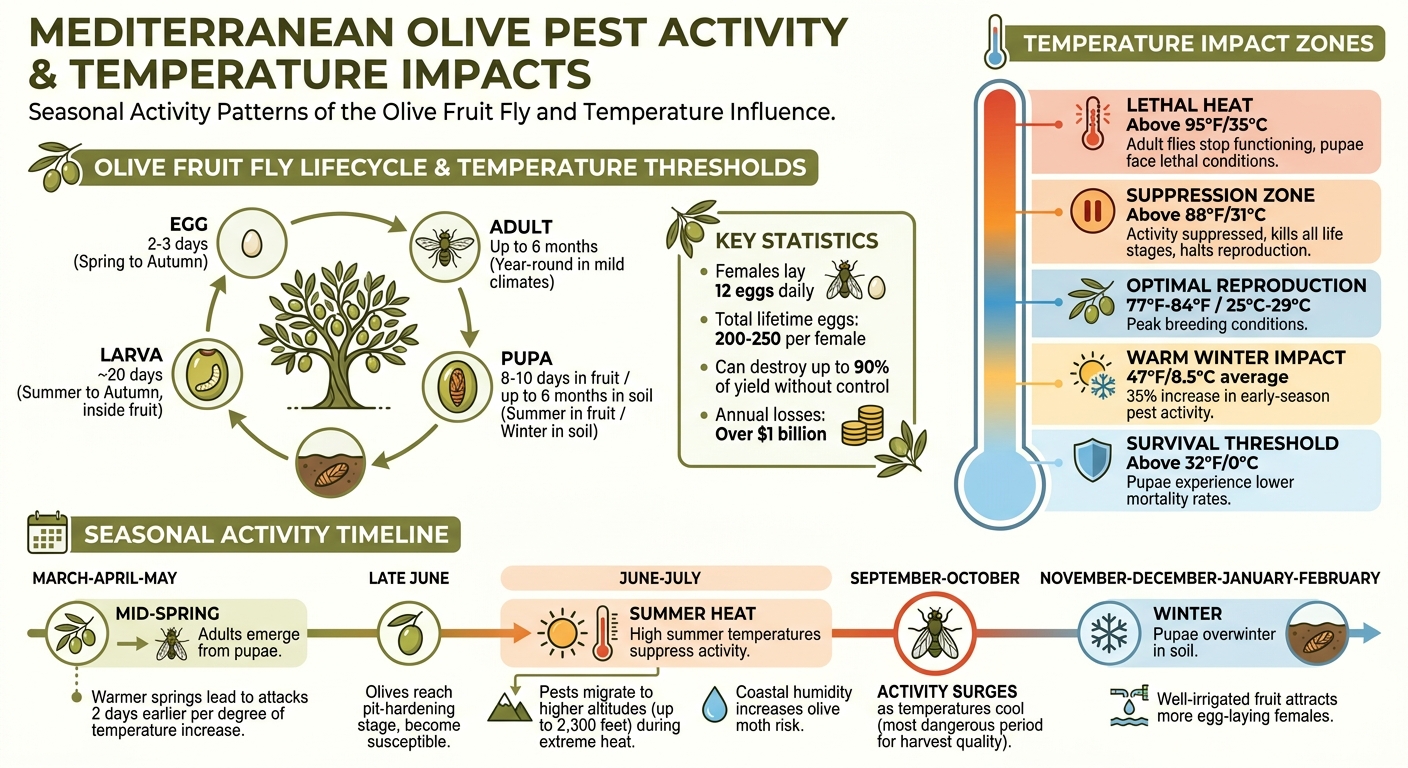
Mediterranean Olive Pest Seasonal Activity and Temperature Impact Chart
Mediterranean olive groves face a variety of pests, each with its own seasonal activity patterns. While the Olive Fruit Fly is the most prominent, other pests also pose challenges. Their behaviors are shaped by factors like temperature, humidity, and the olive tree's growth stages.
Olive Fruit Fly (Bactrocera oleae)
The Olive Fruit Fly's lifecycle aligns closely with the growth of olive fruit. Adults emerge in mid-spring, either from pupae in the soil or as dormant adults hiding in the tree canopy. Early in the season, females may produce a "base generation" before the new crop becomes vulnerable.
The real danger begins in late June when olives reach the pit-hardening stage, making them susceptible to infestation. However, high summer temperatures - especially above 88°F (31°C) - suppress activity by killing all life stages and halting reproduction. At 95°F (35°C), adult flies stop functioning entirely, and pupae face lethal conditions.
As temperatures cool in September and October, activity surges. This period is particularly dangerous for harvest quality, as females lay about 12 eggs daily, totaling 200 to 250 eggs over their lifetimes. Larvae develop inside the fruit over 20 days, and pupation lasts 8 to 10 days. Without control measures, infestations can ruin up to 90% of a grove's yield.
| Lifecycle Stage | Duration | Seasonal Occurrence |
|---|---|---|
| Egg | 2–3 days | Spring to Autumn |
| Larva | ~20 days | Summer to Autumn (inside fruit) |
| Pupa | 8–10 days (in fruit) / up to 6 months (in soil) | Summer (in fruit) / Winter (in soil) |
| Adult | Up to 6 months | Year-round (in mild climates) |
Olive Moth (Prays oleae)
The Olive Moth follows a different seasonal pattern, thriving in coastal areas with mild temperatures and high humidity, particularly during autumn and winter. Unlike the Olive Fruit Fly, which targets the fruit directly, the Olive Moth is a secondary pest that contributes to localized yield reductions. Its activity intensifies under humid and moderate conditions, making it a significant concern in coastal regions.
Olive Knot Moth (Palpita vitrealis)
The Olive Knot Moth primarily affects young olive trees by feeding on buds and leaflets, which causes shoot deformities and disrupts tree growth. In autumn, warmer temperatures can extend the pupal stage, leading to population increases that hinder the development of young plantations and delay their productivity.
How Environmental Conditions Affect Seasonal Pest Activity
Environmental factors play a key role in shaping the seasonal behavior of pests, particularly for olive crops. Temperature and humidity are major influences on the life cycles of these pests, as they are highly sensitive to changes in climate. These conditions directly impact their survival, reproduction, and ability to spread.
Winter temperatures are crucial for determining pest survival rates. For instance, when temperatures stay above 32°F (0°C), olive fruit fly pupae experience much lower mortality rates, allowing them to survive through the season in soil or tree canopies. Research shows that warmer winters - averaging around 47°F (8.5°C) - can increase early-season pest activity by 35%, as adults skip reproductive dormancy and remain active throughout the year. This sets the stage for pest dynamics in the following seasons.
In contrast, summer heat can be deadly for pests. Temperatures exceeding 95°F (35°C) kill off pupae and young larvae, while adult survival drops significantly above 98.6°F (37°C). The ideal temperature range for olive fruit fly reproduction is between 77°F and 84°F (25°C to 29°C). Years with prolonged heat waves in June and July often see reduced pest populations. However, when extreme heat occurs, pests may migrate to cooler, higher-altitude groves - up to 2,300 feet - creating unexpected infestations in areas previously thought to be low-risk.
Humidity adds another layer of complexity. High coastal humidity increases the risk of infestation, particularly for the olive moth. Additionally, well-hydrated fruit tends to attract more egg-laying females. The soil’s water balance in the 30 days before the typical attack period (July–August) also plays a role. Plumper, well-irrigated fruit is more appealing to pests, presenting a challenge for growers. While irrigation is essential for tree health, it can inadvertently make the fruit more vulnerable to pest attacks.
Climate change is further altering these dynamics. According to Gabriele Rondoni from the University of Perugia:
"Bactrocera oleae is expected to expand due to global warming, thus colonizing areas at higher latitudes and altitudes".
Warmer springs are leading to earlier pest activity, with the first attacks occurring about two days earlier for every degree of temperature increase. However, extreme spring heat can also cause a premature decline in overwintering adults. These changes may disrupt the timing between pests and their natural predators, weakening the effectiveness of biological control methods.
Seasonal Pest Management Methods
Effective pest management hinges on understanding how pests behave throughout the year. By combining monitoring, timely actions, and sustainable practices, growers can better protect their crops and maintain quality.
Seasonal Monitoring and Trap Usage
The first step in pest control is keeping a close eye on pest populations at different stages of their life cycle. For olive fruit flies, McPhail traps filled with a 2% ammonium sulfate solution or protein food lures are commonly used to track adult activity. These traps should be checked, cleaned, and refilled every five days during the peak season, which runs from June to October.
A general guideline is to place one trap for every 2,000 trees. For example, on Samos Island, researchers deployed 399 traps and checked them every five days. The data collected was recorded using a mobile app, which digitized trap locations and stored the results in a geodatabase. This system allowed for precise tracking of pest movements across different altitudes.
In addition to traps, weekly fruit sampling provides critical information about infestations. Technicians randomly collect 100 olives from each orchard and inspect them for oviposition punctures, often using a stereomicroscope to detect eggs and larvae. This process typically begins in late June or July, around the pit hardening stage.
Modern tools like GIS systems and mobile apps have made monitoring more accurate. These tools allow for real-time data collection and help identify hot spots for targeted interventions. Predictive models, such as Cumulative Degree Day (CDD) models, use temperature data to forecast pest outbreaks. For instance, a lower threshold of approximately 47°F (9°C) is used to predict when pests will become active. During hot summer months, when lowland temperatures exceed 90°F to 95°F (32°C to 35°C), pests often migrate to cooler mid-to-high altitudes, necessitating focused monitoring in those areas.
Adjusting Harvest Timing to Reduce Pest Damage
Monitoring data also plays a key role in determining the best time to harvest. Pest activity often increases as olives mature in September and October, when weather conditions become more favorable. Larval feeding within the olive mesocarp can lead to higher oil acidity and premature fruit drop, directly affecting both yield and quality.
"The larval stage is responsible for both qualitative and quantitative damage due to its feeding activity within the olive mesocarp, leading to a strong decline in oil quality and premature fruit drop".
In years with mild winters and warm springs, pests may attack earlier, requiring growers to consider an earlier harvest. On the other hand, olive groves located at higher altitudes usually experience delayed pest activity, allowing for a later harvest. Weekly fruit sampling helps growers assess pest levels and decide on the optimal harvest time.
Integrated Pest Management (IPM) Approaches
Harvest timing is just one piece of a larger pest management strategy. Integrated Pest Management (IPM) combines multiple tactics for better results. For example, growers often apply the first pesticide spray at the pit hardening stage and then follow up with additional treatments based on monitoring data.
Between 2015 and 2021, the Umbrian Olive Oil Producer Association (O.P.O.O.) monitored 79 orchards over seven years. Their data revealed that warmer winter and spring temperatures triggered earlier pest activity, while higher-altitude groves experienced delayed infestations. These findings helped improve regional decision support systems, enabling more precise, location-specific recommendations.
Temperature thresholds also guide IPM strategies. For instance, temperatures above 95°F (35°C) are lethal to olive fly pupae and limit adult movement. During heatwaves, growers can reduce chemical use by pausing sprays and relying on natural thermal control.
Research from Samos Island, led by Georgios Katsikogiannis, highlighted seasonal variations in bait spray effectiveness:
"Fly populations are influenced mostly by climate and altitude over longer periods in the season and from bait sprays for shorter periods of time, which appeared to be less effective in autumn, probably due to population movements and overlapping generations".
These findings have led to updated seasonal protocols, emphasizing more intensive monitoring and alternative control methods during autumn when traditional sprays are less effective. By adapting their strategies to seasonal conditions, growers can better protect their crops throughout the year.
How Seasonal Pests Affect Olive Production and Quality
Seasonal pests can have a serious impact on both the quantity and quality of olive production, leading to financial losses that ripple through the industry. For example, infestations by the olive fruit fly are responsible for significant annual losses across the Mediterranean, with damage affecting up to 90% of commercial olive groves when left unchecked.
The effects of pest damage show up in two main ways. First, pests cause premature fruit drop, reducing the harvest volume. Second, they compromise the quality of the olives, especially by increasing oil acidity and oxidation. This combination drives down the market value of the oil. Research from the University of Perugia highlights that larvae feeding on the olive’s mesocarp not only reduces the yield but also lowers the overall quality of the oil produced.
The damage from pests tends to follow seasonal patterns. Two critical periods stand out: July through August, when the fruits are actively growing, and September through October, just before harvest. Autumn temperatures above 54°F (12°C) allow pests, particularly olive fruit flies, to continue laying eggs, extending the window of damage.
The problem goes beyond just immediate losses. Pest-related quality declines have long-term effects on market reputation and profitability. Climate change is adding to the challenge, with rising temperatures extending the flies' egg-laying period into late autumn. Additionally, pests are now invading olive groves at higher altitudes and latitudes, areas that were previously too cool for them to thrive.
For producers of high-end olive oil, the stakes are especially high. Even small amounts of pest damage can increase oil acidity, pushing it out of the "extra virgin" category and into lower-priced tiers. This directly impacts profitability, particularly for those targeting the ultra-premium market.
To protect both yield and quality, proactive pest management is essential. Big Horn Olive Oil is committed to safeguarding its production through strategies that ensure both the integrity and market value of its oils.
Conclusion
Keeping up with seasonal pest trends is essential for protecting olive yields and ensuring high-quality production. Factors like temperature and altitude play a significant role in pest behavior, helping producers anticipate infestations and fine-tune their strategies. With climate change extending pest activity into late autumn and expanding their range, this knowledge becomes even more crucial.
By leveraging this information, producers can implement targeted control measures. Success depends on consistent monitoring, predictive tools, and timely actions. Using agroclimatic data and degree-day calculations allows for precise interventions, minimizing the need for broad-spectrum insecticides while preserving oil quality. The adoption of Integrated Pest Management (IPM) and advanced digital monitoring systems reflects a shift toward more sustainable practices that benefit both the environment and the final product.
These efforts directly impact consumers. Olives from well-monitored groves, particularly those in higher-altitude regions or areas with rigorous pest management, experience less acidity from pest damage. This ensures the oil maintains its extra virgin status and delivers a superior flavor.
Big Horn Olive Oil takes pride in sourcing premium olives from groves that prioritize precise harvest and pest management techniques. By understanding the challenges Mediterranean olive producers face, consumers can truly value the expertise behind ultra-premium extra virgin olive oils. Check out the Big Horn Olive Oil collection to taste the difference that meticulous quality control makes.
FAQs
When should olive growers start monitoring for olive fruit fly each year?
Monitoring for the olive fruit fly (Bactrocera oleae) should start in early spring. As temperatures rise and conditions become more suitable, these seasonal changes often prompt the flies to become active. Catching their presence early is crucial to safeguarding olive crops from potential harm.
How do warmer winters and summer heatwaves change pest pressure in olive groves?
Warmer winters and intense summer heatwaves are making pests like Bactrocera oleae more of a challenge for olive growers. Milder winters and extended warm periods allow these pests to stay active longer, increasing their impact on olive groves. On the other hand, when summer temperatures soar past 95°F, pest activity tends to drop, and many adults don't survive. These shifting seasonal patterns are reshaping pest behavior and population trends, directly affecting olive production.
What pest damage can push olive oil out of the extra virgin category?
Damage caused by pests like Bactrocera oleae can significantly impact olive oil quality, often preventing it from qualifying as extra virgin. This damage includes physical issues like exit holes, faster rancidity, and even a noticeable "grubby" flavor. Together, these factors lower the oil's classification and overall quality.