

How Microbes Transform Olive Mill Wastewater
Olive mill wastewater is hard to treat, but microbes can cut COD, reduce phenols, produce biogas, and clean the water enough for reuse in some systems. In plain terms: I’d test the wastewater first, lower solids and acidity, match the microbe type to the main problem, run treatment in stages, and then check whether the final water, gas, or biomass can be used.
Here’s the short version:
- Raw OMWW is strong waste: COD often runs at 70–170 g/L, phenols can hit 1–8 g/L, and pH is often 3–6.
- Pretreatment comes first: screen solids, let them settle, dilute if needed, and shift pH to about 6.5–7.5.
-
Different microbes do different jobs:
- Fungi cut color and phenols
- Aerobic bacteria lower COD and BOD
- Anaerobic consortia turn organics into biogas
- Microalgae clean up what’s left and make biomass
- One stage is rarely enough: the usual order is pretreat → detox → digest → polish.
- Performance can be high: some systems report up to 90% COD reduction, near-total phenol removal in multi-stage setups, and methane in biogas around 60%–73%.
- Reuse is the end goal: treated water may fit restricted irrigation, while biogas can help with heat demand and biomass may go to soil use after testing.
If I had to reduce the whole article to one idea, it would be this: microbial treatment works best when each step has one clear job and the wastewater is prepared before biology starts.
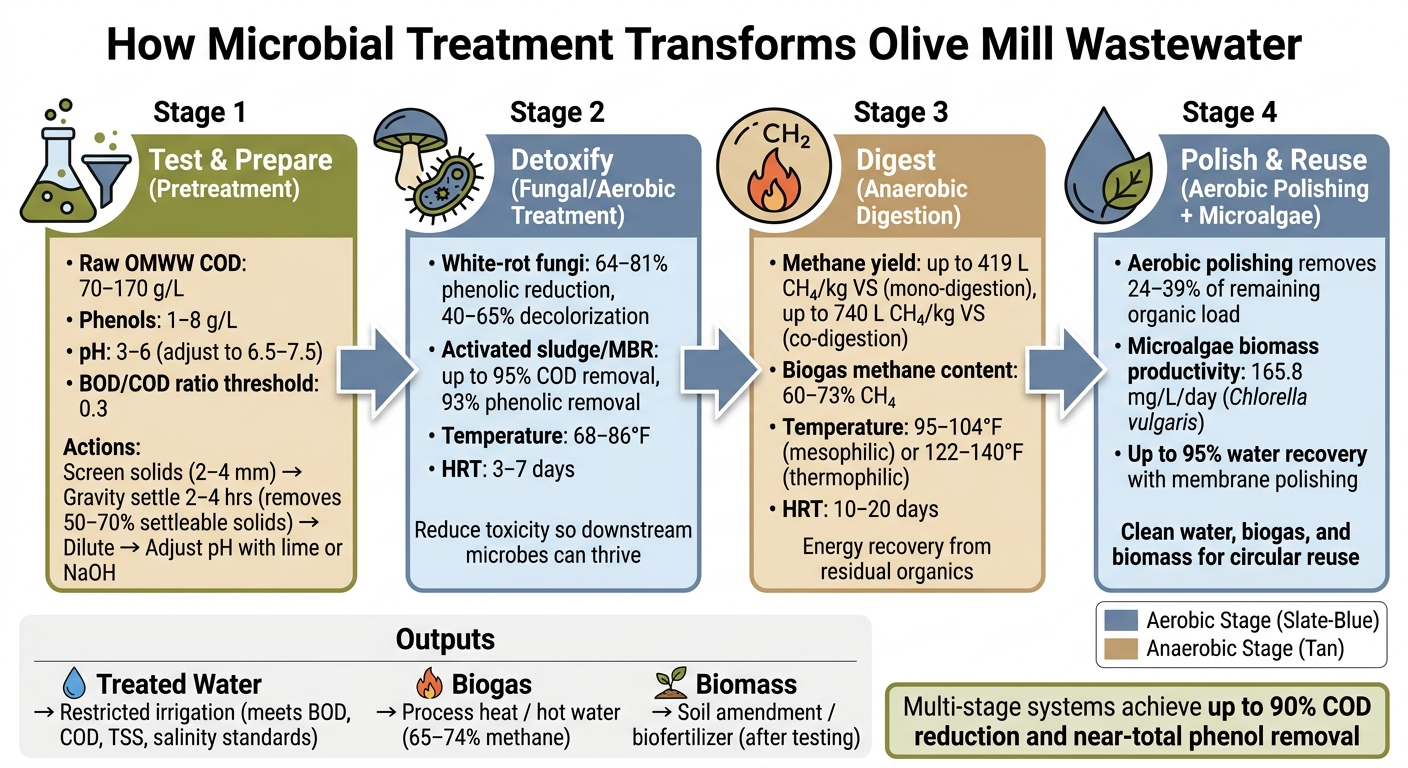
Microbial Treatment of Olive Mill Wastewater: 4-Stage Process Guide
Step 1: Test and Prepare the Wastewater
Before any microbe touches OMWW, you need to know what’s in front of you. Raw OMWW can look very different from one mill to another, and even from one batch to the next. Skip baseline testing, and you’re asking for trouble.
Measure the Key Starting Parameters
Start by measuring seven inputs: pH, COD, BOD, total phenolics, suspended solids (TSS), conductivity, and temperature. These numbers tell you if the wastewater can go straight to biological treatment or if it needs dilution or pretreatment first. Conductivity can reach 20–30 mS/cm, a sign of salt levels that can stress microbial communities.
If COD is above 30,000 mg/L or phenolics are above 2–3 g/L, dilute or pretreat before biological treatment. If the BOD/COD ratio is under 0.3, biodegradability is low, so biology alone probably won’t get the job done. In that case, you’ll likely need a physicochemical step too.
For sampling, use composite samples collected over several hours of mill operation instead of a single grab sample. That gives you a more honest read on what the system will face. Use glass containers, since plastic can adsorb phenolics and skew the results. Keep samples at about 39°F during transport, and run COD and BOD tests within 24 hours. For COD, dilute samples 1:10 or 1:20 with distilled water, test them, and then multiply by the dilution factor.
Use Pretreatment to Help Microbes Work Better
Pretreatment works best in a simple order: screen solids, settle what remains, dilute to the target COD, then adjust pH.
Coarse screening with openings of about 0.08–0.16 inches (2–4 mm) removes leaves, pit fragments, and other debris that can clog pumps and tanks downstream. After that, a gravity settling tank with 2–4 hours of hydraulic retention can remove 50–70% of settleable solids. That’s a solid first cleanup step.
Some cases call for more than simple settling. A 2014 study found that acid cracking at pH 2.0, followed by filtration, removed 96% of suspended solids, 95% of oil and grease, and 58% of COD before the biological stage even started.
Dilution is often the easiest lever to pull. Mixing OMWW with non-salty process water from the mill, or with municipal or well water, in an equalization tank can bring COD down to the 10,000–30,000 mg/L range for aerobic reactors, or 20,000–50,000 mg/L for anaerobic digesters. Once diluted, adjust pH to 6.5–7.5 with lime (Ca(OH)₂) or NaOH. Add the alkali slowly while mixing.
Set Up Basic Tank and Process Conditions
Tank size and operating conditions depend on mill throughput, but a few practical benchmarks help. An equalization tank in the 1,000–5,000 gallon range is a sensible place to start. For example, at 50 gpm, a 3,000-gallon equalization tank gives you about 60 minutes of buffer time before the wastewater moves into the biological reactor.
Temperature matters more than many operators think. Mesophilic anaerobic digestion performs best around 95°F, while thermophilic systems run at 130–140°F. In aerobic systems, most cultures stay active between 68°F and 104°F. If you’re running an outdoor U.S. system where winter temperatures fall below 60°F, insulation or supplemental heating usually pays off. Cold conditions slow microbial metabolism and push retention times up if you want the same COD removal.
For aerobic tanks, target 0.5–2 scfm per 1,000 gallons. Adjust from there based on COD load and tank geometry so solids stay suspended and oxygen levels don’t sag.
With the wastewater screened, balanced, and pH-adjusted, the next move is picking the microbial process that fits its load and biodegradability.
sbb-itb-4066b8e
Step 2: Choose the Right Microbial Treatment Process
After pretreatment, pick the biological process that matches the main issue left in the wastewater. At this point, the key question is simple: what still hurts performance the most? In most cases, that will be one of four things: color and phenolics, COD load, energy recovery, or nutrient cleanup. Use the Step 1 test results to line up the process with that main bottleneck.
Aerobic Options: Fungi, Bacteria, and Activated Sludge
White-rot fungi are often the best fit when color and phenolics are still the main problem, especially in moderately pretreated or diluted OMWW. Species such as Ganoderma spp. and Pleurotus spp. have shown 64–81% phenolic reduction and 40–65% decolorization in OMWW batch cultures. Their COD removal is usually lower, at 12–29%, unless another treatment step follows.
That makes fungi a strong first detox stage, not a full finish line. Aspergillus niger in a bubble-column bioreactor reached 58% COD removal, with biomass close to 30% protein by weight. Bubble columns tend to do better than stirred tanks because they cut down on shear. Run these reactors under aerobic conditions at about 68–86°F and use them upfront to knock down toxicity before moving to the next step.
When the goal shifts from detox to broader COD reduction, polyphenol-degrading bacteria and activated sludge come into play. A conventional activated sludge system treating OMWW can reach 95% COD removal and 93% phenolic removal when sludge settling is good. Membrane bioreactors can go a step farther, hitting 95% COD reduction versus 86% for conventional activated sludge at steady state, while both remove about 80% of polyphenols.
These systems need:
- Continuous aeration
- Enough mixing to keep biomass suspended
- A clarifier or membrane for solid-liquid separation
There is a catch. They are more sensitive to phenolic shock loads than fungi, so pretreatment is even more important before sending OMWW into these reactors.
Anaerobic Digestion and Microalgae for Resource Recovery
If the main target is energy recovery, anaerobic digestion (AD) is usually the right move. In practice, AD works best after pretreatment or co-digestion has lowered inhibition. Methane yields for OMWW mono-digestion reach up to 419 L CH₄ per kilogram of volatile solids, and co-digestion with other organic wastes has pushed yields to about 740 L CH₄/kg VS. Biogas methane content usually falls in the 60% to 73% CH₄ range.
For most U.S. mills, a mesophilic digester at 95–104°F is the practical setup. Thermophilic digestion at 122–140°F can move faster, but it also needs tighter heat control. In other words, you may get more speed, but you pay for it in operating attention.
Microalgae fit best as a polishing step after AD or aerobic treatment. They take up leftover nitrogen, phosphorus, and some organics, while also making biomass that can be used as fertilizer or a soil amendment. Integrated systems that pair anaerobic co-digestion with microalgae cultivation have shown methane contents above 70% in the digestion stage, with the algae stage cutting remaining COD and nutrients even further.
Compare the Main Microbial Treatment Options
| Process | Main Goal | Observed Performance | Conditions | Best Fit |
|---|---|---|---|---|
| White-rot fungi | Detoxification, color removal | Strong phenolic and color reduction; modest COD removal | Aerobic, mesophilic | Small mills needing a first detox stage |
| Polyphenol-degrading bacteria | Targeted detoxification | Good COD reduction after pretreatment; moderate to high phenolic removal | Aerobic, mesophilic | Small to mid-sized, post-pretreatment |
| Activated sludge / MBR | Broad organic load reduction | Highest compliance-focused COD removal | Aerobic, mesophilic | Mid-sized mills with discharge compliance goals |
| Anaerobic digestion | Energy recovery (biogas) | Biogas production from residual organics | Mesophilic to thermophilic anaerobic | Mid-sized mills with consistent OMWW volumes |
| Microalgae | Nutrient removal, biomass production | Polishing stage for residual COD and nutrients | Sunlight-driven | Add-on stage for circular economy operations |
Use the option that fits the main problem left on the table: detoxification, COD reduction, energy recovery, or polishing. Step 3 turns that process choice into an ordered treatment train.
Step 3: Build a Treatment Train That Improves Results
No single microbial step can handle OMWW on its own. The process works better when each group of microbes has a clear job: cut toxicity first, recover energy next, and finish with cleanup for reuse.
After you choose the process, put the stages in an order that lowers toxicity, pulls out energy, and ends with polishing.
The basic rule is simple: pretreat first, digest second, polish last.
Put the Stages in a Practical Order
The best sequence follows a plain, workable logic: reduce toxicity first, recover energy second, clean up last.
Stage 1 is fungal pretreatment. This step lowers phenolics and color, which turns hard-to-treat wastewater into something microbes can digest more easily before it moves anywhere else. Run this stage at about 77–86°F, with hydraulic retention times (HRT) of 3–7 days, and keep dissolved oxygen above 2 mg/L.
Stage 2 sends that pretreated water into an anaerobic digester. This is the energy-recovery step, not just one more treatment unit. When phenolics are lower, methanogens can keep working without as many setbacks. A two-phase anaerobic setup often does better than a single-stage reactor for methane output, along with soluble COD and phenol removal. Typical HRTs at this stage are 10–20 days, based on loading.
Stage 3 is aerobic polishing. This final cleanup step gets the water ready for reuse or discharge. It removes what is still left behind, including color, odor, and soluble COD. In one integrated anaerobic-aerobic system, packed-bed aerobic polishing removed 24% to 39% of the remaining organic load.
Track Results and Adjust the System
Watch the system at three levels: daily checks, weekly tests, and monthly lab analysis.
A few signals matter most because they tell you where the train is slipping:
- pH below 6.8 in the anaerobic digester points to acid buildup. Cut the feed rate, add more dilution, or increase alkalinity.
- COD removal below 30% during pretreatment can mean phenolics are still holding back microbial activity. Extend HRT, lower flow, or check fungal activity.
- Low dissolved oxygen paired with stronger odor in aerobic tanks usually means aeration is falling short. Increase blower runtime.
- Persistent dark color after polishing often means the water needs more HRT, or one more step such as a sand filter or wetland.
Weekly trend tracking helps you spot trouble before performance starts to slide.
Compare Single-Stage and Multi-Stage Systems
Use the table to line up system design with mill size, feed stability, and reuse goals.
| System Design | Treatment Performance | Complexity | Energy Use | Best Fit |
|---|---|---|---|---|
| Single-stage aerobic | Moderate COD/BOD removal; weak phenolic removal; inhibition risk | Low | High; continuous aeration, no biogas recovery | Pilot testing or very small systems |
| Single-stage anaerobic | High COD removal if phenolics are low; unstable on raw OMWW | Moderate | Moderate; biogas recovery offsets some cost | Mills with low-phenolic feedstocks or pre-diluted waste |
| Multi-stage (fungal/aerobic pretreatment → anaerobic → aerobic polish) | Highest overall removal and stability; lower net energy use with biogas recovery | Higher; more tanks and controls, but clearer adjustment levers | Lower net demand; biogas from Stage 2 offsets aeration costs | Seasonal and continuous mills targeting reuse or discharge compliance |
Multi-stage systems do cost more up front and need closer operator attention. But they also give you clear points to step in when something starts going sideways. That matters. Instead of one tank that either works or fails, you get a train with several control points. For seasonal U.S. olive mills, that kind of flexibility can matter just as much as the treatment numbers.
Step 4: Reuse Treated Water and Capture Circular Value
After polishing, the focus moves from treatment to reuse. Once toxicity drops, solids settle out, and pH stays stable, the outputs from the treatment train stop looking like waste and start looking like resources: cleaner water, biogas, and harvestable biomass.
Reuse Options for Water, Energy, and Biomass
The three main outputs from microbial OMWW treatment are cleaner water, biogas, and usable biomass.
Treated water can go to restricted irrigation under reclaimed-water rules once it meets your state's standards. Those rules usually set limits for BOD, COD, total suspended solids, salinity, and pathogen indicators. Integrated biological systems with membrane polishing can reach up to 95% water recovery, with phenolics and phosphorus cut to near-zero levels.
If water reuse isn't practical, energy recovery becomes the next source of value. Biogas has direct energy use. Anaerobic digestion of OMWW can produce methane at around 65–74%, and co-digestion studies have reported up to 29 liters of biogas per liter of reactor volume per day. That output can help cover process heat or hot-water demand.
The same setup can also produce harvestable biomass. Harvested microalgal biomass can be used as a soil amendment or biofertilizer once it is stabilized and tested. One study reported biomass productivity of 165.8 mg/L per day with Chlorella vulgaris, while Neochloris oleoabundans has also been shown to produce biomass rich in pigments, crude protein, and lipids. In the U.S., land application of industrial digestate has to line up with state and federal rules for biosolids or digestate, including regular contaminant and pathogen testing.
How Wastewater Treatment Supports a Circular Olive Oil Business
Responsible OMWW management is more than an environmental requirement. It ties straight into how a quality-focused olive oil business runs. When treated wastewater irrigates groves, digestate supports soil, and biogas helps offset energy costs, the production cycle becomes more circular.
Life-cycle analyses of OMWW biogas systems show positive economic profiles at co-digestion inclusion rates of around 20–30% by volume, pointing to savings on both disposal and energy costs. For an olive oil business, that means lower disposal costs and stronger sustainability claims - from grove to mill to treated water and soil.
Conclusion: The Steps That Make Microbial Treatment Work
Microbial treatment of OMWW works best when each step has a clear role: test and prepare the wastewater, pick the right microbial process based on mill size and goals, build a treatment train that lowers toxicity first, recovers energy next, and polishes at the end, then check reuse options - water, biogas, and biomass - against state rules and what your operation can handle.
That shift from waste to resource doesn't happen in a single tank. It comes from careful sequencing, steady monitoring, and treating wastewater as an input in a circular system.
FAQs
Why is olive mill wastewater so difficult to treat?
Olive mill wastewater is tough to treat. For starters, it carries very high organic loads - its chemical oxygen demand can be 20 to 100 times higher than municipal sewage.
It also contains high levels of phenolic compounds. That matters because these compounds can be toxic and can slow down or stop microbial activity, which makes biological treatment harder.
Then there’s the practical side. Its composition can shift from one batch to the next, production is seasonal, and many small mills struggle with the high cost of proper treatment.
Which microbes work best at each treatment stage?
Different microbes come into play at different stages, based on what the treatment process is trying to do.
In anaerobic digestion, bacteria and archaea break down organic matter. Methanogenic archaea such as Methanosarcina are central to methane production. In microalgal cultivation, species like Scenedesmus sp. and Chlorella pyrenoidosa process nutrients, sugars, and phenolic compounds into lipids and carbohydrates.
Can treated olive mill wastewater be reused safely?
Yes. If olive mill wastewater is treated the right way, it can be reused safely.
The key is removing pollutants like phenolic compounds and suspended solids so the water can meet quality standards for uses such as irrigation, washing machinery, and even reuse in olive oil production.
Methods like advanced filtration, anaerobic digestion, and membrane technologies help stabilize the effluent and make it safer to use. They also reduce phytotoxicity, support resource recovery, and cut its impact on the surrounding area.