

Technologies Transforming Olive Oil Wastewater
Olive mill wastewater is hard to treat, but the best systems now do three jobs at once: clean water, make biogas, and recover phenols. In plain terms, mills are moving away from simple disposal and toward treatment trains that mix membranes, oxidation, biological treatment, and compound recovery.
If I had to boil the article down, it comes to this:
- Membrane systems can push treated water to COD as low as 284 mg/L, which can work for irrigation.
- Membrane bioreactors have shown 90%+ TOC removal and 85%+ polyphenol removal.
- Photocatalytic pretreatment can improve membrane throughput by 19% and help bring COD to below 1.3 g/L.
- Storage ponds and land treatment can cut COD and phenols with lower system demands, with land treatment reaching 93% COD removal and 85% phenol removal in a pilot case.
- Phenol recovery changes the math: OMWW can contain 0.5 to 24 g/L of phenols, and hydroxytyrosol can be purified to 94%+ for food, supplement, and cosmetic use.
The big point is simple: no single method does the whole job well. The strongest setups use a sequence. First, remove solids and hard-to-treat compounds. Then polish the water. If needed, pull out saleable phenols before the final cleanup.
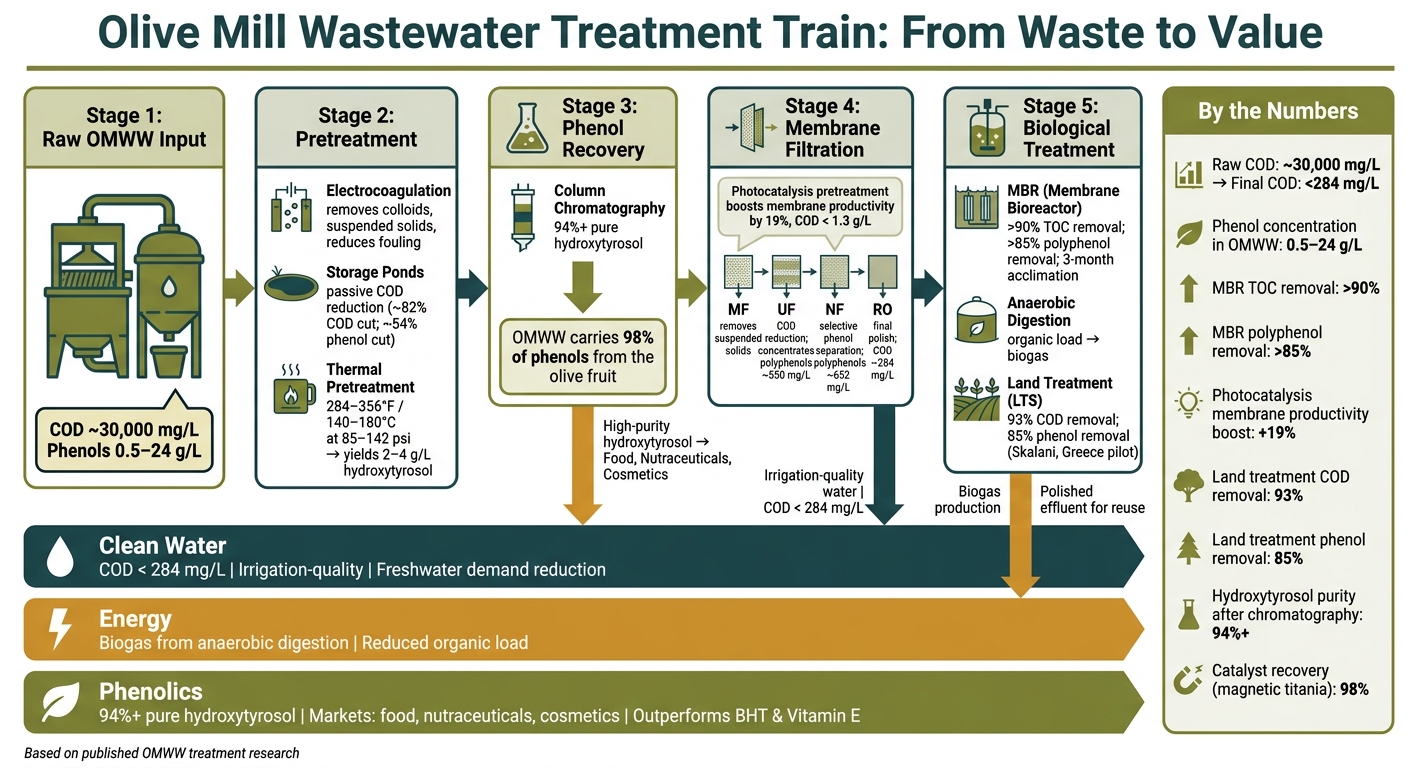
Olive Mill Wastewater Treatment Train: From Waste to Value
P. Kougias | Valorization of olive mill wastewaters in the era of circular bioeconomy
sbb-itb-4066b8e
Quick Comparison
| Method | Main Job | Output |
|---|---|---|
| Membranes (UF/NF/RO) | Separate solids, organics, salts, and phenols | Reuse-grade water, concentrated side streams |
| MBR | Biological breakdown plus membrane polishing | Lower organics and phenols |
| Electrocoagulation | Pretreatment to cut solids and fouling load | Cleaner feed for later stages |
| Photocatalysis | Break down leftover hard compounds | Better membrane performance |
| Anaerobic digestion | Reduce organic load and make gas | Biogas + treated effluent |
| Land treatment | Soil-based removal and nutrient reuse | Lower COD/phenols + biomass growth |
| Phenol recovery | Pull out hydroxytyrosol and related compounds | High-purity extract |
So if you’re looking at OMWW treatment, I’d start with the end goal: water reuse, energy, or phenol recovery. From there, the right treatment train becomes much easier to choose.
Membrane and Electrocoagulation Systems
Membrane Filtration and Membrane Bioreactors
Membrane-based systems are a common best-practice choice for OMWW treatment. The process moves in stages, and each membrane handles a different part of the job.
Microfiltration (MF) removes suspended solids and clears up the stream so finer membranes downstream can do their work. Ultrafiltration (UF) separates larger organic molecules, such as pectins, and lowers COD. Nanofiltration (NF) separates phenolic compounds from inorganic cations, while Reverse Osmosis (RO) acts as the final polishing step. When UF, NF, and RO run in sequence, final permeate COD can drop to about 284 mg/L, which is suitable for irrigation reuse.
| Membrane Stage | Primary Role | Key Outcome |
|---|---|---|
| Microfiltration (MF) | Clarification and pre-treatment | Removes suspended solids; prepares the stream for finer filtration |
| Ultrafiltration (UF) | COD reduction and phenolic separation | Concentrates polyphenols (~550 mg/L) and carbohydrates (~4,000 mg/L) |
| Nanofiltration (NF) | Selective phenol separation | Higher polyphenol concentration (~652 mg/L); lower carbohydrate levels |
| Reverse Osmosis (RO) | Final polishing | Clean permeate with COD ~284 mg/L; suitable for irrigation |
Membrane Bioreactors (MBRs) combine biological degradation and membrane filtration in one unit. A mixed microbial community breaks down complex organics, including phenolics, while the membrane keeps the biomass in the system. In practice, MBRs have reached more than 90% removal of total organic carbon (TOC) and more than 85% removal of total polyphenols (TPh).
That said, stable operation doesn't happen overnight. Acclimatization matters, and acclimation can take about three months. Operators also need to watch transmembrane pressure (TMP) all the time, since it gives a clear signal when membrane fouling starts to build. Scheduled backwashing and coarse air-bubble diffusers help limit bio-floc buildup.
Fouling is still the stubborn weak point across membrane setups. Fixed photocatalysts don't perform well in dark OMWW, but recoverable magnetic titania works better as a pretreatment step. It can increase membrane process productivity by an average of 19%. And when fouling or suspended solids start choking performance, electrocoagulation can step in as a low-sludge pretreatment before the membranes.
Electrocoagulation and EC Hybrid Designs
EC is well suited for heavily loaded OMWW streams that need solids removal before finer treatment. In electrocoagulation, an electric current releases metal ions from sacrificial electrodes into the wastewater. Those ions form flocs that trap colloids, turbidity, and phenolics. Put simply, EC knocks unstable particles out of suspension before they become a headache later.
That matters because it destabilizes emulsified particles and pulls suspended organics out of solution. The result is a lower load on downstream membranes and lower fouling rates. For that reason, EC is often placed ahead of membrane stages in hybrid designs. Its low sludge output and chemical-free operation make it a practical match for seasonal, high-strength OMWW streams.
When EC is sequenced with membrane filtration and downstream polishing steps, the treatment train can recover value-added compounds such as phenols while also producing water fit for reuse. These systems often feed into the oxidation and biological steps that come next.
Oxidation and Biological Treatment Technologies
After primary separation, mills turn to oxidation and biological systems to finish the job and get water ready for reuse.
Fenton, Photo-Fenton, Ozonation, and Other Polishing Steps
Advanced oxidation processes (AOPs) usually work best as polishing steps, not as stand-alone treatment. In OMWW, they help break down stubborn phenolics and leftover organics after primary or biological treatment.
OMWW is dark and opaque, which makes photocatalysis harder to run. One workaround is magnetic core titania. These particles stay suspended during treatment and can later be pulled out with a magnetic trap, which recovers 98% of the catalyst for reuse. When used before membrane filtration, this setup improved process productivity by 19% and reduced final COD to below 1.3 g/L, which meets irrigation quality standards.
After those residual organics are broken apart, biological systems can take over and handle the rest of the load.
Anaerobic Digestion, Aerobic Treatment, and Biogas Production
Retention ponds can pre-stabilize OMWW before more intensive treatment. In practice, they cut COD from about 30,000 mg/L to 5,200 mg/L and total phenols from 2,600 mg/L to 1,200 mg/L.
Land treatment systems (LTS) can go further. In a pilot system in Skalani Village, Greece, researchers applied OMWW at rates up to 500 kg BOD₅ per hectare per day using 40 Eucalyptus camaldulensis seedlings. The upper 6 inches (15 cm) of soil removed 93% of COD and 85% of total phenols. At the same time, the eucalyptus trees recovered 25% of the applied nitrogen and produced increased biomass yield.
Orchard land application can also recycle OMWW at low cost because the soil helps move and biodegrade pollutants.
For mills that want energy recovery, anaerobic digestion turns organic load into biogas, while aerobic treatment stabilizes the effluent further for safe reuse. Put the two together, and each batch of OMWW can deliver more than waste reduction.
These options mainly differ in cost, system difficulty, and the reuse goal.
Technology Comparison by Reuse Outcome
| Technology | Pollutant Removal | Operating Complexity | Best-Fit Outcome |
|---|---|---|---|
| Photocatalysis + Membranes | COD < 1.3 g/L; 19% productivity boost | Moderate - catalyst recovery required | Reclaimed water for irrigation |
| Storage Ponds | ~82% COD reduction; ~54% phenol reduction | Low - passive and chemical-free | Low-cost volume/load reduction |
| Land Treatment (LTS) | 93% COD removal; 85% phenol removal | Low-to-moderate - land and vegetation required | Biomass production and soil fertility |
| Membrane Bioreactor (MBR) | High TOC and polyphenol removal | Moderate-to-high - ongoing operation and monitoring required | Polished effluent for reuse |
There’s no one-size-fits-all answer here. The right pick depends on the reuse target, the budget, and how steady the treatment process needs to be.
Polyphenol Recovery and Integrated Treatment Trains
OMWW still holds recoverable phenolics, which means treatment can also become a value-recovery step. In fact, OMWW carries 98% of the phenols found in the olive fruit itself, with concentrations ranging from 0.5 g/L to 24 g/L. That changes the whole setup: instead of treating OMWW only as a waste stream, mills can pull out phenolics first and then move on to final polishing.
Recovering Hydroxytyrosol and Other Phenolics
One common starting point is thermal pretreatment. This step heats OMWW to 284–356°F (140–180°C) under about 85–142 psi, which pushes phenolics into the water phase and yields 2–4 g/L hydroxytyrosol. In a pilot project in Spain, column chromatography then produced 94%+ hydroxytyrosol purity.
That matters because recovered hydroxytyrosol can be used in food, nutraceutical, and cosmetic ingredients. It also performs better than BHT and vitamin E in oxidation tests. So this is not just cleanup. It's product recovery with a clear market use.
There’s also a process benefit here. Removing phenolics before biological treatment cuts microbial inhibition and helps downstream units run better. Put simply, the same step that recovers saleable compounds also makes the rest of the treatment train easier to manage.
Integrated Circular Systems and Cost-Benefit Models
After phenolics are extracted, the remaining stream can pass through membranes and biological polishing. In many systems, UF, NF, and RO are used in sequence for fractionation, concentration, and final polishing. Each stage recovers useful material while moving the effluent closer to irrigation-quality standards.
The table below shows how each part of an integrated train supports both compliance and value recovery:
| Treatment Stage | Primary Goal | Recovered Output | Value Role |
|---|---|---|---|
| Thermal Pretreatment | Phenolic solubilization | Phenolic liquor at 2–4 g/L | Reduces downstream toxicity; maximizes ingredient yield |
| Column Chromatography | Purification | 94%+ pure hydroxytyrosol | High-value ingredient for nutraceuticals and cosmetics |
| Ultrafiltration (UF) | Fractionation | Pectins; concentrated polyphenols | Source for gelling agents and nutraceuticals |
| Nanofiltration (NF) | Concentration | Concentrated phenolic stream | Phenolic stream for further processing |
| Reverse Osmosis (RO) | Final polishing | Irrigation-quality water | Reduces freshwater demand and supports compliance |
| Membrane Bioreactor (MBR) | Biological polishing | Residual organics after phenolic recovery | Handles variable load; stabilizes effluent for reuse |
As Antonio Lama-Muñoz of the Instituto de la Grasa (CSIC) puts it:
"The selection of the methodology is essential for the economic and sustainable valorization of OMW."
The main trade-off is capital intensity. These systems can cost more up front, and that can be a sticking point for smaller mills. But for mills with steady production volume, revenue from recovered hydroxytyrosol and other phenolics can help offset operating costs. In that case, disposal shifts from a cost center into a revenue stream across food, nutraceutical, and cosmetic markets. That naturally sets up the next question: which treatment options make sense for different types of mills?
Conclusion: Which Technologies Are Changing OMWW Management
No single technology fixes OMWW on its own. The best results come from treatment trains that combine methods to improve water quality, cut energy loss, and recover useful byproducts. So the real question isn’t which one method wins. It’s which treatment train fits the reuse goal.
The methods making the biggest difference are membrane-based systems, photocatalysis as a pretreatment step, anaerobic digestion, and phenolic recovery systems. They tend to work best in sequence, not in isolation. That sequencing is what shifts OMWW management from basic damage control to reuse with clear, measurable outcomes. The strongest setups recover three outputs at once: reusable water, biogas, and phenolics.
What separates these methods most is the output they make possible.
| Technology | Primary Reuse Outcome | Key Performance Metric |
|---|---|---|
| Reverse Osmosis (RO) | Clean process water for reuse | Final permeate COD below 284 mg/L |
| Photocatalysis + Membranes | Irrigation-quality water | 19% higher filtration productivity; COD below 1.3 g/L |
| Anaerobic Digestion | Biogas / energy recovery | Biogas production and COD reduction |
| Land Treatment (LTS) | Nutrient recycling and biomass growth | 93% COD removal; 85% total phenol removal |
That makes the choice practical, not abstract. Start with the reuse target - clean water, energy, or recovered compounds - and then add supporting stages only where they help. The best OMWW systems turn treatment into reuse.
FAQs
Why isn’t one treatment method enough for OMWW?
OMWW is chemically complex and can vary a lot from one batch to the next, so a single treatment method usually won't do the job.
One big problem is its phenols and polyphenols. These compounds can inhibit the microorganisms needed for biological digestion. On top of that, OMWW has a high chemical oxygen demand, which makes direct biological treatment inefficient.
That’s why producers often combine physical, chemical, and biological methods. The goal is to remove toxic compounds, improve biodegradability, and meet discharge standards.
How do mills choose between water reuse, biogas, and phenol recovery?
Mills pick treatment technologies based on plant size, budget, and day-to-day operating needs.
For example, integrated membrane systems are often used when the goal is high water recovery and strong phenol removal. By contrast, anaerobic digestion, especially UASB reactors, is a common choice for biogas production and lower running costs.
Many mills also use phenol extraction before the next treatment stage so they can recover antioxidants. In practice, producers balance upfront spending with long-term efficiency and the return they can get from byproducts such as biogas, fertilizer, and antioxidants.
What makes phenol recovery worth the extra cost?
Phenol recovery is worth the investment because it turns a pollutant-heavy byproduct into something you can use and sell. By pulling out high-value antioxidants, producers can improve the quality and consistency of premium extra virgin olive oils.
It can also open up a new revenue stream, cut the organic load in wastewater, reduce disposal and compliance costs, and shrink the overall footprint of the operation. Put simply, it moves the conversation from waste handling to value creation.