

Olive Oil Preservation in Ancient Greece
Ancient Greeks did not use olive oil alone to keep food safe. They first cured food with salt, brine, vinegar, drying, smoking, or cooking, then added a layer of olive oil to block air and slow spoilage.
If you want the short version, here it is:
- How it worked: olive oil acted as a surface seal
- What it stored: fish, meat, cheese, olives, vegetables, and herbs
- What made it work: foods were usually drier and already cured first
- Where it was stored: in amphorae, pithoi, and small household jars
- Why it mattered: it helped with winter storage, trade, travel, and household reserves
A few facts stand out:
- A standard Attic amphora held about 10 gallons (39 liters)
- A pithos could hold about 150 to 300 liters
- Some records put olive oil at about $3 drachmae per gallon in ancient terms
How Did Ancient Greeks Produce Their Olive Oil?
sbb-itb-4066b8e
Quick Comparison
| Area | Main Point |
|---|---|
| Preservation method | Oil was a final seal, not the first step |
| Best foods | Salted fish, cured meat, brined cheese, cured olives, cooked or pickled vegetables, dried herbs |
| Poor fit | High-moisture foods stored in oil by themselves |
| Main containers | Amphorae for transport, pithoi for bulk storage, small jars for daily use |
| Main purpose | Keep food edible longer and cut waste between harvests |
What I see in this article is simple: olive oil mattered because it helped seal food off from air, but it worked best when paired with other steps first.
How Olive Oil Preservation Worked
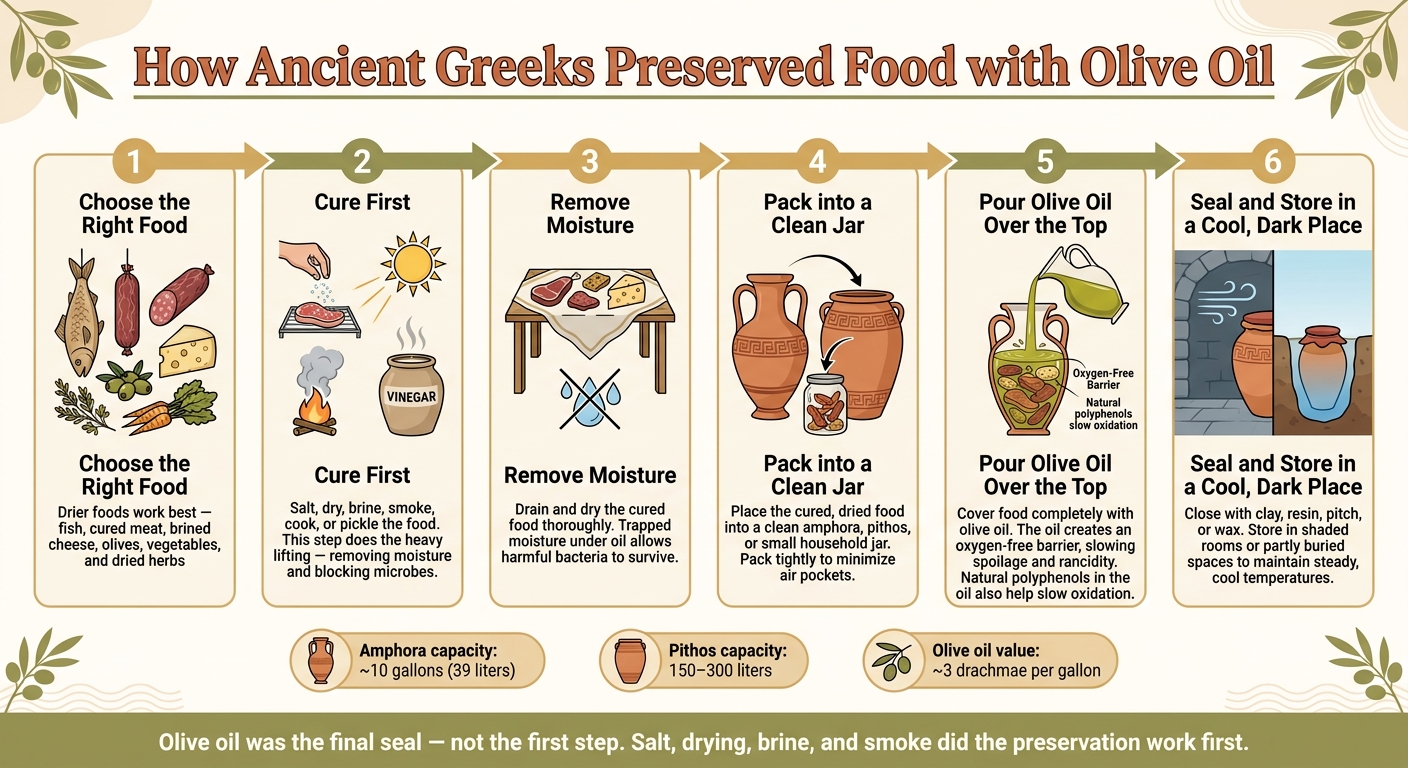
How Ancient Greeks Preserved Food with Olive Oil: Step-by-Step Process
The Protective Role of an Oil Seal
Olive oil helped preserve food by shutting out air. If food stayed fully submerged under a solid layer of oil, that layer created a barrier with little to no oxygen at the surface. A lot of spoilage microbes need oxygen to grow, so cutting off that supply slowed spoilage and helped limit rancidity.
Olive oil also contained natural antioxidant compounds, including polyphenols and tocopherols. These helped slow rancidity in the oil itself and in the foods stored under it. That made olive oil a good final layer for foods like meats, cheeses, and vegetables that had already been cured in some other way.
Common Preparation Steps Before Storage
The oil seal usually came at the end, not at the start. Food was first dried, salted, or brined. After that, it was drained well, packed into a clean, dry jar, and then covered with oil.
Moisture was the big problem. If water got trapped under the oil, harmful bacteria could still survive. That’s why ancient Greeks dried fish, meat, and herbs in the sun or in airy spaces before curing them. Dryness gave the food a better shot at lasting longer. Once the jar was sealed, the next issue was simple: which foods were suited to storage under oil?
Why Olive Oil Was Usually Combined With Other Methods
Olive oil worked as a seal, not as a full preservation method on its own. Salt and drying cut down the moisture that microbes need, which made spoilage much harder, especially in fish and meat. Brine and dark balsamic vinegar added salt and acid, which held back pathogens in olives, cheeses, and vegetables. Honey worked differently. Its high sugar content and low available moisture kept microbes from growing.
So what did the oil do? It protected the surface from air and slowed more oxidation after the main preservation step was already done. In plain terms, salt, brine, vinegar, or drying did the heavy lifting. Olive oil finished the job by sealing the food off. That basic idea shaped which foods ancient Greeks chose to store under oil.
Comparison Table: Olive Oil, Salting, Brining, and Honey
| Method | Main Mechanism | Typical Foods | Key Strength | How Olive Oil Worked Alongside It |
|---|---|---|---|---|
| Olive oil | Oxygen-free barrier; reduces air exposure and rancidity | Cured fish, cheeses, olives, vegetables, herbs | Helps protect texture and flavor; slows rancidity in already-preserved foods | Applied as a final seal over salted, dried, brined, or pickled foods |
| Salting | Draws out moisture via osmosis; creates a high-salt environment hostile to microbes | Meat, fish, olives, some vegetables | Very effective for long-distance transport and long storage of animal proteins | Salted foods could later be packed under oil to limit oxidation and more contamination |
| Brining | Immerses food in salt solution; cures and limits microbial growth | Olives, cheeses, fish, vegetables | Preserves food while keeping it pleasant to eat; works for many foods | Brined foods were drained, then covered with oil for extra protection and flavor |
| Honey | High sugar content and little available moisture prevent microbial growth | Fruits, sweets, cooked meats | Works well for fruits and confections; adds sweetness and a distinct flavor | Usually stored separately from oil |
These differences shaped which foods Greeks kept under oil.
Foods Ancient Greeks Preserved in Olive Oil
Ancient Greeks didn't use olive oil as the first line of food storage. They used it after a food had already been cured with salt, drying, brine, smoke, or heat. In that setup, olive oil worked as the final seal.
Fish, Meat, and Salt-Cured Foods
Fish was one of the most common foods stored this way. It was first heavily salted and sun-dried, then packed into jars and covered with olive oil. That oil layer blocked air and slowed oxidation. It also made fish easier to move inland and helped it last longer during travel or trade.
Meat followed much the same pattern. It was salted, dried, smoked, or cured in vinegar or wine before oil was added as a surface seal. The main preservation work came from the salt, drying, and smoking. The oil came in afterward to keep air off the surface.
The same basic idea also applied to dairy, olives, and herbs.
Cheese, Olives, Vegetables, and Herbs
This method extended to both dairy and produce. Firm or brined cheeses were washed in brine or vinegar, then covered with or fully submerged in olive oil. The oil helped cut down mold and oxidation while protecting texture and flavor.
Olives also went through several steps before oil was used. Bitter olives were soaked in brine, sometimes rinsed in vinegar, and then stored in olive oil as the last step. The oil finished the process and improved flavor.
Vegetables were blanched, cooked, or pickled first, then stored under oil with aromatic herbs. Herbs such as oregano, thyme, dill, and basil were dried first and stored under oil to preserve aroma. In the process, they also created a flavored oil.
Which Foods Worked Best With This Method
Drier foods worked best. Dried fish, cured meats, hard or brined cheeses, fully cured olives, and blanched or cooked vegetables all had less moisture before oil was added. That meant bacteria and molds had already been slowed down. The oil seal then added a second layer of protection by limiting oxygen at the surface.
Fresh, high-moisture foods were a poor fit. Oil by itself did not make them safe to store. Ancient practice relied on a combined method: cure first with salt, drying, brine, or cooking; seal with oil second.
Food-by-Food Storage Summary Table
The table below sums up the best preservation pairings.
| Food | Pre-Treatment | Oil Use |
|---|---|---|
| Fish | Salted, sun-dried, or smoked | Poured over cured fish in jars as a sealing layer |
| Meat | Salted, dried, smoked, or cured in vinegar or wine | Applied as a surface seal after curing |
| Cheese | Brined or washed in vinegar | Covered or fully submerged in oil |
| Olives | Brined, lye-treated, or soaked in vinegar | Used as a finishing storage medium |
| Vegetables | Blanched, cooked, or pickled | Stored in oil with herbs |
| Herbs | Dried or chopped | Used as an infusion medium to preserve aromas |
Storage Vessels and Conditions in Ancient Greek Households
Once food was cured and covered with oil, the next big factor was where it went. The vessel and storage spot did a lot of the heavy lifting. They protected the oil layer by keeping out air, heat, and dirt. Ancient Greek households leaned on three main vessel types, and each had its own job.
Amphorae, Pithoi, and Smaller Household Jars
Amphorae were tall jars with two handles and narrow necks. That shape made them easier to seal, which helped with both storage and transport. A standard Attic amphora held about 10 gallons (39 liters).
Pithoi were much larger, fixed storage jars used for bulk reserves. Pithoi for olive oil could hold about 150–300 liters. In many cases, a pithos stayed in one place or was partly sunk into the floor so it wouldn’t tip or shift.
Smaller ceramic jars sat between those two options. They held modest, day-to-day amounts and were usually kept near the kitchen or pantry.
Still, the shape of the jar only solved part of the problem. If the seal failed, the food was at risk.
Sealing Methods and Cool Storage Practices
Ancient Greek households used clay stoppers, resin, pitch, or wax to close jar openings and cut down airflow. A tight seal helped block insects, dust, and oxygen. That’s one reason narrow-necked vessels like amphorae worked so well: they were simply easier to close tightly.
Placement mattered too. Jars kept in shaded rooms or partly buried spaces stayed at steadier temperatures. That wasn’t a small detail. Heat and direct sunlight can ruin oil fast, so cooler, darker spots helped the oil last longer and protected the food stored under it.
How Vessel Size Affected Daily Use
Households also had to think about how fast the food would be used. A pithos could hold a big reserve, but every opening let in air and warmth and increased the chance of contamination. Smaller jars lowered that risk because they were easier to open, reseal, and empty in a short time.
So families often split storage into two parts: a bulk supply in a large vessel and smaller portions for daily use. It was a simple, practical way to limit spoilage.
Vessel Comparison Table: Which Container Suited Which Use
| Container | Typical Use | Approximate Capacity | Sealing/Storage Features | Best For |
|---|---|---|---|---|
| Amphora | Transport and storage of liquids | About 10 gallons (39 liters) | Narrow neck; easier to seal; portable | Transporting preserved foods |
| Pithos | Bulk household storage | About 150–300 liters | Often stationary; may be partly buried; sealable | Long-term bulk storage of oil, olives, fish, grain |
| Smaller household jar | Daily access and short-term storage | Small daily-use amounts | Easier to open and reseal frequently | Frequent use; short-term storage of portioned foods |
Why Olive Oil Preservation Mattered in Greek Culture and Economy
Daily Life, Trade, and Seasonal Food Security
Olive oil preservation helped Greek households make seasonal food last. People used it to keep fish, cheese, olives, and vegetables edible through winter and in the gap between harvests. That mattered for one simple reason: food supplies could turn shaky fast. Good storage helped families hold steady during poor weather, weak harvests, and supply disruptions.
This same system also mattered beyond the home. Preserved foods packed in olive oil worked well as rations for sailors and soldiers. Ship owners and commanders could count on them as steady provisions when crews were far from port.
Olive Oil as Both Food and Currency
Preservation was more than a kitchen habit. It also helped protect olive oil's place in the Greek economy.
Olive oil was a daily staple, but it was also a high-value trade good. Farmers used part of it at home and stored extra in amphorae for sale or barter. In that sense, a jar of oil wasn't just food on the shelf. It was also something close to stored value. Some records put olive oil at about 3 drachmae per gallon, which was a meaningful part of a skilled worker's daily pay.
Key Takeaways
Put together, these uses made olive oil both a household tool and a trade asset. Its main role was as part of a larger preservation system that helped families get through lean periods, supported regional trade, and acted as a form of stored wealth. It also helped feed fleets and armies. Greeks treated good oil as something worth preserving, storing, and trading.
FAQs
Why wasn’t olive oil used alone?
In ancient Greece, olive oil usually wasn't used on its own to preserve food. It worked best as one part of a broader setup.
Its main job was simple: it formed a barrier against oxygen. That helped slow spoilage caused by aerobic bacteria and mold.
People often paired olive oil with vinegar, salt, or nitre to make the food safer and improve the taste. For example, a 2:1 mix of oil to vinegar could help acidify the food and do a better job of holding back harmful microorganisms.
How did Greeks keep food safe under oil?
Ancient Greeks preserved foods like cheese and vegetables by submerging them in olive oil. The oil formed a natural barrier that blocked oxygen, kept out air, and helped slow spoilage.
They often used this method alongside salting or pickling to keep food in good condition and safe to eat. In some cases, they also added herbs for flavor while helping seasonal produce last longer.
Which foods lasted best in olive oil?
In ancient Greece, the foods that held up best in olive oil had one thing in common: they were firm and low in moisture. That included vegetables like artichokes, eggplant, zucchini, bell peppers, carrots, beets, and green beans.
Salted fish such as tuna, sardines, and anchovies also kept well in oil. Fresh cheeses were submerged too, which helped preserve their texture and slow mold growth.