

Chlorophyll and Carotenoids: Olive Oil Standards
Here’s the short answer: olive oil color does not set IOC grade. I’d look at pigments as lab clues, not pass-or-fail rules.
If you want the main points fast, here they are:
- The IOC does not set fixed chlorophyll or carotenoid limits for extra virgin olive oil.
- Green oil is not automatically better. Tasters even use blue glasses so color does not affect scoring.
- K232, K270, and ΔK are the main IOC UV checks for oxidation and refining.
- Chlorophyll helps make oil look green, but under light it can speed oxidation.
- Carotenoids push color toward yellow and help slow some light damage.
- Pheophytins and pyropheophytins (PPP) can point to aging, heat exposure, or refined oil in a blend.
- Storage matters a lot: in one 2021 study, green glass samples lost 96% of phenols after 300 days, while foil-coated paperboard lost 25% under the same light conditions.
So if I were judging olive oil by the bottle, I would not trust color alone. Pigments can tell part of the story, but labs need to pair them with UV tests, storage history, and marker compounds like PPP and copper.
| Check | What it helps show | IOC pass-fail limit? |
|---|---|---|
| Chlorophylls | Green color, light sensitivity | No |
| Carotenoids | Yellow tones, some oxidation protection | No |
| K232 | Early oxidation | Yes, used by IOC |
| K270 / ΔK | Later oxidation, refining signs | Yes, used by IOC |
| PPP | Aging or heat exposure | No, research marker |
| Copper test | Added copper-based green colorant | No, support test |
That’s the core idea: pigments help explain color, storage damage, and possible tampering, but they sit outside IOC grading rules.
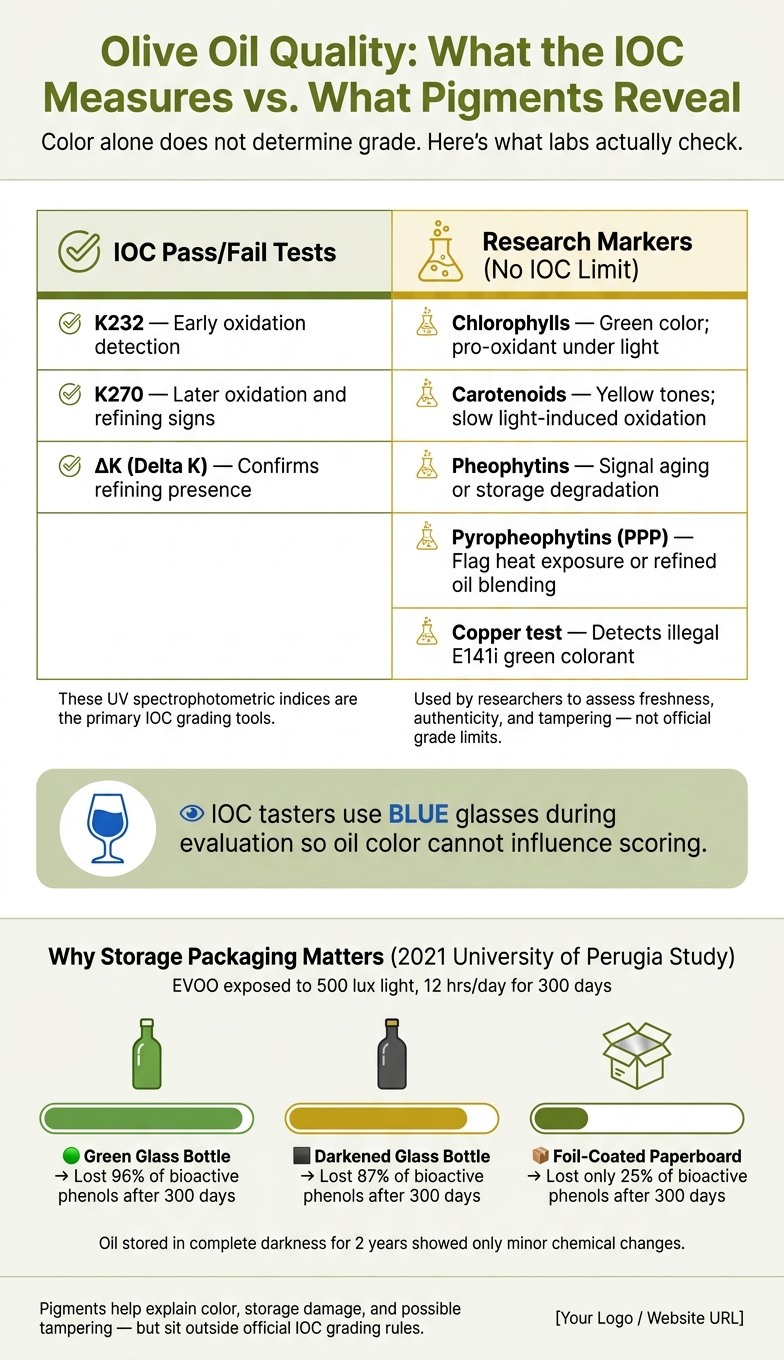
Olive Oil Quality Checks: IOC Standards vs. Pigment Markers Explained
IOC Standards and Pigment Markers
The IOC grades olive oil with chemical and UV tests. It does not set official chlorophyll or carotenoid cutoffs. So, in practice, UV indices do most of the heavy lifting for quality control.
IOC UV Indices Used for Quality Control
The main spectrophotometric indices used by the IOC are K232, K270, and ΔK (delta K):
- K232: early oxidation
- K270 and ΔK: later oxidation and refining
These UV indices do not directly measure chlorophyll or carotenoid levels.
Where Pigments Fit Into Standards Discussions
Pigments still matter in research. Why? Because their breakdown products can help show freshness and heat exposure in ways UV numbers alone may miss.
Chlorophyll breaks down into pheophytins and then pyropheophytins (PPP). PPP can help flag heat-exposed or aged oil that still passes UV thresholds. That makes it useful in research, even though it is not an IOC pigment limit.
Researchers use these pigment markers to build freshness and authenticity benchmarks.
sbb-itb-4066b8e
Research-Based Pigment Benchmarks for Authenticity
Use these research values as reference points, not as IOC pass-fail rules. There isn't an IOC pigment cutoff, so researchers look at pigment ratios and overall profiles when they assess authenticity.
Chlorophyll-to-Carotenoid Ratios in Virgin Olive Oil
In virgin olive oil, a chlorophyll-to-carotenoid ratio of about 1 and a carotenoid-to-lutein ratio of about 0.5 are common reference points.
Typical Pigment Ranges Reported in Studies
Published studies report chlorophyll and carotenoid levels in mg/kg ranges that can vary based on cultivar, ripeness, and harvest timing. Early-harvest olives often yield oils with more chlorophyll. As fruit gets riper, the balance tends to shift toward carotenoids, which gives the oil a more golden color.
Some cultivars, including Koroneiki, Verdale, and Bouquettier, are known for producing greener oils even as ripeness changes. That's why color alone can be misleading. The variety matters just as much as harvest stage.
Pigment Fingerprints and Adulteration Detection
Pigment fingerprints matter because virgin olive oil has a natural pigment balance that's hard to mimic in adulterated or heavily processed products. If those ratios drift far outside expected ranges, that can point to blending or processing issues.
Researchers also check pyropheophytin levels to help spot heating events, which may suggest refined, pomace, or heat-damaged oil. There's a simple chemistry reason for this. Natural chlorophyll contains magnesium, while E141i contains copper and stays stable after heating. That makes E141i easier to identify as an added colorant rather than a natural pigment.
In a study of 34 olive varieties in Catalonia, each cultivar showed a distinct color index; deviations can signal mislabeling or blending.
These pigment patterns also change with light and storage, which the next section covers.
How Pigments Change With Freshness, Light, and Storage
These same pigments also affect how fast premium EVOO loses freshness when it sits in light or heat.
The Dual Role of Chlorophyll in Olive Oil
Chlorophyll does more than signal color. In complete darkness, it works as an antioxidant and helps protect olive oil from oxidation. But once light hits it, the story flips. Chlorophyll becomes a strong pro-oxidant and triggers photo-oxidation, the fastest oxidation route in EVOO.
Under light, chlorophyll produces singlet oxygen, a highly reactive form that can tear through aroma and flavor fast. Carotenoids help slow that damage by absorbing singlet oxygen. That’s why the chlorophyll-to-carotenoid balance matters for more than just appearance.
Pheophytins, Pyropheophytins, and Signs of Aging
This is where pigment breakdown starts to tell a deeper story. These compounds don’t just reflect color shifts. They can also point to loss of freshness.
As olive oil gets older, chlorophyll breaks down into pheophytins, pigments formed during storage. With heat exposure or more advanced aging, pyropheophytins may form too.
High pyropheophytin levels are useful in quality control. Researchers use them to spot heating events, including oil exposed to high temperatures during refining or older, poorly stored oil blended into a product. Because refining uses heat, adulterated oils mixed with refined or pomace oil often show higher pyropheophytin concentrations than fresh, properly handled EVOO.
Storage Guidelines for Premium EVOO
Because light speeds up pigment breakdown, packaging and storage matter a lot.
A 2021 study led by Maurizio Servili at the University of Perugia exposed EVOO to 500 lux for 12 hours a day to mimic supermarket conditions. After 300 days, oil stored in green glass bottles had lost 96% of its bioactive phenols, while oil in darkened glass had lost 87%. By 240 days, all glass-bottled samples had dropped below the extra virgin chemical limit.
Multilayer foil-coated paperboard did best because it blocked both light and oxygen. Under the same conditions, those samples lost only 25% of their phenols after 300 days. Oil kept in total darkness for two years showed only minor chemical changes.
For day-to-day storage, keep olive oil in a cool, dark place like a pantry or closed cupboard. Skip spots near windows or stovetops. Opaque packaging, such as tins, bag-in-box containers, or dark-coated bottles, gives more protection than clear or standard green glass. Pigments can help show freshness, but they still sit outside IOC grade limits.
Measuring Pigments and Key Takeaways
Lab Methods for Measuring Chlorophylls and Carotenoids
Once storage starts to shift pigment levels, labs look at color to follow those changes. CIELAB colorimetry gives them a non-destructive way to measure oil color and connect it to pigment balance. It works by measuring reflected light and turning that into standardized color data, including hue, lightness, and chroma. Labs then use that data to classify virgin oils.
Color, though, doesn't tell the whole story. When labs need a closer look, they run targeted chemical tests to check both authenticity and aging. For example:
- Copper testing helps identify E141i, a copper-based colorant linked to illegal greening.
- Pyropheophytin testing can also flag heat exposure and more advanced aging.
Conclusion: What Olive Oil Standards Say About Pigments
Pigments act as research markers, not IOC pass-fail criteria. Labs use them as supporting evidence for authenticity, ripeness, and freshness, helping fill the gap that UV indices alone cannot cover. IOC standards do not include pigments in grade limits, so labs treat them as supporting evidence rather than a pass-fail measure.
FAQs
Why doesn’t the IOC grade olive oil by color?
The IOC does not grade olive oil by color. That’s because color isn’t a dependable sign of quality.
An oil’s appearance mostly comes down to the olive variety and how ripe the olives were when they were picked. It does not tell you much about freshness or chemical integrity.
To avoid visual bias, IOC tasting panels use dark glasses, usually blue, so judges focus only on aroma and flavor.
What can PPP levels reveal about olive oil?
PPP levels show how fresh an olive oil is and how long it may keep its quality. When PPP levels are higher, the oil has usually started to break down. That can happen with age, or when the oil is exposed to heat during processing or storage.
As an objective quality measure, PPP levels below 17% are a common benchmark for fresh, high-quality extra virgin olive oil.
Which packaging best protects olive oil from light?
Use containers that block light to protect Ultra Premium Extra Virgin Olive Oil from photo-oxidation. The best picks are dark glass bottles, ceramic containers, and opaque stainless-steel tins.
If your oil comes in a clear bottle, store it in a dark spot or wrap the bottle with an opaque material like aluminum foil. Clear glass is a bad bet here. Light can damage the oil fast, which means weaker flavor and lower quality.