

How Olive Oil Producers Handle Waste Legally
Olive oil production generates massive waste - solid residues and wastewater - that, if mismanaged, can harm soil, water, and air. Wastewater, often 100 times more polluted than municipal sewage, contains toxic compounds damaging to plants and aquatic life. Solid waste, like olive pomace, is challenging to dry and dispose of due to its high moisture and organic content.
To comply with strict regulations, producers must treat waste properly. Key rules include adhering to the Clean Water Act for wastewater discharge, managing solid waste responsibly, and maintaining detailed records for audits. Solutions like anaerobic digestion, chemical treatments, and waste reuse (e.g., turning by-products into bioenergy or fertilizers) are increasingly common. These practices not only meet legal standards but also reduce pollution and create new uses for waste.
Producers can also implement advanced systems, such as Zero Liquid Discharge (ZLD) for water recovery or gasification for energy production, to align with modern waste management goals. Following these methods ensures compliance while addressing the challenges of olive oil waste effectively.
Olive Oil Production Waste Statistics and Treatment Methods
Olive mill waste (OMW) management
Waste Types in Olive Oil Production
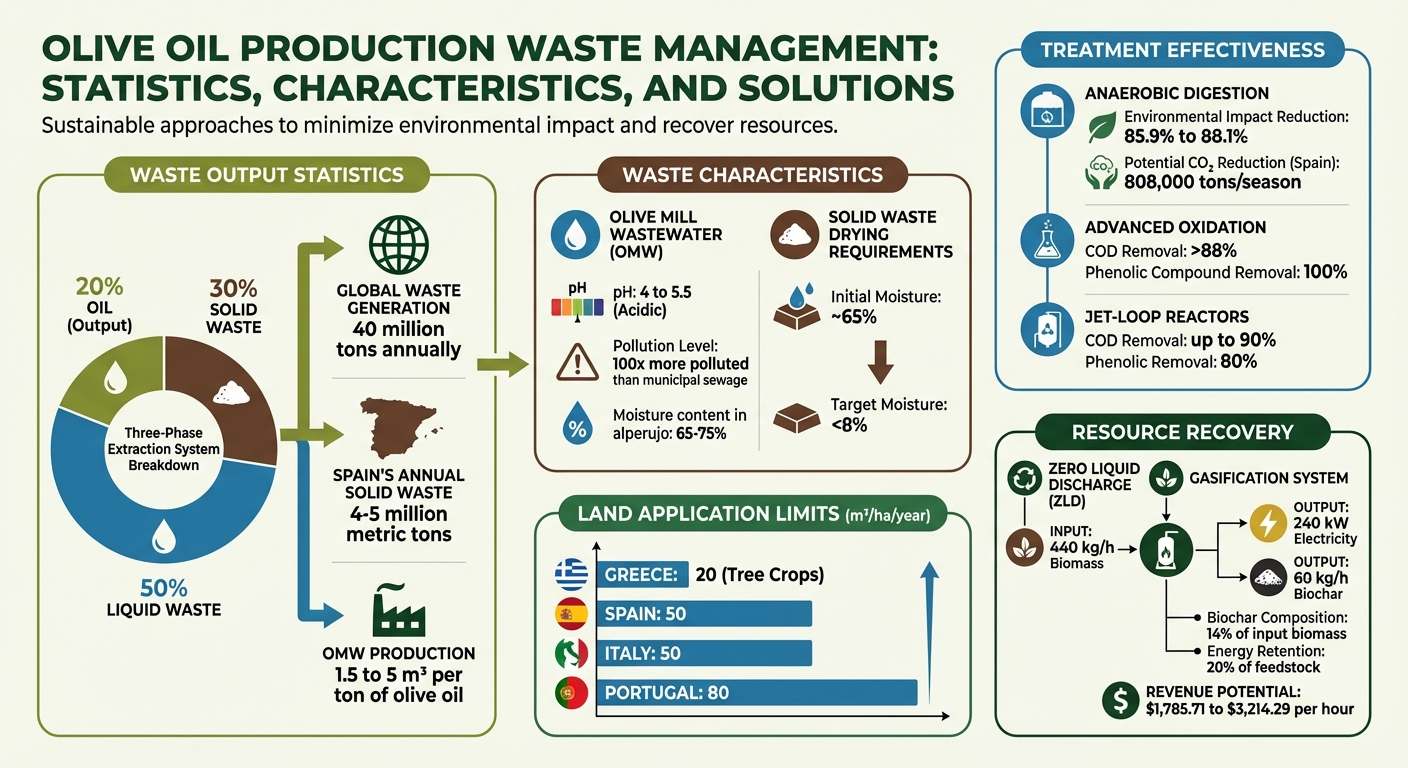
Understanding the different waste types produced during olive oil production is crucial for managing them in ways that comply with environmental regulations. The process generates three primary waste streams: olive mill wastewater, solid waste (such as pomace and husks), and minor cleaning residues. Each type requires specific handling methods to minimize environmental impact. In a typical three-phase extraction system, about 20% of the output is oil, while 30% is solid waste and 50% is liquid waste per production unit.
Olive Mill Wastewater (OMW)
Olive mill wastewater (OMW) is a dark, acidic liquid with a pH ranging from 4 to 5.5. It is packed with organic matter and phytotoxic phenolics.
"OMW poses a serious environmental concern as it is a phytotoxic by-product characterized by high pollution potential related to high content of salts, organic matter, and phenolic compounds."
- Iosif E. Kapellakis, Department of Civil Engineering, Neapolis University Pafos
This waste contains a mix of sugars, acids, pectins, tannins, and lipids. Its high concentration of polyphenols gives it antimicrobial properties, which can interfere with the biological processes used in conventional wastewater treatment plants. In three-phase systems, OMW production ranges from 1.5 to 5 cubic meters per ton of olive oil. On the other hand, two-phase systems cut down on water use by creating a semi-solid "slurry" instead of separating liquid and solid fractions.
While OMW presents unique chemical treatment challenges, managing solid waste involves different energy and logistical concerns.
Solid Waste: Olive Pomace and Husks
The nature of solid waste depends on the extraction method used. Three-phase systems produce a relatively dry by-product called olive cake, which consists of husks and pits left after pressing. In contrast, two-phase systems generate alperujo, a semi-solid waste with a moisture content of 65–75%. The high moisture content significantly increases the weight of the waste and the energy required for drying. For instance, Spain, the largest olive oil producer globally, generates around 4 to 5 million metric tons of solid olive mill waste annually.
Although solid waste is less immediately toxic than OMW, it still poses environmental risks. It is rich in lignin, cellulose, and hemicellulose, and its high levels of phenols, lipids, and organic acids can harm soil ecosystems, disrupt aquatic environments, and contaminate groundwater if not handled properly. Additionally, drying the pomace - reducing its moisture from approximately 65% to below 8% - is one of the most energy-intensive steps in its management.
Understanding these waste streams and their characteristics is essential for ensuring compliance with environmental regulations and minimizing the ecological footprint of olive oil production.
Legal Requirements for Olive Oil Waste Management
Olive oil producers in the United States must follow federal and state laws aimed at safeguarding water, soil, and air quality. The Clean Water Act (CWA), for instance, prohibits the discharge of pollutants into U.S. waters without a National Pollutant Discharge Elimination System (NPDES) permit, as outlined in Section 402. This means olive oil producers must treat and obtain authorization for olive mill wastewater before releasing it into any water body.
Additionally, under 40 CFR Part 112, producers handling large quantities of vegetable oils are required to create and maintain Spill Prevention, Control, and Countermeasure (SPCC) plans to address potential spills. The Resource Conservation and Recovery Act (RCRA), as described in 40 CFR Part 257, prohibits disposal methods that qualify as "open dumping". However, there’s an important exception: agricultural wastes, like crop residues used as fertilizers or soil conditioners, are not subject to these stringent solid waste regulations.
"The criteria [for solid waste disposal] do not apply to agricultural wastes, including manures and crop residues, returned to the soil as fertilizers or soil conditioners." - 40 CFR Part 257
These federal guidelines form the foundation for industry-specific regulations, including those for olive mill wastewater and solid waste.
Regulations for Olive Mill Wastewater
Olive mill wastewater is known for its high levels of chemical oxygen demand (COD), biochemical oxygen demand (BOD), and toxic phenolics. Regulations are in place to protect groundwater by prohibiting contamination beyond facility boundaries. States may adjust these boundaries based on local geological conditions and public health needs. Traditional disposal methods, like open lagoons, are increasingly criticized due to their risks, including groundwater pollution and greenhouse gas emissions. States also tackle non-point source pollution through water quality management plans approved under Section 208 of the Clean Water Act.
In addition to wastewater, the management of solid by-products comes with its own set of legal requirements.
Rules for Solid Waste Handling
Solid waste from olive oil production, such as pomace and husks, must adhere to regional disposal and treatment regulations. In some Mediterranean countries, controlled application of these wastes to agricultural land is allowed under strict volume limits. For instance, Greece permits up to 20 cubic meters per hectare per year for tree crops, while Spain and Italy allow up to 50 cubic meters per hectare per year.
To meet environmental standards, many producers turn to energy recovery methods like gasification, pyrolysis, or direct combustion. Olive stones, for example, are often repurposed as renewable fuel alternatives for industrial boilers or public heating systems. Pretreatment of waste is also a common requirement. For instance, in Greece, regulations mandate that olive mill wastewater undergoes at least three hours of sedimentation and neutralization using 5 kilograms of CaO per ton of fruit processed before disposal.
These practices not only ensure compliance with environmental laws but also offer opportunities for sustainable waste management.
sbb-itb-4066b8e
Waste Treatment Technologies and Methods
Managing waste effectively requires advanced treatment methods to meet discharge standards and adhere to environmental regulations. Choosing the right technology for each type of waste not only reduces pollution but also opens up opportunities to recover useful resources.
Biological and Chemical Treatment Methods
Anaerobic digestion is a process that transforms organic-rich waste into methane biogas while producing a stabilized by-product called digestate. However, high phenolic content can hinder methane production. To address this, producers often mix the waste with nitrogen-rich materials like animal manure. Studies show that anaerobic digestion can lower the environmental impact by 85.9% to 88.1% when compared to traditional pomace oil extraction methods.
Advanced oxidation processes, such as solar photo-Fenton and Fenton-like reactions combined with nanofiltration, are highly effective for breaking down stubborn pollutants. These methods have achieved over 88% COD (chemical oxygen demand) removal and eliminated toxic phenolic compounds in wastewater that’s too contaminated for typical biological treatments.
Jet-loop reactors paired with membrane bioreactors offer another solution, removing up to 90% of COD and 80% of phenolic compounds. These aerobic systems work faster than anaerobic digestion but often require wastewater dilution to minimize bacterial toxicity. To protect equipment from fouling, coagulation-flocculation is typically the first step, removing suspended solids before further treatment.
While wastewater treatment is crucial, repurposing solid waste into energy and valuable materials presents additional opportunities.
Reusing Solid Waste
Solid waste reuse complements wastewater treatment by converting by-products into energy and other useful resources. For instance, gasification converts dried pomace into electricity and biochar using Organic Rankine Cycle turbines. Biochar, which makes up about 14% of the input biomass by weight, retains roughly 20% of the feedstock's energy content, adding economic value to the process.
Anaerobic digestion can also handle solid waste effectively. When pomace is co-digested with nitrogen-rich materials, it optimizes biogas production, which can be used for heat or electricity. In Spain, using this approach for olive mill solid waste could reduce CO₂ emissions by an estimated 808,000 tons per season. However, the resulting digestate cannot be applied directly to land due to regulatory restrictions. It must first be stabilized through composting to ensure compliance with environmental standards.
Documentation and Certification in Waste Management
Tracking Waste and Keeping Records
After waste treatment, maintaining detailed records is essential for staying compliant with regulations. Olive oil producers are required to document every aspect of their operations. This includes recording each type of waste handled - whether it’s received, treated, stored, or disposed of. The records should specify the waste's common name, its EPA Hazardous Waste Number, and its physical form (liquid, sludge, solid, or contained gas). Quantities must be noted using appropriate units like gallons, tons, kilograms, or cubic meters.
Producers also need to include EPA handling codes for the treatment methods they use. For instance, composting is identified as T71, spray irrigation as T73, and waste stabilization ponds as T76. If waste is shipped off-site, it must be tracked using the Hazardous Waste Manifest (EPA Form 8700-22) or the electronic e-Manifest system. For those using solvent extraction, it’s crucial to keep a detailed log of the solvent inventory, including amounts received, purchased, and recovered, as well as the Hazardous Air Pollutant (HAP) content and the quantities of oilseed processed. Any regulatory deviations - such as their frequency, duration, causes, and corrective actions - must also be recorded. These meticulous records are the foundation for compliance audits and certifications.
Certifications and Compliance Audits
Thorough record-keeping plays a critical role in certifications and audits. Producers aiming for USDA Organic Certification must adhere to the National Organic Program requirements. This involves keeping records for at least five years and submitting an annual Organic System Plan that outlines waste management practices. Certifying agents conduct on-site inspections and are required to perform unannounced inspections on at least 5% of certified operations each year. These audits often include mass-balance checks to ensure that the quantities of products produced or purchased align with those used, stored, sold, or transported.
For producers whose waste oils contribute to renewable fuel production, participation in an approved Quality Assurance Plan (QAP) is necessary. This requires independent third-party auditors to conduct site visits every 380 days. Additionally, regulatory bodies like the EPA perform compliance evaluations by reviewing on-site records, data, and reports. Auditors use metrics such as solvent loss, HAP volume fractions, and oilseed quantities processed to calculate the compliance ratio. All documentation must remain accessible and on-site for the entire operational life of the facility.
Conclusion: Meeting Regulations While Protecting the Environment
Key Takeaways for Producers
Producers in the olive oil industry face strict regulations when it comes to waste management. For example, land application limits vary significantly, from 20 m³/ha/year in Greece to 80 m³/ha/year in countries like Portugal and Italy. With global olive oil production generating around 40 million tons of waste annually, managing this waste isn't just a legal obligation - it's a critical step toward protecting the environment.
Shifting from traditional waste disposal to resource recovery is at the heart of recent regulatory efforts. Techniques like anaerobic digestion not only reduce environmental harm but also help offset greenhouse gas emissions. Meanwhile, closed-loop systems, where wastewater is returned to orchards, enrich soil nutrients while ensuring compliance with environmental laws. These approaches highlight how regulatory mandates are driving both environmental responsibility and technological progress.
Advances in Waste Management
Emerging technologies are paving the way for smarter waste management solutions. Take Zero Liquid Discharge (ZLD) systems, for instance. These systems recover up to 95% of water from olive mill wastewater through thermal evaporation, making the reclaimed water suitable for agricultural use in areas prone to drought. Another example is a pilot-scale gasification system capable of processing 440 kg/h (970 lb/h) of biomass to produce 240 kW of electricity and 60 kg/h (132 lb/h) of biochar. These innovations not only reduce waste but also create new opportunities for energy production and economic growth.
Recent research supports this shift toward sustainability:
"This research presents a viable, circular economy-oriented model for the olive oil industry in terms of sustainable waste valorization, water recovery, and renewable energy production." - Nature Scientific Reports
Transforming solid waste into valuable products is another promising avenue. For instance, biochar produced through gasification can be converted into briquettes or hookah charcoal, generating impressive revenues of $1,785.71 to $3,214.29 per hour. These advancements demonstrate how compliance with waste regulations can evolve from being a financial burden to a strategic opportunity, offering both operational improvements and significant financial benefits. By embracing these technologies, producers can align with environmental goals while driving sustainable growth in the industry.
FAQs
What are the environmental challenges caused by olive oil production waste?
Olive oil production leaves behind a considerable amount of waste, both liquid and solid, which can pose environmental risks if not handled properly. Olive mill wastewater (OMWW), for instance, is rich in organic compounds, phenols, and acids. When this waste enters water systems, it can harm aquatic life, pollute water sources, and even contaminate soil. Its low pH and high oxygen demand make it particularly tough to manage.
On the solid side, byproducts like olive husks and pomace make up about 30% of the olives processed. If left untreated, they can lead to problems like bad odors, methane emissions, and soil degradation. To combat these issues, olive oil producers, including Big Horn Olive Oil, use regulated waste management methods such as bioremediation and anaerobic digestion. These approaches not only safeguard water and soil health but also help maintain biodiversity while meeting U.S. environmental regulations.
How do olive oil producers manage waste while following regulations?
Olive oil producers take waste management seriously, adhering to strict laws to handle byproducts responsibly. They follow EPA standards to classify waste and use methods like bioremediation, membrane filtration, and advanced oxidation to treat or recycle materials effectively. These approaches ensure compliance with both federal and state regulations.
By integrating thoughtful waste management practices, producers not only meet legal requirements but also minimize their environmental footprint, promoting a cleaner and more responsible production process.
What are the latest methods for managing olive oil production waste sustainably?
Innovative approaches are reshaping how olive oil waste is managed, with a strong emphasis on reducing waste and reclaiming valuable resources. One standout method is anaerobic digestion, which converts organic waste into biogas - a renewable energy source. This not only cuts down on waste but also minimizes its environmental footprint. Plus, the process leaves behind nutrient-rich byproducts that can be repurposed as organic fertilizer.
Another game-changer is membrane filtration technologies, including nanofiltration (NF) and reverse osmosis (RO). These systems treat wastewater, yielding clean water that can be reused for irrigation or industrial purposes. At the same time, they concentrate nutrients that can be utilized in fertilizer production. Advanced oxidation processes (AOPs) take things a step further by breaking down harmful pollutants while preserving valuable compounds like polyphenols, which can be incorporated into other products.
For high-end producers like Big Horn Olive Oil, adopting these technologies not only ensures compliance with U.S. environmental regulations but also lowers operational costs through energy recovery. Additionally, it creates marketable byproducts, turning what was once waste into a resource that supports a more sustainable and profitable business model.