

Electrocoagulation of Olive Mill Wastewater
Electrocoagulation can reduce solids, oil, color, phenols, and part of the organic load in olive mill wastewater - but it does not guarantee water is ready for reuse or discharge. Pilot testing should cover early-, mid-, and late-harvest wastewater to set treatment targets and identify any further treatment needed.
The process uses electricity and iron or aluminum plates to form clumps that separate pollutants from water. One laboratory study reported 76% COD, 91% polyphenol, and 95% color removal in 25 minutes; those results are not full-scale guarantees.
A mill’s treatment plan should cover:
- Water testing: Measure pollutant loads, pH, and salinity against the intended use and applicable requirements.
- Equipment and safety: Plan screening, flow balancing, electrode care, solids separation, and ventilation for flammable hydrogen.
- Sludge and costs: Include testing, electricity, replacement plates, chemicals, further treatment, and sludge disposal - not just the reactor.
How Electrocoagulation Works in Industrial Wastewater Treatment: A Technical Breakdown
sbb-itb-4066b8e
Wastewater Sources and Seasonal Changes
Wastewater comes from olive washing, extraction, and equipment or floor cleaning. Crushing, malaxation, and centrifugation also release process water, so the mill’s wastewater load reflects the entire extraction line.
| Feature | Two-phase extraction | Three-phase extraction |
|---|---|---|
| Water input | Usually little or no process dilution water | Added dilution water during separation |
| Wastewater volume | Generally less separately discharged liquid wastewater, which can be concentrated and hard to biodegrade | Typically more liquid wastewater discharged as a separate aqueous phase |
| Solids and phenols | Measure actual concentrations to establish treatment loads | Measure actual concentrations; dilution does not guarantee compliance |
| pH and conductivity | Measure to guide reactor settings and check suitability for the intended end use | Measure to guide reactor settings and check suitability for the intended end use |
These are tendencies, not fixed rules. Cultivar, fruit maturity, equipment, water use, and harvest conditions all affect wastewater volume and strength. Electrocoagulation settings therefore need to match the actual wastewater, not an assumed composition.
Sample representative days at the start, middle, and end of harvest. Record the amount of olives processed, wastewater flow, added water, cleaning events, and storage time. Use concentration and flow measurements to calculate pollutant loads.
Pollutants, Tests, and Treatment Targets
Oxygen demand describes how much oxygen wastewater can consume. COD and BOD₅ measure different things: COD measures chemically oxidizable material, while BOD₅ measures microbial oxygen use over five days. They are not interchangeable.
Phytotoxicity means harm to plants or seeds. Turbidity is cloudiness caused by particles, and acidity means a pH below neutral. Dissolved salts are ions that remain in solution and contribute to conductivity.
| Parameter | Lab method | Unit | Treatment goal |
|---|---|---|---|
| COD | Dichromate digestion with colorimetric or titrimetric analysis | mg/L as O₂ | Meet discharge or downstream-treatment requirements |
| BOD₅ | Five-day incubation with dissolved-oxygen measurement | mg/L as O₂ | Meet discharge limits or protect receiving-water oxygen |
| Suspended solids | Filtration and gravimetric weighing | mg/L | Protect pumps, membranes, and reuse equipment |
| Oil and grease | Solvent extraction or infrared method, depending on the laboratory | mg/L | Prevent surface films, fouling, and aquatic impacts |
| Phenols | Colorimetric assay or chromatographic analysis | mg/L | Lower toxicity and improve compatibility with biological treatment |
| Color | Spectrophotometry or standardized color method | Pt-Co units or absorbance | Assess polishing needs |
| pH | Calibrated pH meter | No unit | Stay within receiving-system, reuse, or process limits |
| Conductivity | Conductivity meter with temperature compensation | µS/cm or mS/cm | Assess salinity constraints for the intended end use |
Ask the lab to report its methods, especially for phenols and color, so you can compare treated and untreated results. Measure flow and temperature, too. Add alkalinity, total dissolved solids, nutrients, and reuse-specific tests where needed. Follow the lab’s preservation instructions: settling, fermentation, oxidation, and microbial activity can change stored samples.
Set target concentrations by the intended end use - not a fixed removal percentage. Sewer discharge, surface-water discharge, irrigation, and internal reuse each have different requirements. Clear water can still contain dissolved organic matter, phenols, salts, and residual oil. Conductivity matters especially when salt-sensitive crops or biological treatment are involved. Compare results with the permit or reuse standard rather than judging by appearance. Even a high removal rate can leave concentrations above regulatory or process limits.
These measurements guide electrode choice, current, mixing, and residence time - the settings used to tune the reactor in the next step.
How Electrocoagulation Works
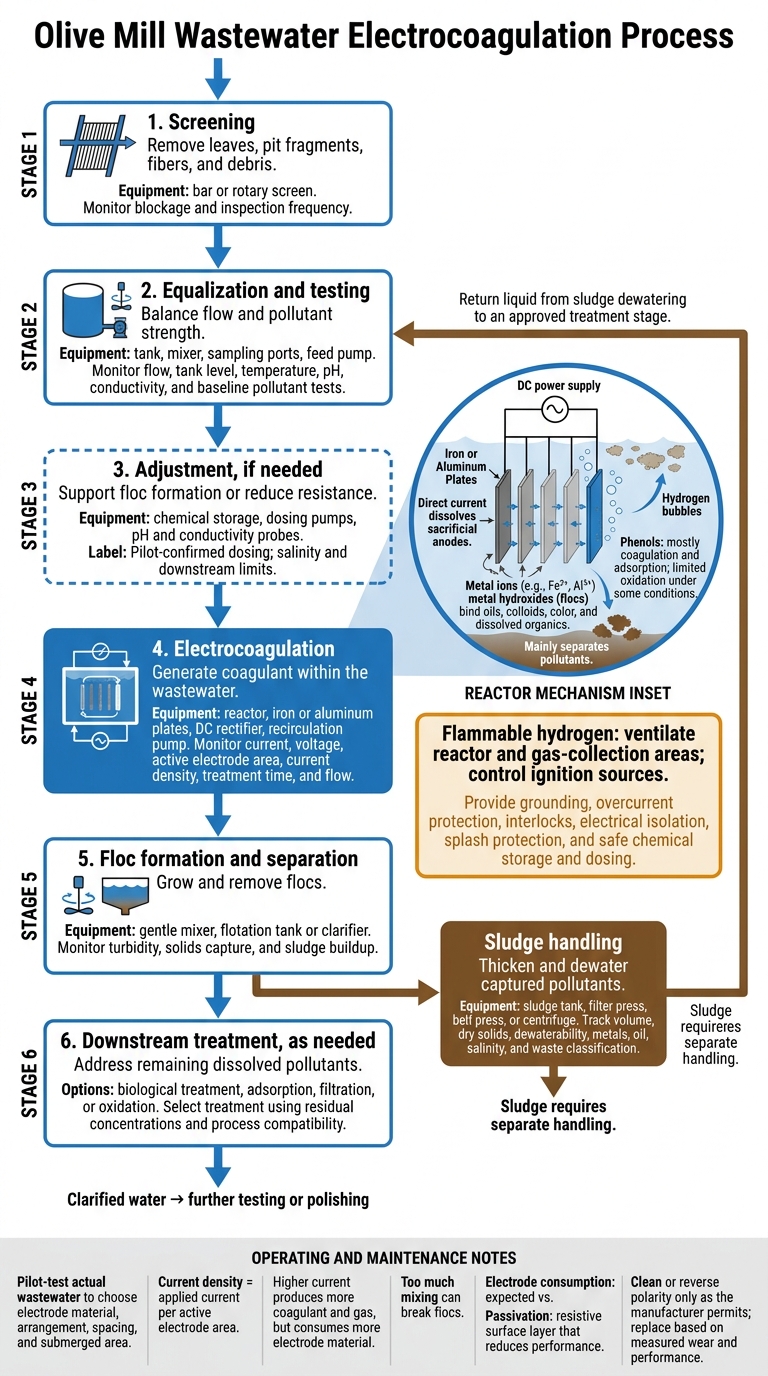
Olive Mill Wastewater Electrocoagulation Process
How Electrodes Form Flocs
Once pollutant targets are set, reactor settings determine how much electrocoagulation can remove. Direct current dissolves sacrificial iron or aluminum anodes, producing hydroxides that bind oils, colloids, color, and some dissolved organics into flocs. Hydrogen bubbles can carry flocs to the surface, while heavier flocs settle.
Electrocoagulation mainly separates pollutants. It removes phenols mostly through coagulation and adsorption, with limited oxidation under some conditions.
Treatment Steps and Equipment
In an olive mill, electrocoagulation treats extraction wastewater after screening and equalization, but before polishing, reuse, or discharge.
Batch systems treat a set tank volume before separation and can suit small, seasonal mills. Continuous systems require steady feed control and a verified hydraulic residence time. Both need equalization to buffer harvest-season surges.
| Stage | Purpose | Typical equipment | Operating measurements or decisions |
|---|---|---|---|
| Screening | Remove leaves, pit fragments, fibers, and debris | Bar or rotary screen | Blockage and inspection frequency |
| Equalization and testing | Balance flow and pollutant strength | Tank, mixer, sampling ports, feed pump | Flow, tank level, temperature, pH, conductivity, baseline pollutant tests |
| Adjustment, if needed | Support floc formation or reduce resistance | Chemical storage, dosing pumps, pH and conductivity probes | Pilot-confirmed dosing; salinity and downstream limits |
| Electrocoagulation | Generate coagulant within the wastewater | Reactor, iron or aluminum plates, DC rectifier, recirculation pump | Current, voltage, active electrode area, current density, treatment time, flow |
| Floc formation and separation | Grow and remove flocs | Gentle mixer, flotation tank or clarifier | Turbidity, solids capture, sludge buildup |
| Downstream treatment | Address remaining dissolved pollutants | Biological treatment, adsorption, filtration, or oxidation equipment | Residual concentrations and process compatibility |
| Sludge handling | Thicken and dewater captured pollutants | Sludge tank, filter press, belt press, or centrifuge | Volume, dry solids, dewaterability, metals, oil, salinity, waste classification |
The process produces clarified water for further testing or polishing, plus sludge that needs separate handling. Return liquid from sludge dewatering to an approved treatment stage.
The reactor generates flammable hydrogen, so safety controls belong in the system design. Ventilate reactor and gas-collection areas and control ignition sources. Provide grounding, overcurrent protection, interlocks, electrical isolation, splash protection, and safe chemical storage and dosing.
Once the reactor is installed, current density, pH, conductivity, and mixing affect both treatment performance and electrode wear.
Operating Settings and Electrode Care
Run pilot tests with the actual wastewater to choose electrode material, arrangement, spacing, and submerged area. These choices affect current distribution and metal release.
Current density is the applied current per active electrode area. Higher current produces more coagulant and gas, but it also consumes more electrode material. Voltage reflects reactor resistance. Treatment time, flow, pH, conductivity, mixing, and temperature also affect performance. Too much mixing can break flocs.
Record flow in gallons per day with m³/day equivalents, energy in kWh/m³, and temperature in °F with °C equivalents. Add pH-control chemicals or conductivity salts only when testing supports their use. Salts increase salinity, and chloride can create unwanted byproducts.
Track electrode mass or thickness, spacing, deposits, runtime, current, and voltage. Sacrificial electrodes are meant to be consumed. Passivation, by contrast, is a resistive surface layer that reduces performance.
Inspect electrodes for oil, scale, sludge deposits, and warping. Use mechanical cleaning, chemical cleaning, or controlled polarity reversal only as the reactor manufacturer permits. Keep submerged area and spacing consistent, prevent short circuits, and replace electrodes based on measured wear and performance - not calendar time alone.
Treatment Results, Sludge, and Costs
Once reactor settings are fixed, check what the process removes, what remains, and how much treatment costs.
Pollutant Removal and Its Limits
Judge electrocoagulation by final effluent quality, sludge output, and total cost - not removal percentage alone. The treated water’s quality determines whether it needs polishing or meets reuse or discharge requirements.
| Pollutant or indicator | Main removal mechanism | Limits and remaining treatment needs |
|---|---|---|
| Suspended solids and turbidity | Trapping in flocs, followed by settling or flotation | Measure remaining solids and turbidity to determine whether filtration is needed. |
| Color | Pigments and phenolic compounds attach to flocs | Clearer water does not prove lower toxicity. Test whether adsorption or oxidation is needed. |
| Oil and grease | Trapping in flocs and removal by flotation | Test residual oil and grease, including stable emulsions, before choosing polishing treatment. |
| Phenols | Adsorption onto metal hydroxides; added oxidation in combined systems | Test residual phenols and toxicity. Phenols may stay dissolved or concentrate in sludge. |
| COD and BOD₅ | Separation of particulate and adsorbed organic matter | Measure COD, BOD₅, and BOD₅/COD before and after treatment to assess downstream biological treatment. Adsorption or oxidation may still be needed. |
A lab aluminum-electrode study reported approximately 76% COD, 91% polyphenol, and 95% color removal in 25 minutes at pH 4–6 - laboratory findings, not full-scale guarantees. A continuous pilot reported 96% COD and 93.6% BOD₅ removal, but only with diluted wastewater and added oxidants and salt; treat it as pretreatment data, not electrocoagulation-only performance.
Sludge Handling and Disposal
Removed pollutants don’t disappear. They move into sludge that needs separate handling.
Sludge from extraction and cleaning wastewater contains trapped solids, metal hydroxides, residual oil and organic matter, and potentially concentrated phenols. Thicken, dewater, store, and test it before disposal.
Measure wet volume, dry-solids mass, and cake moisture separately, since sludge yield varies by mill. Test representative solids for moisture, volatile and fixed solids, oil and grease, phenols, COD, pH, salinity, electrode-derived aluminum or iron, and regulated contaminants. Agricultural use requires testing, an agronomic review, and regulatory approval.
Energy, Supplies, and Maintenance Costs
Operating costs depend on the same variables that drive treatment performance: current, treatment time, electrode wear, chemicals, and sludge volume.
Separate installation costs from operating expenses. Installation covers the reactor, power supply, pumps, mixing, clarification or flotation, controls, and sludge handling. Operating expenses include electricity, replacement electrodes, chemicals, cleaning, labor, testing, dewatering, transport, and disposal.
Price the full treatment train, including polishing for dissolved organics and residual metals. Reactor-only pricing understates the total cost.
Build site-specific estimates in $/1,000 gallons and $/m³, backed by measured kWh/m³, electrode consumption, chemical use, and sludge quantities. Account for seasonal load changes, passivation, fouling, uneven electrode wear, and downtime. Request cost ranges rather than one guaranteed price, and distinguish wet-weight disposal charges from dry-solids production.
Using Electrocoagulation at an Olive Mill
Process Placement and Pilot Testing
Place electrocoagulation after screening and equalization, usually before biological treatment or polishing. It mainly removes suspended solids, colloids, color, oil and grease, plus part of the phenolic and COD load.
Test normal- and peak-harvest wastewater separately. Before sending treated water to biological treatment, check its biodegradability and whether residual phenols, metals, salinity, or oxidants could inhibit microbes.
Verifying Water for Reuse or Discharge
Check treated water against the requirements for its intended use. Clear water does not prove that it’s ready for reuse or has been disinfected. Validate internal wash-water reuse separately, especially when water touches olives or food-contact surfaces.
Test for residual organics, phenols, salinity, metals, and pathogens. For irrigation, assess crop tolerance. For internal reuse, check whether the water is compatible with the process.
Non-contact reuse, irrigation, sewer discharge, and surface-water discharge must each meet applicable U.S. federal, state, local, permit, and sewer-authority requirements. Don’t assume one nationwide reuse standard applies.
Key Takeaways for Mills
When buying equipment, require measured treatment targets, pilot-verified effluent quality, downstream safeguards, and an approved sludge route before commissioning.
FAQs
How do I choose between iron and aluminum electrodes?
Choose electrodes based on your treatment goals and operating costs. Iron electrodes work well for reducing total organic carbon (TOC) and turbidity, at an estimated $3.92 per cubic meter. Aluminum often removes chemical oxygen demand (COD) more efficiently, at about $2.88 per cubic meter.
Iron electrodes need frequent cleaning to prevent oxide buildup, which increases energy use. Test your wastewater to find the best fit for your multistage treatment system.
Is electrocoagulation cost-effective for a small olive mill?
Cost-effectiveness comes down to balancing high upfront equipment costs with long-term operating needs. Electrocoagulation provides low-sludge pretreatment for heavy wastewater loads. But the initial cost can put it out of reach for small, seasonal mills, where equipment may sit idle for much of the year.
To make the investment more feasible, some mills consider cooperative models or combine treatment stages. Combining stages may also allow mills to recover compounds such as phenols, helping offset operating costs.
How do I choose treatment after electrocoagulation?
Match the treatment to your goal: water recovery, biogas production, or phenol extraction. Electrocoagulation mainly works as a pretreatment step, so you’ll typically need further processing to meet final quality standards.
Treat remaining dissolved organic matter with oxidation or biological treatment. Then use membrane filtration or adsorption for final polishing. Before putting the system into use, test the effluent against site-specific reuse requirements and obtain any required local regulatory approval.