

Olive Oil Wastewater Treatment: Study Summary
My takeaway: test your mill’s waste, pilot a treatment sequence, and check final water quality before reuse. A high pollutant-removal rate alone does not make water safe for irrigation or cleaning.
Two-phase olive mill waste can make up about 80% of output by weight. Its organic load, phenols, and moisture make treatment difficult. One six-year field trial found 15% higher fruit oil content with treated-waste compost than with mineral fertilizer - but that result does not establish wastewater reuse safety.
Here’s what I focus on in this review:
- Treatment choices: Physical separation, biological treatment, wetlands, membranes, oxidation, and electrochemical methods address different pollutants. Combined systems add cost, maintenance, and residual waste.
- Research limits: Reported compost results do not prove that other treatment methods will meet a mill’s reuse needs.
- Reuse checks: Test pollutants, salts, microbes, and toxicity. <u>Discharge approval is not reuse approval</u>; check state and local requirements.
- Next steps: Pilot-test peak-season waste, track costs and residuals, and assess recovery of water, biogas, phenols, and solids.
I judge treatment by final quality, safety, and cost - not removal percentages alone.
V. Kinigopoulou | Biobed system for the effective and low-cost treatment of olive oil mill waste...
sbb-itb-4066b8e
What Makes Olive Mill Wastewater Hard to Treat
TPOMW is a wet, acidic residue. Its moisture content often exceeds 50%, and its pH typically ranges from 4.8 to 5.6. Production is seasonal, so large amounts of waste arrive during a short harvest period, creating storage problems. Evaporation lagoons concentrate pollutants as water evaporates, but they do not solve phytotoxicity.[2]
Pollutants and Their Treatment Challenges
Each component poses a different challenge for treatment or reuse.
| Component or concern | Treatment challenge | Reuse concern |
|---|---|---|
| Organic load | High concentrations and a slurry texture make the waste difficult to manage. | - |
| Phenols | Present in TPOMW and linked to phytotoxicity. | Untreated waste is toxic to plants. |
| Moisture | Often above 50%, making dewatering difficult. | Increases dewatering costs. |
| Potassium | The most abundant nutrient in olive fruits. | Can be returned to orchards after treatment. |
| Nitrogen | Present at moderate levels, mainly in organic form, and needed for plant development. | Requires treatment before use as fertilizer. |
Researchers study composting with agricultural wastes, membrane systems, biological treatment, wetlands, and oxidation methods to address these challenges. Published studies test multiple treatment routes because storage alone does not address the waste’s properties.
Published Treatment Results
Published evidence is limited, so this section distinguishes reported results from methods without published outcomes. No quantified removal rates are reported for physical, biological, wetland, oxidation, or electrochemical treatments. Membrane performance data are also absent.
Physical Treatment and Membranes
Evaporation ponds and thermal concentration are listed as physical treatment options.
Biological Treatment and Constructed Wetlands
The clearest published result comes from composting, rather than reactor or wetland trials. A six-year field trial in Jaén, Spain, tested compost made from TPOMW mixed with olive pruning, sheep manure, and horse manure in a Picual olive grove.
Compared with mineral fertilization, the TPOMW compost increased fruit oil content by 15%. It also increased soil organic matter and available nitrogen, phosphorus, and potassium. These results support using stabilized TPOMW as a resource for land application after treatment.
Water Reuse Requirements and Treatment Limits
Treatment results are only part of the picture. The next step is checking whether the effluent meets the target for its planned use. Reuse depends on final water quality, toxicity, and intended use - not removal rate alone. A discharge permit does not authorize irrigation or mill cleaning. Check U.S. reuse requirements with state and local authorities; EPA guidance can support planning but does not replace approval.
Testing Water Before Reuse
Test final COD, BOD, TSS, pH, EC or TDS, sodium, chloride, alkalinity, boron, nutrients, oils and grease, phenols or total polyphenols, and toxicity. Include microbiological indicators, plus any metals or site-specific contaminants the authority requires. Sample several batches throughout the milling season to account for changes in wastewater quality.
For irrigation, assess crop sensitivity, soil texture and drainage, baseline salinity, sodium-adsorption risk, groundwater depth, climate, irrigation rate, and cumulative loading across multiple seasons. EPA guidance links TDS below 500 mg/L with no noticeable harm. Levels above 2,000 mg/L are limited to tolerant plants on permeable soils. These are benchmarks, not permits. Monitor soil conditions and set stop-use triggers for increasing salinity, sodium, or plant injury.
Non-food-contact cleaning and food-contact uses need separate approval. Cleaning plans should cover worker exposure, aerosols, odors, corrosion, deposits, and microbial regrowth. Washing olives or rinsing food-contact equipment requires specific food-safety authorization. Removing COD or phenols alone does not prove sanitary safety.
Single-Stage and Combined Treatment Systems
The table compares each system’s treatment limits and potential to meet reuse goals.
| System | Removal capability | Reuse potential | Energy and chemicals | Residuals | Scalability | Evidence strength |
|---|---|---|---|---|---|---|
| Physical separation or filtration | Removes mainly solids and some organic load; limited removal of dissolved phenolics and salinity | Pretreatment or restricted non-contact use unless further treatment and testing are provided | Low to moderate, depending on pumping and backwashing | Screenings, settled solids, backwash water | Can scale, but performance depends on loading | Moderate for solids removal; not enough alone to support broad reuse claims |
| Biological treatment | Reduces biodegradable organic matter; phenols, salinity, and shock loads may limit performance | Useful after pretreatment, subject to final-quality and microbiological testing | Moderate; may need aeration, nutrients, and process control | Excess biomass and treatment residuals | Depends on the site and climate; constructed wetlands need land | Variable; stronger evidence from pilot studies than long-term mill-scale use |
| Membrane treatment | Strong separation of suspended and dissolved fractions, depending on membrane type; does not automatically destroy contaminants | High-quality nonpotable water with adequate pretreatment, polishing, and disinfection | Moderate to high; cleaning chemical use and pressure requirements can be high | Concentrate, spent cleaning solutions, and fouled membranes | Can scale technically, but sensitive to pretreatment and fouling | Moderate; fouling and concentrate management limit confidence |
| Oxidation or electrochemical treatment | Effective for reducing phenolics and toxicity; may not remove salts or all dissolved matter | Polishing or detoxification stage; reuse needs final testing and approval | Often high energy or chemical demand | Sludge, spent chemicals, oxidation byproducts, or concentrated residuals | Moving from pilot to full scale requires site-specific validation | Promising laboratory and pilot evidence; limited long-term full-scale evidence |
| Combined treatment system | Treats different pollutant classes in sequence and offers the strongest route toward a defined reuse target | Most promising for controlled irrigation or nonpotable mill uses when final testing and regulatory approval support the use | Highest overall capital, operating, monitoring, and staffing burden | Multiple residual streams requiring coordinated disposal | Offers more treatment options but is more complex to operate and maintain | Stronger technical rationale, but long-term cost and reliability remain uncertain |
This comparison reflects review findings, not verified reuse approval for an individual mill. Pilot-test wastewater that represents peak-season conditions, including startup, shutdown, cleaning, and process upsets. Changes in feed quality, seasonal operation, fouling, and residual disposal can affect performance. Combined systems also need more monitoring, maintenance, and skilled staff. Limited full-scale testing leaves long-term costs uncertain.
Conclusion: Research Findings and Future Mill Practices
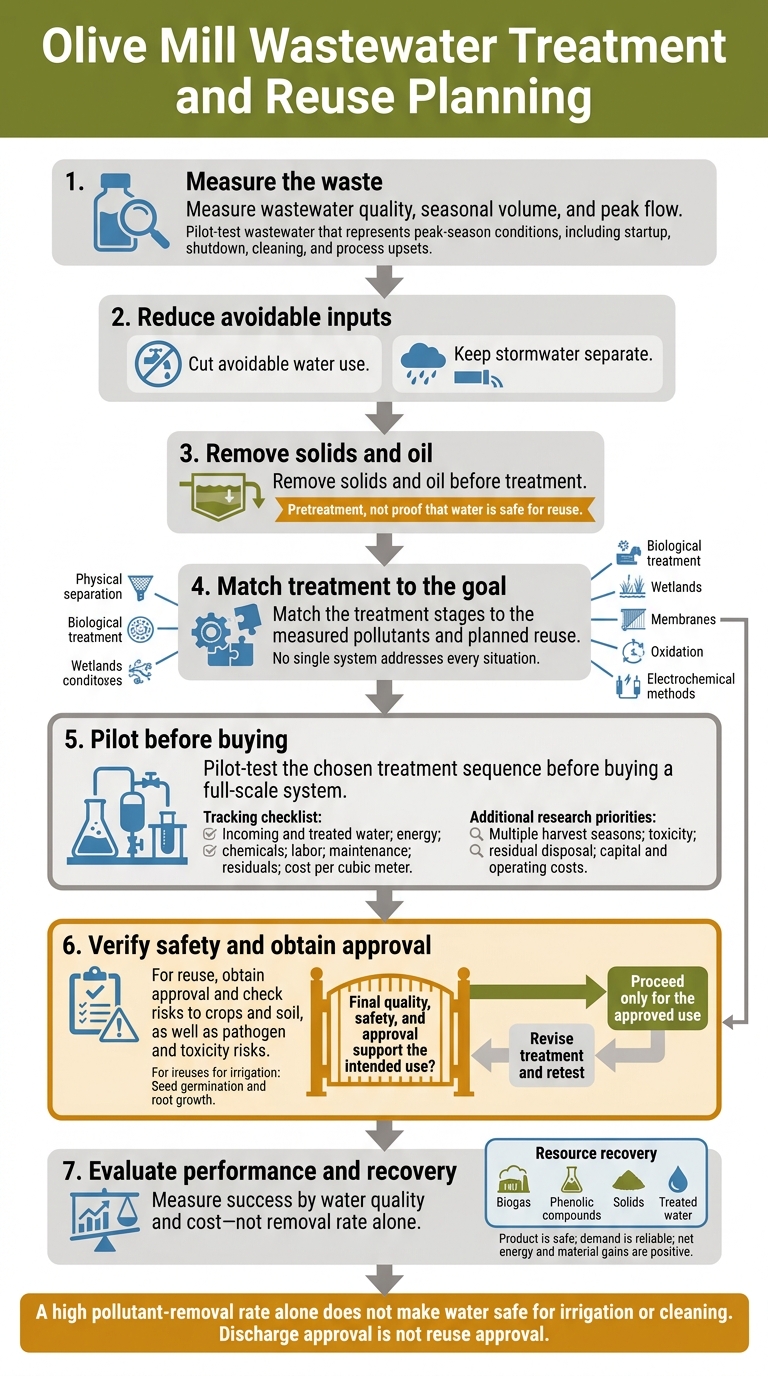
Olive Mill Wastewater Treatment and Reuse Planning
The treatment results above align with published research: staged treatment works better than relying on one system for every situation. Performance depends on wastewater strength, loading, retention time, and study scale. Future trials should cover multiple harvest seasons, test toxicity, specify how residuals will be disposed of, and report capital and operating costs.
Resource recovery can also add value through biogas, phenolic compounds, solids, and treated water. But these uses should move forward only when the product is safe, demand is reliable, and net energy and material gains are positive.
Steps for Planning Mill Improvements
Start by measuring wastewater quality, seasonal volume, and peak flow. Cut avoidable water use, keep stormwater separate, and remove solids and oil before treatment. Then match the treatment stages to the measured pollutants and planned reuse.
Pilot-test the chosen treatment sequence before buying a full-scale system. Track incoming and treated water, along with energy, chemicals, labor, maintenance, residuals, and cost per cubic meter. For reuse, obtain approval and check risks to crops and soil, as well as pathogen and toxicity risks. Irrigation testing should include seed germination and root growth. Measure success by water quality and cost - not removal rate alone.
FAQs
How do I choose treatment stages for my mill?
Test your olive mill wastewater first to determine system size and pretreatment needs. Remove solids and fats with screening, sedimentation, or microfiltration to prevent membrane fouling.
To recover water and phenols, use ultrafiltration followed by nanofiltration or reverse osmosis. Then adjust the pH or use activated carbon to meet reuse standards. Check local discharge and irrigation regulations before finalizing your design.
How long should I pilot-test wastewater treatment?
Research does not set a universal timeline for pilot testing. Testing must fit your mill’s wastewater. Before choosing a system, assess water use and waste management. Include a waste audit that measures volume, composition, and seasonal changes.
Measure baseline COD, BOD, pH, and phenolics to support accurate system design. Wastewater composition changes with the olive cultivar, ripeness, and milling method.
What should I do if treated water fails reuse tests?
Stop irrigation or equipment washing immediately to prevent contamination or equipment damage. Check for declining permeate quality, unusual pressure readings, or reduced flux rates. These changes often point to a need for maintenance or adjustments.
Keep a clear escalation plan so your team knows when to consult technical experts about complex issues. Before resuming reuse, recheck all water quality parameters - including pH, COD, and microbial levels - against state and federal standards.