

Chemical Methods for Olive Oil Wastewater Detoxification
Olive mill wastewater (OMW) is a major byproduct of olive oil production that poses serious environmental challenges. With toxic compounds like phenolics and high chemical oxygen demand (COD), untreated OMW can harm ecosystems, deplete oxygen in water, and prevent plant growth. Chemical detoxification methods offer solutions to these problems by breaking down pollutants and making wastewater safe for discharge or reuse in agriculture.
Key Points:
- OMW Characteristics: High COD (up to 220 g/L), phenolic content (4–10 g/L), and acidic pH (3.0–6.0).
- Environmental Impact: Toxic to plants, disrupts aquatic life, and pollutes groundwater.
-
Chemical Detoxification Methods:
- Coagulation-Flocculation: Removes suspended solids but generates sludge.
- Advanced Oxidation Processes (AOPs): Breaks down pollutants using hydroxyl radicals (e.g., Fenton reaction, ozonation).
- Electrocoagulation: Uses electrical currents to remove turbidity and emulsified oils.
Multi-stage treatment systems combining these methods are often necessary to meet strict discharge standards, such as reducing COD to below 1,000 mg/L. Treated OMW can even be reused for irrigation, offering a way to recycle water in drought-prone areas.
Understanding and implementing these chemical processes is crucial for olive oil producers aiming to manage waste responsibly while meeting regulatory requirements.
Composition and Challenges of Olive Oil Wastewater
Key Pollutants in Olive Oil Wastewater
Olive oil wastewater (OMW) is a mix of organic and inorganic compounds, with its composition influenced by factors like olive variety, fruit maturity, climate, and - most importantly - the extraction method used.
"OMW characteristics differ depending on several factors such as extraction method, olive cultivar, climatic conditions, and characteristics of the fruit." - Mostafa et al.
The table below highlights how OMW pollution levels vary across major olive oil–producing countries. These differences underline the inconsistency in its composition:
| Country | pH | COD (g/L) | Total Phenols (g/L) |
|---|---|---|---|
| Spain | 4.7 | 82 | 1.2 |
| Italy | 5.0 | 28.4 | 1.4 |
| Greece | 4.6 | 47 | 8.1 |
| Tunisia | 4.8 | 58.5 | 9.1 |
| Egypt | 3.8–5.2 | 45.3–134.4 | 19.7–22.0 |
Source: Journal of Water Reuse and Desalination
OMW isn’t just high in COD and phenols - it also contains elevated levels of BOD₅ (up to 100 g/L), total suspended solids (TSS), fats, lipids, pectin, and inorganic salts like sulfates, chlorides, and potassium and sodium phosphates. Its dark color, ranging from reddish-brown to black, comes from compounds like lignin and tannins, which become more concentrated as phenolics degrade over time. These unique characteristics make OMW particularly challenging to manage.
Toxicological Concerns
Phenolic compounds in OMW - such as tyrosol, hydroxytyrosol, caffeic acid, and oleuropein - are present in concentrations that pose serious risks to the environment. These compounds disrupt aquatic ecosystems and microbial communities, particularly by inhibiting soil microbial enzymes. This interference accelerates soil degradation, making it harder for natural processes to maintain soil health.
When discharged untreated, OMW has a cascade of harmful effects: it depletes dissolved oxygen, endangers aquatic life, darkens waterways, and releases long-lasting foul odors. On land, even when diluted 100 times, OMW can prevent seed germination, highlighting its strong phytotoxicity.
Conventional treatment methods often fall short of addressing these issues. Standard approaches typically reduce organic compounds and toxicity by less than 40%. Biological treatments struggle with OMW's high phenolic content, which inhibits microbial activity, while membrane filtration systems face rapid fouling due to the fine particle size - 75.1% of particles in secondary-treated OMW are smaller than 2 μm. These challenges reveal the need for more precise chemical treatment methods.
Detoxification Goals
Effective detoxification of OMW focuses on reducing COD and phenol levels to meet regulatory standards, ensuring the treated water is safe for discharge or agricultural use. For instance, Spain requires irrigation water to have a pH of 6.0–9.0, TSS below 500 mg/L, and COD under 1,000 mg/L.
Treated OMW should also be suitable for crop irrigation, especially in regions facing water scarcity. Reducing electrical conductivity (EC) - which can reach 2–3 mS/cm in raw OMW - is critical, as high salinity can damage soil and harm plants over time. Achieving these goals requires advanced chemical treatment methods, which will be discussed in the next section.
sbb-itb-4066b8e
Adventech | Olive Mill Wastewater Treatment
Main Chemical Detoxification Processes for OMW
The high organic load and toxicity of Olive Mill Wastewater (OMW), with COD levels reaching up to 220 g/L, necessitate a multi-step treatment plan. Three primary chemical methods are commonly employed, each addressing specific pollutants. These methods are often combined in sequence to achieve the best outcomes.
Chemical Coagulation and Flocculation
In this process, chemicals like aluminum sulfate, ferric sulfate, or lime (Ca(OH)₂) are added directly to OMW. These agents destabilize suspended particles, causing them to form larger clusters, or flocs, which can then be removed. This approach is cost-efficient and effective for handling large amounts of suspended solids, oil, and grease. However, it does create substantial volumes of sludge that require further disposal, and concerns have been raised about residual aluminum in the treated water and its potential health risks. As a result, coagulation is often used as a pretreatment step, setting the stage for more advanced methods like oxidation or electro-based removal.
Chemical Oxidation and Advanced Oxidation
Advanced oxidation processes (AOPs) go beyond separation - they break down organic pollutants at a molecular level. These methods rely on hydroxyl radicals (OH•, 2.80 V) to oxidize persistent pollutants, converting them into simpler, biodegradable compounds like carbon dioxide, water, and inorganic salts.
One widely used AOP is the Fenton reaction, which combines hydrogen peroxide (H₂O₂) with an iron catalyst (Fe²⁺). This process operates at room temperature, keeping equipment and energy costs low. For example, in April 2021, researchers at the University of Pablo de Olavide in Seville used a heterogeneous photo-Fenton reaction with 50 g/L of HFeO₂ catalyst at a pH of 3.0 and 68°F (20°C). They achieved a 62.8% reduction in COD and an 88.9% removal of total phenolic compounds, with the catalyst being successfully recovered and reused three times at a recovery rate exceeding 90.5%. Maintaining a pH of around 3.0 is key for generating effective hydroxyl radicals.
"Simplicity in both equipment and operation has postulated Fenton's reagent as one of the most economic alternatives for treating those effluents." - Gassan Hodaifa, Researcher
Ozonation is another AOP option. It’s often used as a pretreatment to enhance biodegradability before biological treatment stages. When combined with membrane filtration, ozonation can remove up to 95% of COD and 70% of phenols. However, its high energy requirements make it costly for large-scale applications. Following oxidation, additional steps like electrocoagulation can further improve pollutant removal.
Electrocoagulation and Electroflotation
Electrocoagulation (EC) involves generating coagulants directly in the wastewater by passing an electrical current through sacrificial metal anodes, typically made of iron or aluminum. As the anodes dissolve, the released metal ions react with pollutants to form insoluble flocs. Simultaneously, gas bubbles produced at the cathode lift these flocs to the surface in a process called electroflotation, making them easier to remove.
This method is particularly effective for reducing turbidity and breaking up oil-in-water emulsions. For instance, in June 2025, Ahmad Jamrah and his team at the University of Jordan used an EC reactor with iron electrodes. Running for about 53 minutes at a current density of 15.11 mA/cm², the system achieved 54.46% phenol removal and a 92% reduction in turbidity at a cost of roughly $3.92 per cubic meter. When paired with an adsorption stage using biochar derived from olive stones, total COD removal increased to 72.88%.
However, EC has its limitations. It concentrates pollutants into sludge rather than fully degrading them, and electrode fouling over time can reduce efficiency. For these reasons, EC is most effective when integrated into a broader, multi-stage treatment system.
Comparing Chemical Methods and Combining Processes
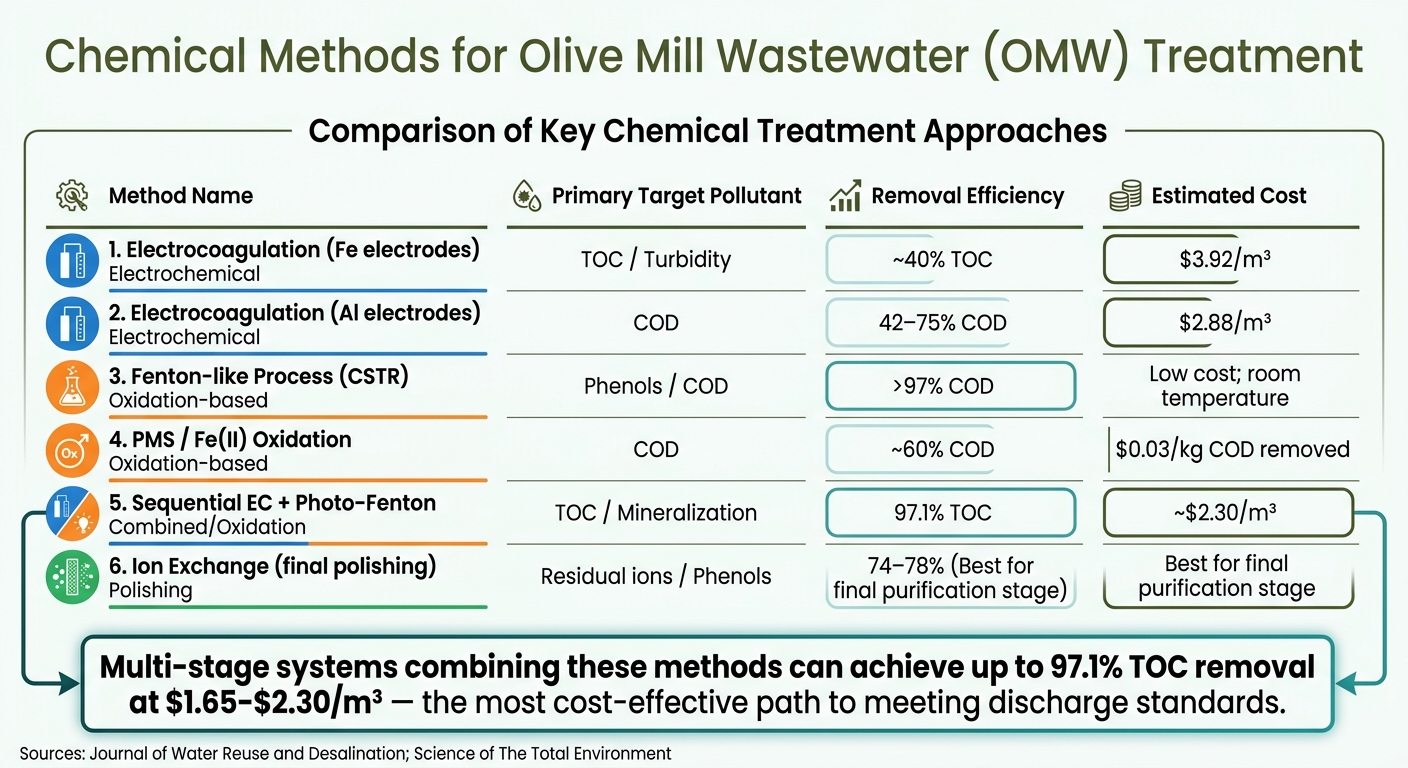
Chemical Methods for Olive Mill Wastewater Treatment: Performance & Cost Comparison
Performance Comparison of Chemical Methods
No single chemical method can fully detoxify OMW on its own. Each approach has its benefits, but also its limitations when used independently.
The table below highlights how various chemical processes perform in terms of their target pollutants, efficiency, and estimated costs.
| Method | Primary Target | Removal Efficiency | Estimated Cost |
|---|---|---|---|
| Electrocoagulation (Fe electrodes) | TOC / Turbidity | ~40% TOC | $3.92/m³ |
| Electrocoagulation (Al electrodes) | COD | 42–75% COD | $2.88/m³ |
| Fenton-like (CSTR) | Phenols / COD | >97% COD | Low; room temperature operation |
| PMS / Fe(II) Oxidation | COD | ~60% COD | $0.03/kg COD removed |
| Sequential EC + Photo-Fenton | TOC / Mineralization | 97.1% TOC (summarized from sequential outcomes) | ~$2.30/m³ |
| Ion Exchange (final polishing) | Residual ions / Phenols | 74–78% | Best for final purification stage |
One key takeaway is the significant improvement achieved with sequential treatment systems. For instance, a Fenton-like process in a continuous stirred tank reactor (CSTR) can remove over 97% of COD, but this level of performance is highly dependent on effective pretreatment. Without proper initial steps, reagent usage and operational inefficiencies can increase dramatically.
This comparison highlights why combining multiple processes is often necessary for effective OMW treatment, as explored in the next section.
Building a Multi-Stage Treatment System
"Due to the complexity of the effluent, OMW cannot be efficiently treated by a single process, requiring a sequence of technologies before reaching the required characteristics for discharge into water courses or use in crop irrigation." - Science of The Total Environment
A practical multi-stage system starts by removing bulk solids, then targets dissolved organics, and finally polishes the effluent. For instance, lime (CaO) pretreatment can eliminate 99% of total suspended solids and reduce total phenolic content by 48%. This step significantly reduces the burden on subsequent treatments. Advanced oxidation methods, such as Fenton reactions or electrocoagulation, can then tackle the dissolved organic matter, followed by adsorption or membrane filtration to capture any remaining pollutants.
Real-world applications back this approach. In January 2026, researchers at the University of Jordan tested a system combining aluminum-electrode electrocoagulation with adsorption using olive stone biochar. Operating at a current density of 12.41 mA/cm² for about 45 minutes, the system achieved 70.31% soluble COD removal and 61.41% total phenol removal at a cost of $2.88/m³. A similar system using iron electrodes, as reported in June 2025, improved total COD removal to 72.88%, though at a slightly higher cost of $3.92/m³.
"The integrated EC and adsorption (ECA) process demonstrated markedly higher efficiencies, with TPh removal reaching 61.41%... compared to using EC alone." - Ahmad Jamrah et al., University of Jordan
Maintaining proper pH levels between treatment stages is crucial. For example, Fenton reactions work best at a pH of around 3.0, while PMS activated by Fe(II) performs optimally at a pH of 5.0. Skipping pH adjustments can lead to wasted reagents and diminished treatment efficiency.
Safety and Operational Considerations
Multi-stage systems offer better performance but come with added safety and operational demands.
Chemical handling requires strict protocols. For example, concentrated hydrogen peroxide used in Fenton reactions is a strong oxidizer, necessitating careful storage, dilution, and dosing. Lime calcination, often used in pretreatment, operates at extreme temperatures of about 1,832°F (1,000°C), requiring specialized equipment and safety measures.
Electrocoagulation systems also need regular maintenance. Iron electrodes must be cleaned frequently to prevent oxide buildup, which can otherwise lead to performance drops and higher energy consumption (up to 14.31 kWh/m³).
Finally, while processes like electrocoagulation and coagulation concentrate pollutants into sludge, this waste requires proper disposal under environmental regulations. Advanced oxidation methods, such as Fenton reactions, have the advantage of converting organics into CO₂ and water, producing far less secondary waste.
Chemical Detoxification and Sustainable Olive Oil Production
Reducing the Environmental Footprint
Sustainable olive oil production has embraced advanced chemical treatments to tackle one of its biggest challenges: minimizing its environmental impact. Olive mill wastewater (OMW) is produced in massive amounts across the Mediterranean region and is notorious for its extremely high chemical oxygen demand (COD). Left untreated, this wastewater can contaminate soil, harm aquatic ecosystems, and squander valuable agricultural resources.
Chemical detoxification provides a practical way forward. Advanced Oxidation Processes (AOPs) break down stubborn organic compounds in OMW into biodegradable intermediates, which can eventually be converted into water, carbon dioxide, and inorganic salts. For example, Fenton's process enhances the BOD₅/COD ratio of OMW, making it suitable for municipal wastewater treatment or anaerobic digestion to produce biogas. Additionally, the treated water can be reused for crop irrigation - an especially important benefit in areas struggling with water shortages.
"OMW can be transformed from an environmental liability into a resource for water and nutrients." - Science of The Total Environment
Beyond reducing environmental harm, responsible waste management also strengthens brand reputation and consumer trust, particularly for producers aiming to stand out in the premium olive oil market.
Quality, Brand Reputation, and Waste Management
For high-end olive oil producers, managing wastewater responsibly is just as important as maintaining the quality of their product. Companies like Big Horn Olive Oil demonstrate how waste management can become part of their commitment to excellence.
A study conducted in September 2024 by Yazan Akkam of Yarmouk University highlights the possibilities of advanced detoxification. Using a combination of SDS micelles and lime coagulation, the study achieved a 95% reduction in OMW toxicity to human cells, decreased polyphenol levels to just 2.5% of their original concentration, and improved seed germination rates from 0% to 100%. These results show how effective waste treatment can turn environmental challenges into opportunities for sustainability and innovation.
Life-Cycle Considerations for Chemical Treatments
While detoxifying OMW is essential, managing the byproducts of these processes is equally important. Life-cycle considerations ensure that chemical treatments remain both effective and economically viable. For instance, traditional homogeneous Fenton processes, though effective, produce iron sludge that must be carefully disposed of. Heterogeneous Fenton systems, on the other hand, use reusable solid catalysts, significantly cutting down on secondary waste and operational costs.
Cost is a major factor, as hydrogen peroxide alone can account for up to 75% of the expenses in a standard Fenton process. Choosing the right treatment methods is critical for balancing performance with long-term economic and environmental goals. Using locally sourced materials, such as limestone waste or olive stone biochar as adsorbents, can help reduce both costs and the overall carbon footprint. By evaluating every aspect of the treatment process - from sourcing reagents to disposing of sludge - producers can ensure their operations are not just efficient but genuinely sustainable.
Conclusion and Key Takeaways
Recap of Effective Chemical Methods
Chemical detoxification offers producers practical solutions to tackle OMW contamination. Each method targets specific pollutants, and the results speak for themselves:
| Method | Key Pollutants Targeted | Performance Metrics |
|---|---|---|
| Fenton-like Process | COD, Phenols | Over 97% COD, >99% Phenols |
| Lime Pretreatment | TSS, TPC, COD | 99% TSS, 48% TPC, 43% COD |
| Electrocoagulation (Fe/Fe) | TOC, Turbidity | ~40% TOC (as pretreatment) |
| EC/PEF Sequential | TOC, COD | 97.1% TOC |
| Acid Cracking | Oil-Grease, TSS | 95% Oil-Grease, 96% TSS |
By combining techniques, such as electrocoagulation with photoelectro-Fenton at a pH of 3.0, producers can achieve up to 97.1% reduction in TOC. The cost? Between $1.65 and $2.30 per cubic meter. These integrated methods not only meet regulatory requirements but also align with sustainable production goals.
Detoxification's Impact on Olive Oil Production
When multi-stage processes are applied, OMW treatment becomes more than just compliance - it’s a step toward turning waste into a resource. Proper chemical detoxification reduces environmental risks and promotes sustainability, showcasing a producer's dedication to responsible practices. Treated OMW that meets FAO irrigation standards can even be used to nourish olive groves, creating a full-circle system from grove to bottle.
"Chemical oxidation based on the Fenton's process... would be first step towards using a closed-circuit system in olive-oil mills to treat and reuse effluents." - L. M. Nieto et al.
FAQs
Which chemical method works best for reducing phenols vs. COD in OMW?
The Fenton process, along with its variations like electro-Fenton and photo-Fenton, is an efficient method for breaking down phenolic compounds in olive mill wastewater. This process relies on the production of hydroxyl radicals, which are powerful agents for degrading pollutants.
Although coagulation-flocculation is a widely used technique, its ability to address both phenols and chemical oxygen demand (COD) is somewhat limited unless paired with additives like lime. On the other hand, electrochemical oxidation has shown great potential for reducing COD, with its success largely depending on the choice of anode material and operating conditions.
Why do multi-stage OMW systems need pH adjustment between steps?
In multi-stage systems for treating olive mill wastewater, adjusting the pH is a critical step. Each treatment method - whether it’s chemical oxidation or biological processes - functions best within a specific pH range. Since raw olive mill wastewater tends to be naturally acidic, with a pH between 3 and 6, bringing it to the right pH level is essential.
This adjustment not only helps remove harmful organic materials and toxic phenolic compounds but also ensures that processes like oxidation and coagulation perform as intended. Achieving the correct pH is key to making the wastewater safe for discharge or potential reuse.
What are the main safety and sludge-disposal issues with chemical OMW treatment?
Chemical treatment of olive mill wastewater (OMW) comes with its own set of hurdles, particularly when it comes to sludge disposal and ensuring environmental safety. For instance, the Fenton process, while effective, produces iron-laden sludge that can carry harmful organic compounds, making disposal tricky. OMW’s naturally acidic nature further complicates the process, often requiring precise pH adjustments to proceed safely.
Other methods, like electrocoagulation, can streamline the removal of pollutants but still leave behind waste that needs careful handling afterward. In some cases, pre-treatment steps may inadvertently increase the wastewater's toxicity, making it essential to rigorously monitor and manage the water before it’s discharged.