

5 Green Extraction Methods for Olive Byproducts
Olive byproducts still hold usable phenolics, antioxidants, and residual oil - and the best extraction method depends on your feedstock, your food use, and how much cleanup you can handle.
If I had to boil the article down, I’d say this:
- Water-based extraction is the simplest food-safe starting point, but the extract can be dilute.
- Ethanol-water extraction gives better phenolic selectivity, but solvent handling adds cost and control steps.
- Microwave-assisted extraction (MAE) cuts processing time to minutes, but heat control and scale-up are harder.
- Ultrasound-assisted extraction (UAE) is gentler on heat-sensitive compounds, though larger systems can vary batch to batch.
- Pressurized liquid extraction (PLE) and supercritical fluid extraction (SFE) give cleaner extracts, but they often need dry feedstock and higher capital spend.
A few numbers stand out right away:
- Global olive oil output is about 3.2 million tonnes per year
- Olives should be processed within 2 to 24 hours after harvest to limit oxidation
- One study found 70% ethanol outperformed water for phenolic recovery from dried pomace
- MAE often reaches peak recovery in about 5 to 10 minutes, not 1 hour+
So if you make beverages or sauces, you may lean toward water-based or ethanol-water methods. If you need a more concentrated ingredient for supplements or functional foods, MAE, UAE, or pressure-based systems may fit better. And if your material is wet pomace or wastewater, moisture handling can shape the whole decision.
Quick Comparison
| Method | Best Starting Use | Main Tradeoff | Good Fit For |
|---|---|---|---|
| Water-based | Wet streams, simple food-grade processing | Low selectivity, more dilution | Beverages, sauces, clean-label products |
| Ethanol-water | Broader phenolic recovery | Solvent recovery and flammability controls | Dressings, bakery, beverages, supplements |
| MAE | Fast phenolic recovery | Heat control and scale-up issues | Functional ingredients, concentrated extracts |
| UAE | Lower-temperature extraction | Uneven energy spread at larger scale | Beverages, sauces, supplement ingredients |
| PLE / SFE | Cleaner, more concentrated extracts | Drying load and higher equipment cost | Standardized extracts, supplements |
Bottom line: I’d match the method to the moisture level of the byproduct first, then to the final food format, then to the cleanup and safety steps needed before launch.
sbb-itb-4066b8e
Why Olive Byproducts Are Worth Recovering
Olive pomace and olive mill wastewater aren’t just leftovers. They’re recoverable feedstocks that still contain phenolics, antioxidants, and residual oil.
That matters for a simple reason: when you recover those compounds, you can improve ingredient yield and help finished foods stay stable against oxidation. High-polyphenol extracts can help food products maintain stability for 18 to 24 months. But that range isn’t fixed. It depends on how the material is handled and recovered, which is why method choice matters.
Key Compounds Targeted from Olive Byproducts
The main targets are polyphenols, tocopherols, and residual oil.
These compounds are prized because they support:
- antioxidant activity
- product stability
- flavor intensity
Raw Material Variables That Affect Recovery
Recovery doesn’t depend only on the compound you want. It also depends on the raw material itself.
Harvest timing is one of the biggest variables. Early harvest tends to increase polyphenols, while late harvest tends to increase oil yield but reduce antioxidant levels. That tradeoff is hard to ignore. If the fruit is picked earlier, gentler handling is usually needed to protect the higher phenolic load.
Other factors also shape the outcome, including cultivar, irrigation, processing technology, and the time between harvest and processing. The processing system plays a part too: two-phase centrifugal lines help retain water-soluble phenolics. And timing moves fast here. Olives should be processed within 2 to 24 hours of harvest to limit oxidation.
All of that affects which extraction method gives the best yield, purity, and fit for food use.
1. Water-Based Extraction
Water-based extraction is the simplest place to start.
Feedstock and Solvent Inputs
This method uses olive pomace and two-phase olive mill waste (TPOMW, or alperujo).
Temperature Control
Keep processing at or below 81°F (27°C) to limit phenolic loss.
Extract Quality and Selectivity
Water-based extraction is simple and food-safe, but it’s less selective than solvent-based or assisted methods. If you need more selective extraction, the next move is often an ethanol-water blend.
Food-Use Fit and Limitations
Raw TPOMW is a wet slurry, so it needs separation and cleanup before food use.
2. Ethanol-Water Extraction
Ethanol-water extraction is more selective than water alone. By changing the ethanol level, you change the solvent’s polarity, which shifts which phenolics dissolve best. That makes it useful for recovering compounds like hydroxytyrosol and oleuropein. Compared with plain water, it gives you better selectivity while still staying in the food-grade range.
Feedstock and Solvent Inputs
This method works with dried or wet pomace, along with skins and other mill residues. If you dry and mill the pomace first, the solvent usually makes better contact with the material. That said, wet pomace can also be used directly if you adjust the ethanol ratio.
In practice, the ethanol range is about 40% to 75% by volume. One comparative study on dried olive pomace found that 70% ethanol yielded 43.25 ± 2.08 mg gallic acid equivalents per gram (mg GAE/g) of dried pomace solids. That beat both water at 36.49 ± 0.29 mg GAE/g and 70% methanol at 41.68 ± 0.95 mg GAE/g. The study chose 70% ethanol because it paired strong phenolic recovery with food-grade use. Methanol, of course, is not suitable for food processing.
Recovery Speed and Process Intensity
Standard ethanol-water extraction is slower than microwave- or ultrasound-assisted methods. One reported setup used 60% ethanol at 158°F (70°C) for 120 minutes with a 5:1 mL/g liquid-to-solid ratio.
The upside is that the equipment is less specialized than what assisted methods need. Even so, an industrial setup still has to handle ethanol safely. That means explosion-protected equipment, ventilation, temperature control, and ethanol vapor recovery.
Extract Quality and Selectivity
The crude extract usually doesn’t contain just phenolics. It often pulls in sugars and other nonphenolic material too, which can dilute the final ingredient.
One common cleanup step is macroporous resin purification. This can increase phenolic concentration and reduce sugars in the crude extract. The antioxidant results also improved sharply: about 3.7 times higher DPPH activity and 4.7 times higher ferric-reducing antioxidant power than the unpurified extract. That kind of cleanup matters most when the target is a supplement or a standardized functional ingredient.
Food-Use Fit and Limitations
Food-grade ethanol is fairly easy to recover, and residual solvent can be lowered to compliant levels before use. That opens the door to uses such as antioxidant ingredients in:
- sauces
- dressings
- marinades
- bakery products
- beverages
The main drawback is sensory impact. Concentrated extracts can be dark, bitter, and astringent, which makes them harder to use in lightly flavored products. Before any commercial use, teams need sensory testing, stability testing, and confirmation that residual solvent levels meet applicable U.S. food rules.
For shorter processing times, the next methods turn to microwaves or ultrasound.
3. Microwave-Assisted Extraction
Microwave-assisted extraction heats the solvent and the moist feedstock all the way through the material, which helps release phenolics like hydroxytyrosol, oleuropein, and maslinic acid much faster than old-school extraction methods.
Feedstock and Solvent Inputs
MAE can be used with dried and milled olive pomace, exhausted olive pomace, and other olive mill residues. For polyphenol recovery, a 50% ethanol-water mix is a practical food-grade solvent. Solid-to-liquid ratio depends on the system, but one optimized study on exhausted olive pomace used about 3.9% solids loading to get the most hydroxytyrosol.
Recovery Speed and Process Intensity
This is where MAE shines. In one study, 500-700 W of microwave power more than doubled phenolic yield compared with maceration, and the process leveled off at about 10 minutes instead of roughly 1 hour for the conventional approach. Another comparison found that 600 W for 5 minutes produced hydroxytyrosol, maslinic acid, and oleanolic acid levels 8%, 24%, and 22% higher than conventional extraction.
But there’s a catch: more power and more time don’t always help. One study found the highest total phenolic content at 5 minutes, with recovery dropping when treatment ran longer. Push the process too far, and oxidation plus heat damage can start to chip away at sensitive compounds. That’s why temperature, time, and power need close control.
Extract Quality and Selectivity
MAE can produce concentrated phenolic extracts fast, but the end result changes a lot based on the feedstock and the settings. One study reported hydroxytyrosol recovery of about 1.2 g/kg from olive pomace using 700 W for 10 minutes with 20% ethanol. In another case, a water-based MAE setup at 1,000 W, about 187°F (86°C), for 3 minutes produced 104 mg gallic acid equivalents per gram (mg GAE/g) of total phenolics.
Selectivity comes down to things like ethanol concentration, temperature, time, and solid-to-liquid ratio. If temperature goes too high or exposure lasts too long, the extract can also pull in sugars, pigments, minerals, and off-flavors. In plain English, you can get more than you bargained for.
Food-Use Fit and Limitations
MAE extracts work well in beverages, sauces, dressings, bakery products, functional foods, and dietary supplements when the aim is a standardized phenolic ingredient.
The main drawbacks are pretty practical:
- High equipment cost
- Scale-up complexity
- Uneven heating
- Vessel pressure
- Solvent flammability
Because of that, ventilation, temperature control, and solvent recovery matter a lot. Before any commercial use, the extract also needs testing for residual solvent, microbial hazards, pesticide residues, heavy metals, process contaminants, and sensory defects. If you want similar recovery with less heat, ultrasound-assisted extraction is the next option.
4. Ultrasound-Assisted Extraction
When heat-sensitive phenolics need a gentler process, ultrasound can be a fast, low-temperature choice. Ultrasound-assisted extraction (UAE) uses cavitation to break cell walls and speed up phenolic release. That improves mass transfer, so compounds like hydroxytyrosol and tyrosol can be recovered from olive byproducts in less time.
Feedstock and Solvent Inputs
UAE can be used with dried or partly dried pomace, skins, pits, leaves, and wastewater solids. In food-grade processing, producers usually use water or ethanol-water, often around 104°F (40°C) with a 1:20 solid-to-liquid ratio.
Recovery Speed and Process Intensity
UAE is usually faster than standard maceration, with lab setups often landing in the 5- to 30-minute range. That’s a big reason people look at it in the first place. Still, water-based systems may need more time when the feedstock is hard for the solvent to penetrate.
Wattage by itself doesn’t tell you much about yield. What matters more is the full setup: amplitude, time, temperature, and reactor design. Push the system too hard, and the mix can overheat, which may damage phenolics.
Extract Quality and Selectivity
Water tends to pull out very polar compounds, while ethanol-water brings in a broader phenolic profile. One setup using a 60:40 ethanol-water mixture at 122°F (50°C) for 20 minutes recovered a broad mix of phenolics with good efficiency.
For food use, the extract still needs more work before it’s ready. That usually includes:
- Filtration
- Solvent removal
- Testing for residual solvent
- Microbial quality checks
- Sensory review
Food-Use Fit and Limitations
UAE extracts work well in beverages, sauces, and supplements. Ethanol-water extracts can also give a more concentrated phenolic profile for encapsulated products or supplement formats after solvent recovery.
The biggest issue is scale-up. Pilot-scale sonication produced lower yields and more batch-to-batch variation than lab runs. In larger vessels, acoustic energy doesn’t spread evenly. That can create dead zones and uneven batch quality. So while UAE is a strong fit when speed matters, it works best when the operation can handle the variability that comes with scaling.
Pressurized liquid and supercritical fluid extraction shifts the process from sound to pressure.
5. Pressurized Liquid and Supercritical Fluid Extraction
For recovery methods that lean on pressure, PLE and SFE take a different path from heat- or sound-based options. Pressurized liquid extraction (PLE) and supercritical fluid extraction (SFE) are used to recover phenolics from olive byproducts under pressure.
Feedstock and Solvent Inputs
These methods work best with dry feedstock. That’s a key difference from ultrasound-based extraction, which can handle wetter material more easily. In practice, two-phase olive mill waste (alperujo) is usually too wet for direct pressure-based extraction, so it has to be dried first.
Olive pits make up 13% to 18% of the total waste product and can be separated mechanically before processing. That matters because it gives processors another way to sort and prepare feedstock before extraction.
A big plus here is the output. PLE and SFE tend to produce cleaner, more concentrated extracts, which makes them a good fit for standardized functional ingredients and supplements.
Main Limitation
The main drawback is the need to dry high-moisture feedstocks like alperujo. That extra step adds cost and can lower compound quality. Put simply, the drying load is the main tradeoff in the method comparison below.
Side-by-Side Comparison of All 5 Methods
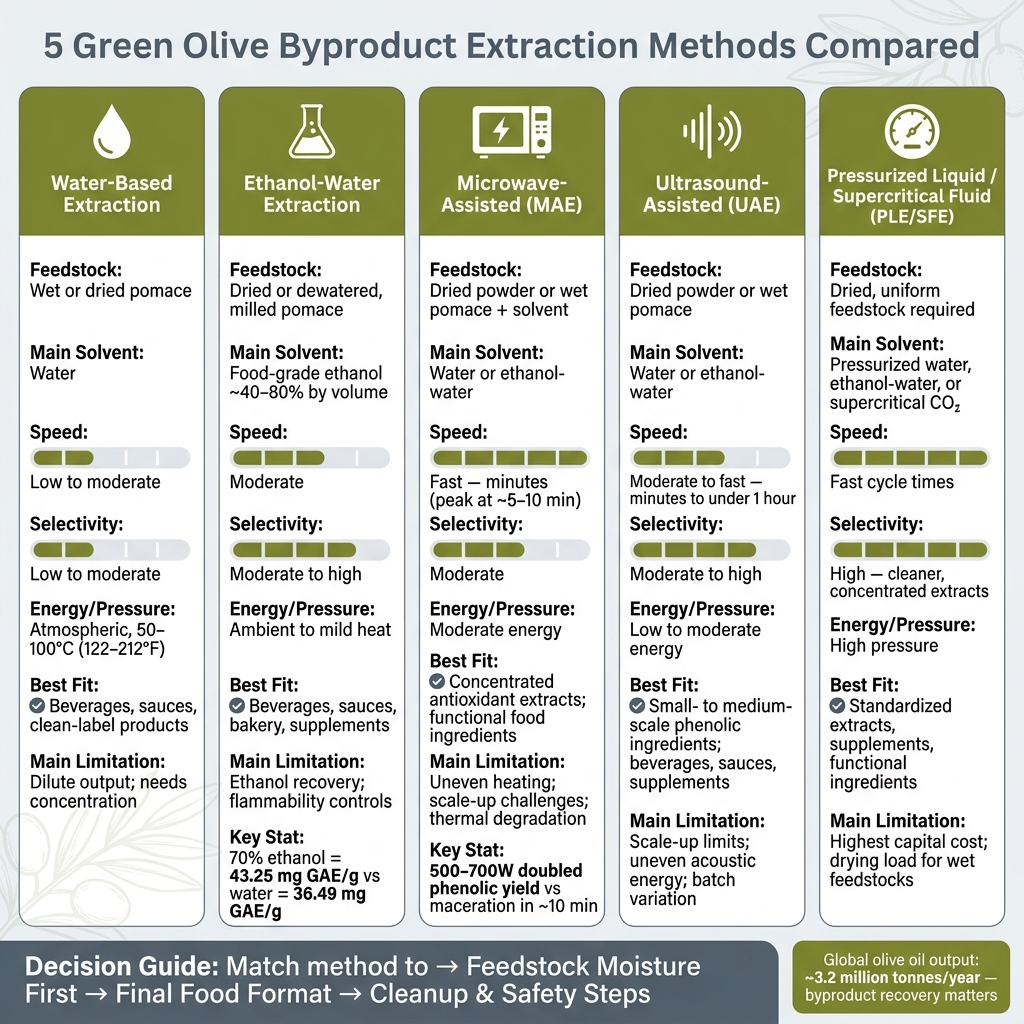
5 Green Olive Byproduct Extraction Methods Compared
There’s no single “best” extraction method here. Each one comes with trade-offs around cost, speed, selectivity, and how clean the final extract is for food use. In practice, the right pick depends on the feedstock, the compounds you want, and where the extract will end up.
This comparison looks at the factors that usually matter most: feedstock moisture, selectivity, speed, and final food use.
Note: MAE and UAE are energy-assisted methods that can use water or ethanol–water.
The table below turns those method details into a quick selection guide.
| Method | Feedstock Condition | Main Solvent | Equipment Needs | Processing Speed | Target Compounds | Selectivity | Solvent Residue | Energy / Pressure | Best Fit | Main Limitation |
|---|---|---|---|---|---|---|---|---|---|---|
| Water-based | Wet or dried pomace; wet material may need clarification and microbial control | Water | Heated stirred tank, filtration or centrifugation, concentration/drying unit | Low to moderate | Highly polar phenolics, sugars, organic acids, minerals | Low to moderate; co-extracts many non-target components | No organic-solvent residue, but the extract may be dilute and need concentration or stabilization | Atmospheric; ambient to 50–100°C (122–212°F) | Beverages, sauces, clean-label products | Low selectivity; dilute output requires concentration |
| Ethanol–water | Dried or dewatered, milled pomace | Food-grade ethanol blended with water, typically about 40% to 80% ethanol by volume | Stirred tank, filtration, solvent recovery unit | Moderate | Phenolics, including hydroxytyrosol and oleuropein-related compounds | Moderate to high; tunable by adjusting ethanol ratio | Food-grade, but ethanol must be recovered or reduced for final use | Ambient to mild heat | Beverages, sauces, bakery, supplements | Ethanol recovery, flammability controls, residual-solvent compliance |
| Microwave-assisted (MAE) | Dried powder or wet pomace mixed with solvent | Water or ethanol–water | Microwave reactor or controlled microwave vessel | Fast; minutes in many cases | Polar phenolics, including hydroxytyrosol and oleuropein | Moderate; rapid heating can improve release but requires tight control to avoid degradation | Same as the chosen solvent | Moderate energy | Concentrated antioxidant extracts; functional food ingredients | Uneven heating, scale-up challenges, thermal degradation risk |
| Ultrasound-assisted (UAE) | Dried powder or wet pomace | Water or ethanol–water | Ultrasonic bath or probe, tank, filtration | Moderate to fast; typically minutes to under an hour | Phenolics and other antioxidant compounds | Moderate to high; mild temperatures help protect heat-sensitive compounds | Same as the chosen solvent | Low to moderate energy | Small- to medium-scale phenolic ingredients | Probe wear, foaming, scale-up limits, oxidation risk during prolonged sonication |
| Pressurized liquid / supercritical fluid | Dried, uniform feedstock preferred; wet material usually needs drying first | Pressurized water, ethanol–water, or supercritical CO₂ with an optional ethanol co-solvent | Pressure-rated extractor, pumps, heat control, depressurization unit | Fast cycle times | Phenolics via pressurized liquid extraction; nonpolar compounds such as residual oil and lipids via supercritical CO₂ | High; cleaner, concentrated extracts | Pressurized water reduces residue concerns; supercritical CO₂ leaves minimal residue after depressurization | High pressure | Standardized extracts, supplements, functional ingredients | Highest capital cost; drying load for wet feedstocks; specialized maintenance and safety requirements |
It’s best to read this table as a guide, not a scoreboard. A method that works well for one pomace stream may fall short with another, especially when moisture, particle size, and solvent ratio shift. That’s why the next step is to match the method to the food application instead of chasing a one-size-fits-all answer.
Choosing the Right Method for Your Food Application
Use the comparison table to match each extraction method to the final food, not just the yield. Yield and speed matter, sure. But for food use, they’re only part of the picture. You also need to look at moisture handling, quality retention, and whether the equipment is built from food-grade materials like AISI 304 stainless steel.
Method Fit for Beverages, Sauces, Bakery, and Supplements
Two-phase water-based extraction works well for functional beverages because it keeps more water-soluble polyphenols without extra dilution water. If your main goal is supplement-grade antioxidant retention, vacuum malaxation makes more sense.
For sauces, dressings, and bakery products, ethanol-water extraction is often the better match. It gives you better selectivity and a broader phenolic profile, which matters when flavor intensity and stability carry more weight.
That said, ethanol-water extraction is a poor match for wet olive mill waste and pomace. Wet olive mill waste usually needs an energy-intensive drying step before processing, and that pushes up cost while also risking quality loss.
When moisture and cost start driving the choice, it helps to shift from end-use fit to feedstock handling.
Choosing Based on Cost and Moisture Handling
If upfront cost is the main limit, two-phase extraction has a clear edge because it avoids added dilution water. But there’s a catch: wet feedstock. Wet olive mill waste usually has a moisture content above 50%, so moisture control still plays a big role.
Wet olive mill waste also usually needs drying before ethanol-water or pressure-based extraction. That adds energy cost and can hurt product quality. In plain terms, if you’re working with wet material, the extraction method and the moisture burden are tied together - you can’t treat them as separate decisions.
Conclusion
Across the five methods above, there’s no single winner for every situation. The right pick comes down to your feedstock, the compounds you want to pull out, the sensory profile you need, and the equipment you have on hand.
And even if one method gives you the strongest extract on paper, that doesn’t mean it’s ready for food use. You may still need filtration, solvent recovery, purification, and both sensory and safety checks before it fits the job. A practical way to start is with the simplest food-compatible method that meets your product spec. If recovery, speed, or selectivity doesn’t hold up, then it makes sense to step up to an assisted or pressurized method. At pilot scale, check traceability, residual solvents, microbial quality, and batch consistency before moving into full production.
What matters most isn’t just lab yield. The best process is the one that balances sustainability, extract quality, sensory fit, cost, and food-safety validation. In plain terms: match the method to the byproduct stream first, then match it to the final food application.
FAQs
Which extraction method is best for wet olive pomace?
For wet olive pomace, anaerobic digestion is the best option for energy recovery. It turns high-moisture material into biogas, which makes it a strong fit for wet pomace from two-phase extraction systems.
If the aim is to recover useful compounds, water-based extraction at ambient temperature is the simplest and most practical choice. It also helps avoid the energy cost of drying.
Do I need to dry olive byproducts before extraction?
It depends on how you're extracting the oil and what you plan to do with the leftover material.
With traditional pomace oil extraction using hexane, the pomace usually has to be dried to below 8% moisture. That drying step takes a lot of energy, which can add cost and slow things down.
Supercritical CO2 extraction works differently. It leaves the waste nearly dry, so you don't need extra drying afterward. That's a big practical difference.
For other end uses, the answer changes again. Burning pits for energy calls for drying first. But anaerobic digestion may work better with raw pomace diluted with water instead.
Which method is best for food-grade phenolic extracts?
Water-based extraction at ambient temperature is the best choice for food-grade phenolic extracts. It’s simple, low-cost, and lines up well with food and pharmaceutical rules.
Using water at room temperature can recover polyphenols well while keeping the process safe and well suited for high-quality food-grade products.